If you are still relying on manual evaluation methods, you are likely facing the same challenges many organizations deal with today. The process is slow, results are often inconsistent, and the experience lacks personalization. Whether it is employee performance reviews, candidate screening, or learning assessments, manual systems struggle to keep up with modern expectations.
Manual assessments take time to design, distribute, and evaluate. This delays decision making and creates bottlenecks for HR teams, educators, and business leaders. On top of that, human bias can easily influence results, making it difficult to ensure fairness and accuracy across evaluations.
Another major limitation is the lack of personalization. Traditional assessments follow a fixed structure, which means every user gets the same experience regardless of their skills, goals, or progress. This leads to surface level insights instead of meaningful outcomes.
This is where AI powered self assessment tools are transforming the landscape. They bring speed, intelligence, and adaptability into the process. Instead of static questionnaires, businesses can now offer dynamic, real time assessments that adjust based on user responses and deliver actionable insights instantly.
For organizations looking to improve decision making, reduce bias, and create more engaging evaluation experiences, AI is no longer optional. It is becoming the standard.
An AI self-assessment generator is a smart digital tool that creates personalized evaluations based on user input, behavior, and goals. Instead of using fixed questionnaires, it adapts questions in real time using artificial intelligence and machine learning. This allows businesses, educators, and HR teams to understand skills, performance, and progress more accurately without relying on one-size-fits-all assessments.
From a business perspective, these tools help organizations make faster and better decisions. They reduce manual effort in evaluations, improve accuracy, and provide instant insights that can be used for hiring, employee development, or training effectiveness. Companies can scale assessments across teams or users without compromising on quality or consistency.
What makes AI self-assessment generators powerful is their ability to personalize every interaction. Each user receives a unique set of questions and feedback based on their responses. This creates a more engaging experience and delivers insights that are relevant and actionable. Whether used in education, recruitment, or corporate training, AI-driven assessments make the entire evaluation process smarter, faster, and more meaningful.
Businesses today are under constant pressure to make faster, smarter decisions while managing growing teams and data. Traditional assessment methods often slow things down, create inconsistencies, and require heavy manual effort. This is where AI self-assessment tools are making a real difference.
These tools are not just improving processes. They are reshaping how organizations evaluate talent, measure performance, and support learning at scale.
AI self-assessment tools help organizations move from delayed evaluations to real time insights. Instead of waiting days or weeks for reviews, businesses can instantly analyze responses and generate meaningful results.
This speed is especially valuable in areas like hiring and employee performance. Decision makers get clear, data backed insights quickly, which helps them act with confidence and reduce delays in critical processes.
HR teams often spend a significant amount of time managing assessments, reviewing responses, and preparing reports. AI automates these repetitive tasks, allowing HR professionals to focus on more strategic responsibilities like talent development and employee engagement.
By reducing manual effort, companies not only save time but also improve consistency and accuracy across evaluations.
Hiring the right talent is one of the biggest challenges for any business. AI self-assessment tools bring structure and objectivity to the process.
They analyze candidate responses, identify patterns, and provide deeper insights into skills, behavior, and potential. This helps recruiters go beyond resumes and gut feeling, leading to better hiring decisions and reduced bias.
As a result, businesses can build stronger teams with candidates who are truly aligned with their roles.
In learning and development, one size rarely fits all. AI self-assessment tools create personalized evaluation experiences that adapt to each individual.
They identify knowledge gaps, recommend next steps, and provide targeted feedback. This makes learning more effective and engaging for employees and learners.
Organizations benefit from better training outcomes, improved skill development, and a workforce that continues to grow in the right direction.
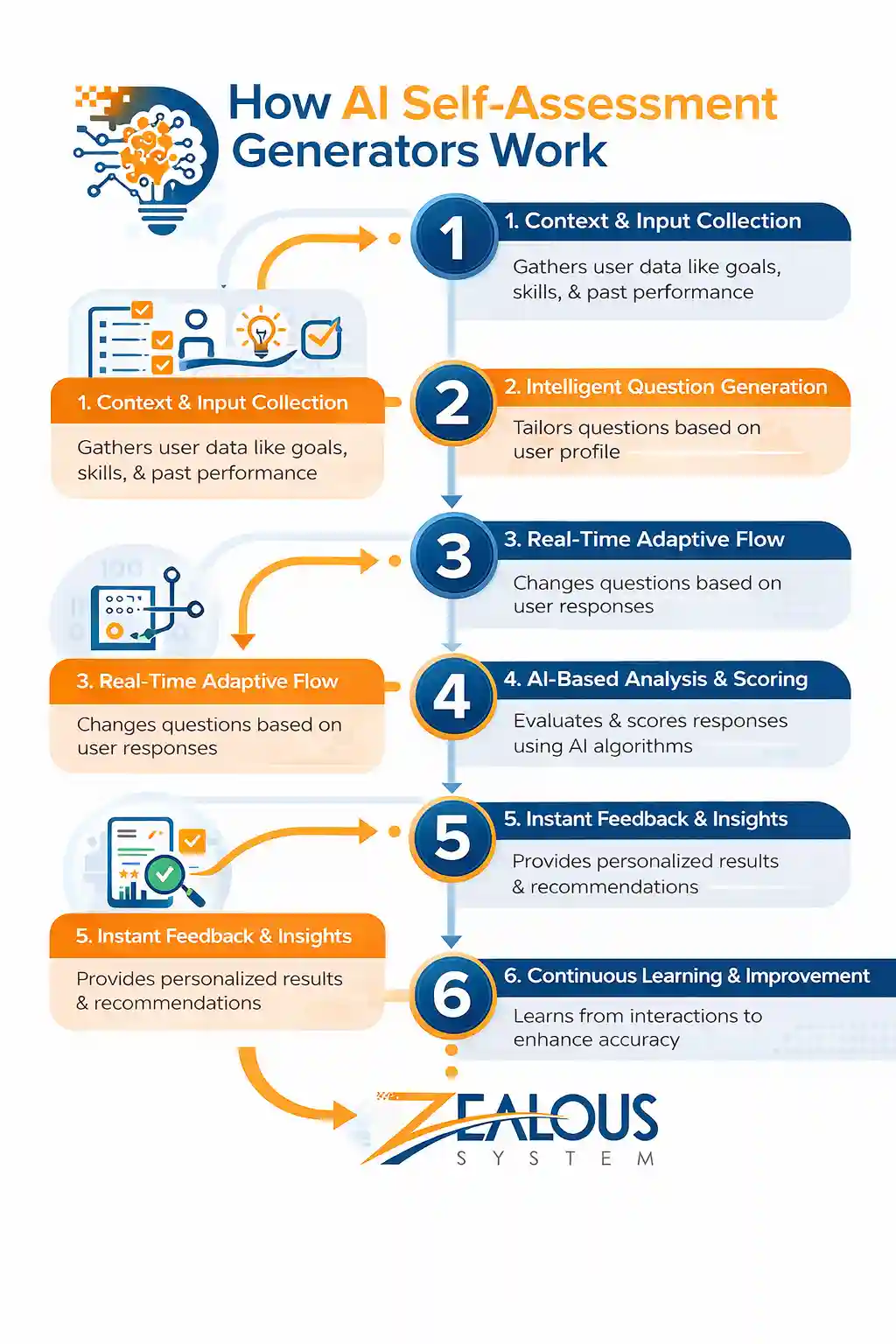
AI self-assessment tools may look simple on the surface, but behind the scenes they follow a smart, adaptive process. Instead of asking the same static questions to everyone, these systems learn from each response and adjust in real time.
Here is a clear, step by step flow to understand how it works.
The process begins by understanding the user.
The system collects basic inputs such as:
This helps the AI set the right starting point instead of using a one size fits all approach.
Once the context is clear, the AI generates relevant questions.
Instead of fixed questionnaires, it:
This ensures every user gets a personalized assessment experience.
This is where AI makes a real difference.
As the user answers questions, the system:
For example, if a user struggles with a concept, the AI may ask deeper or simpler follow-up questions to better understand the gap.
Behind the scenes, machine learning models evaluate responses.
The system can:
For open-ended responses, natural language processing helps interpret meaning, tone, and intent.
Once the assessment is complete, users receive immediate results.
This typically includes:
The feedback is not generic. It is tailored based on how the user performed during the assessment.
AI systems improve over time.
With each interaction, the system:
This means the more the tool is used, the smarter and more effective it becomes.
AI self-assessment tools are no longer just experimental technology. Businesses across industries are using them to make faster decisions, reduce manual effort, and improve accuracy in evaluation processes.
What makes them powerful is their ability to adapt in real time, analyze responses intelligently, and provide insights that actually help users take action.
Let’s explore how different industries are using AI self-assessment tools and what kind of results they are seeing.
Hiring the right talent quickly is one of the biggest challenges for growing companies. Traditional screening methods often rely on resumes and manual interviews, which can be time-consuming and biased.
AI self-assessment tools change this completely.
They allow candidates to evaluate their own skills, confidence levels, and role readiness before even speaking to a recruiter. The system then analyzes responses and highlights top candidates based on predefined criteria.
This helps recruitment teams focus only on qualified applicants instead of spending hours filtering profiles.
Business impact:
Real-world outcome:
Companies using AI-based pre-screening have seen significant improvements in shortlist accuracy and a noticeable reduction in time-to-hire.
Performance reviews are often inconsistent and influenced by bias. Employees may also struggle to accurately reflect on their own progress.
AI self-assessment tools bring structure and clarity to this process.
They guide employees through personalized questions based on their roles, past performance, and goals. The system evaluates responses and generates meaningful insights that managers can use for fair and data-driven reviews.
For learning and development teams, these tools help identify skill gaps and recommend targeted training programs.
Business impact:
Real-world outcome:
Organizations using AI-powered assessments report better alignment between employee performance and business goals, along with improved retention rates.
In digital learning environments, one of the biggest challenges is understanding how well a student has actually learned a concept.
AI self-assessment tools solve this by creating adaptive assessments that change based on student responses.
Instead of static quizzes, learners get personalized questions that match their knowledge level. The system identifies weak areas and provides instant feedback, helping students improve faster.
For EdTech platforms, this also means better engagement and higher course completion rates.
Business impact:
Real-world outcome:
Platforms integrating AI assessments have seen improved learning outcomes and stronger user retention.
In healthcare and wellness applications, timely self-evaluation can make a significant difference.
AI self-assessment tools are used to track mental health, lifestyle habits, and early symptoms. Users answer simple questions, and the system provides insights or recommendations based on patterns and responses.
This helps individuals become more aware of their well-being while enabling healthcare providers to identify potential risks earlier.
Business impact:
Real-world outcome:
Health platforms using AI assessments have improved patient interaction and enabled proactive care instead of reactive treatment.
Professionals today are constantly looking to upskill and stay relevant, but many are unsure where they stand.
AI self-assessment tools provide clarity.
They evaluate current skills, identify gaps, and suggest personalized learning paths or career directions. This helps individuals make informed decisions instead of relying on guesswork.
For platforms offering career services, this creates a more valuable and engaging user experience.
Business impact:
Real-world outcome:
Users who receive AI-driven insights are more likely to complete recommended courses and achieve measurable career growth.
AI self-assessment generators are being used in multiple industries and can be helpful for decision-making, personal development, and operational productivity. Here are a few scenarios where they provide value.
Companies use AI tools to simplify the self-evaluation process during performance reviews. The generator guides employees through thoughtful questions, helps them reflect accurately, and produces consistent reports that managers can build on.
Recruiters use AI self-assessments to gauge candidates’ confidence in their skills, work preferences, or soft skills—before the first interview. It helps shortlist the right people faster and reduces human bias in early screening.
Online education platforms integrate AI-based assessments to check how much a student has grasped. The system adapts questions in real-time and offers personalised study tips based on weak areas.
After training sessions, employees complete AI-powered assessments to check what they’ve learned. The tool offers instant insights, helping L&D teams identify whether the training worked or needs adjustment.
Apps focused on mental health or fitness use self-assessment generators to understand users’ habits, emotions, or sleep patterns. Based on answers, users receive immediate feedback, daily tips, or alerts if intervention is needed.
Professionals use AI tools to evaluate their current skill levels, interests, and goals. The results guide them toward new learning paths or career moves based on evidence, not guesswork.

A well-designed AI self-assessment generator does more than ask questions and display basic results. It is built to handle complex scenarios, deliver meaningful insights, and continuously improve with usage. Here are the key features that make these tools effective and valuable for businesses.
The system adapts questions based on user responses. Instead of following a fixed format, it uses intelligent logic to explore areas that need more context. This makes the assessment more personalized and engaging.
Responses are analyzed instantly using trained algorithms. This allows the platform to generate scores and insights in real time, helping users receive immediate feedback without delays.
For open-ended responses, the system uses natural language understanding to interpret meaning, tone, and intent. This enables more accurate and context-aware feedback.
The assessment structure can be tailored based on business needs. Organizations can define their own question sets, scoring methods, and evaluation criteria to align with their goals.
The output goes beyond scores and provides clear insights. Users receive structured reports that highlight strengths, identify improvement areas, and suggest next steps in a simple and easy-to-understand format.
Handling sensitive data requires strong security measures. Advanced tools include encryption, access controls, and compliance standards such as GDPR to ensure data protection at every stage.
Users can track their performance over time through detailed logs and reports. This helps in measuring growth, identifying patterns, and making informed decisions for improvement.
Modern solutions are designed to work across devices including desktop, mobile, and tablet. They also integrate seamlessly with platforms such as HR systems, learning management systems, and CRM tools for better workflow management.

Building an AI self-assessment tool is not just about creating questions. It is about creating an experience that understands users, adapts to them, and gives meaningful insights. Here is how you can approach it in a simple and practical way.
Before anything else, ask yourself what you want this tool to achieve. Are you helping users identify skill gaps, measure performance, or guide learning? Also think about who will use it. This clarity makes every next step easier and more focused.
Your questions are the foundation. They should feel natural, relevant, and easy to answer. Instead of using only one format, mix things up with multiple choice, ratings, and open-ended questions to get better insights.
This is where AI really adds value. Instead of asking the same questions to everyone, the tool should adjust based on responses. If a user seems confident, move forward. If they struggle, go deeper. This makes the experience more personal and useful.
To make the tool smarter, you need AI models that can analyze answers. This is especially important for written responses. With technologies like natural language processing, the system can understand meaning and give more relevant feedback.
Users do not just want scores. They want to know what they are doing well and where they can improve. Your tool should provide clear insights and simple next steps that users can actually act on.
Since you are handling user data, security should be a priority from the start. Make sure the system follows proper data protection practices and gives users confidence that their information is safe.
Once your tool is ready, test it with real users. See how they interact with it and where they face issues. Use that feedback to improve the experience. Even after launch, keep refining it so it gets better over time.
Building an AI self-assessment tool is not just about adding AI. Many businesses struggle with creating adaptive logic, ensuring accurate insights, and integrating systems smoothly. Without the right expertise, projects become complex, slow, and hard to scale.
At Zealous, we simplify this process. We help you design and develop intelligent assessment solutions that are scalable, secure, and aligned with your business goals. From AI model integration to seamless platform connectivity, our focus is on building solutions that deliver real results, not just features.
With strong experience in AI and software development, we have helped businesses launch smart, data-driven platforms that improve decision making, user engagement, and operational efficiency. If you are looking to build a reliable AI assessment solution, Zealous is the partner you can trust.
AI self-assessment programs are emerging as a critical tool for organizations aiming to deliver immediate, personalized insights—without sacrificing quality or depth. When solidly built, they can help users reflect, understand gaps, and create actionable next steps in their development—especially in the education sector, where self-guided learning and adaptive assessments are becoming essential.
The success of an AI-enabled evaluation will, of course, be contingent upon its development—from the logic that is baked in and adaptability, to privacy of data and user experience. That’s why choosing the right technology partner or deciding to hire AI developers with deep expertise is a crucial step.
Zealous System is a reliable, trusted custom AI software development company that offers both the technical expertise and strategic mindset to translate your idea into a dependable AI and machine learning solution. With proven success in education software development services, Zealous has helped educational institutions and training platforms build AI-powered tools that are accurate, scalable, and highly engaging for end users.
Whether you’re in the EdTech space or any industry looking to create impactful self-assessment tools, Zealous System is your go-to partner. To explore how you can hire AI developers or leverage their education software development services to build smart, secure, and purpose-driven AI solutions, get in touch with the Zealous team today.
Our team is always eager to know what you are looking for. Drop them a Hi!

Pranjal Mehta is the Managing Director of Zealous System, a leading software solutions provider. Having 10+ years of experience and clientele across the globe, he is always curious to stay ahead in the market by inculcating latest technologies and trends in Zealous.




Comments