Patient data moves through your systems constantly. Electronic health records continue to expand, while AI tools now read clinical notes and imaging results in real time. Without clear control, small gaps in accuracy or access can quickly turn into risks around privacy and compliance.
You deal with this pressure every day. CMS interoperability rules and prior authorization requirements are now fully in place. Payers expect faster access to structured, reliable data, yet governance often falls behind. A defined healthcare data governance strategy brings consistency to how data is handled and keeps systems aligned as demands grow.
In this guide, you will see how modern data governance solutions fit into healthcare IT environments. We will cover how they connect with EHR systems, support a practical governance framework, and address HIPAA requirements without adding unnecessary complexity. Each section focuses on what works in real-world settings.
Data governance solutions bring together policies, processes, and technologies that control how data is handled across your organization. In healthcare, this means defining how patient information is collected, stored, shared, and protected at every stage. The goal is simple: create consistency so every team works with data in the same, reliable way.
In healthcare settings, these solutions go beyond basic storage or access rules. They track healthcare data lineage from the moment a lab result enters your EHR to every report, dashboard, or AI model that uses it later. They also enforce quality checks, restrict unauthorized access, and maintain audit trails that support compliance requirements.
A typical data governance framework in healthcare includes a few core elements:
Together, these elements give you clear visibility and tighter control without disrupting daily workflows. Whether you manage a hospital network or a growing healthtech platform, the right data governance solutions help you maintain accuracy, security, and compliance across your entire data environment.
Healthcare IT teams face growing pressure as data volumes rise and regulations tighten. AI tools add another layer of dependency on accurate, well-structured information. A clear data governance strategy helps maintain control across these moving parts and reduces the need for constant fixes.
Patient data now flows in from wearables, imaging systems, and remote monitoring devices at a steady pace. Without structure, this volume leads to inconsistencies and rework. Data governance keeps information organized so teams can rely on it without constant correction.
CMS interoperability rules and prior authorization demands require precise, consistent data exchange. State and federal privacy expectations continue to evolve. Data governance puts the right controls in place so compliance becomes part of the process, not a last-minute effort.
AI tools already support clinical and operational decisions, but their accuracy depends on the quality of input data. Inconsistent records lead to unreliable outputs. Governance ensures data is validated and traceable before it reaches models or reports.
Patients expect their data to remain secure while moving smoothly across providers and payers. FHIR standards support this exchange, but only when data is properly managed. Data governance protects patient information while maintaining consistency across systems.
Healthcare IT teams now look for solutions that deliver control without slowing down daily operations. If you are evaluating the best data governance solutions for healthcare IT, these categories cover the core options around EHR systems, patient records, and compliance. Each type solves a specific problem, whether you run a hospital network or a growing healthtech platform.
These tools create a single view of all your data assets with full lineage mapping from source to final use. In practice, they help track every field in your EHR so teams know exactly where patient information originates and how it moves. This visibility supports FHIR exchanges and makes audits far less disruptive for your compliance group.
Platforms in this group run continuous checks on accuracy, completeness, and consistency across clinical inputs. They flag issues before data reaches AI models or payer reports, which keeps your healthcare data management reliable. For hospital administrators, this means fewer rework cycles and stronger trust in every decision point.
MDM solutions unify patient identifiers, provider details, and facility records into one trusted source. They prevent duplicate entries that often break interoperability flows. Healthtech founders and CIOs use them to maintain clean master records that feed every downstream system while upholding patient data privacy rules.
Focused on access controls and encryption at the field level, these tools enforce HIPAA requirements automatically across hybrid environments. They generate ready audit logs and apply policies that protect sensitive records during sharing. Compliance teams value the built-in monitoring that reduces manual reviews and exposure risks.
These platforms offer scalable oversight that connects on-premise EHR with cloud analytics and AI layers. They simplify updates to your data governance framework as regulations shift. For digital transformation leaders, the flexibility means adding new data sources without rebuilding policies from scratch.
Start with the category that addresses your most immediate gap. Combine two or three to build momentum in your healthcare data governance efforts this year.
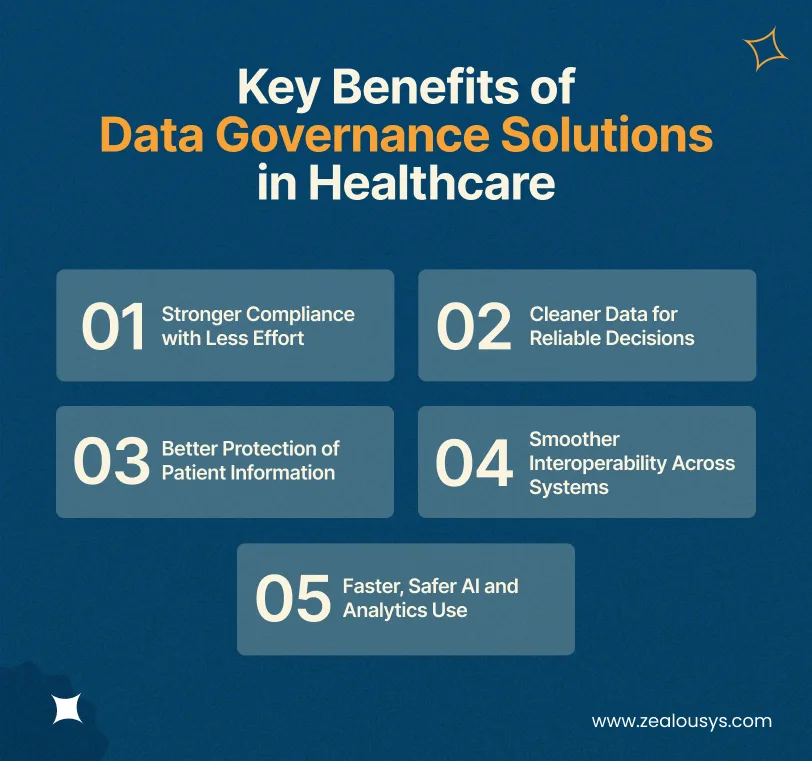
Data governance solutions bring structure to how your teams handle data across EHR/EMR systems and analytics environments. The impact shows up in compliance, decision-making, and everyday operations.
Built-in controls and automated reporting help you meet CMS, HIPAA, and state requirements without constant manual follow-ups. Audits become more predictable, with logs and policies already in place.
Errors in clinical records and patient identifiers are caught early and corrected at the source. This improves clinical data management and ensures reports, dashboards, and AI outputs reflect consistent, dependable information.
Access controls and monitoring safeguard sensitive data while allowing approved sharing. Patient data remains protected during FHIR exchanges and payer interactions, reducing exposure risks.
Standardized formats and clear data lineage reduce mapping issues between hospitals, clinics, and payers. This leads to fewer delays and less rework in data exchange.
Models receive validated inputs from the start, reducing the need for rechecks later. You can roll out AI features with clearer oversight and fewer risks tied to inconsistent data.
These benefits tend to reinforce each other over time. They turn governance from a required checkbox into a practical support layer for your broader goals in 2026.
Healthcare organizations often hit the same roadblocks when they try to bring order to their data environments. These issues arise from legacy systems, growing data volumes, and the constant push for better sharing and analysis. Spotting them early makes it easier to fix issues before they affect compliance or operations.
Departments often maintain separate repositories for clinical, financial, and research data. This fragmentation makes it difficult to track healthcare data lineage or maintain consistent standards. Your teams end up working with incomplete or duplicated data.
CMS rules, state privacy updates, and FHIR requirements continue to shift. Many organizations struggle to update policies fast enough. This leads to repeated manual reviews and uncertainty around whether the current data governance strategy meets expectations.
Incoming data from wearables, labs, and EHR systems introduces inconsistencies faster than manual checks can handle. Without automated controls, errors move into dashboards and AI models, creating rework and unreliable outputs.
You need to protect patient data while supporting smooth data exchange. Overly strict controls slow down access for providers and payers. Looser controls increase risk. Finding the right balance remains a constant challenge.
AI tools are added quickly for summarization and risk scoring, but governance often lags behind. Gaps in model oversight, input validation, and accountability create risk and slow adoption across teams.
Recognizing these patterns is the first step toward fixing them. It helps you prioritize fixes that fit your specific environment and build momentum toward stronger controls this year.
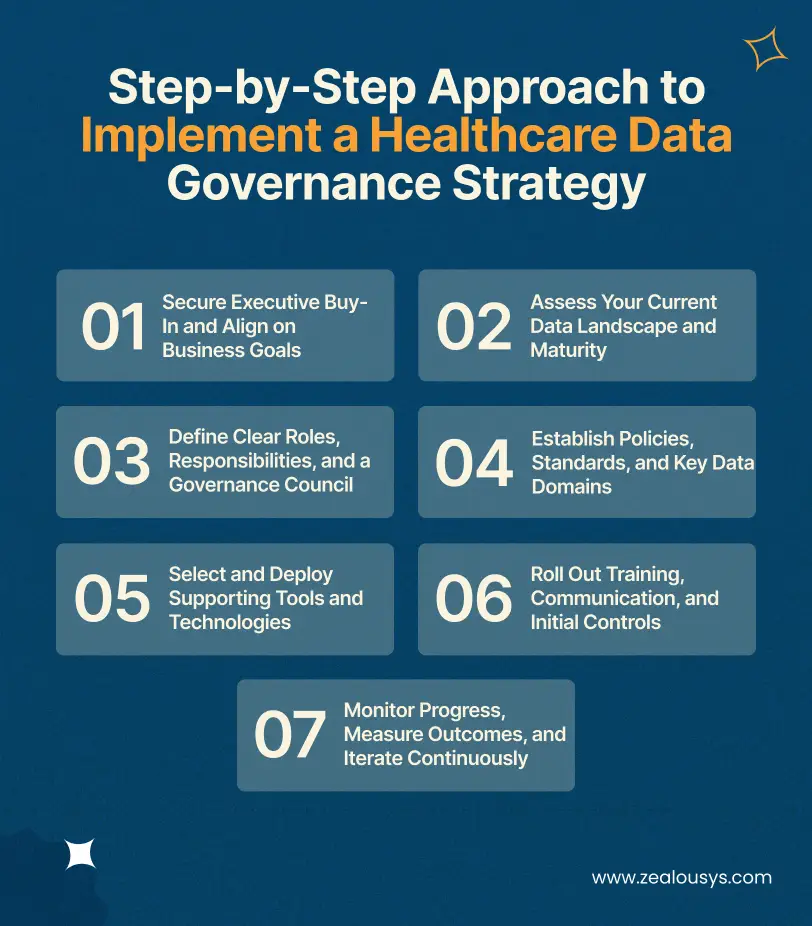
Implementation works best when done in stages, not as a single rollout. Start where the pressure feels highest, perhaps compliance gaps or inconsistent EHR data, and build momentum from there. This approach breaks the work into clear steps that fit both hospital management systems and healthtech platforms. Each one builds on the last, so progress feels steady and measurable.
Begin by bringing leadership into the conversation early. Present how poor data handling creates real delays in reporting, compliance risks, or AI reliability issues. Tie governance directly to priorities like faster interoperability or trustworthy clinical analytics. Once executives see the link to patient outcomes and operations, they are more likely to support resources and remove blockers.
Map where patient data currently lives across EHR platforms, analytics systems, cloud storage, and third-party sources. Identify issues such as duplicate records, inconsistent quality, or weak lineage tracking. This gives you a clear baseline for your healthcare data governance strategy.
Create a cross-functional team with members from IT, clinical operations, compliance, and analytics. Assign clear ownership, such as data stewards for quality and custodians for access control. Defined roles reduce confusion and speed up issue resolution.
Set practical rules for data quality, access, and privacy aligned with HIPAA and CMS requirements. Focus first on high-impact areas like patient identifiers, clinical records, and billing data. These standards guide how data is handled across systems.
Choose tools that integrate with your existing systems, including EHR and cloud platforms. Start with a focused pilot instead of a full rollout. Prioritize automation to reduce manual effort and maintain consistency at scale.
Communicate the why and how to everyone involved through targeted sessions and quick-reference guides. Introduce essential controls first, such as data validation rules or role-based access. Clear communication helps adoption happen naturally across departments.
Track metrics such as data quality scores, issue resolution time, and audit readiness. Review progress regularly and refine policies based on feedback. This keeps your data governance in healthcare aligned with changing regulations and system updates.
Follow these steps in order, but adapt the pace to your organization’s size and readiness. The key lies in starting small, proving value quickly, and expanding from proven results.
Best practices keep your governance program practical as AI adoption grows and interoperability demands increase. Apply these consistently to strengthen how patient records, clinical workflows, and data sharing are handled.
Tie policies to outcomes that matter, such as faster payer approvals, reliable analytics, or smoother FHIR exchanges. When governance supports real operational goals, adoption becomes easier across teams.
Start with critical data like patient identifiers, lab results, and medication records. Use automated validation to catch inconsistencies early and reduce manual correction later.
Apply access controls and data classification at the point of creation. Regular monitoring helps detect unusual access patterns and keeps patient data protected during routine use and sharing.
Assign data stewards across clinical, IT, compliance, and analytics teams. Clear ownership speeds up issue resolution and keeps standards consistent across systems.
Select solutions that integrate with your EHR and support lineage tracking, quality monitoring, and FHIR exchange. Start with a focused use case, then expand once results are proven.
Provide simple, role-based guidance so teams understand how governance affects their daily work. Share practical outcomes, such as fewer audit issues or faster access to data, to reinforce adoption.
Measure data quality, issue resolution time, audit readiness, and user feedback. Use these insights to adjust policies and keep your governance approach aligned with changing needs.
These practices work best when adjusted to your organization’s size and current priorities. Start with one or two that address your biggest pain points, prove the value, then build outward. Over time, they turn governance into a reliable foundation for safer care and smarter decisions.
The shift is already visible this year as AI embeds deeper into clinical and operational workflows. Regulations catch up with real-world use cases, and data flows grow more interconnected through FHIR integrations and real-time exchanges. Healthcare data governance must adapt to these changes to protect patient information while enabling innovation. These are the trends already shaping priorities in 2026.
AI tools now handle documentation, risk prediction, and administrative tasks at scale in many organizations. Without dedicated oversight, risks around bias, transparency, and PHI misuse rise quickly. Expect more health systems to form AI governance boards, create approved tool lists, and build policies for model training data and output validation. This shift ensures AI outputs remain defensible under HIPAA and supports confident clinical use.
New scrutiny falls on how protected health information feeds into AI models. Rules increasingly require synthetic data alternatives, clear consent mechanisms, and audit trails for training processes. Patient data privacy gets tighter safeguards, especially in multi-state or international setups. These measures help avoid enforcement actions while letting you responsibly advance AI-driven insights in diagnostics and care coordination.
Centralized approaches struggle with the volume of data from wearables, remote patient monitoring, and cloud analytics. Federated models let data stay local while applying consistent policies across distributed systems. This trend supports better interoperability under FHIR standards and reduces latency in real-time decisions. It fits environments where trust and compliance must span hospitals, payers, and third-party partners.
Payers push for near-real-time assessments of quality metrics and readmissions. This demands governance that handles event-driven feeds and continuous quality checks without manual intervention. Data governance solutions evolve to automate lineage tracking and compliance in hybrid setups. The payoff comes in smoother exchanges, fewer denials, and stronger population health efforts.
These trends show governance shifting from a compliance task to a strategic function. Focus on the ones that align closest with your current AI initiatives or interoperability gaps. Addressing them early positions your organization to handle accelerating change effectively.
Healthcare data governance has become non-negotiable in 2026. Patient records now feed directly into AI-driven diagnostics, real-time payer decisions, and cross-provider exchanges under FHIR rules. Without structured controls, small inconsistencies turn into compliance risks, delays, or loss of trust. The steps, practices, and trends outlined here give you a practical path toward more reliable data handling.
Progress moves fastest when you focus on one clear problem first. It could be duplicate patient identities affecting FHIR exchanges, inconsistent clinical data impacting model outputs, or manual clean-up slowing compliance work. Fixing a single, visible issue creates momentum for broader improvements.
At Zealous System, we work with healthcare IT teams facing these challenges. From selecting the right data governance solutions to integrating them with existing EHR and cloud systems, the focus stays on making governance practical and sustainable. As regulations tighten and AI adoption grows, early structure has a direct impact on compliance, data quality, and daily operations.
If you are evaluating your next step, start by identifying one gap in your current data flow. Addressing that first often sets the foundation for a stronger, scalable data governance strategy.
1. What is the difference between data governance and data management in healthcare?
2. How do data governance solutions support healthcare IT?
Data governance solutions help healthcare organizations control how data is collected, stored, and shared across systems. They improve data quality, ensure HIPAA compliance, and provide visibility into data lineage. This makes healthcare IT systems more reliable for clinical decisions, reporting, and AI use.
3. What role does FHIR play in a healthcare data governance strategy?
FHIR defines standardized formats for secure data exchange. Governance incorporates FHIR by setting policies for mapping, validation, consent, and privacy during those exchanges. This ensures interoperability stays compliant and error-free.
4. How can small or mid-sized health organizations start implementing data governance without massive resources?
Start small: assess one high-risk area (e.g., patient matching or lab data quality), form a lean cross-functional team, and pick affordable, integrable tools for cataloging or quality checks. Prove value with one quick win, like fewer duplicates or faster audits, then scale gradually.
5. Is data governance only about compliance, or does it drive business value?
No. While compliance is a key driver, data governance in healthcare also improves data accuracy, reduces operational inefficiencies, and supports better decision-making.
It plays a direct role in analytics, AI performance, and overall system reliability.
6. How often should a healthcare data governance program be reviewed or updated?
Healthcare data governance programs should be reviewed at least quarterly. Reviews should also happen after major regulatory updates, AI implementations, or system changes. Regular updates keep policies aligned with compliance requirements and operational needs.
7. What are the best data governance solutions for healthcare IT?
The best data governance solutions for healthcare IT typically include data catalog tools, data quality platforms, master data management systems, and compliance-focused security tools. The right choice depends on your existing systems, data volume, and regulatory requirements.
Our team is always eager to know what you are looking for. Drop them a Hi!

Pranjal Mehta is the Managing Director of Zealous System, a leading software solutions provider. Having 10+ years of experience and clientele across the globe, he is always curious to stay ahead in the market by inculcating latest technologies and trends in Zealous.




Comments