In many hospitals, device data still travels in fragments. A monitor records vital signs. A nurse notes them down. Later, someone enters the same values into the system. It works, but it slows everything down and leaves room for mistakes.
Medical device software integration changes that flow. It connects patient monitors, infusion pumps, ventilators, and imaging systems directly to your EHR or hospital platforms, so information moves on its own and stays consistent everywhere it is needed.
The results become visible early in day-to-day operations. Clinical teams no longer spend time copying readings. Data reaches the right place at the right moment, which supports faster and more informed decisions.
By 2026, this shift will have become easier to achieve. Standards such as FHIR, along with improvements in healthcare interoperability, have made device connections more reliable and easier to scale across departments and locations.
This guide walks through what that looks like in practice. You will see how integration works, the types available, the standards behind it, and the steps required to implement it without disrupting day-to-day operations.
Medical device software integration refers to the process of linking clinical equipment with the software systems that manage patient records and hospital operations. Instead of handling device readings separately, the data flows directly into your EHR, EMR, or hospital information system as it is generated.
In a working environment, patient vitals, infusion data, and imaging results enter the record automatically as they are generated. The connection is handled through software layers that translate device data into formats your systems can understand, while also managing timing, accuracy, and security.
Most healthcare environments rely on a mix of devices from different manufacturers. Without integration, each system operates in isolation. With the right setup in place, these systems begin to work together, allowing data to move between devices, records, and clinical tools in real time.
Standards such as FHIR and HL7 support this exchange by defining how information should be structured and shared. At the same time, advances in medical IoT have made it easier to connect a growing number of devices without adding unnecessary complexity.
When implemented well, medical device software integration supports consistent data flow across the entire care environment. It also creates a reliable base for real-time monitoring, clinical alerts, and connected systems that depend on accurate, up-to-date information.
In most healthcare settings, the real challenge is not access to data, but how reliably it moves between systems. Medical device software integration addresses that gap by connecting equipment and records in a way that supports everyday clinical work without added friction.
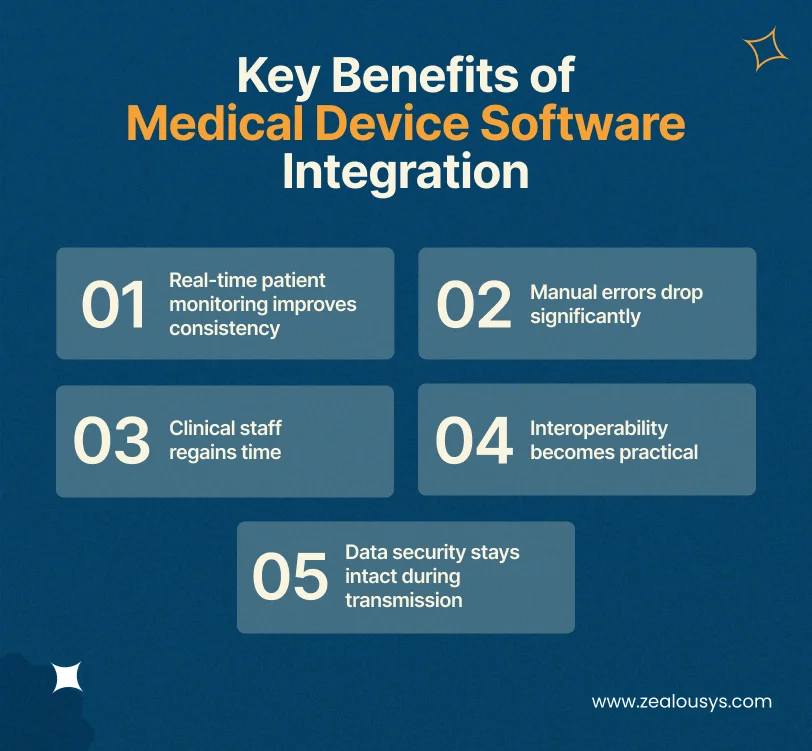
The benefits are most visible in areas tied to technology, operations, and compliance:
1. Real-time patient monitoring improves consistency.
Bedside devices send readings directly into the system, so changes are visible as they happen. Care teams do not wait for updates or rely on delayed entries.
2. Manual errors drop significantly.
Automatic data capture replaces handwritten notes and repeated entry. This leads to more accurate patient records and stronger clinical decisions.
3. Clinical staff regains time.
Nurses and technicians spend less effort tracking down or entering data. That time shifts back to patient care and coordination across departments.
4. Interoperability becomes practical.
Devices from different manufacturers begin to work within the same system. Hospitals gain a unified view of patient data without building separate connections for each device.
5. Data security stays intact during transmission.
Integrated systems apply controls that protect sensitive information while it moves between devices and records. Access remains traceable without slowing down operations.
Over time, teams begin to rely on a consistent and uninterrupted data flow. What once required manual effort becomes part of a steady, reliable flow, supporting faster decisions and more consistent care across the organization.
The pace of change is also reflected in the broader medical device market. It is projected to grow at a CAGR of 7% between 2026 and 2031, driven by advances in technology, a growing aging population, and wider use of digital health tools such as wearables. As more devices enter clinical environments, the need for consistent and reliable integration becomes part of everyday operations.
The way you connect medical devices depends on how your systems are set up today and how far you plan to scale. Some hospitals start small with a few direct connections, while others build centralized or cloud-based setups to manage hundreds of devices across locations. Most integration strategies fall into four common types. Each one handles data flow differently and fits a specific level of complexity.
Direct integration connects individual devices straight to your EHR or EMR using built-in protocols or simple adapters. It is often used in smaller setups, such as a single department with a limited number of bedside monitors or infusion pumps.
This approach keeps things simple. There are no additional software layers, so setup is faster and initial costs stay lower.
Limitations begin to surface as the number of devices increases. Adding devices from different manufacturers usually requires separate connections, which can become difficult to manage over time. For that reason, many hospitals use direct integration as a starting point rather than a long-term solution.
Middleware integration introduces a central layer between devices and your core systems. This layer handles data translation, routing, and security, so information reaches your hospital management systems in a consistent format.
In environments with mixed devices and multiple departments, this setup tends to be more practical. Instead of building separate integrations for each device, everything connects through a single engine.
It reduces repeated work and supports scale without forcing major changes to your existing infrastructure. Many mid-sized and large hospitals rely on middleware to maintain stable performance as their device ecosystem grows.
Cloud-based integration routes device data through secure online platforms that connect with your on-premise or hybrid systems. This model works well when operations span multiple locations or when device volumes change over time.
Its primary strength lies in how easily it adapts to changing scale. New devices or sites can be added without significant local infrastructure changes.
Maintenance also becomes easier to manage. Updates, monitoring, and performance checks happen centrally, which reduces the burden on internal IT teams. For many organizations, this approach provides a balanced path between scalability and control.
IoMT integration connects a broader network of smart medical devices using the Internet of Medical Things. This includes everything from bedside equipment to wearables and remote monitoring tools.
In these setups, devices continuously exchange data across systems, supporting real-time visibility both inside and outside the hospital. It becomes especially useful for remote patient monitoring and multi-site operations.
This type of integration is designed for scale from the start. It brings together large volumes of device data into unified dashboards, making it easier to manage complex environments. Many forward-looking healthcare organizations now treat IoMT as the foundation for long-term interoperability and connected care.
Medical device software integration relies on established standards and protocols to make connections reliable across different devices and systems. These rules define how data moves between equipment and your EHR, EMR, or hospital information systems. They also support secure medical device integration and help you avoid repeated custom fixes.
HL7 provides the messaging framework that has powered clinical data exchange for years. You use HL7 v2 messages for real-time events like admissions, orders, and results from devices such as monitors or lab equipment. It keeps legacy systems running smoothly while feeding accurate information into your core records.
This standard still handles much of the heavy lifting in many hospitals. It ensures device readings reach the right place without gaps, which directly supports integrating medical devices with healthcare systems in mixed environments.
FHIR became the modern standard for healthcare data exchange in 2026. It uses simple web-based APIs so devices and applications share information in a consistent, resource-based format. You turn to FHIR when you need fast, flexible links between connected medical devices and your electronic health records.
The approach makes healthcare interoperability practical at scale. It supports real-time updates and works well with mobile tools or cloud platforms, giving your teams quick access to patient data without complicated setups.
Check out How to Integrate FHIR APIs in Healthcare Software: Step-by-Step Guide
DICOM governs how imaging devices communicate and store pictures and related data. You apply it for everything from X-ray machines and CT scanners to ultrasound systems that must send studies straight into your PACS or EHR. The standard keeps images and measurements consistent across vendors.
This protocol is essential for radiology and cardiology workflows. It ensures device data interoperability for visual records, so clinicians see complete, accurate information without manual transfers.
IEEE 11073 (also known as ISO/IEEE 11073) handles direct communication between medical devices and systems at the bedside. It defines plug-and-play rules for vital signs monitors, pumps, and other equipment so they exchange data in a standardized way. You rely on it for high-acuity settings where devices must talk to each other and to your hospital systems instantly.
The standard simplifies hospital device integration systems in critical care. It supports real-time medical device data integration and reduces the need for extra translation layers.
These standards and protocols form the backbone of any successful medical device software integration project. They give you a clear path to connect devices securely while meeting current regulatory expectations. Choose the right mix based on your devices, existing infrastructure, and goals for long-term healthcare interoperability.
In most hospitals, integration projects succeed or fail during planning, not implementation. A clear process helps avoid rework, especially when multiple devices, systems, and teams are involved.
The following steps reflect how these projects are carried out in working hospital environments. Each stage builds on the last, so gaps do not surface later when systems are already live.
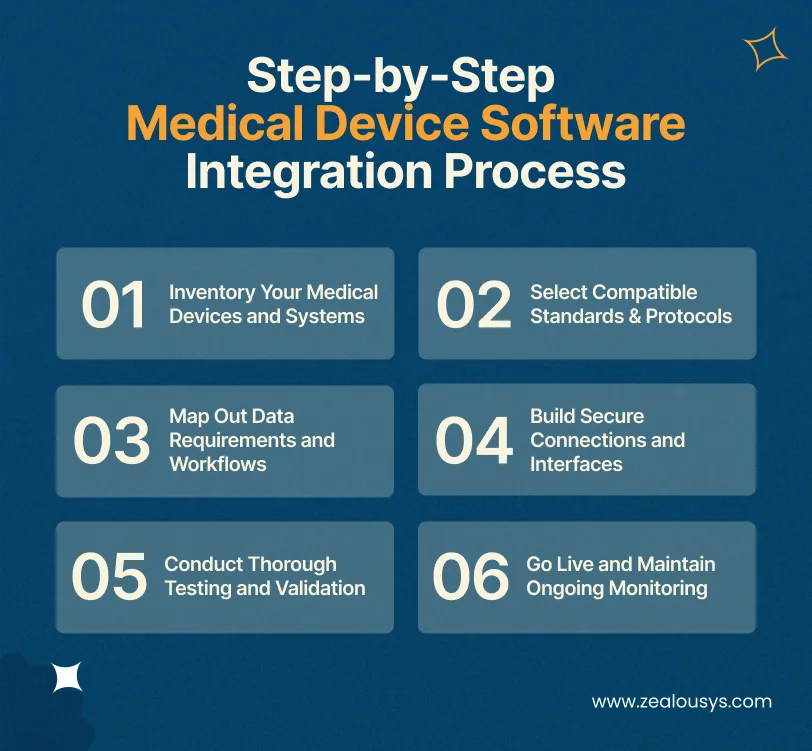
Start with a complete view of your current environment. List every device in use, including bedside monitors, infusion pumps, ventilators, and imaging equipment. Note their make, model, firmware version, and how they connect today.
At the same time, review your EHR, EMR, and hospital information systems. Look for gaps where data still depends on manual entry or delayed updates. This stage usually exposes hidden dependencies and gaps. It also prevents missed dependencies during integration.
Once the inventory is clear, the next decision involves choosing the standards that will carry your data. Most environments rely on a mix of HL7, FHIR, DICOM, or IEEE 11073, depending on device types and system capabilities.
The goal here is not just compatibility, but stability over time. The standards you choose will shape how easily new devices can be added later. In many cases, middleware or cloud platforms are introduced at this stage to bridge older systems with newer protocols.
Not every data point needs to move, and not every alert needs to trigger action. This step focuses on defining what matters. Identify which readings, alerts, and events must appear in the patient record. Then map how that data moves between devices and systems, including timing, format, and direction.
Input from clinical teams is essential at this stage. Workflows should reflect how care is actually delivered, not how systems are designed. When this step is done well, it reduces friction later.
With a clear plan in place, the technical work begins. Devices are connected through middleware, APIs, or cloud gateways based on the architecture you selected.
Security is built into every layer. Encryption, access control, and compliance checks are applied as data moves between systems. Most teams start small. A few devices are connected and tested first, then expanded gradually across departments once the data flow proves reliable.
Testing goes beyond basic connectivity. Systems need to perform under real clinical conditions. This includes simulating patient scenarios, verifying data accuracy, and confirming that alerts reach the right teams without delay. Performance under load also matters, especially in high-acuity settings.
Clinical staff should be involved at this stage. Their feedback ensures the integration supports actual care workflows, not just technical requirements.
Going live is not the end of the process. It marks the point where monitoring becomes part of daily operations. In the early stages, teams track data accuracy, system performance, and security logs closely. Alerts are set up to detect delays or connection failures before they affect care.
Over time, the system evolves. New devices are added, standards are updated, and workflows are refined. Ongoing review keeps the integration stable as the environment grows.
Medical device software integration sounds straightforward on paper, yet most hospitals hit the same roadblocks when they start connecting equipment to their EHR and hospital systems. These issues tend to delay timelines and increase overall costs. You can avoid many setbacks by knowing exactly where they appear.
Different manufacturers use their own protocols and data formats. This creates mismatches that complicate healthcare device integration and force repeated custom work to get data into your core systems.
Every new connection opens another entry point for threats. Older devices often lack modern encryption, making secure medical device integration harder without slowing clinical workflows.
Your existing EHR or hospital information systems may not support the latest standards like FHIR. They struggle with real-time streams from connected medical devices and require extra translation layers.
Some connections introduce delays that matter in critical care. Network congestion can push ventilator or pump data seconds late, so alerts fail to trigger on time.
You must satisfy overlapping rules on privacy, safety, and audit trails at the same time. One missed step during integration can trigger lengthy reviews or force a rollback.
These challenges appear in nearly every project. Spotting them early lets you build stronger connections that support real-time patient monitoring systems and full healthcare interoperability.
Medical device software integration comes with costs that vary based on your hospital size, device count, and chosen approach. You pay for software licenses, interfaces, testing, training, and ongoing support.
Looking at costs by integration type makes planning more practical.
Direct integration usually falls on the lower end of the cost range. Initial setup typically runs between $5,000 and $20,000. This approach relies on simple adapters or built-in protocols to connect devices directly to your EHR. It works well for smaller environments or single departments where the number of devices is limited.
The limitation appears as systems grow. Each new device or vendor may require additional configuration, which can increase maintenance effort over time.
Middleware setups generally range from $15,000 to $50,000 upfront. Here, a central engine manages data translation and routing between devices and systems. This reduces the need for individual connections and supports more consistent data flow across departments.
For many mid-sized hospitals, this approach strikes a balance between cost and scalability. It does require careful setup in the early stages, especially when handling real-time data streams.
Cloud-based models typically start around $50,000 and can reach $150,000 depending on scale. These platforms connect devices through secure online infrastructure, making it easier to expand across locations without heavy on-site investment.
Ongoing management becomes simpler, since updates and monitoring are handled centrally. The trade-off is reliance on stable network performance, which becomes critical in high-volume environments.
IoMT integration sits at the higher end, often starting at $100,000 and extending beyond $300,000 for large deployments. This approach connects a wide network of devices, including wearables and remote monitoring systems, into a unified environment. It is designed for hospitals or health systems that need continuous data flow across multiple locations.
The scale brings added complexity. Security, device management, and long-term planning all require close attention from the start.
Here is a clear comparison of typical costs for connecting devices to EHR and hospital systems in 2026:
| Integration Type | Initial Setup Cost | Annual Maintenance | Best Suited For |
|---|---|---|---|
| Direct Integration | $5,000 – $20,000 | $1,000 – $5,000 | Small units or single departments |
| Middleware Integration | $15,000 – $50,000 | $5,000 – $15,000 | Mid-sized hospitals with mixed vendors |
| Cloud-Based Integration | $50,000 – $150,000 | $10,000 – $30,000 | Multi-site or hybrid environments |
| IoMT Integration | $100,000 – $300,000+ | $20,000 – $50,000 | Large networks with many connected devices |
A few factors tend to influence the final investment more than anything else:
These elements help you forecast expenses more precisely and avoid surprises when you move forward with integrating medical devices with healthcare systems.
Medical device software integration gives you the foundation to move patient data automatically and accurately across your entire operation. You have now seen the different types of connections, the essential standards like FHIR and HL7, a clear step-by-step process, the real challenges you will face, and how costs break down in practice. With this knowledge, you can build reliable links that support real-time patient monitoring systems and full healthcare interoperability without constant workarounds.
The right integration reduces manual work, improves data accuracy, and lets your clinical teams focus on care instead of data entry. It also meets today’s security and compliance requirements while preparing your systems for future growth in connected medical devices. Hospitals and HealthTech teams that follow these practices see smoother operations and stronger clinical outcomes.
At Zealous System, we deliver specialized Medical Software Development Services and Application and Software Integration Services that help organizations achieve secure, scalable medical device software integration. Our work centers on matching solutions to your exact devices, workflows, and regulatory needs.
You now have a clear reference to guide integration decisions in 2026. Apply these steps in your next project, and you will create the connected environment your teams and patients deserve.
Medical device software integration often raises similar questions across teams. Here are clear answers based on how these projects typically unfold in practice.
1. How to integrate medical devices with EHR systems?
Start by listing all your devices and their current connections. Choose standards such as FHIR or HL7, map the exact data flows you need, build secure interfaces, test end-to-end, and then go live with monitoring. This method gives you reliable EHR medical device integration with minimal manual work.
2. What are the common challenges in medical device integration, and how to solve them?
Vendor differences, security gaps, old systems, data delays, and compliance rules are the usual hurdles. Address them early with middleware for translation, layered defenses, phased upgrades, dedicated networks, and compliance checks from the start.
3. How much does medical device software integration cost in healthcare?
Expect $5,000–$20,000 for simple direct links in small units and up to $300,000+ for large IoMT setups. Your total depends on device count, legacy systems, security needs, and whether you choose middleware or cloud options.
4. Which standards matter most for medical device connectivity solutions?
HL7 handles messaging, FHIR powers modern APIs, DICOM manages images, and IEEE 11073 covers bedside devices. Pick the mix that matches your equipment and systems for smooth, future-ready connections.
5. What are the best practices for medical device integration in hospitals?
Begin with a full device inventory, involve clinical teams early, test under real workloads, build security in from day one, and set up ongoing monitoring. These steps keep hospital device integration systems accurate and reliable.
6. How can I achieve secure medical device integration?
Apply encryption, role-based access, isolated networks, and regular audits on every link. Middleware or cloud platforms with built-in controls make secure medical device integration straightforward while meeting current regulations.
Our team is always eager to know what you are looking for. Drop them a Hi!

Meet the Zealous Team – your dedicated source for cutting-edge insights on the latest technologies, digital transformation, and industry trends. With a passion for innovation and a commitment to delivering unparalleled expertise.




Comments