Businesses across industries are exploring smart contract development to automate transactions and reduce manual processes. A smart contract is a self-executing program stored on a blockchain that automatically enforces agreements when predefined conditions are met. Many startups and enterprises now invest in blockchain smart contract development to build secure and transparent digital systems. In this guide, we explain how smart contract development works and why companies are adopting this technology.
Startup founders, CTOs, and product managers use smart contract development services to build innovative solutions such as DeFi platforms, NFT marketplaces, and Web3 applications. Fintech and Web3 companies rely on custom smart contract development to create secure payment systems, trading platforms, and decentralized applications. Enterprises also partner with a reliable smart contract development company to automate supply chains, financial agreements, and digital identity management.
Businesses choose smart contracts because they improve transparency, increase efficiency, and reduce operational costs. Understanding the benefits of smart contract development for businesses, the cost of smart contract development, and the industries using smart contracts helps decision-makers plan successful blockchain projects. This complete guide will help you learn how to build a smart contract and understand how businesses can use blockchain technology to create secure and automated digital ecosystems.
A smart contract is a self-executing digital agreement that runs on a blockchain network. It automatically performs actions when predefined conditions are met. Businesses use smart contract development to automate agreements without relying on intermediaries. Companies across fintech, supply chain, and Web3 platforms adopt blockchain smart contract development to increase transparency and efficiency.
Startup founders, CTOs, and enterprises use custom smart contract development to build secure solutions for decentralized applications, DeFi platforms, and NFT marketplaces. Many organizations also partner with a smart contract development company to design reliable contracts that support their blockchain products and business processes.
Smart contracts operate on blockchain networks such as Ethereum or other decentralized platforms. Developers write the contract logic using blockchain programming languages and deploy it on the network. When users trigger specific conditions, the contract automatically executes the programmed actions.
For example, a DeFi platform can release funds once it verifies a transaction on the blockchain. This automated process shows how smart contract development works in real-world applications. Businesses use smart contract development services to build these automated systems for payments, trading, and digital asset management.
Every smart contract includes several essential components that enable it to run securely on a blockchain. First, developers define the contract rules and conditions that trigger actions. Second, the contract stores data related to transactions, participants, or assets on the blockchain. Third, the contract includes automated functions that execute actions when the conditions are satisfied.
Developers follow structured processes in custom smart contract development to ensure accuracy, security, and scalability. Businesses often evaluate how to build a smart contract, the benefits of smart contract development for businesses, and the cost of smart contract development before launching blockchain solutions. Organizations across finance, supply chain, and Web3 ecosystems continue to explore industries using smart contracts to automate operations and build trust in digital transactions.
Smart contract development helps businesses automate agreements without relying on manual processes. Companies use blockchain smart contract development to create self-executing contracts that run automatically when predefined conditions are met. Startup founders and fintech companies use custom smart contract development to streamline transactions in DeFi platforms, NFT marketplaces, and Web3 applications. This automation reduces delays and allows businesses to operate more efficiently.
Smart contracts run on blockchain networks, which record every transaction in a transparent and immutable way. Businesses and product teams can track agreements, transactions, and data changes in real time. This level of transparency builds trust among partners, customers, and stakeholders. CTOs and enterprises exploring blockchain often adopt smart contract development services to ensure that all participants can verify transactions easily.
Smart contract development services help businesses reduce operational costs by removing intermediaries and manual verification processes. Automated contracts eliminate the need for third-party approvals in many financial and trading processes. Fintech and Web3 companies benefit from lower transaction costs and faster settlement times. Businesses that understand how smart contract development works can significantly reduce administrative and operational expenses.
Security plays a critical role in blockchain smart contract development. Smart contracts use cryptographic algorithms and decentralized networks to protect sensitive business data and transactions. Developers follow secure coding practices and auditing processes to minimize vulnerabilities. Enterprises and investors trust custom smart contract development because it provides a secure and tamper-resistant environment for digital agreements.
Smart contract development enables faster transactions by removing manual approvals and paperwork. Blockchain networks automatically execute agreements once the defined conditions are fulfilled. Fintech companies and trading platforms rely on smart contracts to process transactions quickly and efficiently. Businesses that invest in a smart contract development company can improve operational speed and deliver better services to their customers.
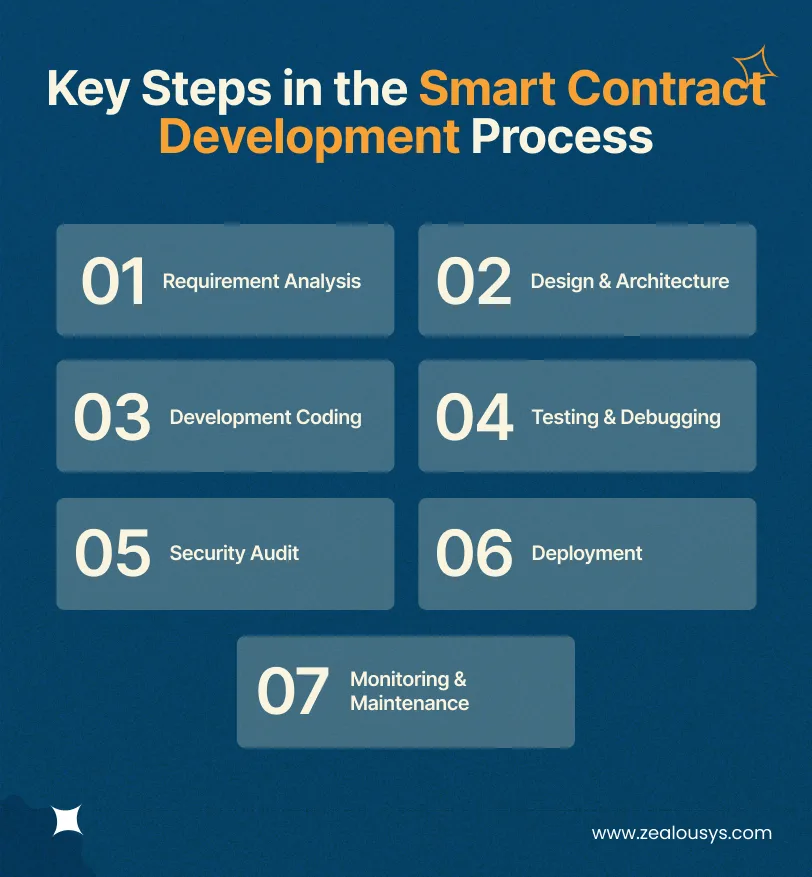
Businesses across fintech, Web3, and enterprise sectors rely on a structured process to build secure blockchain applications. A well-planned smart contract development process helps startups, CTOs, and product teams build reliable decentralized solutions. Companies offering smart contract development services follow multiple stages to ensure the contract works accurately, securely, and according to business goals.
Below is a simple step-by-step process that most smart contract development companies follow when building blockchain smart contract solutions.
The smart contract development process begins with understanding the business requirements. The development team works closely with startup founders, CTOs, and product managers to identify the purpose of the smart contract.
The team defines what the contract will do, which users will interact with it, and which blockchain network will support the application. At this stage developers also identify risks, compliance requirements, and transaction rules.
For example, a DeFi platform may require automated lending and borrowing rules, while an NFT marketplace may require ownership transfers and royalty logic. Clear requirement analysis helps teams design custom smart contract development solutions that match business needs.
After defining the requirements, the team designs the technical architecture. Developers select the right blockchain platform such as Ethereum, Polygon, or Hyperledger based on scalability, cost, and performance.
The team defines the contract structure, data flow, and system interactions. Developers also plan how the smart contract will interact with external systems, APIs, or off-chain data sources.
This stage helps businesses understand how smart contract development works and ensures the contract can support real-world use cases like trading platforms, digital asset systems, or decentralized applications.
Once the architecture is finalized, developers start coding the smart contract. Developers write the code using programming languages such as Solidity for Ethereum or other blockchain languages, depending on the selected platform.
The team follows best practices for blockchain smart contract development and focuses on writing clean and secure code. Developers create reusable modules and implement secure logic for transactions, permissions, and automation.
During this phase, developers build features required for DeFi platforms, Web3 applications, and blockchain products.
Testing plays a critical role in smart contract development. Developers run multiple tests to ensure the contract performs correctly in different scenarios.
The team performs unit testing, integration testing, and transaction simulations. Developers use tools such as Hardhat, Truffle, and Remix to validate contract functionality.
Testing helps identify vulnerabilities, logic errors, and performance issues before deployment. Proper testing reduces risks and ensures reliable smart contract development for businesses.
Security remains one of the most important stages in smart contract development. A security audit helps protect blockchain applications from vulnerabilities and financial risks.
Blockchain security experts review the contract code carefully and test the system against common attack scenarios. The audit focuses on issues such as access control problems, overflow vulnerabilities, and reentrancy attacks.
Many businesses choose smart contract audit services to ensure their blockchain applications meet security standards and protect digital assets.
After testing and auditing, the development team deploys the smart contract on the blockchain network. Developers first deploy the contract on a test network to validate performance in a real environment.
Once the contract passes the test stage, developers deploy it on the main blockchain network. The smart contract becomes active and starts processing transactions automatically based on the programmed logic.
Deployment marks the stage where blockchain smart contract development moves from development to real business operations.
Smart contract deployment does not end the development lifecycle. Businesses continue monitoring the contract performance after deployment.
Developers track transactions, gas usage, and contract activity to identify unusual behavior. Teams maintain the system and introduce upgrades when required.
Ongoing monitoring ensures the contract continues to operate efficiently and securely for blockchain applications such as DeFi platforms, trading systems, and Web3 solutions.
Businesses choose different platforms for smart contract development based on scalability, security, transaction speed, and ecosystem support. The right blockchain platform helps companies build reliable decentralized applications and automate agreements through blockchain smart contract development. Many startups and enterprises work with a smart contract development company to select the best platform for their business needs.
Ethereum is one of the most widely used platforms for custom smart contract development. Developers use Solidity to build decentralized applications, DeFi platforms, and NFT marketplaces. Many businesses prefer Ethereum because it provides strong security, a large developer ecosystem, and reliable tools for smart contract development services. Startups and Web3 companies often use Ethereum when they want to build scalable blockchain solutions.
Binance Smart Chain offers a fast and cost-efficient environment for smart contract development. Businesses choose BSC because it provides lower transaction fees and faster processing compared to many other networks. Fintech companies and DeFi startups often use this platform for blockchain smart contract development, especially when building trading platforms or financial applications.
Polygon improves Ethereum’s scalability and reduces transaction costs. Many businesses building Web3 applications choose Polygon for efficient custom smart contract development. The platform helps companies deploy decentralized applications faster while maintaining compatibility with Ethereum tools and infrastructure.
Solana focuses on high performance and extremely fast transaction speeds. Companies developing high-volume applications such as NFT platforms, gaming ecosystems, and trading platforms often use Solana for smart contract development services. Its architecture allows businesses to build blockchain solutions that handle large numbers of transactions efficiently.
Hyperledger is designed for enterprise blockchain solutions that require privacy and permissioned networks. Large organizations use Hyperledger for industries such as finance, supply chain, and digital identity management. Enterprises often partner with a smart contract development company to build secure enterprise applications using Hyperledger frameworks.
Selecting the right platform is an important step in understanding how smart contract development works for different business models. The platform choice directly affects performance, security, and scalability. Businesses across industries use these technologies to build innovative solutions and explore new industries using smart contracts.
The finance sector widely adopts smart contract development to automate financial transactions and remove intermediaries. DeFi platforms use blockchain smart contract development to enable secure lending, borrowing, staking, and trading. Smart contracts automatically execute agreements when predefined conditions are met.
Fintech companies rely on custom smart contract development to create secure payment systems and digital asset platforms. Businesses in finance also use smart contract development services to build transparent and tamper-proof financial solutions.
Many organizations use smart contract development to improve transparency and efficiency in supply chain operations. Smart contracts automatically track goods, verify deliveries, and trigger payments between suppliers and distributors.
Companies implement blockchain smart contract development to record every transaction on a secure and immutable ledger. This automation reduces manual work and errors. Businesses that want to understand how smart contract development works often explore supply chain solutions as a practical starting point.
Healthcare providers use custom smart contract development to manage patient records, automate billing, and secure sensitive medical data. Smart contracts help hospitals and insurers share verified information without compromising privacy.
Developers build healthcare platforms using smart contract development services to improve trust and efficiency across medical systems. This technology also supports secure data exchange between healthcare providers and insurance companies.
Real estate companies adopt smart contract development to simplify property transactions and reduce paperwork. Smart contracts automatically transfer ownership when buyers meet payment conditions.
Businesses use blockchain smart contract development to create transparent property records and eliminate fraud. Property platforms that explore how to build a smart contract often focus on automating lease agreements, escrow services, and property transfers.
The gaming industry uses smart contract development to power blockchain-based games and NFT marketplaces. Developers use custom smart contract development to manage digital assets, in-game items, and player rewards.
Smart contracts ensure transparent ownership and secure trading of NFTs. Many Web3 gaming companies partner with a smart contract development company to build decentralized gaming ecosystems.
Insurance companies adopt smart contract development services to automate policy management and claims processing. Smart contracts automatically validate claims when predefined conditions are met.
This automation reduces processing time and minimizes fraud. Businesses in the insurance sector also evaluate the benefits of smart contract development for businesses, including faster settlements and improved transparency.
The cost of smart contract development depends on several technical and business factors. Businesses usually choose custom smart contract development to build secure blockchain solutions for DeFi platforms, NFT marketplaces, and Web3 applications. On average, smart contract development services can cost between $5,000 and $50,000+, depending on the project requirements and complexity.
The blockchain platform plays an important role in determining the development cost. Popular platforms such as Ethereum, Polygon, Binance Smart Chain, and Solana use different tools, frameworks, and transaction structures. Ethereum development may require higher effort due to network complexity and gas optimization. A reliable smart contract development company evaluates your business needs and recommends the most suitable platform for efficient blockchain smart contract development.
The complexity of the contract directly impacts the development time and cost. Simple smart contracts that automate basic transactions or token transfers usually cost $5,000 to $10,000. Medium-complexity contracts used in decentralized applications can cost $10,000 to $25,000. Advanced contracts used in DeFi platforms, trading systems, or complex financial automation may cost $25,000 to $50,000 or more.
Security remains a critical factor in smart contract development because blockchain applications often manage digital assets and financial transactions. Developers implement secure coding practices, encryption mechanisms, and access control systems to protect the contract from vulnerabilities. Businesses investing in smart contract development services prioritize security to ensure safe and reliable blockchain operations.
Professional teams perform a thorough audit and testing before deploying a smart contract on the blockchain. Developers run unit tests, integration tests, and security audits to detect potential issues. A complete smart contract security audit usually costs between $3,000 and $15,000, depending on the contract size and complexity. Proper testing ensures that businesses can safely deploy smart contracts in industries using smart contracts such as fintech, supply chain, and digital asset platforms.
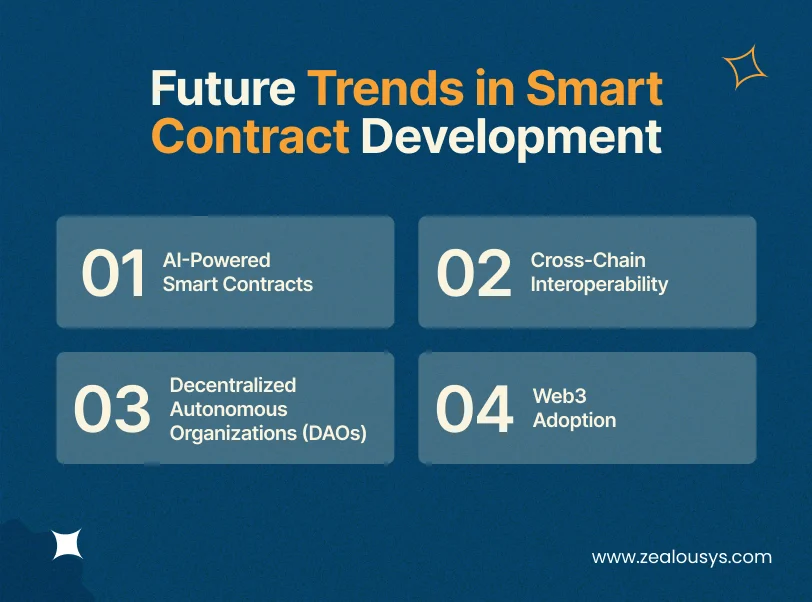
AI is transforming smart contract development by making blockchain applications smarter and more automated. Businesses combine AI with blockchain smart contract development to analyze data, detect risks, and trigger automated actions. Startups and fintech companies increasingly adopt these solutions to improve efficiency and security in decentralized applications.
Cross-chain interoperability is becoming important in custom smart contract development. Developers now build smart contracts that work across multiple blockchain networks instead of a single platform. This approach helps businesses transfer assets and data between different ecosystems and build more scalable blockchain solutions.
Decentralized Autonomous Organizations rely on smart contract development to automate governance and decision-making. Smart contracts manage voting systems, rules, and treasury operations on blockchain networks. Many Web3 startups and communities now use DAOs to create transparent and decentralized management systems.
Growing Web3 adoption is increasing the demand for smart contract development services. Businesses build decentralized applications, DeFi platforms, and NFT marketplaces using secure smart contracts. Many startups and enterprises now partner with a reliable smart contract development company to develop scalable blockchain solutions.
At Zealous System, we have strong blockchain expertise with practical business understanding to deliver reliable smart contract development services. Our team builds secure and efficient blockchain solutions that help businesses automate agreements, transactions, and digital processes. We support startups, CTOs, and enterprises that want to launch DeFi platforms, NFT marketplaces, and Web3 applications with confidence.
Our Strengths in Blockchain and Smart Contracts:
Our developers specialize in blockchain smart contract development across platforms such as Ethereum, Polygon, Binance Smart Chain, and Hyperledger. We help businesses choose the right blockchain network based on scalability, security, and performance requirements.
As an experienced smart contract development company, we provide complete development services, including consulting, architecture design, coding, testing, and deployment. Our team also builds custom smart contract development solutions that match your business logic and product requirements.
We follow strict security practices during development and testing. Our team audits contracts carefully and applies proven frameworks and libraries to reduce vulnerabilities and ensure safe blockchain transactions.
We design smart contracts that support scalable blockchain applications. Our developers optimize contracts for better gas efficiency, faster execution, and improved system performance.
We help companies integrate smart contracts with existing platforms and applications. Our team understands how smart contract development works within real business systems and ensures smooth integration with wallets, dApps, and enterprise platforms.
Our support continues after deployment. We help businesses monitor contracts, upgrade features, and optimize performance while managing the cost of smart contract development efficiently. We also support companies in various industries using smart contracts, including fintech, supply chain, and digital asset platforms.
Smart contract development is transforming how businesses create and manage digital agreements. Companies use blockchain smart contract development to automate transactions, reduce manual work, and increase transparency across business operations. Startup founders, CTOs, and product teams building DeFi platforms, NFT marketplaces, or Web3 applications rely on custom smart contract development and professional smart contract development services to build secure and scalable blockchain solutions.
As more organizations explore industries using smart contracts, the demand for reliable smart contract development companies continues to grow. Businesses that understand how smart contract development works and evaluate the cost of smart contract development can make better technology decisions. By adopting smart contracts, companies can streamline processes, improve security, and unlock new opportunities in the evolving blockchain ecosystem.
Our team is always eager to know what you are looking for. Drop them a Hi!

Pranjal Mehta is the Managing Director of Zealous System, a leading software solutions provider. Having 10+ years of experience and clientele across the globe, he is always curious to stay ahead in the market by inculcating latest technologies and trends in Zealous.




Comments