
Mobile technologies and digital services contributed 240 billion dollars to Africa’s economy in 2025, equal to 7.8 percent of the continent’s GDP, according to the GSMA’s Mobile Economy Africa 2026 report. Artificial intelligence is now a visible part of that growth story. African mobile operators are moving beyond connectivity into AI-enabled digital services, banks are rebuilding core systems around AI and automation, and PwC’s most recent Africa CEO survey found that AI adoption among African businesses rose to 75 percent in 2025, even as most companies remain stuck at the pilot stage rather than scaling AI across the enterprise.
That gap between adoption and impact is the real story of AI in Africa today. Businesses across the continent are experimenting with AI at a fast pace, but relatively few have moved from pilot projects to measurable, enterprise-wide results. For CTOs, CIOs, and business owners trying to decide where AI fits into their 2026 strategy, understanding that gap, and how to close it, matters more than tracking the latest AI headline.
This article examines where AI adoption in Africa actually stands, which industries and countries are ahead, what is slowing broader adoption, what AI implementation typically costs, and how businesses can build a realistic AI roadmap.
AI is helping African businesses cut fraud losses, extend credit to underserved customers, diagnose disease earlier, forecast crop yields, and automate logistics and customer service. Adoption is highest in financial services and telecommunications and concentrated in South Africa, Nigeria, Kenya, and Egypt, but most organizations remain in early pilot stages rather than full-scale deployment.
Africa’s AI adoption story in 2026 is one of broad experimentation but shallow depth. According to PwC‘s 29th Global CEO Survey, released in February 2026, overall AI adoption among African businesses rose to 75 percent, yet only 26 percent of African CEOs believe their current level of AI investment is sufficient to meet their organization’s goals. A separate PwC AI Performance study, published in May 2026 and covering executives across Africa, found that more than 82 percent of African organizations are running AI pilots, but only a small share have scaled AI adoption across the enterprise.
This mirrors a global pattern, where companies move quickly into AI experimentation but struggle to convert pilots into production systems that show up in financial results. Among African companies that have invested in AI, PwC found that about 23 percent reported revenue growth and 25 percent achieved cost reductions tied to AI, which is meaningful but still limited to a minority of adopters.
Generative AI adoption is growing fastest at the consumer and knowledge-work level. Microsoft’s Global AI Diffusion report for the first quarter of 2026 found that generative AI usage among South Africa’s working-age population reached 23.1 percent, up from 21.1 percent in the second half of 2025, ranking South Africa 46th out of 147 economies tracked and ahead of every other African country in the dataset. Globally, the same report found that AI usage in the Global South is growing at less than half the rate of the Global North (a 1.3 percentage point rise compared with 2.8 points), a gap the report attributes to unreliable electricity, limited internet access, and underrepresentation of African languages in AI training data.
In South Africa, a 2025 World Wide Worx study conducted with Dell Technologies and Intel found that generative AI usage is expanding quickly inside businesses, particularly for email and report drafting, but that only 14 percent of South African companies have a formally integrated AI strategy. That gap between usage and strategy is common across the continent: businesses are adopting AI tools faster than they are building the governance, skills, and data foundations to use them safely and effectively.
Nigeria, Kenya, South Africa, and Egypt, often called Africa’s “Big Four” tech markets, accounted for roughly 83 percent of AI-focused startup funding by early 2025, and 87 percent of the 1.25 billion dollars raised by African AI startups between 2019 and early 2025. Total African startup funding across all sectors reached 3.42 billion dollars in 2025, with fintech continuing to capture the largest share of capital.
Africa holds less than 2 percent of the world’s data center capacity, according to Andela’s 2025 AI at Work analysis cited by ITWeb Africa, even as the continent’s data center construction market, valued at 1.26 billion dollars in 2024, is projected to reach 3.06 billion dollars by 2030. Major providers are responding: Microsoft and G42 announced a 1 billion dollar investment package to build a green data center for an Azure East Africa Cloud Region in Kenya, and Cassava Technologies has deployed thousands of NVIDIA GPUs across South Africa with planned expansion into Nigeria, Kenya, Egypt, and Morocco.
A World Bank survey of 174 African universities found that only 31 percent offer dedicated AI programs and 34 percent offer data science degrees, and industry estimates suggest fewer than 3 percent of the global AI workforce is currently based on the continent, even as LinkedIn’s 2025 Emerging Jobs Report lists AI engineer, machine learning engineer, and data scientist among the fastest-growing job titles in Nigeria, Kenya, and South Africa.
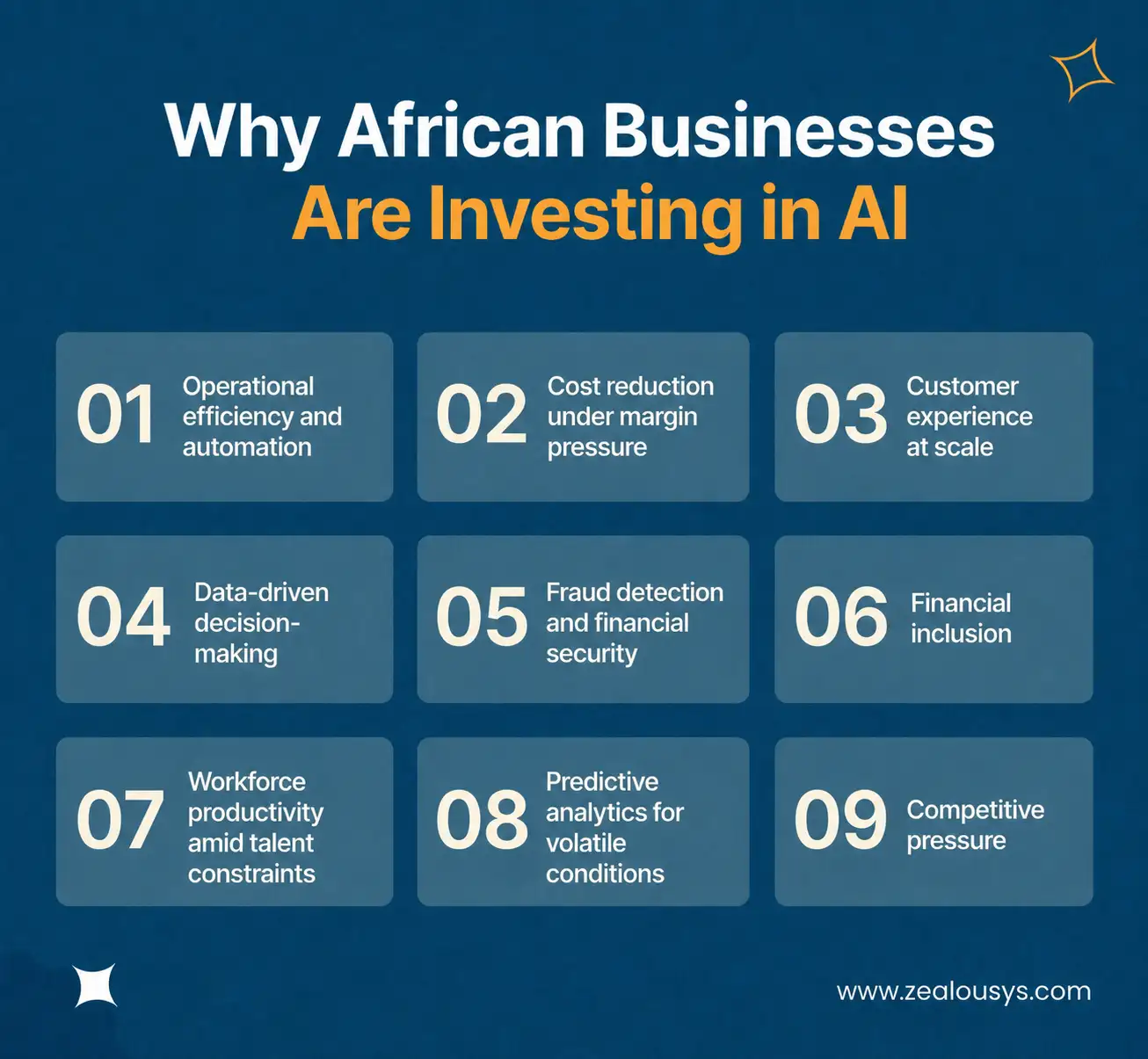
The business case for AI in Africa mirrors the global case, but several drivers are more acute on the continent because of the specific operating environment African businesses face.
Manual, paper-based, or partially digitized processes remain common across African back offices, from claims processing to inventory reconciliation. AI-based automation lets businesses close operational gaps without the multi-year ERP overhauls that legacy competitors used elsewhere. Intelligent process automation and document automation are particularly attractive because they need less underlying data infrastructure than predictive AI.
Currency volatility, high inflation in markets like Nigeria, and rising input costs push African businesses toward AI-driven efficiency gains as a way to protect margins without raising prices. PwC’s research found that cost reduction, alongside revenue growth, is one of the two most commonly reported financial benefits among African companies that have invested in AI.
With large, mobile-first customer bases and comparatively thin customer service infrastructure, AI chatbots and virtual assistants let banks, telecoms, and retailers offer round-the-clock support without proportionally scaling call center headcount.
Businesses operating across multiple African markets, each with different regulatory, currency, and logistics conditions, use AI-based analytics to make faster regional decisions instead of relying on slow, manual reporting cycles.
Digital payments have scaled extremely quickly across Africa, and fraud has scaled with them. The Central Bank of Nigeria’s 2025 Fintech Report found that 87.5 percent of Nigerian fintechs now use AI primarily for fraud detection, making it the single most widely deployed AI application in the sector.
Traditional credit bureaus cover a small share of the African population. AI-based credit scoring models that use mobile phone usage, transaction history, and other alternative data sources let lenders extend credit to previously unscored customers, addressing what Development Aid estimates as roughly 330 billion dollars in untapped credit demand across the continent.
With skilled labor shortages in several technical fields, AI tools that augment existing staff, rather than requiring large new specialist teams, are often more realistic for African businesses than for companies in markets with deeper talent pools.
Weather variability, currency swings, and supply chain disruption make predictive tools for demand forecasting, crop yield estimation, and maintenance scheduling disproportionately valuable in African operating environments.
As banks, telecoms, and retailers in South Africa, Nigeria, and Kenya publicly announce AI investments, competitors across the same markets face pressure to match at least baseline AI capability to avoid falling behind on cost structure and customer experience.
The business problem: Africa has a large unbanked and underbanked population, high fraud exposure on fast-growing digital payment rails, and thin traditional credit data.
How AI addresses it: Machine learning models analyze alternative data sources to score credit risk, detect anomalous transaction patterns in real time, and automate customer support and compliance workflows.
Practical use cases:
Real-world example: The Central Bank of Nigeria’s 2025 Fintech Report found that 87.5 percent of surveyed Nigerian fintechs use AI primarily for fraud detection, reflecting how central AI has become to protecting Nigeria’s high-volume digital payments infrastructure.
Potential business impact: Fewer fraud losses, expanded addressable market through alternative credit scoring, and lower cost-to-serve for high-volume, low-margin transactions.
The business problem: Mining operations in Africa face safety risk in underground and remote sites, equipment downtime, and pressure to improve yield from lower-grade ore bodies.
How AI addresses it: Predictive maintenance models flag equipment failure before it happens, computer vision and sensor data support safety monitoring, and AI-assisted geological modeling helps identify higher-value extraction sites.
Practical use cases:
Potential business impact: Reduced downtime, lower safety incident rates, and more efficient use of capital-intensive equipment, which matters given how sensitive mining margins are to both commodity prices and operating costs.
The business problem: Many African health systems face a shortage of qualified medical professionals relative to population size, along with limited access to specialist care in rural areas.
How AI addresses it: AI supports remote diagnosis, disease outbreak prediction, and triage, extending the reach of a limited pool of clinicians.
Practical use cases:
Real-world example: Reliance Health, a Nigerian health-tech company, applies AI across diagnostics support and insurance claims processing, illustrating how private health-tech firms are combining AI with insurance and care delivery in a single platform.
Potential business impact: Extended reach of scarce clinical expertise, earlier detection of outbreaks, and reduced administrative burden on health workers, though outcomes depend heavily on the quality and representativeness of underlying health data.
The business problem: Smallholder farming still employs a large share of Africa’s workforce, but productivity is constrained by unpredictable weather, limited access to credit and insurance, and inconsistent extension services.
How AI addresses it: AI-powered tools use satellite imagery, weather data, and mobile-based data collection to support precision farming, crop insurance underwriting, and pest and disease detection.
Practical use cases:
Real-world example: Apollo Agriculture, operating in Kenya, uses predictive models to underwrite crop insurance and extend input financing to smallholder farmers, an approach that depends on AI to make small, distributed loans economically viable.
Potential business impact: Higher and more predictable yields, expanded access to credit and insurance for smallholder farmers, and reduced crop losses from pests and disease, though impact still depends on smartphone and connectivity access in rural areas.
The business problem: Fragmented road networks, customs complexity across borders, and high fuel costs make African logistics comparatively expensive and unpredictable.
How AI addresses it: AI-based route optimization, demand forecasting, and predictive maintenance reduce fuel use, downtime, and stockouts.
Practical use cases:
Potential business impact: Lower fuel and maintenance costs, more reliable delivery windows, and better inventory turnover, which matters directly for e-commerce and retail businesses operating on thin logistics margins.
The business problem: African retailers and e-commerce platforms operate in price-sensitive markets with high customer acquisition costs and complex last-mile delivery.
How AI addresses it: Recommendation engines, demand forecasting, and AI-driven customer support increase conversion and reduce cost-to-serve.
Practical use cases:
Real-world example: Jumia, one of Africa’s largest e-commerce platforms, has integrated AI into its customer support operations as part of a broader efficiency push, illustrating how AI-driven automation is reshaping cost structures even at large, established African tech companies.
Potential business impact: Higher conversion rates, reduced customer support cost per ticket, and tighter inventory management, though this shift also has workforce implications that businesses need to plan for carefully.
The business problem: African telecom operators face high infrastructure investment needs, network optimization challenges across large and often rural coverage areas, and growing competition from digital-first players.
How AI addresses it: Telecom operators are using AI for network optimization, fraud prevention on mobile money platforms, and customer churn prediction.
Practical use cases:
Real-world example: According to the GSMA’s Mobile Economy Africa 2026 report, 79 percent of African mobile operators now identify becoming a “digital transformation partner,” rather than a pure connectivity provider, as a primary business objective, with AI deployment central to that shift.
Potential business impact: Lower network operating costs, reduced fraud losses on mobile money platforms, and improved customer retention in increasingly competitive telecom markets.
The business problem: African manufacturers often operate older equipment, face inconsistent power supply, and compete against lower-cost imports.
How AI addresses it: Predictive maintenance, quality control via computer vision, and production planning tools help manufacturers extract more reliable output from existing assets.
Practical use cases:
Potential business impact: Reduced downtime and waste, more consistent product quality, and better-managed energy costs, all of which matter directly to manufacturers competing on cost against imported goods.
The business problem: Property markets in many African cities suffer from fragmented listings data, limited transaction transparency, and difficulty assessing property values and risk.
How AI addresses it: AI-powered valuation models, chatbots for lead qualification, and predictive tools for property management support both developers and property managers.
Practical use cases:
Potential business impact: Faster, more consistent property valuations, lower lead response times, and reduced administrative overhead for property management companies operating across multiple sites.
South Africa remains the most AI-mature market on the continent, and it is worth treating separately because its infrastructure, regulatory environment, and enterprise adoption patterns differ meaningfully from the rest of Africa.
South African enterprises are adopting generative AI quickly, particularly for email and report drafting, according to the 2025 South African Generative AI Roadmap study by World Wide Worx, Dell Technologies, and Intel. Yet the same study found that only 14 percent of South African companies have a formally integrated AI strategy, meaning adoption is often ahead of governance. South Africa’s largest banks increased IT spending by as much as 32 percent in 2025 as they accelerated core system modernization alongside AI adoption.
South Africa’s deep capital markets and mature banking sector make it Africa’s most advanced market for AI in fraud detection, credit risk modeling, and algorithmic trading support, building on a financial infrastructure that is significantly more developed than in most other African markets.
As Africa’s most industrialized mining economy, South Africa is an early adopter of AI for predictive maintenance and safety monitoring in deep-level mining operations, where the cost of downtime and safety incidents is especially high.
Both public and private healthcare providers in South Africa are piloting AI for diagnostic imaging support and administrative automation, though adoption still varies widely between well-resourced private facilities and the public health system.
South African retailers are among the most advanced in Africa in using AI for demand forecasting, personalization, and supply chain optimization, supported by comparatively strong data infrastructure.
South Africa has attracted significant infrastructure investment, including a Microsoft commitment of roughly 300 million dollars (5.4 billion rand) through 2027 to expand AI and cloud infrastructure, including data centers in Johannesburg and Cape Town. The country also has some of Africa’s deepest developer and AI talent pools, though it still faces the same continental skills shortage affecting more specialized AI roles.
South Africa governs AI primarily through existing data protection law, the Protection of Personal Information Act (POPIA), and the Cybercrimes Act, rather than a standalone AI law. The country’s National Artificial Intelligence Policy Framework aims to position South Africa as a continental leader in AI-driven economic growth. Businesses operating in South Africa should treat POPIA compliance as a baseline requirement for any AI system that processes personal data.
South Africa’s advantages, deeper capital markets, more reliable cloud infrastructure through local AWS and Azure data centers, and a comparatively skilled workforce, are offset by persistent challenges including load-shedding-related power reliability issues, high youth unemployment that AI-driven automation could worsen if not managed carefully, and a widening gap between AI usage and formal AI governance inside companies.
Africa is not a single market, and AI adoption, funding, and regulatory maturity differ substantially by country.
Nigeria leads the continent in AI startup deal volume, with 205 tech funding transactions recorded in 2025, and hosts over 120 active AI startups in Lagos alone. However, average deal sizes remain small (about 1.6 million dollars, compared with 6.9 million dollars in Kenya), and currency devaluation, with the naira falling to roughly 1,420 per US dollar alongside inflation of 25 to 30 percent by early 2026, has made the investment environment more difficult. Nigeria’s AI activity is concentrated in fintech, where the CBN’s 2025 Fintech Report found fraud detection to be the leading AI use case, and the country has a 2024 draft National AI Strategy alongside the Nigeria Data Protection Act as its current governance framework.
Known as “Silicon Savannah,” Kenya has overtaken Nigeria in total capital raised as of 2025 and 2026, driven partly by clean-energy and climate-tech hardware companies alongside fintech. Kenya launched its National AI Strategy in March 2025, prioritizing healthcare, agriculture, education, security, and SME support, with an explicit emphasis on data sovereignty. Kenya and Rwanda were identified as East Africa’s AI readiness leaders in a 2025 IMF-commissioned study, reflecting stronger digital infrastructure and innovation ecosystems relative to regional peers.
Egypt’s AI adoption pattern differs sharply from Sub-Saharan Africa: as of July 2025, only 9.8 percent of Egyptian internet users aged 16 and older had adopted AI tools directly, trailing Kenya’s 42.1 percent, but Egypt’s adoption is corporate-led rather than grassroots, with companies actively experimenting with generative AI according to McKinsey’s State of AI in Africa research. Egypt benefits from strong government AI policy and close ties to European and Gulf investors, and in Q2 2025 North Africa led African venture capital deal flow for the first time in five years.
Ghana’s AI adoption is notable for CEO confidence: PwC’s research found Ghanaian CEOs reporting some of the strongest AI-related financial outcomes on the continent, with 18 percent reporting both higher revenue and lower costs from AI, above the global average of 12 percent. Ghana was also an early mover on national AI strategy development, one of a small group of African countries with a drafted national AI strategy as of 2024.
Rwanda has positioned itself as a policy leader in AI governance relative to its size, with an established national AI strategy and active government-led programs applying AI to healthcare, exemplified by AI-supported diagnostic tools deployed through the country’s public health system. Rwanda’s small domestic market means its AI opportunity is more about becoming a regional testing and policy hub than about matching Nigeria or Kenya on raw funding volume.
| AI Use Case | Business Application | Industries | Potential Benefit |
|---|---|---|---|
| AI chatbots | Customer support, order tracking, basic financial advice | Retail, fintech, telecom | Lower support cost, 24/7 availability |
| AI agents | Multi-step task automation across systems (claims, procurement) | Insurance, healthcare, logistics | Reduced manual processing time |
| Predictive analytics | Demand, yield, and churn forecasting | Agriculture, retail, telecom | Better planning, reduced waste |
| Fraud detection | Real-time transaction and identity monitoring | Fintech, telecom, banking | Lower fraud losses |
| Document automation | KYC checks, claims documents, contracts | Financial services, insurance, real estate | Faster processing, fewer errors |
| Computer vision | Quality inspection, crop and disease detection, safety monitoring | Manufacturing, agriculture, mining | Improved accuracy, safety |
| Demand forecasting | Inventory and supply chain planning | Retail, manufacturing, logistics | Reduced stockouts and overstock |
| Predictive maintenance | Equipment failure prediction | Mining, manufacturing, logistics | Reduced downtime, lower repair costs |
| Personalized recommendations | Product and content suggestions | Retail, e-commerce, media | Higher conversion and engagement |
| Supply chain optimization | Route planning, warehouse automation | Logistics, retail, manufacturing | Lower fuel and operating costs |
| Generative AI | Content creation, summarization, code assistance | Cross-industry | Faster content and knowledge work |
| Intelligent process automation | End-to-end workflow automation | Banking, insurance, government services | Lower operating costs, faster turnaround |
AI reduces time spent on repetitive tasks such as data entry, document review, and basic customer queries, freeing staff for higher-value work, which matters in markets where skilled labor is comparatively scarce.
Automation and predictive maintenance lower the cost of running operations, particularly for asset-heavy sectors such as mining, manufacturing, and logistics where downtime and fuel use are major cost drivers.
AI-driven dashboards and forecasting tools let regional and country teams make pricing, inventory, and staffing decisions faster than manual reporting cycles allow.
AI chatbots and virtual assistants extend service availability beyond business hours and reduce wait times, which is particularly valuable in markets with large, mobile-first customer bases.
AI-based fraud detection and credit scoring help financial institutions manage risk more precisely than manual underwriting or rules-based fraud systems.
AI systems can process transaction or customer volume growth without proportional increases in headcount, which matters for businesses scaling quickly across multiple African markets.
Alternative credit scoring, mobile-first AI tools, and lower-cost automated services let banks, insurers, and healthcare providers reach customers that traditional infrastructure could not economically serve.
These benefits are real, but PwC’s data is a useful check on overstatement: even among companies actively investing in AI, only around a quarter report clear revenue or cost benefits so far, underscoring that AI adoption alone does not guarantee business results without the right implementation approach.
Digital infrastructure. Africa holds less than 2 percent of global data center capacity, and unreliable electricity remains a structural barrier, particularly outside major cities. Microsoft’s research links slower AI adoption in the Global South directly to gaps in electricity access (89 percent versus 98 percent in the Global North) and internet access (66 percent versus 90 percent).
Enterprise AI systems commonly cost tens of thousands to several hundred thousand dollars to build and deploy, a significant barrier for small and mid-sized African businesses operating with thinner margins and less access to capital than peers in wealthier markets.
Many African businesses and public institutions lack clean, structured historical data, which limits the accuracy of predictive AI models trained on local conditions rather than adapted from data collected elsewhere.
A World Bank survey found that only 31 percent of 174 African universities studied offer dedicated AI programs, and fewer than 3 percent of the global AI workforce is based in Africa, even as demand for AI engineers and data scientists grows quickly in Nigeria, Kenya, and South Africa.
As African data protection laws move from paper rules to active enforcement, businesses deploying AI systems that process personal data face growing compliance obligations, alongside the broader cybersecurity risks that come with more automated, connected systems.
As of 2025, only a handful of African countries, including Benin, Egypt, Ghana, Mauritius, Rwanda, Senegal, and Tunisia, had drafted national AI strategies, and none had implemented comprehensive binding AI-specific regulation, leaving many businesses to navigate AI deployment using general data protection law instead of AI-specific guidance.
Most large language models are trained predominantly on English and a small number of global languages, leaving African languages significantly underrepresented, which limits AI accuracy and accessibility for large parts of the population.
AI models trained largely on non-African data can perform less accurately or fairly when applied to African contexts, a concern national AI strategies in Kenya and elsewhere explicitly try to address through data sovereignty provisions.
Reliance on international cloud providers for compute-intensive AI workloads means African businesses often pay in foreign currency for infrastructure, compounding the effect of local currency volatility on already tight AI budgets.
It is worth being direct about the overall picture: AI adoption in Africa is not universally positive or effortless. Businesses that treat AI as a straightforward productivity fix without addressing data, infrastructure, and skills gaps are the ones most likely to end up stuck at the pilot stage that PwC’s research describes.
Africa does not yet have a single, binding AI law. At the continental level, the African Union’s Continental AI Strategy, endorsed by the AU Executive Council in July 2024, sets a non-binding but influential direction for the continent, built around five focus areas: harnessing AI’s benefits, building AI capabilities, protecting rights, developing data infrastructure, and supporting a vibrant AI startup ecosystem. Its implementation runs in two phases, with 2025 to 2026 focused on governance structures and national strategy development, and later phases focused on executing specific policy actions.
At the national level, regulatory maturity varies significantly:
For businesses, the practical takeaway is that AI regulation in Africa currently operates primarily through general data protection law rather than AI-specific statutes, and this is changing quickly. Businesses building AI systems that process personal data (which covers most customer-facing AI in fintech, healthcare, and retail) should treat compliance with the relevant national data protection law as the current baseline, and should expect AI-specific obligations to expand over the next few years as national strategies move from planning into implementation. This is general market information, not legal advice, and businesses should consult qualified local counsel before deploying AI systems that process personal or sensitive data.
There is no single fixed price for AI implementation, and businesses should be skeptical of any vendor quoting a fixed number before understanding the use case. Based on current industry benchmarks for enterprise AI projects globally, the following ranges provide a realistic starting point for budgeting discussions, though actual costs in African markets depend heavily on data readiness, integration complexity, infrastructure, and compliance requirements:
Actual costs for African businesses depend on several factors beyond the technology itself: the quality and structure of existing data, the number of systems requiring integration, local infrastructure and connectivity, security and compliance requirements under laws such as POPIA or the Nigeria Data Protection Act, and whether the business is building from scratch or integrating existing AI models. A realistic first step for most African businesses is a proof of concept scoped around a single, high-value use case rather than an enterprise-wide AI platform.
| Approach | Best For | Advantages | Limitations |
|---|---|---|---|
| Building custom AI | Businesses with a unique, high-value problem, strong proprietary data, and a long-term AI strategy | Full control over the model and data, competitive differentiation, no ongoing licensing dependency | Highest cost and longest timeline, requires specialized talent that is scarce across Africa |
| Buying an existing AI platform | Businesses that need a proven solution quickly for a common problem, such as customer service or basic analytics | Fast time to value, lower upfront cost, vendor handles maintenance and updates | Less differentiation, less control over data handling, ongoing subscription costs, may not fit local context well |
| Integrating third-party AI APIs or models | Businesses that want to combine flexibility with speed, using existing foundation models but customizing the application layer | Faster than building from scratch, more flexible than an off-the-shelf platform, can start small and scale | Requires ongoing engineering support, dependency on external API pricing and availability, data residency needs careful review |
For most African businesses starting their AI journey, integrating third-party AI models into existing systems is the most practical starting point. It avoids the cost and talent requirements of building foundation models from scratch while still allowing meaningful customization to local business context, languages, and regulatory requirements.
Start with a specific, measurable pain point, such as fraud losses, customer support cost, or equipment downtime, rather than a general goal to “adopt AI.”
Review what data already exists, its quality, and whether it is structured enough to support the intended AI use case.
Assess infrastructure, connectivity, existing systems, and internal skills honestly before committing budget to a specific approach.
Prioritize a use case with clear, measurable ROI and manageable technical complexity, such as a chatbot or fraud detection model, over a broad, ambitious platform.
Match the approach to the business’s data maturity, budget, timeline, and long-term strategic priorities using the comparison above.
Test the chosen use case on a limited scale before committing to a full rollout, and define success metrics upfront.
Track the proof of concept against defined metrics such as cost savings, revenue impact, or processing time, not just technical performance.
Expand proven use cases to additional business units or markets only after the proof of concept demonstrates clear value.
Put in place data privacy safeguards, model monitoring, and clear accountability for AI decisions, particularly for any system that affects customers directly, such as credit decisions or healthcare triage.
Several trends are likely to shape AI in Africa over the next several years, though the pace and scale of each remains uncertain and should be treated as a forecast rather than a settled fact.
Generative AI and AI agents are expected to move from pilot projects toward broader production use as African businesses build more confidence in managing AI risk and governance, following the global pattern where agentic systems that complete multi-step tasks are becoming the fastest-growing category of enterprise AI investment.
Local language AI models are likely to expand, driven by initiatives such as the GSMA’s “AI language models in Africa, by Africa, for Africa” programme and Microsoft’s commitment to develop Swahili and English large language models as part of its Kenya data center investment, addressing the current underrepresentation of African languages in mainstream AI systems.
AI-powered financial services should continue to deepen financial inclusion, particularly through expanded alternative credit scoring and embedded finance, though this depends on continued regulatory clarity from central banks such as those in Nigeria and Kenya.
Healthcare AI is likely to expand gradually, building on existing programs such as the Africa CDC’s Pathogen Genomics Initiative and national programs in Rwanda and Kenya, though scale-up will remain constrained by health data infrastructure gaps.
Agricultural AI is expected to grow as satellite data, mobile connectivity, and AI-based underwriting models mature, potentially expanding smallholder access to credit and insurance beyond current early adopters like Apollo Agriculture in Kenya.
Edge AI and sovereign or local AI infrastructure are becoming more prominent as African governments and businesses seek to reduce dependency on foreign cloud infrastructure and address data sovereignty concerns raised in strategies such as Kenya’s National AI Strategy.
AI skills development will likely remain a top priority, given the World Bank’s finding that only about a third of surveyed African universities currently offer dedicated AI or data science programs, and given continued private investment in AI training through organizations such as ALX.
Responsible AI and regulation are expected to mature significantly as the African Union’s Continental AI Strategy moves from its 2025 to 2026 governance-building phase into policy execution, and as more countries follow Kenya and Rwanda in adopting formal national AI strategies.
None of these trends is guaranteed to unfold at the pace current forecasts suggest. Infrastructure investment, talent development, and regulatory clarity all need to advance together for Africa’s AI potential to translate into the kind of enterprise-wide business impact that, as of 2026, most African organizations have not yet achieved.
Moving from an AI pilot to a system that reliably delivers business value, exactly the gap PwC’s research identifies as Africa’s central AI challenge, requires more than access to a large language model. It requires the right use case selection, clean data foundations, and an implementation partner who understands both the technology and the constraints of operating across African markets.
Zealous System works with businesses across financial services, healthcare, logistics, and other sectors on:
Businesses evaluating where to start their AI journey are welcome to discuss their specific requirements and constraints with Zealous System’s team to identify a realistic, high-value first step rather than an overly broad AI initiative.
AI adoption among African businesses reached 75 percent in 2025, according to PwC, but most organizations remain at the pilot stage rather than scaling AI across the enterprise. South Africa, Nigeria, Kenya, and Egypt lead in adoption, funding, and infrastructure, while adoption elsewhere on the continent remains significantly lower.
Businesses primarily use AI for fraud detection, credit scoring, customer service chatbots, predictive maintenance, and demand forecasting. Financial services and telecommunications are the most AI-mature sectors, while healthcare, agriculture, and manufacturing show growing but earlier-stage adoption.
South Africa leads in generative AI usage, with 23.1 percent of its working-age population using generative AI tools as of the first quarter of 2026, according to Microsoft. Nigeria, Kenya, and Egypt are the other major AI markets, though each leads in different areas, from startup funding to corporate AI experimentation.
South African enterprises are integrating AI quickly into email, reporting, and customer service, and the country leads the continent in AI infrastructure investment, including new data centers from Microsoft and other cloud providers. However, only about 14 percent of South African companies have a formal AI strategy, meaning adoption is often ahead of governance.
Financial services, telecommunications, and mining currently show the most mature AI adoption, largely due to clear ROI from fraud detection, credit scoring, and predictive maintenance. Agriculture and healthcare have significant AI potential but face larger data and infrastructure gaps that slow adoption.
The main barriers are unreliable digital infrastructure, a shortage of AI-skilled talent, limited access to high-quality local data, the cost of implementation, and regulatory uncertainty, since most African countries do not yet have AI-specific laws.
Businesses should start by identifying a specific, high-value problem, assessing their existing data quality, and testing a focused proof of concept before scaling. Integrating existing AI models into current systems is usually more practical than building custom AI from scratch, especially for businesses without in-house AI talent.
AI in Africa is expected to expand through local language models, deeper financial inclusion tools, and growing government investment in AI infrastructure and skills, guided by the African Union’s Continental AI Strategy and a growing number of national AI strategies. The pace of this growth depends heavily on closing current infrastructure, talent, and funding gaps.
Our team is always eager to know what you are looking for. Drop them a Hi!

Pranjal Mehta is the Managing Director of Zealous System, a leading software solutions provider. Having 10+ years of experience and clientele across the globe, he is always curious to stay ahead in the market by inculcating latest technologies and trends in Zealous.


Comments