African schools are rapidly moving toward digital systems, and many school owners and administrators now ask a common question: how much does it cost to build school ERP software for African schools? You may manage a private school, run a school group, or plan expansion across regions, but manual processes still slow down operations. Schools need better ways to handle student records, fee management, attendance, and communication. A reliable system can solve these challenges, but understanding the school ERP software cost in Africa helps you plan the right investment from the start.
If you run an EdTech startup, lead an NGO, or manage a government-backed education project, you likely evaluate different options before making a decision. Many teams compare ready-made tools with custom solutions and search for terms like ERP software for schools in Africa, price, or affordable school ERP software in Africa.
While off-the-shelf tools may seem cheaper initially, they often limit customization and scalability. On the other hand, a custom solution gives you full control, especially when you need features like mobile access, integrations, and region-specific functionality. That is why many decision-makers explore the cost to build school ERP software in Africa in detail.
In this guide, you will learn exactly how much it costs to build a school ERP in Africa, what factors influence pricing, and how features like mobile apps impact your budget. We will also break down the ERP system for schools with mobile app cost and explain how you can choose the right approach based on your goals. Whether you want a basic system or a scalable platform, this guide will help you make a clear and confident decision.
A school ERP software is a centralized digital system that helps schools manage their daily operations from one place. Many school owners and administrators in Africa now adopt ERP systems to replace manual work and improve efficiency. If you are exploring the school ERP software cost in Africa or planning to build one, you should first understand what it actually does.
In simple terms, a school ERP connects all departments and automates routine tasks. It helps schools save time, reduce errors, and improve communication between staff, students, and parents. Whether you run a private school, an NGO-led institution, or an EdTech startup, an ERP system makes operations smoother and more scalable.
A typical ERP system for schools includes key modules that handle different functions:
As more institutions explore digital transformation, understanding these modules helps you estimate the cost to build school ERP software in Africa more accurately. It also helps EdTech startups, IT consultants, and government projects decide which features they really need before investing.
In short, a school ERP software is not just a tool, but it is the foundation for building a modern, efficient, and scalable education system in Africa.
If you are a school owner, EdTech startup, NGO, or IT consultant, you probably want a clear answer to one question:
What is the actual school ERP software cost in Africa?
The honest answer is that it depends on your requirements. But to make things simple, let’s break it down into three clear tiers so you can estimate your budget easily.
If you want an affordable school ERP software in Africa, you can start with a basic version. You can typically build this type of system within a budget of $5,000 to $10,000.
This type of system covers essential operations and works well for small schools or institutions that are just starting their digital journey.
What you get:
This option suits:
If your school handles more students or multiple processes, you will need more functionality. You can expect the cost to fall between $10,000 and $25,000 depending on features and customization.
This is where most institutions fall when they evaluate the ERP software for schools Africa price.
What you get:
This option suits:
If you want a fully scalable and future-ready system, you should go for an advanced ERP. You will usually need a budget of $25,000 or more, depending on complexity and integrations.
This is the right choice if you plan to build a strong digital ecosystem for education.
What you get:
This option suits:
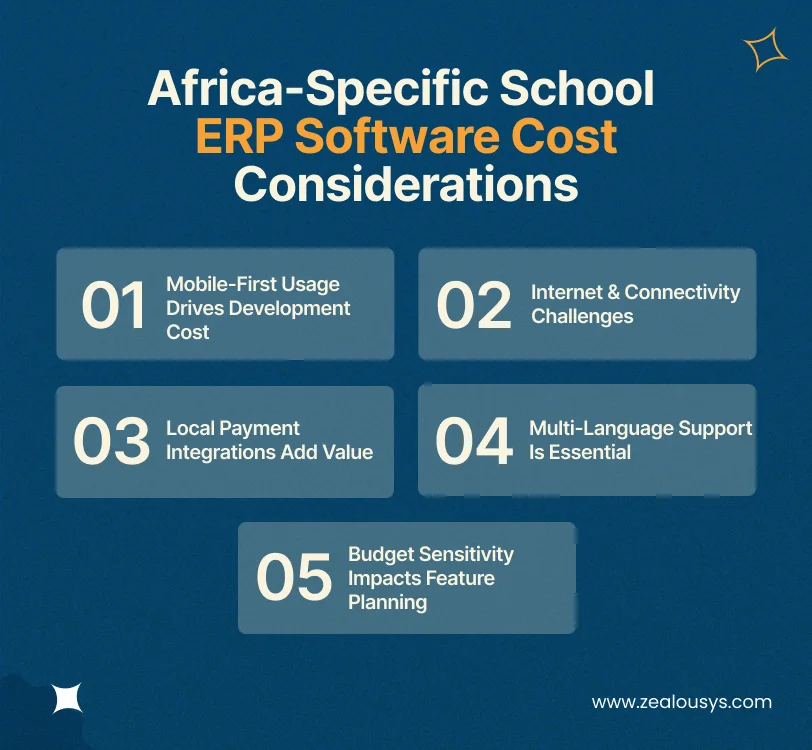
When you calculate the school ERP software cost in Africa, you cannot rely on global estimates alone. You must consider how schools actually operate across different African regions. These real-world factors directly impact the cost to build school ERP software in Africa and influence your final budget.
Most African schools and parents access systems through smartphones instead of desktops. You need to build a mobile-first ERP system or even a dedicated mobile app.
This approach increases the ERP system for schools with a mobile app cost, but it improves usability and adoption. If you target school owners or EdTech startups, you must prioritize responsive design or native apps from the start.
Many regions still face unstable or slow internet connections. You need to design your system to work smoothly in low-bandwidth environments.
Developers must add:
These requirements increase development complexity and affect the ERP software for schools Africa price, but they ensure consistent performance for all users.
Schools across Africa rely on local payment systems like M-Pesa and Flutterwave. You must integrate these platforms into your ERP for fee management.
This integration increases the cost to build school ERP software in Africa, but it simplifies fee collection for schools and improves cash flow. NGOs and government projects especially prefer systems with localized payment options.
Africa includes multiple countries, languages, and education systems. You need to build an ERP that supports different languages such as English, French, and regional dialects.
Multi-language capability increases development effort and testing time. However, it makes your solution scalable and more attractive to a wider audience looking for affordable school ERP software in Africa.
Many schools operate with limited budgets. You must plan features carefully and often start with an MVP (Minimum Viable Product).
This approach helps:
If you align features with real needs, you can control the school ERP software cost in Africa while still delivering value.
When you explore the school ERP software cost in Africa, one big question comes up:
Should you buy a ready-made solution or build your own?
Let’s break it down in a simple way so you can decide what fits your school or organization best.
Many schools in Africa start with SaaS solutions because they offer a quick and affordable entry point.
Why schools choose SaaS ERP:
However, SaaS tools come with limitations.
Where SaaS ERP falls short:
If you search for affordable school ERP software Africa, you will mostly find SaaS tools. They work well for small schools or early-stage adoption.
If you want full control and long-term scalability, a custom ERP becomes a strong option.
Why organizations choose custom ERP:
Yes, you will see a higher upfront investment.
What impacts the custom ERP cost:
That’s why queries like cost to build school ERP software in Africa or ERP system for schools with mobile app cost are becoming more popular. Schools now think beyond short-term savings and focus on long-term value.
If you are a school owner, EdTech startup, NGO, or IT consultant, you don’t need to overspend to build a powerful ERP. You can control your budget and still get a high-quality system by making smart decisions early.
Let’s look at how you can reduce your school ERP software cost in Africa without compromising on quality
You should always begin with an MVP instead of building everything at once.
An MVP helps you launch faster and test your idea in real conditions.
You can include only essential modules like:
You avoid unnecessary spending in the early stage.
You also get real feedback from users before you invest more.
This approach works best for:
You should focus only on features that solve real problems.
You should avoid adding complex modules in the beginning.
Ask yourself:
You can start with:
You can add advanced features later when your system grows.
This strategy helps you:
You should build your ERP with scalability in mind from day one.
A scalable system allows you to expand without rebuilding everything.
You can:
This is especially important for:
A scalable approach reduces long-term costs.
It also helps you manage your ERP system for schools with a mobile app at a cost-efficient price.
When you evaluate the school ERP software cost in Africa, you should not look at it as an expense. You should treat it as a long-term investment that improves efficiency, increases revenue visibility, and strengthens communication across your institution.
For school owners, administrators, EdTech startups, NGOs, and IT consultants, a well-built ERP system delivers measurable returns from day one.
A school ERP system automates daily operations and removes repetitive manual tasks.
You can:
Your staff spends less time on paperwork and more time on productive work. This directly reduces operational costs and improves efficiency.
When you calculate the cost to build school ERP software in Africa, you will notice that automation quickly offsets the initial investment.
Many African schools face challenges with fee tracking and delayed payments. A school ERP solves this problem with structured and transparent systems.
You can:
This improves cash flow and reduces revenue leakage.
If you explore the ERP software for schools Africa price, you will see that better fee collection alone can justify the investment within a short time.
A school ERP creates a central communication system for administrators, teachers, parents, and students.
You can:
This becomes even more powerful when you build an ERP system for schools with a mobile app, as most users in Africa rely on mobile devices.
Better communication leads to higher parent satisfaction and stronger trust in your institution.
When you look at how much it costs to build a school ERP in Africa, you should also consider the long-term gains:
Even if you choose an affordable school ERP software in Africa or invest in a custom solution, the return on investment remains strong.
Many school administrators and EdTech startups consider mobile apps essential for modern school management.
Zealous understands the real challenges behind building a school ERP system in Africa. Many organizations search for school ERP software cost in Africa or try to estimate the cost to build school ERP software in Africa, but they often get generic answers that do not match their needs. We take a practical approach by analyzing your requirements, suggesting the right features, and giving you a clear cost structure. This helps school owners, EdTech startups, and organizations make confident decisions without overspending.
We design ERP solutions specifically for African schools by focusing on mobile-first usage, local payment integrations, and scalability. If you are comparing ERP software for schools Africa price or looking for affordable school ERP software in Africa, we help you start with the right modules and expand as you grow. Our team ensures your system works smoothly even in challenging environments, which makes it reliable for daily operations.
We also support long-term growth by building custom solutions that match your goals. Whether you want to understand how much it costs to build school ERP in Africa or need an ERP system for schools with a mobile app cost, we guide you at every step. From planning to development and scaling, we act as your technology partner and help you turn your ERP investment into real operational value.
The school ERP software cost in Africa usually depends on features, scale, and customization. A basic system with core features like student records and attendance can cost between $5,000 to $10,000. A mid-level solution with fee management, reporting, and parent portals can cost $10,000 to $25,000. An advanced ERP system with mobile apps, integrations, and analytics can go beyond $25,000.
If you plan to build a custom solution, the cost to build school ERP software in Africa increases based on your exact requirements. Many school owners and administrators choose scalable systems so they can start small and expand later.
Yes, small schools can afford ERP systems if they plan wisely. Many vendors now offer affordable school ERP software in Africa with flexible pricing. Schools can start with basic modules and upgrade as their needs grow.
You can also reduce costs by:
This approach works well for small private schools and NGOs that want to digitize operations without a large upfront investment.
The development time depends on the complexity of the system. A basic ERP system usually takes 2 to 3 months. A mid-level system takes around 3 to 6 months. An advanced solution with mobile apps and integrations can take 6 months or more.
If you include features like a mobile app, the ERP system for schools with mobile app costs and timeline both increase. Many EdTech startups and IT consultants prefer phased development so they can launch faster and improve the system over time.
SaaS ERP works well for schools that want a quick and low-cost solution. It requires less upfront investment and offers faster deployment. However, SaaS systems often limit customization and scalability.
Custom ERP works better for schools, governments, and NGO projects that need tailored features. A custom system allows full control, better scalability, and integration with local tools like payment gateways.
If you compare both options, SaaS reduces the initial ERP software for schools Africa price, while custom ERP delivers long-term value. Many growing institutions choose custom development when they need flexibility and expansion.
Several factors affect the cost to build school ERP software in Africa:
If you clearly define your requirements, you can control the budget and build a solution that fits your needs.
When you add a mobile app, the total ERP system for schools with mobile app cost increases. A basic mobile-enabled ERP can start from $15,000 and go higher depending on features.
Mobile apps add value because they:
Our team is always eager to know what you are looking for. Drop them a Hi!

Pranjal Mehta is the Managing Director of Zealous System, a leading software solutions provider. Having 10+ years of experience and clientele across the globe, he is always curious to stay ahead in the market by inculcating latest technologies and trends in Zealous.


Comments