You sit at the helm of enterprise technology decisions. Legacy applications still power core operations for many organizations in 2026. They handle routine tasks reliably enough on most days. Still, those same systems impose limits that surface in budgets, team productivity, and the ability to respond quickly to market shifts.
The application modernization statistics 2026 put those constraints in sharp relief. A growing number of companies now examine their monolithic applications and weigh options like microservices architecture or hybrid cloud adoption. They address technical debt at its root and open up room for systems to scale without friction.
You notice the effects in everyday operations. Maintenance work eats into time that could go toward innovation. Competitors move faster with updates because their technology stacks allow it. Enterprise leaders face a widening gap that demands attention.
The data ahead reflects current market conditions, adoption patterns, and outcomes from real projects. It helps you assess your current environment and map out a practical modernization roadmap. What comes next gives you clear insights into where the industry stands and the next steps worth considering.
Across enterprises, modernization efforts are picking up pace in 2026. The figures below come from recent reports by Verified Market Research, Precedence Research, Fortune Business Insights, MarketsandMarkets, and Mordor Intelligence. They break down market scale, services spending, adoption levels, costs, risks, and technology drivers into clear categories.
Application Modernization Market & Growth Stats
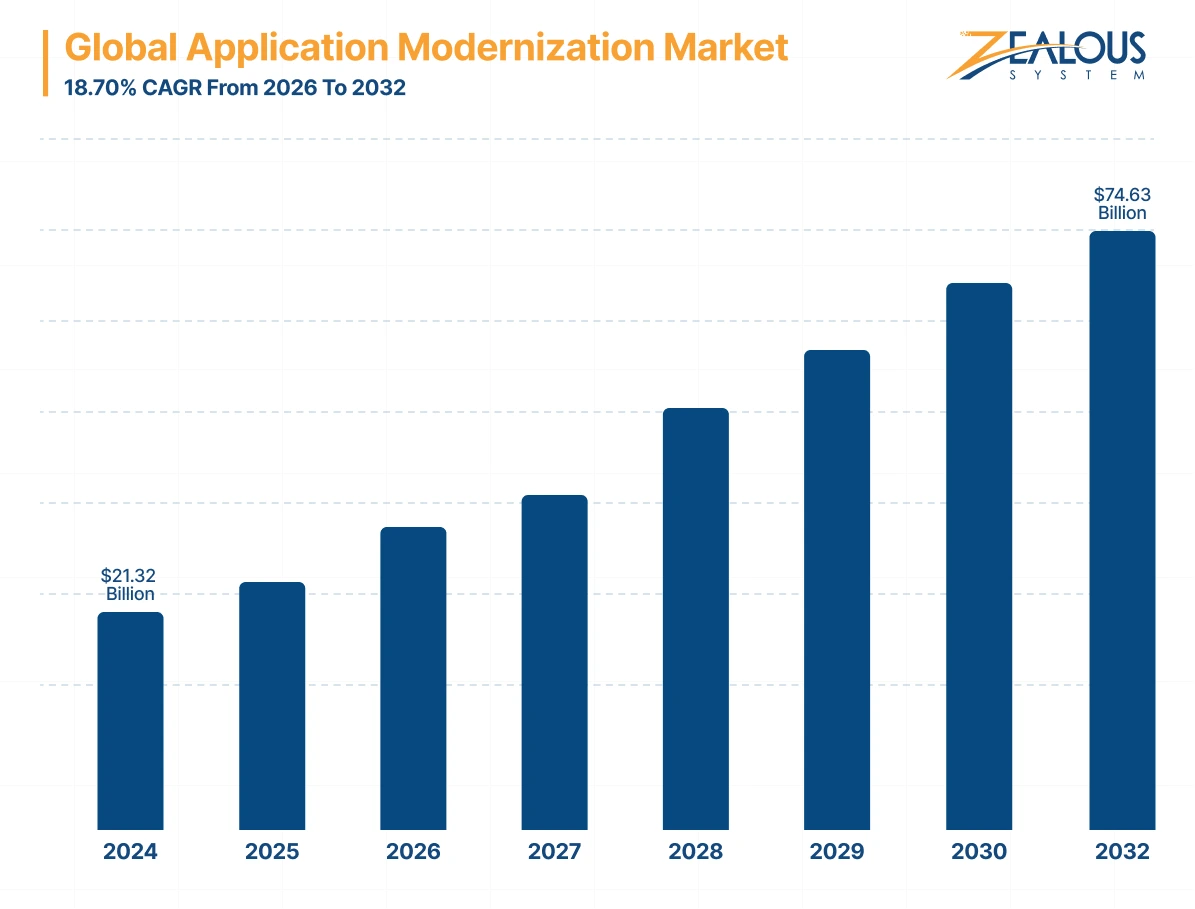
In 2024, the global application modernization market stood at USD 21.32 billion.
Strong momentum continues, with the CAGR from 2026 to 2032 set at 18.70 percent.
Projections take the market to USD 74.63 billion by 2032.
Cloud application migration holds 35 to 38 percent of the total share in 2026.
Large enterprises account for 68 to 72 percent of activity, with banking, financial services, and insurance leading demand.
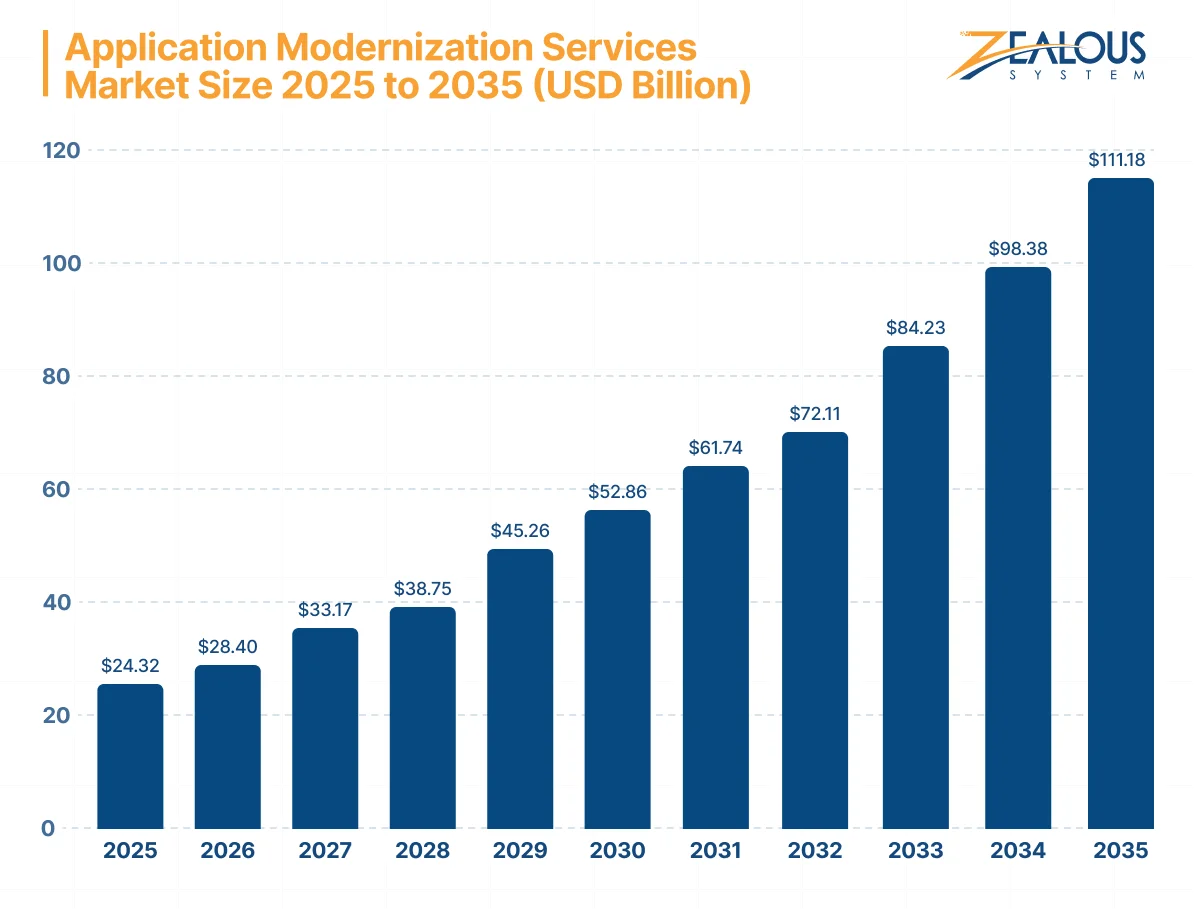
The application modernization services market is expected to reach USD 28.40 billion in 2026, which was earlier accounted for USD 24.32 billion in 2025.
It is projected to expand to USD 111.18 billion by 2035.
This growth occurs at a CAGR of 16.41%.
North America leads current spending while Asia-Pacific records the fastest regional expansion.
Re-platforming and cloud migration form the largest service segments.
Application Modernization Adoption Stats
Hybrid cloud deployment now operates in 73% of organizations.
More than 70% of organizations have moved to hybrid cloud setups this year.
Large enterprises drive the majority of initiatives.
Most new digital workloads now follow cloud-native designs.
More teams now rely on AI tools for code assessment and refactoring.
Application Modernization Cost & Risk Stats
Legacy systems absorb up to 80% of annual IT operating budgets, leaving scant resources for innovation.
Enterprises that modernize core platforms report 30–50 percent lower run costs alongside double-digit performance improvements.
These gains free capital for data analytics and AI pilots.
Technical debt from outdated applications increases operational pressure each year.
Security gaps and compliance requirements add further risk that grows harder to manage over time.
When leaders review annual spending, the case for modernization becomes difficult to ignore.
Application Modernization AI & Cloud Stats
AI-assisted tools now handle code analysis, refactoring, and testing in many modernization efforts.
Hybrid and multi-cloud setups help balance scalability with security and regulatory needs.
A joint survey by Coursera and AWS shows that 95% of leaders are investing in cloud transformation and 91% in generative AI.
Cloud migration and re-platforming segments show the highest growth rates.
Together, these trends show that AI and cloud now sit at the center of most enterprise projects.
What These Application Modernization Stats Actually Mean
The numbers point to what is really happening behind the scenes. They point to real shifts in budgets, team capacity, and competitive positioning that you deal with daily. The patterns below connect those figures to decisions you face in your own environment.
What the Market & Growth Stats Mean for Your Enterprise
Enterprises in banking, insurance, and manufacturing now commit serious capital to replace aging platforms.
As a result, teams struggle to respond to market changes at the same speed.
Industry surveys show 92% of enterprises are actively planning or running at least one modernization initiative right now.
What the Services Market Size Tells You About Timing
Leaders have moved past the pilot stage and are scaling full programs with external expertise.
At this pace, delaying action becomes harder to justify.
At the same time, nearly 79% of modernization projects still miss their original targets, which highlights the importance of choosing the right execution approach.
What the Adoption Stats Reveal About Competitive Pressure
Hybrid and cloud-native setups have become the working standard in most portfolios.
Your teams see the difference every quarter when competitors ship updates faster and scale without downtime.
Organizations that remain on monolithic systems tend to fall behind in release speed.
What the Cost & Risk Stats Signal for Your Budget
Legacy systems continue to dominate IT spend and quietly limit what your teams can deliver.
This leaves almost no room for new initiatives or innovation work.
Technical debt and compliance exposure build steadily, turning small delays into larger operational constraints.
What the AI & Cloud Stats Indicate for Your Modernization Roadmap
AI tools and hybrid cloud strategies now address the exact issues that cause most projects to stall.
Leaders who integrate them report clearer visibility into dependencies and fewer surprises during execution.
These capabilities are now part of how teams turn plans into measurable results.
Taken together, these insights offer a clear view of the current landscape. They help you weigh your options before the cost of inaction grows heavier.
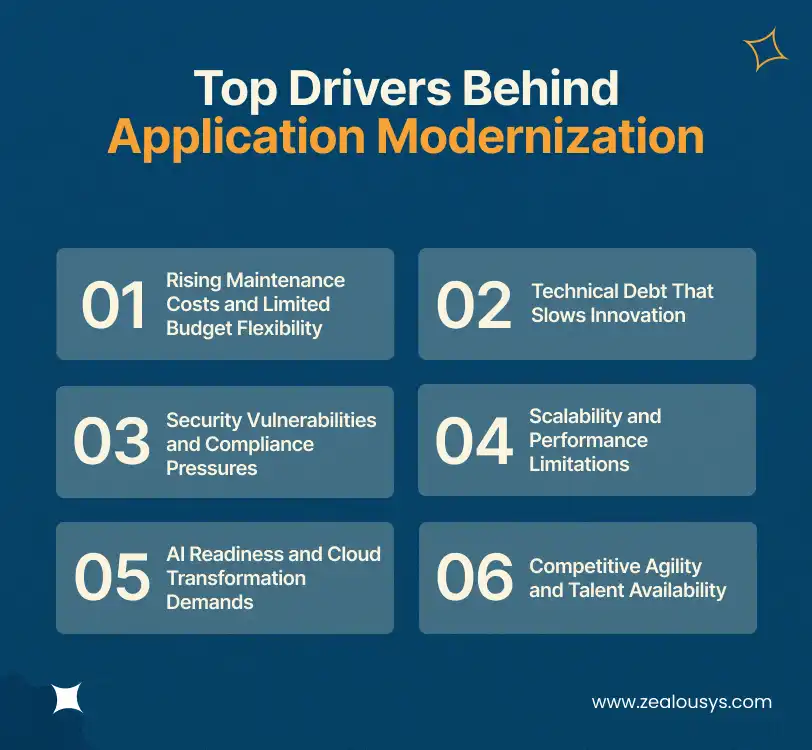
Top Drivers Behind Application Modernization
The application modernization statistics 2026 point to several clear forces that now shape decisions at the executive level. Each of these drivers shows up in day-to-day work with legacy systems, from budget strain to competitive pressure. The patterns below show why most enterprises treat modernization as a core priority rather than an optional project.
Rising Maintenance Costs and Limited Budget Flexibility
Legacy systems still pull the majority of IT operating budgets toward upkeep instead of new work.
This leaves little room for innovation or growth initiatives that matter to the business.
Organizations see direct pressure to free up capital, especially when maintenance overruns become predictable line items each year.
Technical Debt That Slows Innovation
Technical debt now accounts for a significant share of engineering time and new development budgets.
It creates hidden complexity that makes even small changes take longer and cost more.
Teams report spending up to 42% of their week on maintenance tasks instead of building features that drive revenue.
Security Vulnerabilities and Compliance Pressures
Outdated platforms expose organizations to higher breach risks through unsupported software and weak controls.
77% of enterprises list security as a top concern when reviewing legacy applications.
Modernization becomes the practical way to adopt zero-trust models, automated monitoring, and current compliance standards without constant workarounds.
Scalability and Performance Limitations
Monolithic applications struggle to handle current demand levels or sudden traffic spikes.
This creates reliability issues that affect both internal operations and customer-facing services.
Red Hat survey data shows that most organizations rank scalability and reliability as primary reasons to modernize, with measurable gains reported in over half of completed projects.
Over half of organizations that modernized report measurable gains in scalability (53%), reliability (52%), and security (58%), with 98% seeing benefits in at least one critical area.
AI Readiness and Cloud Transformation Demands
Legacy codebases block effective use of generative AI and cloud-native tools.
91% of technology leaders now prioritize generative AI as part of their transformation efforts.
Hybrid cloud setups, already in place at 73%of organizations, give teams the flexibility to integrate AI without full system overhauls.
Competitive Agility and Talent Availability
Faster feature delivery and quicker market responses have become table stakes.
At the same time, the pool of engineers skilled in older languages and platforms continues to shrink.
These pressures push leaders to modernize, so their teams can focus on high-value work rather than keeping outdated systems alive.
60% of technology leaders also rank “keeping pace with technological change” as a top urgency driver, which is why many organizations now combine legacy modernization with AI pilots in the same initiatives.
This is why application modernization now sits at the center of most enterprise roadmaps. They give you concrete ways to evaluate your own portfolio and decide where action delivers the clearest returns.
Biggest Challenges in Application Modernization
The application modernization statistics 2026 show clear momentum, yet consistent barriers slow or derail many initiatives. These hurdles often push projects over budget, delay timelines, or reduce expected outcomes. The details below draw from industry research and focus on the practical issues teams face when modernizing legacy systems.
Complexity of Legacy Systems
Legacy codebases carry decades of undocumented logic, hidden dependencies, and custom fixes. This makes accurate assessment and planning take far longer than most teams anticipate.
Survey respondents name this the top organizational challenge at 48% overall, rising to 58% for organizations still in early stages.
Security Concerns
Outdated platforms lack current controls and expose systems to known vulnerabilities. Teams must close these gaps without interrupting live business operations.
Security ranks as the leading individual barrier at 56 percent.
Integration Challenges
Linking legacy applications to modern cloud-native components requires extensive mapping of data flows and interfaces.
Mismatched architectures and formats create repeated rework during execution.
Integration appears as a major individual obstacle for 47% of respondents.
Competing Priorities and Resource Constraints
Day-to-day operations and other IT demands continuously pull focus and funding away from modernization efforts. This results in fragmented teams or projects that lose momentum.
Competing priorities show up in 42% of organizational responses and 44 percent of individual ones.
Uncertainty in Choosing the Right Approach
Multiple strategies exist, like rehosting, replatforming, refactoring, or full replacement, with no single path fitting every workload.
Without clear evaluation criteria, teams risk selecting approaches that create new problems later. This challenge affects 41% of organizations overall.
Skill Gaps and Change Management
Internal teams often lack recent experience with containers, microservices, or cloud-native practices.
Resistance to new processes and the need for upskilling add further friction.
Many organizations report that additional training becomes essential to keep initiatives on track.
These challenges are a major reason many modernization efforts stall or fall short. A clear understanding of them lets you build targeted mitigation steps into your own plan from the start.
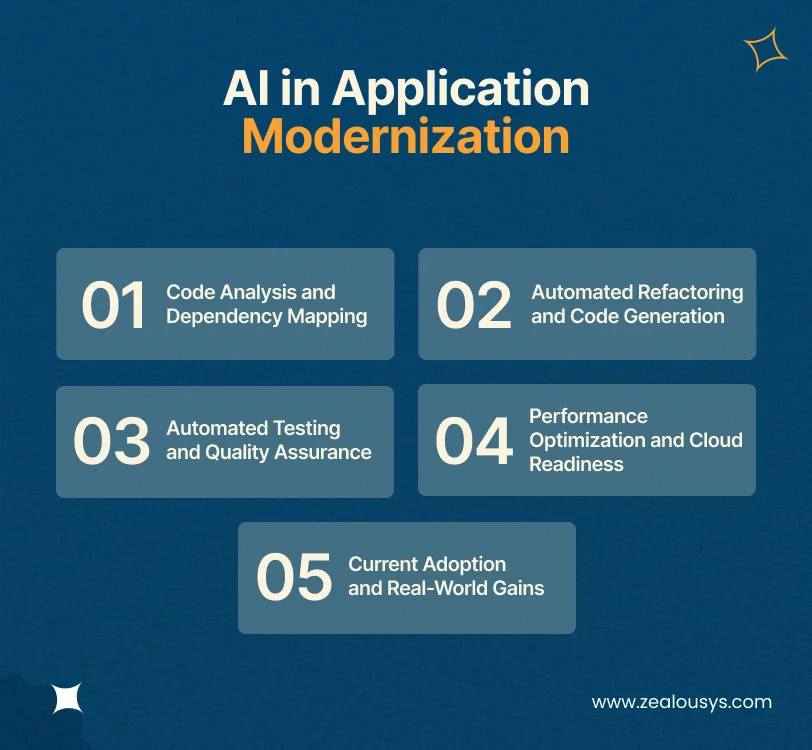
AI in Application Modernization
The data points to one clear shift. AI has moved from an experimental add-on to a core part of how enterprises tackle legacy systems. It addresses the exact pain points that cause most projects to stall. The sections below show where AI delivers the most impact today and how it fits into your own portfolio.
Code Analysis and Dependency Mapping
AI tools scan massive legacy codebases in hours instead of weeks. They surface hidden dependencies, business rules, and undocumented logic that teams miss during manual reviews. This visibility removes the biggest source of surprises once migration work begins.
Automated Refactoring and Code Generation
Generative AI now handles repetitive refactoring tasks such as language upgrades, framework migrations, and API extraction. It suggests clean, maintainable code while preserving original business logic. Early adopters report 30 to 60 percent faster coding cycles on modernization sprints.
Automated Testing and Quality Assurance
AI can take a lot of the heavy lifting out of testing. It can automatically create test cases, check edge scenarios, and run regression tests without constant manual effort. This means it often spots issues that people might miss, especially in large and complex applications. The best part is that teams can keep their quality standards high without slowing down their project timelines.
Performance Optimization and Cloud Readiness
AI analyzes runtime data to recommend containerization strategies, scaling patterns, and cloud-native patterns. It identifies performance bottlenecks and security gaps before they reach production. Hybrid cloud setups benefit most because AI helps balance regulatory needs with speed and cost.
Current Adoption and Real-World Gains
91% of technology leaders now prioritize generative AI in their cloud and modernization efforts. 78% of organizations already use or plan to use AI specifically to support modernization efforts, with 53% actively applying it today.
Organizations already using AI in these programs see measurable reductions in manual effort and technical debt. Agentic AI tools take this further by orchestrating entire assessment-to-migration workflows with minimal human intervention.
This is why AI now sits at the center of successful modernization programs in 2026. They turn complex legacy challenges into structured, repeatable steps that deliver faster results and lower risk.
ROI of Application Modernization
The data reflects more than just market expansion. They show measurable financial and operational returns when projects follow a structured approach. The outcomes below draw from recent enterprise studies and give you clear benchmarks for your own business case.
Maintenance Cost Reduction
Modernization cuts legacy maintenance costs by 30 to 50 percent once systems are updated.
Enterprises in banking, financial services, and insurance report 25 to 40 percent lower annual maintenance spend after completion.
Infrastructure and Operational Efficiency
Strategic programs deliver 20 to 40 percent infrastructure cost optimization.
This shift redirects budget from keeping outdated platforms alive to new initiatives that drive growth.
Speed and Productivity Gains
Teams achieve 30 to 50 percent faster release cycles following modernization.
Feature delivery speed rises by up to 40% when AI-assisted refactoring is in place.
Reliability and Risk Reduction
Modernized applications show 40% fewer failures and recover 5 times faster according to DORA metrics.
These gains reduce downtime expenses and limit exposure to compliance or security incidents.
AI-Driven Acceleration
AI tools shorten overall transformation timelines by up to 40%.
Organizations see quicker payback and stronger long-term returns when AI supports code analysis and automation.
For most enterprises, well-executed modernization programs deliver measurable ROI within 12 to 18 months. They help you quantify the value before committing resources.
When Should You Modernize Your Applications?
The data also points to clear signals on timing. Modernization delivers the best returns when specific operational and financial pressures appear in your portfolio. The indicators below come from recent enterprise research and help you decide whether to act now or continue monitoring.
Maintenance Costs Consuming 70% or More of IT Budgets
Legacy systems that absorb 70% or more of total IT spending leave almost no room for innovation or growth projects.
When upkeep costs rise faster than business revenue, the system has crossed the threshold where modernization becomes the lower-risk option.
Frequent Downtime, Slow Performance, or Scalability Limits
Applications that experience repeated outages, long load times, or fail under peak demand directly affect revenue and customer experience.
These issues signal that the current architecture cannot support current or future workloads without constant fixes.
Security Vulnerabilities and Compliance Gaps That Cannot Be Easily Patched
Outdated platforms expose organizations to known exploits and make regulatory compliance increasingly difficult.
When security audits repeatedly flag unfixable risks or when vendor support ends, modernization is no longer optional.
Integration Difficulties with New Tools, Cloud Services, or AI Capabilities
Legacy codebases that resist connection to modern APIs, cloud platforms, or generative AI tools create repeated rework and missed opportunities.
This barrier appears when your teams spend more time on workarounds than on delivering business value.
Talent Shortages or Critical Knowledge Held by Only a Few Engineers
When only a few people really understand the legacy system, things can get risky. Hiring new talent with those niche skills is often expensive or sometimes just not feasible, which makes day to day operations feel a bit uncertain.
That is usually when organizations start thinking seriously about modernization. It is not just about upgrading technology, but about preserving critical knowledge before it fades away with time.
Feature Delivery Cycles 3 Times Slower Than Competitors
Teams that take significantly longer to release updates or add capabilities lose ground to faster rivals.
When release velocity drops and technical debt visibly slows progress, the system has reached the point where modernization restores competitive speed.
These triggers mark the point where the cost of inaction outweighs the investment required. Reviewing your portfolio against them now lets you prioritize workloads and build a focused modernization roadmap before pressures become critical.
Why Choose Zealous for Application Modernization?
The application modernization statistics 2026 show that success depends on partners who combine deep technical expertise with minimal business disruption. Zealous System delivers this through a structured assessment-to-execution process aligned with your objectives and existing infrastructure.
Organizations select Zealous System because of:
Customized modernization strategies based on detailed legacy system assessments.
Strong capabilities in cloud migration (AWS, Azure, Google Cloud), microservices architecture, API development, and data transformation.
Phased implementation that maintains continuous operations and reduces risk.
Full-cycle support, including testing, quality assurance, UI/UX updates, and ongoing maintenance.
Proven results across regulated sectors such as healthcare, finance, e-learning, and defense.
This focused approach turns the current modernization pressures into measurable operational gains without unnecessary complexity.
Final Thoughts
The data lay out the current reality in plain terms. Legacy systems keep draining budgets and slowing progress for many enterprises. At the same time, targeted upgrades deliver measurable improvements in cost control, speed, and flexibility.
The right Application Modernization Services help you move past these constraints without unnecessary disruption. Review your own portfolio against the drivers, challenges, and timing signals covered here. That assessment gives you the foundation for a practical modernization roadmap that fits your specific environment and priorities.
FAQs
1. What do the application modernization statistics 2026 actually mean for most enterprises?
They show the market growing steadily while legacy systems still consume 70–80 percent of IT budgets in many organizations. This creates a widening gap between companies that modernize and those that do not, especially in speed to market and operational costs.
2. How do I know it’s the right time to modernize legacy applications?
Start when maintenance eats 70 percent or more of your IT budget, downtime affects revenue, or security audits flag unfixable risks. Other clear signals include integration problems with new tools, talent shortages for old platforms, or release cycles that lag behind competitors.
3. What kind of ROI can enterprises expect from application modernization?
Most organizations see 30–50 percent lower maintenance costs and 20–40 percent infrastructure savings within 12 to 18 months. Faster release cycles and fewer outages add further value, with many projects paying back the investment within the first two years.
4. How does AI change application modernization projects in 2026?
AI tools now scan codebases, map dependencies, and automate refactoring and testing. This cuts manual effort significantly and helps teams complete assessments in days instead of weeks, making larger modernization programs more practical.
5. What are the most common reasons modernization projects fall short?
The top issues are underestimating legacy complexity, security gaps during transition, and integration problems with existing systems. Competing priorities and skill shortages also cause many initiatives to lose momentum or miss targets.
6. How should CTOs select Application Modernization Services?
Look for partners who offer detailed legacy assessments, phased delivery that keeps systems running, and proven experience with your industry and cloud platforms. Prioritize those who combine technical depth with clear business outcomes rather than one-size-fits-all approaches.
We are here
Our team is always eager to know what you are looking for. Drop them a Hi!
Pranjal Mehta is the Managing Director of Zealous System, a leading software solutions provider. Having 10+ years of experience and clientele across the globe, he is always curious to stay ahead in the market by inculcating latest technologies and trends in Zealous.





Comments