Hospitals still rely on manual processes in many critical areas, and that slows everything down. Teams manage appointments, billing, and patient records with outdated workflows, which creates delays and confusion. Staff handle repetitive tasks every day, and that leads to burnout and inefficiencies across departments. At the same time, patients expect faster service and better experiences, but manual systems make that difficult to deliver.
Many hospital leaders, including COOs, CIOs, and healthcare IT heads, try to control rising operational costs, but manual workflows continue to increase overhead. Healthcare IT managers and administrators struggle with disconnected systems, data silos, and limited automation tools. Even HealthTech founders and product managers face challenges when they try to scale platforms or integrate new solutions into existing hospital environments.
In fact, many hospitals lose around 20–30% efficiency because they depend on manual processes instead of healthcare process automation. When hospitals delay hospital digital transformation, they miss clear healthcare automation opportunities that could improve patient workflow automation, reduce costs, and enhance overall care delivery.
Most hospitals still rely on manual processes in critical areas, and that’s where inefficiencies quietly start to build. While teams stay busy managing day-to-day operations, these small inefficiencies turn into bigger challenges that directly impact cost, speed, and patient experience.
Let’s break this down in a practical way.
When staff handle appointments, registrations, and records manually, delays become unavoidable. Patients wait longer, front-desk teams feel overwhelmed, and the overall workflow slows down.
Many hospital administrators and COOs see this daily, especially during peak hours. Without proper hospital workflow automation, even simple processes take more time than they should.
Manual data entry increases the chances of errors in patient records, billing, and insurance claims. A small mistake in documentation can lead to claim rejections, compliance issues, or even patient safety risks.
Healthcare IT Heads and CIOs often struggle with this because fragmented systems don’t communicate well. This is where healthcare process automation becomes critical to reduce risk and improve accuracy.
When systems don’t connect properly, data stays locked in silos. Doctors, admin teams, and management don’t get a unified view of patient information or operations.
This lack of visibility makes decision-making slower and less effective. For hospitals aiming for hospital digital transformation, disconnected data becomes a major roadblock.
Manual workflows demand more staff time, increase rework, and slow down revenue cycles. Over time, this leads to higher operational costs without delivering better outcomes.
Hospital owners and directors often focus on expansion and patient care, but hidden inefficiencies quietly impact profitability. Many hospitals miss the opportunity to reduce operational costs with automation simply because these issues don’t look urgent at first.
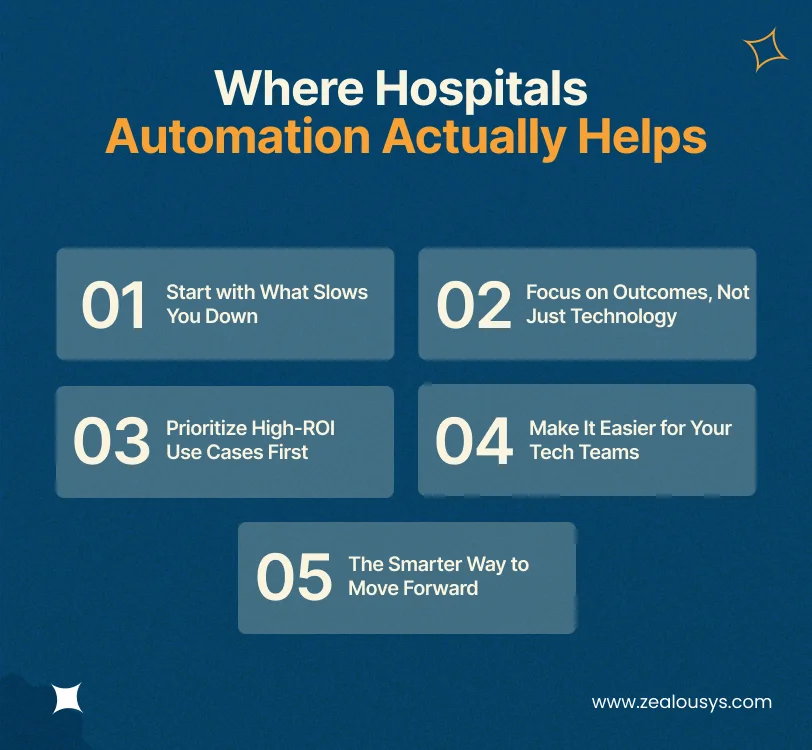
Many hospitals start their hospital digital transformation journey with one common mistake. They try to automate everything at once. This approach often increases complexity, delays results, and adds unnecessary costs.
The truth is simple. Not every process needs automation.
Hospitals should focus on high-impact healthcare automation opportunities where automation can solve real problems. When teams take this approach, they see faster results and better ROI.
If you look closely at daily operations, you will quickly spot areas that need improvement. Manual workflows, repetitive administrative tasks, and disconnected systems often create bottlenecks.
These are the exact areas where hospital workflow automation delivers the most value.
When hospitals automate these processes, they:
Many decision-makers get attracted to tools instead of outcomes. But successful automation in hospitals always starts with a clear goal.
Ask simple questions:
When you answer these questions, the right healthcare process automation opportunities become obvious.
Hospitals that succeed with automation do one thing differently. They start small and focus on areas that deliver measurable results.
For example:
These are proven healthcare automation use cases that directly improve efficiency and reduce costs.
This approach also helps hospitals understand the real hospital automation ROI before scaling further.
For Healthcare IT Heads and technical teams, a focused strategy reduces pressure. Instead of dealing with large, complex transformations, they can solve specific problems step by step.
This helps them:
It also minimizes common challenges in healthcare automation, especially integration issues.
If you want to automate hospital operations successfully, do not aim for perfection from day one.
Start with the areas that create the biggest impact. Solve real problems. Then scale gradually.
This is how hospitals unlock the true benefits of automation in hospitals without overwhelming teams or budgets.
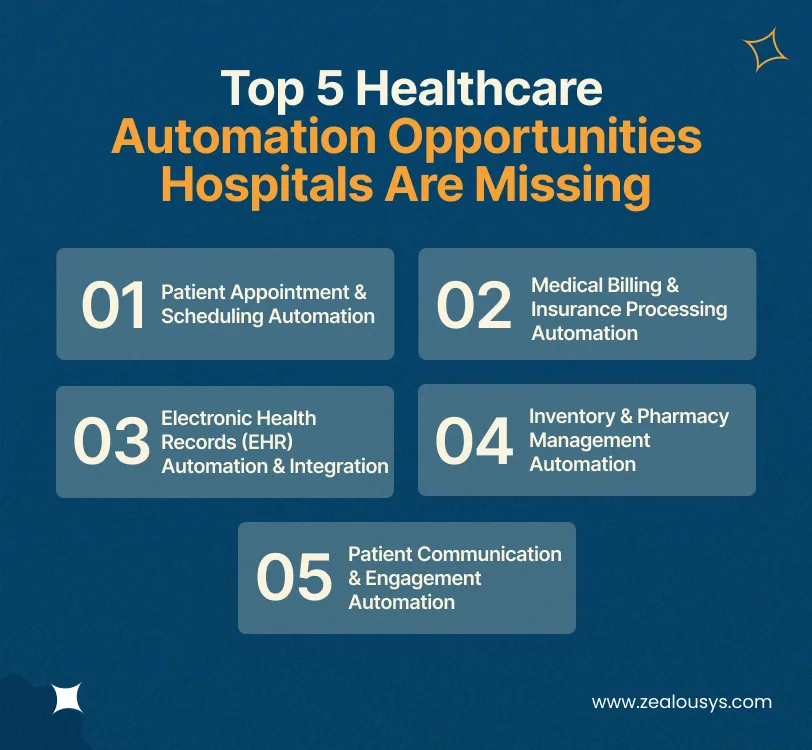
Hospitals are under constant pressure to improve efficiency while maintaining quality care. Many hospital owners, CIOs, and healthcare IT heads already know that hospital digital transformation is no longer optional. Still, many hospitals miss high-impact healthcare automation opportunities that can quickly reduce costs and improve patient experience.
Let’s break down five areas where automation in hospitals delivers real results without overcomplicating your systems.
Many hospitals still rely on manual booking systems, which creates delays, double bookings, and frustrated patients. You can solve this by implementing hospital workflow automation for appointment scheduling.
With online booking and AI-based slot management, you allow patients to book appointments anytime without staff intervention. The system automatically adjusts schedules, manages cancellations, and fills gaps efficiently.
This approach reduces waiting time and lowers the administrative burden on your staff. It also improves patient satisfaction because patients experience faster and smoother service.
When you automate hospital operations at this level, you create a better first impression for every patient.
Billing remains one of the most complex and error-prone processes in healthcare. Manual billing often leads to claim rejections, delays, and revenue leakage.
You can use healthcare process automation to streamline billing workflows and insurance claims. Automated systems validate data, generate bills, and submit claims without manual intervention.
This reduces human errors and speeds up approvals. It also helps hospitals receive payments faster and maintain a steady cash flow.
One of the most practical healthcare automation use cases is improving your revenue cycle without increasing staff workload.
Many hospitals struggle with fragmented systems and data silos. Doctors and staff often waste time searching for patient information across multiple platforms.
You can fix this by implementing patient workflow automation in hospitals through EHR automation and integration. A centralized system ensures that patient data flows seamlessly between departments.
Doctors can access accurate and updated information instantly, which improves diagnosis and treatment decisions. It also reduces duplication and manual data entry.
Strong hospital digital transformation starts with connected data that supports faster and smarter decisions.
Inventory mismanagement leads to stockouts, overstocking, and unnecessary expenses. Many hospitals still track supplies manually or use disconnected systems.
You can introduce AI automation in the healthcare industry to monitor inventory in real time. Automated systems track medicine usage, send low-stock alerts, and optimize procurement.
This helps you avoid wastage and ensures that critical supplies are always available. It also gives better visibility into operational costs.
If your goal is to reduce hospital operational costs with automation, inventory management is one of the quickest wins.
Communication gaps often lead to missed appointments, poor follow-ups, and low patient engagement. This directly affects outcomes and satisfaction.
You can improve this with automated reminders, follow-ups, and notifications. These systems send appointment alerts, medication reminders, and post-treatment updates without manual effort.
This keeps patients engaged and improves adherence to treatment plans. It also reduces no-shows and strengthens patient relationships.
Among all examples of healthcare automation, this one directly impacts both patient experience and long-term retention.
When hospitals invest in the right healthcare automation opportunities, they don’t just improve systems—they see measurable results across operations, costs, and patient care.
Here’s what that impact looks like in real scenarios
Hospitals often rush into healthcare automation opportunities with the right intent but the wrong approach. This leads to wasted budgets, frustrated teams, and little to no improvement in outcomes. If you are planning a hospital digital transformation, avoiding these common mistakes can save both time and cost.
Many hospital leaders try to automate multiple processes at the same time. This approach creates confusion, increases risk, and slows down adoption. Instead of improving hospital workflow automation, it often overwhelms staff and systems.
A smarter approach focuses on high-impact areas first, such as patient monitoring, scheduling, or billing. When you start small, you can measure results, improve processes, and scale automation gradually. This method helps you truly see the benefits of automation in hospitals without disrupting daily operations.
Hospitals already use multiple systems like EHRs/EMRs, billing software, and inventory tools. When teams ignore integration, automation creates more silos instead of solving problems. This directly impacts healthcare process automation and reduces overall efficiency.
For example, if your patient workflow automation does not connect with your existing systems, staff still need to enter data manually. This defeats the purpose of automation. A well-planned strategy ensures seamless integration, improves data flow, and supports better decision-making across departments.
Many hospitals choose off-the-shelf tools because they seem faster and cheaper. However, these tools rarely match the complex needs of healthcare operations. Over time, they limit scalability and fail to deliver strong hospital automation ROI.
Custom solutions, on the other hand, align with your workflows, compliance needs, and long-term goals. They help you address real healthcare automation use cases instead of forcing your team to adjust to rigid systems. This approach becomes especially important for hospitals dealing with legacy systems and unique operational challenges.
Hospitals often jump into healthcare automation without a clear plan, and that leads to wasted investment and frustration. A smarter approach focuses on what truly creates impact.
You should begin with processes that consume the most time, cost, and manual effort. Areas like patient workflow automation in hospitals, billing, and appointment scheduling often deliver quick wins. When you automate these, you reduce hospital operational costs with automation and improve efficiency almost immediately. This approach also helps you prove the value of healthcare process automation to stakeholders without taking big risks.
Many hospitals already use multiple platforms, but those systems often work in isolation. You need to connect them instead of replacing everything. Strong hospital workflow automation depends on seamless integration between EHRs, billing systems, and communication tools. When you eliminate data silos, you improve data accuracy, speed up operations, and create a smoother patient experience. This step plays a key role in successful hospital digital transformation.
You should not build automation just for today’s needs. Hospitals grow, patient volumes increase, and new technologies evolve. You need scalable solutions that support future expansion and advanced capabilities like AI automation in the healthcare industry. A flexible approach ensures your automation strategy adapts as your hospital evolves, without requiring constant redevelopment.
When you take a strategic approach like this, automation in hospitals becomes more than just a tech upgrade. It becomes a long-term investment that improves efficiency, enhances patient care, and delivers measurable hospital automation ROI.
Many hospital leaders we speak with, from COOs to Healthcare IT Heads, already know that automation in hospitals is important. But they often struggle to identify where it actually creates a measurable impact.
We often see hospitals invest in multiple tools without a clear roadmap. This approach increases complexity instead of improving efficiency. Teams continue to deal with manual workflows, disconnected systems, and rising operational pressure.
At Zealous System, we take a different approach. We help hospitals focus on the right healthcare automation opportunities based on their current challenges, not trends.
For example, a hospital administrator may want to improve patient experience. Instead of overhauling everything, we identify specific areas like patient workflow automation in hospitals, communication systems or hospital management systems that deliver faster results. This approach reduces staff overload and improves patient satisfaction at the same time.
We also understand that many healthcare organizations deal with legacy systems and data silos. Our team ensures that any hospital workflow automation integrates smoothly with existing systems. This avoids disruption and helps teams adopt new processes easily.
For HealthTech founders and product managers, the challenge looks different. They want to scale platforms while managing costs. We help them design healthcare process automation solutions that support growth without increasing operational complexity.
The goal is simple. We help hospitals and healthcare businesses reduce operational costs with automation, improve efficiency, and deliver better patient outcomes.
Because in healthcare, the right automation strategy does not start with tools. It starts with understanding where automation creates real value.
If you’re exploring healthcare automation opportunities but feel unsure where to begin, you’re not alone. Many hospital owners, CIOs, and healthcare IT leaders we speak with face the same challenge. They want to improve efficiency, reduce operational costs, and fix manual workflows, but they struggle to identify where automation will actually deliver results.
We regularly help hospitals move from fragmented systems and staff overload to streamlined hospital workflow automation that improves both operations and patient experience. Instead of trying to automate everything at once, we guide teams to focus on high-impact areas that show quick and measurable ROI. This approach helps reduce complexity while supporting long-term hospital digital transformation.
If you are a healthcare decision-maker or part of a growing HealthTech team, this is the right time to evaluate how healthcare process automation can solve your current bottlenecks. Whether you are dealing with legacy systems, data silos, or integration challenges, the right strategy can simplify operations and unlock better outcomes.
Our team is always eager to know what you are looking for. Drop them a Hi!

Pranjal Mehta is the Managing Director of Zealous System, a leading software solutions provider. Having 10+ years of experience and clientele across the globe, he is always curious to stay ahead in the market by inculcating latest technologies and trends in Zealous.


Comments