Video now drives how people learn online. If you run an eLearning platform, you already see how learners prefer watching lessons over reading long text. That’s why video API integration for eLearning has become essential for modern apps.
Today, learners expect more than just recorded videos. They want live classes, interactive sessions, and flexible on-demand learning. As a result, many platforms now invest in eLearning app video integration to deliver smooth and engaging experiences. Whether you build a new platform or upgrade an existing one, using a video streaming API for education apps helps you launch faster and scale easily.
For EdTech startup founders, video helps you build a strong MVP and attract early users. For CTOs and tech leads, choosing the right video API for LMS ensures performance and scalability. Product managers rely on video features like live sessions, recordings, and engagement tools to improve retention. At the same time, corporate training providers use live streaming API for eLearning to train teams efficiently.
In this guide, you will learn everything you need to make the right decisions. We will break down the video API cost for online learning, explore must-have features, and share best practices for smooth implementation. By the end, you will clearly understand how to choose the right video SDK for education apps and build a scalable eLearning solution.
Video API integration lets you add live classes, recorded sessions, and real-time interaction directly into your platform without building everything from scratch. If you run an LMS or plan an online learning app, you can use a video API for LMS to stream, record, and manage video easily.
For EdTech startup founders, this means you can launch faster and focus on your core idea. For CTOs and tech leads, it reduces infrastructure complexity and improves scalability. Product managers can quickly roll out features like live classes, playback, and student engagement tools using a reliable video streaming API for education apps.
In simple terms, a video API acts like a ready-made engine that powers video inside your application. Instead of building your own streaming system, you connect your app to an API and start delivering video experiences. This makes video API integration for eLearning faster, more cost-effective, and easier to scale.
A video API works as a backend service that handles video streaming, recording, and delivery. You send requests, and the API manages the heavy lifting like encoding, bandwidth, and scaling.
A video SDK for education apps gives you pre-built tools and UI components to integrate video features into your frontend quickly. It helps developers build interactive experiences like live classrooms with chat, screen sharing, and controls.
Custom infrastructure means you build your own video system from scratch using servers, codecs, and streaming protocols. You control everything, but you also handle scaling, security, and maintenance.
Modern learning platforms rely heavily on video, and that’s where video API integration for eLearning plays a key role. If you are building or scaling an eLearning product, you need flexible and scalable video capabilities without managing complex infrastructure.
You can use a live streaming API for eLearning to deliver real-time classes with low latency. This allows instructors to teach, interact, and respond instantly. EdTech startup founders and product managers can create classroom-like experiences directly inside their apps without relying on third-party tools.
You can allow recorded sessions using a video SDK for education apps. This helps learners access content anytime, which improves course completion rates. LMS owners and corporate training providers can build structured learning journeys with easy access to past sessions.
You can improve interaction by combining video with chat, reactions, and collaborative features. With the right video API for LMS, learners stay engaged instead of passively watching content. This is especially useful for product teams that want to increase retention and user activity.
You don’t need to build complex streaming systems from scratch. With video streaming API for education apps, you can scale from a small group of users to thousands of concurrent learners. CTOs and tech leads can focus on product growth instead of infrastructure challenges while keeping the video API cost for online learning under control.
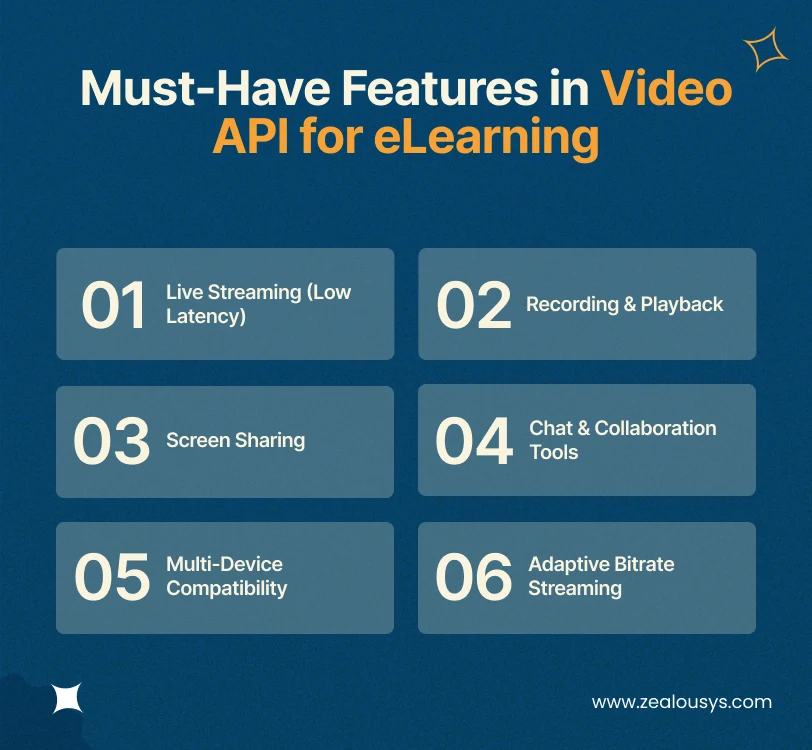
When you plan video API integration for eLearning, you should focus on features that improve learning experience, scalability, and performance. Whether you build an MVP or scale an existing platform, the right video SDK for education apps makes a huge difference.
Here are the key features you should include:
If you plan video API integration for eLearning apps, you can expect:
You can build a basic platform within a budget of $5,000 to $10,000. You include core features like live streaming, simple playback, and limited users. This option works best for EdTech startup founders who want to validate their idea quickly without high investment.
You can develop a more advanced solution by investing $15,000 to $30,000. You add features like recording, chat, screen sharing, and better scalability. This stage fits growing platforms where CTOs and product managers want to improve engagement and performance.
You can build a fully scalable system starting from $50,000 and above. You include advanced security, analytics, integrations, and support for large user bases. This option suits LMS owners and corporate training providers who need high reliability and enterprise-level performance.
The total cost of eLearning app video integration depends on a few key factors. Let’s break them down in a simple way.
When you choose a video streaming API for education apps, the provider usually charges based on usage.
If your platform runs frequent live classes or supports many users, your cost increases. That’s why CTOs and tech leads must choose the right video API for LMS based on expected usage.
Your development cost depends on how complex your app is.
If you want to integrate a video SDK for education apps, your team must handle backend logic, frontend experience, and testing. This is where many product managers decide to work with experienced development teams.
Every recorded lecture or session needs storage.
If your platform focuses on recorded courses, your storage and delivery costs grow over time. This factor matters a lot for online course platforms and LMS owners.
Your work does not stop after integration.
If your platform grows fast, you need better infrastructure and optimization. This directly impacts your long-term cost, especially for corporate training platforms and large-scale eLearning systems.
If you’re planning video API integration for eLearning, choosing the right provider can directly impact your app’s performance, cost, and user experience. Whether you’re building an MVP or scaling a full platform, you need a solution that fits your use case, budget, and technical needs.
Let’s compare three popular options used in eLearning app video integration
Pricing Model
Twilio uses a usage-based pricing model, where you pay per participant per minute. This works well if your usage varies or you’re starting small.
Best Use Cases
Pros
Limitations
Pricing Model
Agora also follows a pay-as-you-go model, mainly based on minutes of video usage and streaming quality.
Best Use Cases
Pros
Limitations
Pricing Model
Vonage offers flexible pricing based on video usage, including per-minute billing and package-based options.
Best Use Cases
Pros
Limitations
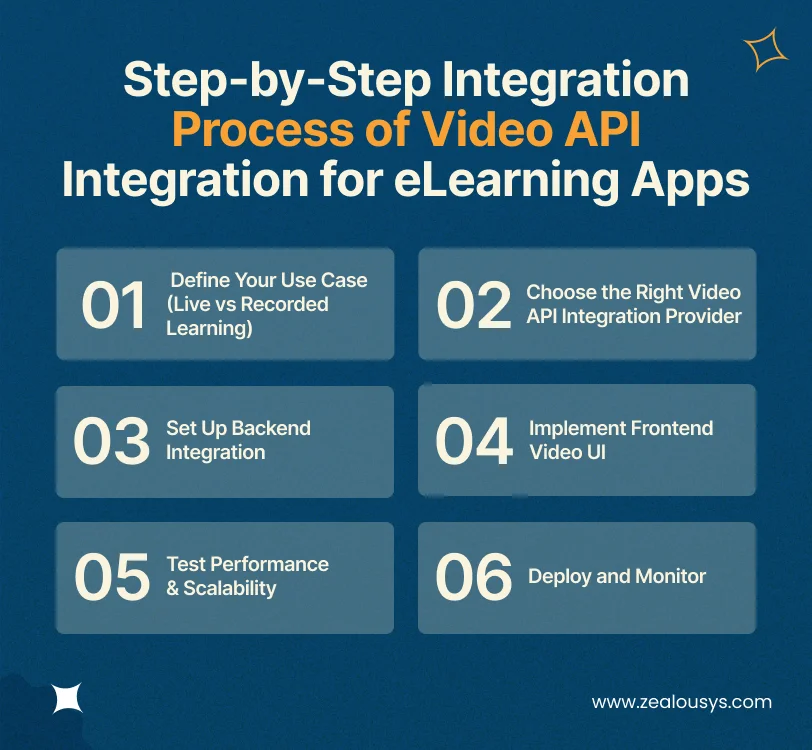
Integrating a video API for eLearning doesn’t need to feel complex. If you break it into clear steps, you can move faster and avoid costly mistakes. Whether you’re building an MVP or scaling an existing platform.
Start by deciding how your users will consume video. If you want real-time interaction, you should focus on live streaming APIs for eLearning. If your platform delivers courses on demand, you should prioritize recording and playback features.
EdTech startup founders often begin with a simple MVP that supports recorded lessons. As the platform grows, they add live classes, chat, and engagement tools. CTOs and product managers should align this decision with business goals, user experience, and scalability needs.
Now select the right video streaming API for education apps based on your requirements.
You should compare providers based on:
If you run an LMS or online course platform, you should pick a video API for LMS that scales with your users and content library. Making the right choice here helps you control long-term video API cost for online learning.
Next, connect your backend with the chosen API. You need to handle authentication, session management, and secure API requests.
Your development team should:
CTOs should ensure the backend stays scalable and secure, especially when user traffic grows.
After backend setup, build the user interface where learners interact with video. You can use a video SDK for education apps to speed up this process.
Your UI should include:
Product managers should focus on creating a smooth and engaging experience, especially for live classes.
Before launch, test how your platform performs under real conditions. You should simulate multiple users joining sessions at the same time.
Your team should check:
This step helps you avoid issues like buffering, lag, or crashes common problems in eLearning app video integration.
Once testing is complete, deploy your solution to production. After launch, you should continuously monitor performance and usage.
Track:
Corporate training providers and LMS owners should regularly optimize usage to reduce costs and improve experience.
Ongoing monitoring helps you scale efficiently and maintain high-quality learning experiences.
When you plan video API integration for eLearning, you will face a few common challenges. If you handle them early, you can build a smooth and scalable learning experience.
Many EdTech startup founders and product managers struggle with poor video performance. Users leave quickly when they face lag during live classes.
Why it happens:
How to solve it:
This improves user experience and keeps students engaged.
As your platform grows, CTOs and tech leads need to handle thousands of users joining live sessions at the same time.
Why it becomes a problem:
How to solve it:
This ensures your platform performs well during peak usage.
Many online course platforms and LMS owners underestimate video costs. Streaming video consumes a lot of bandwidth, which increases expenses.
Why costs increase:
How to solve it:
This helps you control costs without affecting quality.
Corporate training providers and development teams often find eLearning app video integration complex, especially when combining multiple features.
Why it feels complex:
How to solve it:
This reduces development time and avoids costly mistakes.
EdTech startup founders use video API integration for eLearning to launch live classes quickly. You can add real-time video, chat, and screen sharing using a live streaming API for eLearning. CTOs choose scalable APIs to support thousands of concurrent learners without lag.
Product managers design features like breakout rooms, polls, and attendance tracking to boost engagement. This setup helps you deliver smooth, interactive sessions while keeping infrastructure simple.
Online course platforms rely on eLearning app video integration to offer on-demand content. You can use a video SDK for education apps to upload, store, and stream lessons with adaptive quality.
LMS owners organize videos into modules and track learner progress. Teams control video API cost for online learning by optimizing storage and delivery. This model works well for self-paced learning and global audiences.
Corporate training providers use a video API for LMS to deliver structured learning programs. You can run live workshops, record sessions, and manage internal knowledge libraries in one system. Tech leads integrate secure access controls and analytics to track performance.
Businesses use a video streaming API for education apps to train teams across locations without extra tools. This approach improves consistency and reduces training costs.
Hybrid learning apps combine live sessions with recorded content using video API integration for eLearning. You can offer flexibility by letting users switch between real-time classes and on-demand videos.
Product teams design seamless experiences where learners join live classes and revisit recordings anytime. Developers use a video SDK for education apps to unify both modes in one platform. This model supports modern learning habits and improves retention.
Video API integration for eLearning means you connect your app with a video service to allow live streaming, recording, and playback. You use a video streaming API for education apps instead of building everything from scratch.
This helps EdTech founders and LMS owners launch faster and deliver smooth video experiences.
The cost of eLearning app video integration depends on features and scale:
You pay for development, API usage, and storage. Starting with core features helps control cost.
The best video SDK for education apps depends on your needs.
CTOs and product teams should choose based on scalability and use case.
Yes, you can build live classes using a live streaming API for eLearning.
You can:
This works well for online platforms and corporate training systems.
The timeline for video API integration for eLearning depends on complexity:
Video API integration for eLearning apps plays a key role in delivering engaging and scalable learning experiences. By choosing the right video streaming API for education apps, you can launch faster, manage live and recorded sessions smoothly, and improve user engagement. Partnering with an eLearning app development company that also offers application integration services helps ensure the right architecture and seamless connectivity with your LMS and other tools. EdTech founders can use video API integration for eLearning to build MVPs quickly, while CTOs can select the right video API for LMS based on performance, scalability, and security.
Understanding video API cost for online learning helps you plan better and avoid unexpected expenses as your platform grows. Product managers can use a reliable video SDK for education apps to add features like live classes, recordings, and real-time interaction without complexity. Whether you run an online course platform or corporate training system, eLearning app video integration helps you deliver better learning outcomes.
In the end, the right live streaming API for eLearning lets you focus on creating great learning experiences instead of handling infrastructure challenges. If you want a scalable and cost-effective solution, working with an experienced development partner can help you get there faster.
Our team is always eager to know what you are looking for. Drop them a Hi!

Pranjal Mehta is the Managing Director of Zealous System, a leading software solutions provider. Having 10+ years of experience and clientele across the globe, he is always curious to stay ahead in the market by inculcating latest technologies and trends in Zealous.


Comments