We analyzed 30 SaaS products across productivity, CRM, content, development, analytics, customer service, and HR categories to understand how AI integration in SaaS actually plays out. The clearest finding: products that tied AI to a specific, high-friction workflow saw measurable adoption and retention impact.
Products that added AI as a marketing layer, without changing how users actually work, saw low engagement and, in many cases, feature abandonment. The difference is less about which AI model you use and more about where inside the product you place it.
If you have been on any SaaS product’s homepage in the last 18 months, you have probably seen the phrase “AI-powered” sitting prominently near the hero section. Sometimes above the fold. Sometimes in the product name itself.
The pressure is real. Boards are asking about it. Customers are asking about it. Competitors are shipping it. And according to Gartner, over 80% of companies will have AI-enabled applications deployed by the end of 2026, compared to just 5% in 2023. That is not a gradual shift. That is an acceleration most SaaS founders and product teams are still trying to catch up with.
But here is what the headlines miss: shipping AI features and shipping AI features that users actually return to are two very different things. McKinsey’s 2025 State of AI report found that while 78% of organizations now use some form of AI, only a small fraction have achieved meaningful EBIT impact from it. That gap between usage and value is where most SaaS AI stories quietly fall apart.
We looked hard at 30 SaaS products that have added AI features through publicly documented launches, product announcements, case studies, and user research. We tracked what was built, how it was positioned, what users actually engaged with, and what the business results looked like where data was available. This is what we found.
The urgency is coming from multiple directions at once, and that combination is what makes it feel so intense.
First, there is the competitive signal. When a direct competitor ships an AI feature, especially one that gets press coverage, every product team in that category suddenly has a stakeholder asking, “When are we doing this?” It does not matter whether users are asking for it yet. The perception of being behind creates internal pressure faster than any feature request survey ever could.
Second, there is a real market shift happening underneath the noise. It is reported that 71% of firms are using generative AI in at least one business function in 2025, up from 55% just a year before. That kind of adoption velocity means users are arriving at your product with a higher baseline expectation. They have already used AI in their email client, their writing tool, and their code editor. Now they wonder why your platform is not keeping pace.
Third, there is a valuation story. Per SEG Research, 80% of private equity and strategic buyers now report offering a valuation premium for AI-native SaaS companies. That is a strong financial incentive on top of everything else.
The race, in short, is being driven by competitor pressure, rising user expectations, and capital market signals. All three hit simultaneously, which is why so many SaaS teams are shipping AI fast, and sometimes without a clear plan for what success looks like.
We selected 30 SaaS products spanning seven categories: productivity and collaboration, CRM and sales, writing and content, software development, data and analytics, customer service, and HR and operations. The selection criteria was straightforward. Each product had to have publicly launched at least one AI feature, have documented adoption signals or business impact data, and be established enough in its category that its decisions carry some signal for the broader market.
Here are the 30 products we analyzed, grouped by category:
| Category | Products |
|---|---|
| Productivity and Collaboration | Notion, Slack, Zoom, Loom, Microsoft 365 Copilot, Google Workspace (Gemini), Asana |
| CRM and Sales | Salesforce, HubSpot, Pipedrive, ZoomInfo, Intercom |
| Writing and Content | Grammarly, Jasper, Copy.ai, Canva |
| Software Development | GitHub Copilot, Linear, Jira (Atlassian Intelligence) |
| Data and Analytics | Tableau, Power BI, Mixpanel, Amplitude |
| Customer Service | Zendesk, Freshdesk, Drift |
| HR and Operations | Workday, Rippling, Monday.com |
For each product, we reviewed official release notes, product announcements, published case studies, third-party analyst reports from Gartner, McKinsey, IDC, and Forrester, and publicly available user research. Where business outcome data was unavailable, we focused on documented feature behavior and positioning strategy. We did not rely on vendor-supplied metrics without a named, verifiable source.
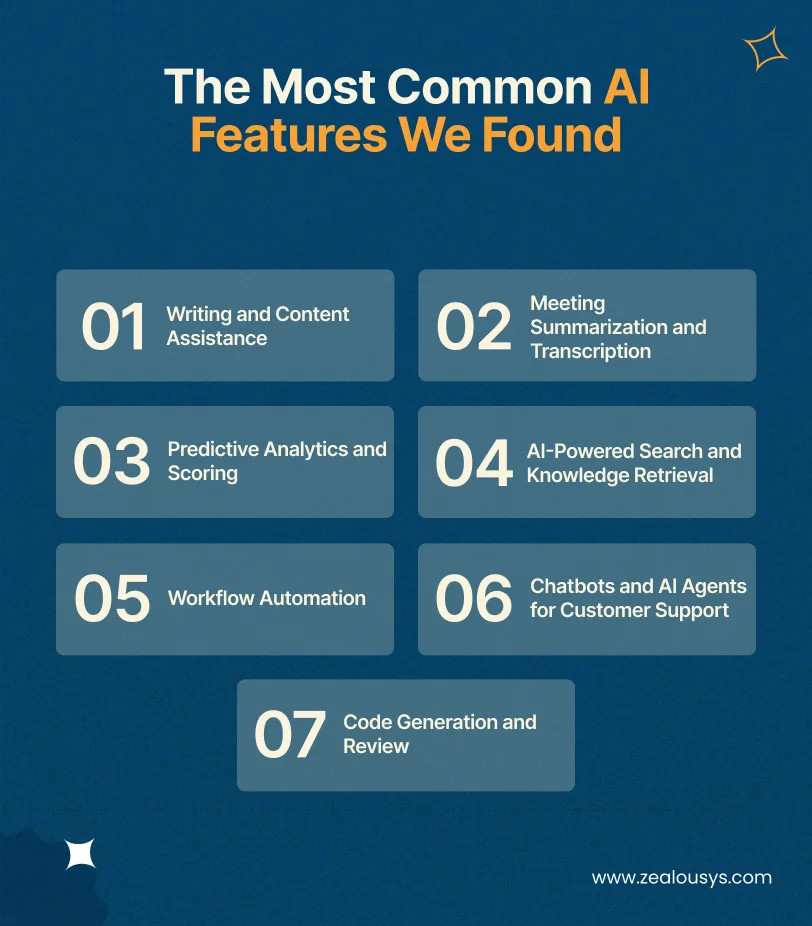
Across 30 products, seven types of AI features appeared repeatedly. The frequency itself tells you something about where SaaS teams believe the highest-value, most defensible AI applications currently sit.
Nearly every product with a text interface shipped some form of it. From Grammarly’s inline suggestions to Notion AI’s draft generation to HubSpot’s Breeze content tools, text-adjacent AI was the most common first deployment. It is low-risk, easy to scope, and easy to evaluate.
Every collaboration tool in our set had some version of it. Zoom generates meeting summaries automatically. Loom added AI-generated transcripts. Notion AI Meeting Notes transcribes calls in the background, even with the screen locked. This category saw consistent adoption because it addresses a universal, daily frustration: nobody wants to take notes.
CRM and sales tools leaned hardest into this category. Salesforce Einstein has been scoring leads and forecasting the pipeline since 2016. HubSpot’s Breeze Intelligence now provides predictive deal insights. The reason this category thrives: it fits directly into an existing decision-making workflow without requiring a new behavior.
Productivity tools built this into their core value proposition. Notion’s Q&A feature lets users query across their entire workspace. Slack AI surfaces relevant past messages. The challenge here, which we will get into later, is that quality depends entirely on how well-organized a team’s data already is.
Almost every category had at least one automation feature. Monday.com suggests automation rules based on usage patterns. Asana uses AI to flag at-risk tasks. Rippling automates HR workflows based on triggers. This is one of the highest-engagement categories because it removes steps rather than adding them.
Every customer-facing product in the set had one. Intercom’s Fin, Zendesk’s AI agents, Freshdesk’s Freddy. HubSpot’s Breeze Customer Agent reportedly handles 60 to 70% of customer inquiries automatically for some users.
Developer tools adopted this faster than any other category. GitHub Copilot is the clearest example, with developers seeing measurable increases in completed tasks according to GitHub’s own published productivity research. Atlassian Intelligence surfaces AI suggestions inside Jira. Linear uses AI for issue writing and backlog summarization.
Not every category is moving at the same pace. Some verticals have both the data infrastructure and the user workflows where AI creates immediate, visible value. Others are still working through foundational SaaS challenges.
CRM and sales has the longest AI track record of any category we reviewed. Salesforce has been building AI into its platform since 2016 with Einstein, and by 2024, 80% of Fortune 500 companies using Salesforce had adopted Einstein features, per Salesforce’s Q1 2025 investor report. HubSpot’s Breeze consolidated its AI tools in 2024, and published case studies show customers saving 750 hours per week and increasing deal velocity by 20%.
By raw volume of AI launches, nothing is moving faster right now. The combination of text, meeting, and search AI across tools like Notion, Slack, Zoom, and Microsoft 365 has made these the most AI-dense products in the market today.
Developer tools have arguably produced the most measurable productivity data of any category. GitHub Copilot’s widespread adoption changed the baseline expectation for engineering environments. Microsoft and GitHub have both published research showing significant productivity gains from their AI coding tools, with developers completing more tasks in less time.
Customer service makes the business case for AI faster than any other function. The ROI calculation is visible and fast. Zendesk and Intercom can point to ticket deflection rates. HubSpot can point to support costs saved. One documented HubSpot case study reported a 77% reduction in support tickets handled by human agents after deploying Breeze AI.
Canva and Jasper have made AI central to their positioning. Canva’s Magic Suite (Magic Write, Magic Design, Magic Resize) lowered the skill floor for visual content creation and drove significant user growth across their platform.
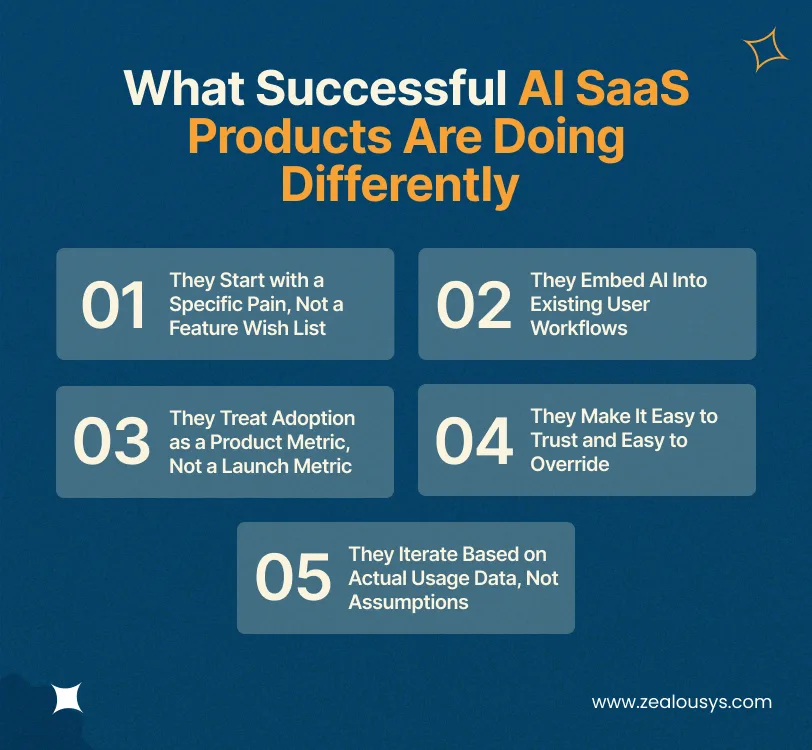
After reviewing 30 products, the patterns among high-adoption AI features are consistent enough to be worth naming clearly.
The products seeing real engagement did not ask “what AI features can we build?” They asked, “Where do users get stuck, and can AI remove that friction?” Zoom’s meeting summary feature works because taking notes during a call is universally annoying. Slack’s thread summarization works because no one wants to scroll through 200 messages after a day off. The pain point was specific before the solution was designed.
Products with dedicated “AI tabs” or isolated AI dashboards tend to have lower engagement than those where AI surfaces in context, while the user is doing their actual work. Grammarly understood this from the beginning. The suggestion appears inline, at the moment of writing, without requiring a tab switch or a separate action.
Several of the products we reviewed tracked AI feature engagement at the account level, not just at activation. Notion, for example, rolled out an AI analytics dashboard for enterprise admins that shows which AI features are driving adoption across their workspace. That is not a feature for users. That is a signal that the product team is measuring real usage, not launch traffic.
The AI features with the best retention share a design principle: they show their work and give the user control. Grammarly explains why it is making a suggestion. GitHub Copilot shows the completion as a suggestion, not a command. Users stay engaged when they feel in control rather than replaced.
McKinsey’s research is clear that redesigning workflows, rather than simply adding AI features, is the primary factor for achieving meaningful business impact from AI. The best products treat their AI launches as version one, not as finished work.
The same analysis that shows what works also surfaces what does not. These were the most consistent patterns among AI features with low adoption or abandoned rollouts.
Some of the products we reviewed had AI features that were clearly built to say the product “has AI,” not to solve a specific user problem. Isolated AI summarization tools that users had to navigate to, rather than encountering naturally, consistently showed low return visits. Building for your homepage rather than your users is a short-term strategy with a long-term adoption cost.
AI search and retrieval features are only as useful as the data they can access. Several products launched smart search or Q&A features that struggled to gain traction, not because the AI was poor, but because the underlying workspace data was messy, incomplete, or inconsistently structured. The AI cannot compensate for disorganized source data. It amplifies whatever quality already exists.
Some products launched AI features at confusing price points: either burying them in enterprise tiers with no mid-market access, or charging separately in ways that created friction at the point of first use. Notion adjusted its pricing structure in 2025, gating AI features at Business and Enterprise tiers, which drew user criticism. How you price AI access directly affects initial adoption, which in turn affects the feedback loop you need to improve the feature.
A user clicking on an AI feature once is not the same as a user incorporating it into their daily workflow. The latter is what drives retention and expansion revenue. Product teams that celebrated early click-through rates without tracking weekly return usage often found themselves looking at flat engagement numbers two quarters later.
Several of the weaker AI launches we looked at tried to build for everyone simultaneously and ended up serving no segment particularly well. The products with the strongest AI retention often started with a specific user type, often the daily active user, and built around that behavior before expanding.
Beyond individual feature decisions, five broader patterns emerged across the full set of products.
Across almost every category, an AI writing or workflow assistant is no longer a differentiator. It is expected. The interesting design question has shifted from “should we build a copilot?” to “what should our copilot actually be able to do that others cannot?”
Gartner predicts that 33% of enterprise software will include agentic AI by 2028, from less than 1% in 2024. Notion launched autonomous AI agents in September 2025. Salesforce’s Agentforce is being positioned as the company’s primary growth driver. HubSpot’s Breeze Agents operate end-to-end on defined tasks. The shift from “AI that suggests” to “AI that executes” is already in the product release notes.
The separate AI add-on model is showing signs of strain. Users resist paying twice for the same product, and the add-on model creates a lower adoption rate for the AI features themselves, which reduces the feedback data needed to improve them. Several products we reviewed have moved toward bundling AI into existing tiers during 2024 and 2025.
As the underlying AI models (GPT, Claude, Gemini) become more commoditized, the proprietary behavioral data a SaaS product holds about its specific user base becomes the most defensible advantage. Products sitting on rich, structured data are better positioned to build AI features that feel native rather than generic.
Salesforce’s consumption-based pricing for generative AI, introduced in late 2024, reflects a broader shift. As AI inference costs at scale become a real operational consideration, outcome-based and usage-based models are emerging as the pricing layer on top of traditional subscription pricing.
The business case for AI in SaaS is real, but it is not evenly distributed. There is a meaningful gap between companies that have added AI features and companies that have achieved measurable returns.
McKinsey’s 2025 State of AI report confirmed that 74% of organizations that deployed AI achieved first-year ROI. AI-powered SaaS platforms are commanding a valuation premium of 1 to 3x compared to non-AI equivalents, per SEG Research’s private market data. Salesforce reported that Agentforce reduces operational costs by 30% for customer service and sales pipeline workflows.
The customer service category has the clearest before-and-after story. HubSpot’s documented case studies show support teams resolving 60 to 70% of inquiries automatically, with one customer reporting a 77% reduction in human-handled tickets. Zendesk and Intercom publish similar deflection rate improvements across their customer base.
What the data also shows, and this is the part most SaaS teams skip over, is that the companies achieving strong results had done the workflow redesign work first. McKinsey is explicit about this. Adding an AI feature to a broken or unexamined workflow does not fix the workflow. It makes the underlying problem more visible and easier to hit.
The obstacles are technical, organizational, and sometimes just economic. None of them are insurmountable, but underestimating them is where most AI implementation plans go wrong.
This is the first challenge most enterprise buyers raise. The EU AI Act, GDPR, and industry-specific regulations like HIPAA create real constraints around what data can flow into AI models and where inference can happen. Products handling sensitive user data need trust architecture before they need AI features. This is why Salesforce built the Einstein Trust Layer as a product in its own right.
A significant percentage of SaaS products are built on architectures that predate modern AI integration patterns. According to a Salesforce-commissioned study, 72% of organizations report struggling with disconnected data, and that fragmentation makes it technically difficult to build AI features that have access to meaningful context. The AI layer cannot perform better than the data infrastructure it sits on.
Per SEG Research, 41% of SaaS CEOs identify a lack of technical AI talent as their primary barrier to adoption. Building a competent AI engineering team in-house is a multi-quarter initiative that competes for budget with the core product. For most SaaS companies at the $500K to $5M ARR stage, the build-versus-partner decision is not philosophical. It is a resource constraint.
Trust in AI outputs is earned slowly and lost quickly. SaaS products that ship AI without adequate guardrails, transparency, or accuracy testing risk not just feature abandonment but product-level trust damage. Several of the products we reviewed saw a negative user feedback spike, not because AI was introduced, but because AI made visible errors in high-stakes workflows with no clear way to override or correct them.
What costs little in a prototype can become a meaningful operational expense when usage scales. This is one reason usage-based pricing is emerging alongside subscription models, and why many product teams underestimate the infrastructure cost of AI features during the planning phase.
Based on the patterns across 30 products, these are the practical steps that separate successful AI integrations from the ones that never get past the launch announcement.
Pick the workflow where users consistently get stuck, abandon tasks, or spend disproportionate time on low-value work. Build the AI feature around eliminating that specific friction. Scope it tightly. Ship it, measure it, and only then expand.
If user data is scattered, inconsistently labeled, or siloed across systems, the AI features you build will reflect that chaos back at users. The data cleanup work is unglamorous and takes longer than expected, but it is what the best AI features are actually built on.
Is it daily active use? Time-to-value reduction? Support ticket deflection? Retention improvement at the segment level? Picking the metric before launch forces clearer design decisions and prevents the trap of celebrating activation as if it were adoption.
Deciding whether to build proprietary AI models, buy capabilities from foundation model providers via API, or partner with an AI development team is one of the most consequential technical decisions a SaaS product can make. It affects cost, timeline, control, and your ability to differentiate. Most products in the $1M to $5M ARR range integrate via API first, then build proprietary layers as they accumulate sufficient data. You can explore what a structured AI integration approach looks like for a product at your stage.
Every product in our analysis that saw strong long-term adoption iterated significantly from v1. The teams that benefited most treated early AI launches as instruments for learning what users actually needed, not as completed deliverables.
The products with the highest trust scores were not the ones with the most advanced models. They were the ones that showed users what the AI was doing and why, and made it easy to accept, reject, or modify the output. Trust design is as important as the AI architecture itself.
If you are building or scaling a SaaS application and working through where AI fits in your product roadmap, the answers tend to come from analyzing actual user behavior in your product, not from replicating what competitors have announced.
The 30 products we analyzed do not tell a single story about AI integration in SaaS. They tell several stories simultaneously. Some shipped AI strategically, tied it to specific user problems, measured adoption rigorously, and saw real business impact. Others moved fast under competitive pressure, built features that looked good in demos, and are now quietly dealing with low engagement numbers.
What the data shows clearly is that the question is no longer whether to add AI to your SaaS product. That ship has sailed. The question is whether the AI you add solves a problem your users actually have, inside a workflow they are already running, with enough trust and transparency that they come back to it tomorrow.
The companies making real progress are the ones doing the workflow design work before the engineering work, not after.
At Zealous System, we work with SaaS founders and product teams across the US, UK, and Australia to architect and deliver AI-powered software and integrate generative AI capabilities into existing platforms. If your team is working through the build-versus-integrate decision, or trying to figure out where AI fits in your next product sprint, our AI consulting team can help you map that out with a technical and business lens, not just a feature list.
Our team is always eager to know what you are looking for. Drop them a Hi!

Pranjal Mehta is the Managing Director of Zealous System, a leading software solutions provider. Having 10+ years of experience and clientele across the globe, he is always curious to stay ahead in the market by inculcating latest technologies and trends in Zealous.


Comments