
UK haulage businesses are under more pressure than at any point in the past decade. Rising fuel costs, Smart Tachograph 2 deadlines, driver shortages, and tightening margins are forcing operators to make a critical decision: invest in the right fleet management software or fall further behind. This guide breaks down exactly what fleet management software does, how much it costs, and whether you should build a custom solution or buy an existing platform in 2026.
Running a haulage business in the UK in 2026 is harder than it has ever been. Fuel prices, regulatory changes, driver retention issues, and customer expectations around real-time visibility are all pulling in different directions. And somewhere in the middle of all that, fleet managers are expected to keep vehicles moving, compliant, and profitable.
Fleet management software for UK haulage companies has become less of a nice-to-have and more of a survival tool. But with dozens of platforms on the market and the option to build something bespoke, the question most operations directors and managing directors are asking is this: should we buy an existing system, or should we build our own?
This guide gives you a practical, honest answer. We cover what fleet management software actually does, what it costs in 2026, and how to make the right decision for the size and complexity of your operation.
Before making any software decision, it helps to understand the landscape you are operating in. These statistics come from authoritative sources and reflect the current state of UK haulage and fleet management.
Fleet management software is a digital platform that gives transport operators centralised control over their vehicles, drivers, compliance obligations, and operational data.
At its simplest, it replaces spreadsheets, paper manifests, phone calls between drivers and dispatchers, and manual compliance checks. At its most sophisticated, it integrates real-time GPS tracking, tachograph data, route optimisation, predictive maintenance alerts, fuel monitoring, driver behaviour scoring, and invoicing into a single connected system.
For UK haulage companies, fleet management software is the operational backbone of the business. It is how you know where your vehicles are, whether your drivers are compliant, when a vehicle needs servicing, and whether your routes are costing more than they should.
There are two broad categories:
The decision between the two is what the rest of this guide is built around.
Regardless of whether you build or buy, any platform worth considering should cover these core functional areas.
| Feature | What it does | Why UK haulage needs it |
|---|---|---|
| Real-time GPS tracking | Shows vehicle location on a live map | Customer ETAs, proof of location, theft recovery |
| Tachograph integration | Downloads and analyses driver hours data | DVSA compliance, Smart Tachograph 2 compatibility |
| Route optimisation | Calculates fastest, most fuel-efficient routes | Reduces fuel spend, improves delivery windows |
| Driver behaviour monitoring | Tracks speeding, harsh braking, idling | Reduces accidents, lowers insurance premiums |
| Predictive maintenance alerts | Flags upcoming service needs before breakdown | Reduces unplanned downtime, extends vehicle life |
| Fuel management | Tracks consumption per vehicle and per driver | Identifies waste, supports cost reduction |
| Digital job management | Assigns, tracks and updates jobs in real time | Replaces paper manifests, improves dispatcher visibility |
| Compliance management | Manages MOT dates, operator licence, driver licences | Avoids DVSA enforcement, protects O-licence |
| Reporting and analytics | Generates performance reports across fleet | Supports management decisions, customer reporting |
| Mobile driver app | Gives drivers job updates, navigation, forms | Reduces admin, improves driver communication |
| EV fleet management | Manages charging schedules, range data | Required for mixed HGV and EV fleets |
| Customer portal | Gives customers live delivery tracking | Improves customer experience, reduces inbound calls |
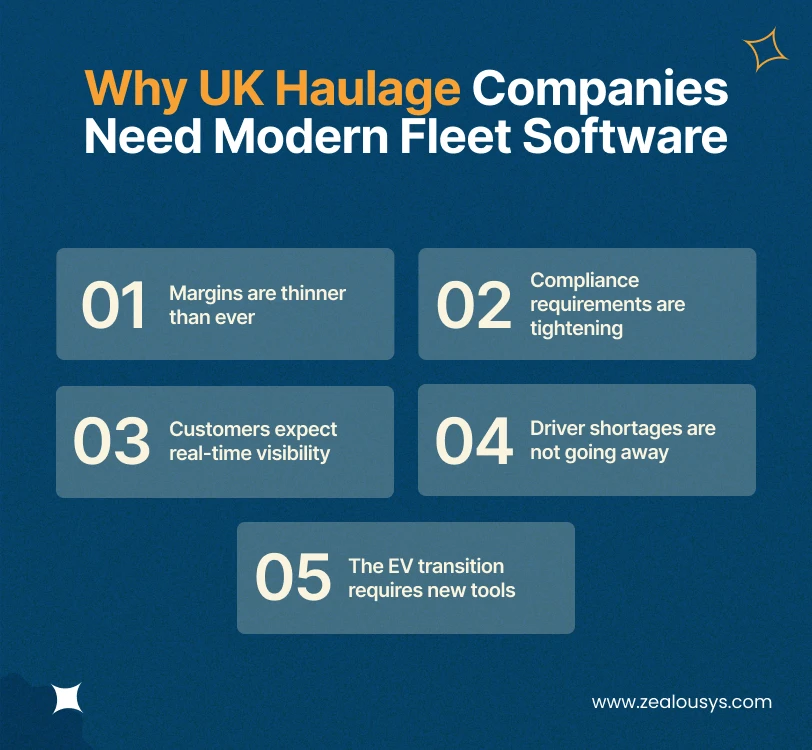
The haulage industry in 2026 is not the same as it was five years ago. Several forces have combined to make modern fleet management software not just useful but operationally necessary.
With 494 haulage businesses entering insolvency in 2023 alone, the industry is under severe financial pressure. When fuel accounts for 27% of HGV operating costs, any software that reduces fuel waste by even 10% has a direct and measurable impact on whether a business survives the year.
Smart Tachograph 2 is now mandatory for newly registered HGVs and for vehicles undertaking international journeys. From July 2026, thousands of van operators who have never previously needed tachographs will come into scope for the first time. Managing this compliance manually is increasingly untenable.
Shippers and retailers now expect the same level of tracking from their haulage partner as they get from a parcel carrier. If you cannot provide a live ETA or a proof of delivery in real time, you are at a competitive disadvantage.
With the average HGV driver now aged 51 and the industry needing 40,000 new drivers per year to cover retirements, operators need to make every driver they do have as efficient and compliant as possible. Fleet software that automates job assignment, reduces dead mileage, and handles compliance monitoring frees drivers from administrative tasks and reduces the margin for human error.
One in four commercial vehicles registered in 2024 was battery-electric. Managing a mixed fleet of diesel HGVs and electric LCVs requires software that handles both vehicle types, with range monitoring, charging schedules, and ULEZ compliance built in.
For UK fleet managers, operations directors, and managing directors evaluating fleet management software, the build vs buy decision is one of the most consequential technology choices your business will make. The wrong call costs you years of workarounds, growing subscription fees, and a system that never quite fits how your operation actually runs.Here is a detailed comparison across every dimension that matters for UK haulage and logistics operations.
| Factor | Off-the-shelf Platform | Custom Fleet Management Software |
|---|---|---|
| Initial Cost | £50 to £500 per vehicle per year, costs compound as fleet grows | One-time development investment, no per-vehicle fees ever |
| Time to Go Live | Days to weeks for a generic setup | 12 to 32 weeks for a system built precisely around your operation |
| Fit to Your Workflows | You adapt your processes to fit the software | Software is built around your exact processes, nothing changes on your end |
| Scalability | Entirely dependent on what the vendor decides to build next | Fully within your control, scale exactly as your business demands |
| Integration with Existing Systems | Limited to integrations the vendor has already built and supports | Integrates with any system you use, TMS, ERP, fuel cards, customer APIs |
| Compliance Features | Generic, built for a global market, rarely matches UK-specific DVSA and tachograph requirements precisely | Built exactly to your compliance requirements including Smart Tachograph 2, DVSA reporting, and operator licence management |
| Vendor Lock-in | High, your operational data lives in their system on their terms | Zero lock-in, you own the software, the code, and every byte of your data |
| Ongoing Cost | Subscription fee grows every time you add a vehicle or a user | Fixed annual maintenance cost regardless of how many vehicles or users you add |
| Customisation | Surface-level configuration only, core logic is locked | Unlimited, every feature, every workflow, every report is yours to define |
| Support | Shared vendor helpdesk, generic ticket queue, no knowledge of your operation | Dedicated support from a team that built your system and knows your business |
| Ownership of Data | Shared or restricted, export terms set by the vendor | 100% yours, stored where you choose, accessible however you need |
| Feature Control | Vendor roadmap decides what gets built and when | You decide what gets built, when it gets built, and how it works |
| Long-term ROI | Costs increase year on year with no asset to show for it | Investment depreciates, operational savings compound, you own a valuable asset |
| Competitive Advantage | Every competitor in your sector can buy the same platform | Your software is unique to your business and cannot be replicated by competitors |
| Best For | Operators under 30 vehicles with standard, straightforward operations | Growth-focused haulage businesses, multi-depot operators, and any fleet where off-the-shelf has already let you down |
Buying an existing fleet management system is the right choice in several specific situations.
You are running a relatively standard operation with a single depot, a straightforward job type (point-to-point deliveries or trunking), and fewer than 30 vehicles. Most off-the-shelf platforms cover these requirements well and the subscription cost is manageable at that scale.
You need to be up and running within weeks rather than months. If you are replacing a system that has failed or you are starting a new operation, buying gives you speed to deployment that building cannot match.
Your compliance requirements are standard. If your fleet operates within standard UK domestic rules, without complex multi-customer reporting, cross-border operations, or sector-specific compliance requirements, most established platforms will cover your needs.
Your budget for upfront investment is limited. Custom development requires capital. If your business does not have £15,000 to £150,000 available for a development project, buying is the more practical choice for now.
Custom fleet management software becomes the stronger choice when the off-the-shelf market cannot serve your specific needs.
If you run 50 or more vehicles across multiple depots, manage a mix of vehicle types, handle multiple customer contracts with different reporting requirements, or operate in a specialist sector (temperature-controlled, hazardous goods, abnormal loads), off-the-shelf platforms become increasingly poor fits. The features you need either do not exist or require workarounds that create more admin, not less.
Most haulage businesses already run TMS platforms, ERP systems, fuel card integrations, customer portals, or accounting software. If an off-the-shelf fleet platform does not connect cleanly with your existing stack, you end up maintaining data across multiple systems manually. Custom software can integrate with any system you already use.
Off-the-shelf platforms charge per vehicle. At 100 vehicles, a platform costing £150 per vehicle per year costs £15,000 annually. At 200 vehicles, it doubles. A custom-built system has a fixed maintenance cost regardless of how many vehicles you add. The crossover point where custom becomes cheaper than subscription is typically between years two and four, depending on fleet size.
Customer data, driver data, route data, and operational data are among the most commercially sensitive assets a haulage business holds. When that data sits in a vendor’s platform, your access to it is governed by their terms of service. Custom software means your data stays on your own infrastructure, fully under your control.
Some haulage businesses are not just looking for a tool to manage compliance. They are building operational capabilities that their competitors do not have: proprietary route optimisation algorithms tuned to their lane network, AI-powered demand forecasting integrated with their customer systems, or automated dynamic pricing based on real-time capacity. None of that is available in an off-the-shelf platform.
Whether you build or buy, there are costs that rarely appear in the initial conversation but will materially affect your total cost of ownership over three to five years.
The honest reality is that neither option is cheap when you account for the full picture. The key question is which set of costs gives you the most control and the best return.
The following comparison assumes a fleet of 75 HGVs and 25 LCVs, operating from two depots with standard UK domestic and some international operations.
| Cost Category | Off-the-shelf Year 1 | Off-the-shelf Year 3 | Custom Build Year 1 | Custom Build Year 3 |
|---|---|---|---|---|
| Licence / Subscription Fee | £37,500 | £45,000 | £0 | £0 |
| Initial Setup and Onboarding | £5,000 | £0 | £40,000 | £0 |
| Hardware (Trackers, Devices) | £12,000 | £3,000 | £12,000 | £3,000 |
| Integration Development | £8,000 | £4,000 | £3,500 | £1,000 |
| Training | £3,000 | £1,500 | £2,500 | £1,000 |
| Maintenance and Support | £0 (Included) | £0 (Included) | £8,000 | £8,000 |
| Feature Upgrades / Additions | £6,000 | £8,000 | £5,000 | £4,000 |
| Total Annual Cost | £71,500 | £61,500 | £71,000 | £17,000 |
| 3-Year Total Cost | £194,500 | £105,000 | ||
| 5-Year Total Cost | £317,500 | £139,000 | ||
Note: These figures are indicative ranges based on typical UK market rates as of 2026. Your actual costs will vary based on fleet size, system complexity, chosen vendor, and development scope. Request a detailed quote before making any decision.
At this fleet size, off-the-shelf is cheaper in year one and year three. By year five, the gap is narrower. For a fleet of 200 or more vehicles, the custom build crossover point typically arrives in year three.
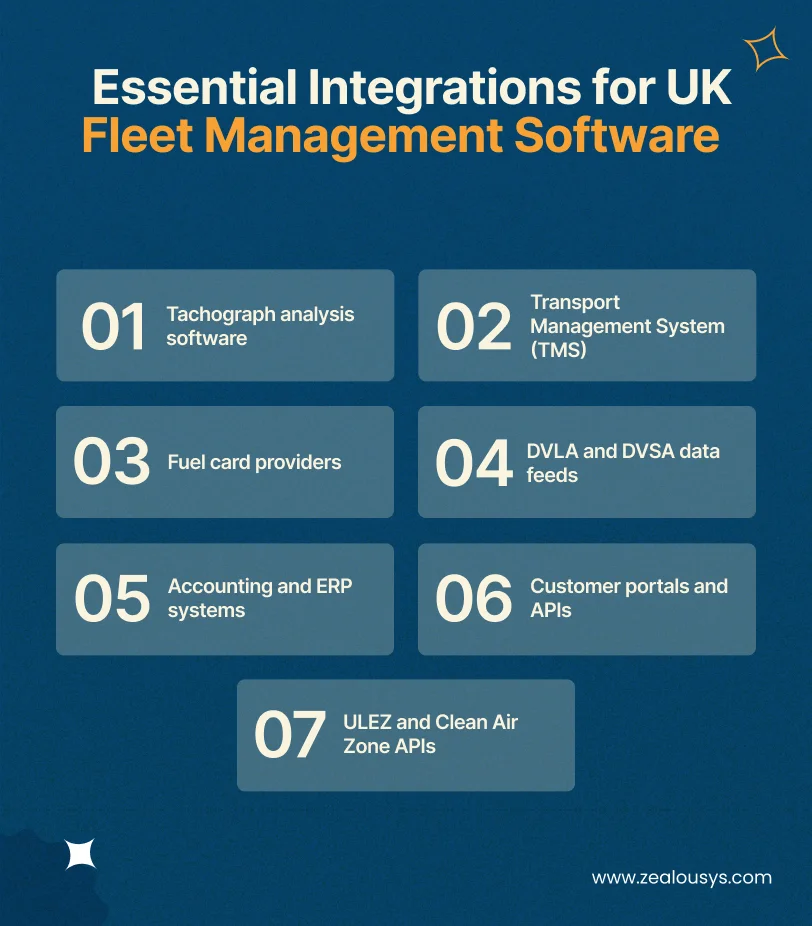
A fleet management system that does not connect to your other tools creates data silos, manual re-entry, and errors. These are the integrations that UK haulage operations typically need as a baseline.
Your fleet management platform needs to pull tachograph data for drivers’ hours compliance. For Smart Tachograph 2 compatibility, ensure your platform supports DTCO 4.0 data formats.
If you run a separate TMS for load planning and customer orders, your fleet management software needs a live integration so job status updates flow in both directions automatically.
Integrating with UK fuel card networks (Keyfuels, BP Fuel+, DHL Fuel Card, Fleetcor) allows per-vehicle fuel spend to be matched automatically against telematics data, making it easy to identify discrepancies.
Automated checks on driver licence status and vehicle MOT/tax status remove manual overhead from compliance management.
Integration with Sage, Xero, QuickBooks, or your ERP ensures that job completion, mileage data, and fuel costs flow through to your finance system without manual export.
Many large shipper customers now require a direct data feed or API connection so their systems can pull delivery status in real time. Your fleet platform needs to be able to deliver this.
As more UK cities expand clean air zones, automated checks of whether specific vehicles are compliant for specific routes save dispatcher time and prevent avoidable charges.
Artificial intelligence is no longer a premium add-on. In 2026, these AI features are becoming standard expectations for any serious fleet management platform.
Modern AI dashcams process video in real time to detect distracted driving, mobile phone use, seatbelt violations, and lane departure. The data feeds directly into driver risk scoring, allowing coaches to intervene before incidents happen. When you are operating on 2% margins, preventing a single serious claim can represent the entire annual profit from several vehicles.
AI models trained on engine sensor data, mileage patterns, and historical fault records can flag which vehicles are likely to need maintenance in the next 14 to 30 days. This shifts maintenance from reactive to proactive, reducing unplanned downtime which is one of the highest hidden costs in fleet operations.
Static route planning is no longer enough. AI-driven optimisation considers live traffic, road closures, delivery time windows, vehicle load capacity, driver hours availability, and ULEZ restrictions in real time. For operators running tight delivery windows, this directly affects customer SLA performance.
AI can identify unusual fuel consumption patterns that may indicate fuel card fraud, theft, or vehicle defects. For a fleet of 100 vehicles, even a 2% reduction in unexplained fuel loss represents significant savings.
Beyond scoring past behaviour, AI models can predict which drivers are showing early signs of fatigue, increased risk patterns, or reduced engagement. This supports proactive driver management and reduces turnover in an industry already struggling with staff retention.
For haulage operators working with regular customers on supply chain contracts, AI-driven demand forecasting can predict vehicle and driver requirements 2 to 4 weeks ahead, allowing you to plan capacity without over-committing or under-resourcing.
This checklist covers the compliance requirements that every UK fleet management system should support as a minimum. Use it to evaluate both off-the-shelf platforms and custom build specifications.
If you decide to commission custom fleet management software, here is a realistic overview of what the process looks like from first conversation to go-live.
This is where your fleet management solution takes shape on paper before a single line of code is written. Your development partner works directly with your operations directors, fleet managers, transport managers, and dispatchers to document every workflow, compliance requirement, integration need, and user role.
The output is a detailed technical specification that defines exactly what your custom fleet management platform will do, how it will handle UK-specific compliance requirements like Smart Tachograph 2 and DVSA reporting, and how it will integrate with your existing TMS, fuel cards, and ERP system.
This phase is the most important phase of the entire project. Operators who skip or rush discovery almost always end up with a fleet tracking software system that solves yesterday’s problems rather than tomorrow’s.
Your fleet software development company designs the technical architecture, including database structure, API layer, hosting environment, and integration points. UX wireframes are produced for every user role, your dispatcher interface, driver mobile app, fleet manager dashboard, and management reporting view.
Good UX design at this stage is what determines whether your drivers and dispatchers actually adopt the system after go-live. A fleet management platform that people avoid using because it is poorly designed delivers no return on investment regardless of how technically capable it is.
Development of your custom fleet management system runs in two-week sprints. You receive working software at the end of each sprint, not a finished product at the end of 16 weeks. Regular sprint reviews let your operations team test real functionality and redirect development if priorities shift.
For UK haulage companies, this phase typically includes building the core GPS tracking and fleet visibility layer first, then adding tachograph integration, driver hours monitoring, job management, and compliance reporting in subsequent sprints.
All third-party integrations are connected and tested in this phase. This includes Smart Tachograph 2 data feeds, fuel card providers like Keyfuels and BP Fuel+, DVLA licence checking, your TMS, and any customer portal APIs your logistics clients require.
User acceptance testing (UAT) runs with your actual fleet managers, transport managers, and dispatchers using real operational data. This is where edge cases specific to UK haulage operations, multi-drop routes, mixed fleet vehicle types, cross-border compliance, get identified and resolved before go-live.
Your team is trained on the new fleet management system, data is migrated from your existing platform, and the system goes live. Most custom fleet software projects include a hypercare period of 4 to 6 weeks post-launch where the development team is on standby for rapid fixes and operational questions.
Total timeline: 21 to 32 weeks from first brief to go-live for a full-featured platform. A focused MVP with core tracking, compliance, and job management can be delivered in 12 to 16 weeks.
Learning from other operators’ mistakes saves you time, money, and significant frustration. Here are the most common errors seen in both buy and build decisions.
The cheapest platform per vehicle often becomes the most expensive once you factor in missing integrations, per-module add-on costs, and the productivity impact of workarounds.
The people who use fleet software every day are the best judges of whether it actually works. Evaluating a platform without their input almost always results in low adoption after go-live.
Moving historical vehicle records, driver records, and maintenance logs from one system to another is rarely straightforward. Build migration time and cost into your plan before you commit.
If your fleet management system and your transport management system cannot communicate, you create a data gap that your dispatchers will fill with spreadsheets and phone calls.
Many older fleet platforms were not built to handle DTCO 4.0 data formats. If your software cannot process Smart Tachograph 2 downloads, you face a compliance gap that will get harder to manage as the fleet transitions to the new devices.
Fleet operations run 24 hours a day, 7 days a week. A software vendor whose support team is based in a different time zone with no UK number is a risk to your operations when something goes wrong at 3am on a Sunday.
With one in four new commercial vehicle registrations now battery-electric, any fleet platform deployed in 2026 that does not include EV range, charging, and mixed-fleet management will be inadequate within 18 to 24 months.
As clean air zones expand across UK cities, manually checking vehicle compliance for each zone on each route is not scalable. This should be an automated feature of your fleet platform, not a manual daily task.
The biggest budget overruns in custom fleet software happen when operators try to build everything at once. Build the core system first, go live, and add modules based on real operational experience.
Traffic Commissioners expect operators to demonstrate a systematic approach to compliance. A fleet management system that does not provide a clear, exportable audit trail of compliance checks, defect records, and driver records is a liability in a public inquiry.
A platform that works well for 50 vehicles but hits performance limits at 100 is a problem you will face sooner than you expect if your business is growing. Scalability should be part of the evaluation criteria from day one.
Some fleet management platforms only support their own proprietary hardware. If you already have telematics devices fitted across your fleet, check hardware compatibility before you commit to any platform.
A UK haulage business operating 85 vehicles from three depots across England. The business specialises in chilled and ambient food distribution for retail clients, running a mix of temperature-controlled HGVs and smaller refrigerated LCVs. The company had been using an off-the-shelf fleet platform for six years but was facing several growing problems.
Their existing platform did not integrate with their TMS, meaning dispatchers manually re-entered job information twice daily. Temperature monitoring data from their trailer units was managed in a separate system, so when a customer raised a temperature breach claim, locating and exporting the relevant data took several hours. Their tachograph data was managed in a third separate tool. Compliance reporting for their three depots was manually consolidated by the transport manager each month.
With 85 vehicles, their subscription fee had grown to over £22,000 per year. Every time they needed a new report or a minor workflow change, the vendor’s response was either “that feature is on our roadmap” or a quoted customisation cost.
After a formal evaluation, the business commissioned a custom fleet management platform. The brief included: unified job management integrated directly with their TMS, real-time temperature monitoring integrated into the same interface as GPS tracking, Smart Tachograph 2 compatible driver hours management, automated multi-depot compliance reporting, and a customer portal giving retail clients live delivery visibility.
Development took 26 weeks. The first phase went live at their largest depot before rolling out to the others over 8 weeks. Within 6 months of full deployment, the business had eliminated the double-entry of job information entirely, reduced the time to produce compliance reports from two days to two hours, and had a clear audit trail that satisfied their largest customer’s supplier compliance requirements. Their monthly subscription spend dropped from £22,000 per year to a fixed maintenance fee of £14,000 per year, regardless of whether they added more vehicles.
This case is a fictional composite based on common patterns seen in UK food distribution and multi-depot haulage operations. Your outcomes will vary based on your specific requirements and the quality of your development partner.
Fleet management software is a digital platform that gives transport operators centralised control over vehicle tracking, driver compliance, route planning, maintenance scheduling, fuel management, and reporting. It replaces manual processes and disconnected tools with a single integrated system.
Off-the-shelf fleet management platforms typically cost between £50 and £500 per vehicle per year in licence fees, depending on the features included. Custom-built fleet management software typically costs between £15,000 and £150,000 to develop, with annual maintenance costs of around £5,000 to £20,000. For larger fleets, custom development becomes more cost-effective than subscription pricing from around year three onwards.
A Transport Management System (TMS) handles the planning and management of loads, customer orders, carrier selection, and freight costs. Fleet management software handles the operational management of vehicles and drivers, including tracking, compliance, maintenance, and fuel. They are complementary systems and the best setups integrate both.
DVSA does not certify specific software products. However, good fleet management software should support your compliance with DVSA requirements by managing tachograph data downloads, drivers’ hours monitoring, vehicle inspection records, and operator licence documentation. Always verify that any platform you evaluate supports Smart Tachograph 2 data formats.
Smart Tachograph 2 is the latest generation of digital tachograph mandated for HGVs operating internationally. From July 2026, it will also apply to LCVs between 2.5 and 3.5 tonnes used for international hire and reward. Your fleet management software must be able to download and process data from Smart Tachograph 2 devices to maintain compliance.
A focused custom fleet management system covering core tracking, compliance management, and job management typically takes 12 to 16 weeks to build. A full-featured platform with multi-depot management, customer portals, EV management, and advanced AI features typically takes 24 to 32 weeks.
Yes. One of the primary reasons operators choose custom software is precisely to achieve integrations that off-the-shelf platforms do not support. A custom-built fleet platform can integrate with any TMS, ERP, fuel card provider, or customer system via API, provided your development partner has the technical capability to build the integration.
This varies by vendor but is an important question to ask before signing any contract. Some vendors make data export straightforward. Others make it difficult, provide only partial exports, or charge exit fees. When you build custom software, you own your data completely and can do whatever you choose with it.
Modern fleet management software should include integration with Transport for London’s ULEZ checker and similar APIs for other UK clean air zones. This allows the system to automatically flag whether a specific vehicle is compliant for a planned route, rather than requiring dispatchers to check manually.
Temperature-controlled fleet operations need their fleet platform to integrate with trailer temperature monitoring systems, log and alert on temperature breaches in real time, attach temperature data to specific delivery records for customer reporting, and maintain a complete audit trail that satisfies food safety compliance requirements.
Fleet software reduces administrative burden on drivers by digitising daily walkaround checks, job updates, proof of delivery, and hours management. This makes the working experience more straightforward and lets drivers focus on driving rather than paperwork. It also supports better driver behaviour coaching through data, which can improve retention by creating a fairer, evidence-based environment.
Working with a development partner that understands UK-specific compliance requirements, DVSA regulations, Smart Tachograph 2 requirements, and the operational patterns of UK haulage is a genuine advantage. It reduces the time spent explaining context and increases the likelihood that the software will handle UK-specific regulatory requirements correctly from the start.
For fleets under 20 vehicles with standard operations, well-established off-the-shelf platforms such as Quartix, Teletrac Navman, or Samsara provide good value. For fleets above 50 vehicles, or for operators with complex workflows or specific compliance requirements, the case for custom software development becomes significantly stronger.
Fleet management software reduces fuel costs through several mechanisms: route optimisation reduces unnecessary mileage, driver behaviour monitoring identifies idling and harsh acceleration patterns that waste fuel, fuel card integration highlights discrepancies between recorded fuel purchases and expected consumption, and predictive maintenance catches engine issues that reduce fuel efficiency before they become costly.
A good development brief for fleet management software should cover your fleet size and vehicle types, your depot structure, your current systems and required integrations, your compliance obligations (including any sector-specific requirements), the user roles who will access the system, any reporting requirements from customers or auditors, your hardware requirements, and your go-live timeline. The more detail you provide at this stage, the more accurate the development proposal you receive will be.
Fleet management software for UK haulage companies is not a single product. It is a category that ranges from basic GPS tracking tools to sophisticated operational platforms that integrate every aspect of how you run your fleet.
The build versus buy decision comes down to three things: the complexity of your operation, the size of your fleet, and how much control you need over your technology and your data.
If you are running fewer than 30 vehicles on standard domestic routes with no unusual compliance requirements, buying an established platform is the sensible choice for 2026. You will be up and running quickly and the subscription cost is manageable.
If you are running 50 or more vehicles, operating from multiple depots, managing complex integrations, or finding that every off-the-shelf platform requires significant workarounds to fit how your business actually operates, building custom fleet management software is worth serious consideration. The upfront investment is higher, but the long-term operational control, the data ownership, and the ability to build exactly what your business needs are advantages that compound over time.
The UK haulage industry is consolidating. The operators who survive and grow through this period are the ones who invest in operational efficiency now, not the ones who wait for margins to recover before upgrading their tools.
Our team is always eager to know what you are looking for. Drop them a Hi!

Pranjal Mehta is the Managing Director of Zealous System, a leading software solutions provider. Having 10+ years of experience and clientele across the globe, he is always curious to stay ahead in the market by inculcating latest technologies and trends in Zealous.


Comments