
Agentic AI and traditional automation solve different problems. Traditional automation follows fixed rules and works best for stable, repetitive, high-volume tasks. Agentic AI pursues goals, adapts to context, and handles work that involves judgment and unstructured data. Most businesses in 2026 will get the best results from a combination of both. This 2026 business automation guide explains the differences, compares costs and risks, and gives you a practical framework to decide where each one belongs in your operations.
The agentic AI vs traditional automation question is sitting on almost every technology leader’s desk right now. Automation budgets for 2026 are set, vendors are making bold claims, and the pressure to act is real. According to Gartner, 40% of enterprise applications will include task-specific AI agents by the end of 2026, up from less than 5% in 2025.
That number sounds like a mandate to rip out your existing automation. It isn’t.
Here’s the uncomfortable truth. The same research firm predicts that over 40% of agentic AI projects will be canceled by the end of 2027 due to rising costs, unclear business value, or weak risk controls. The businesses that win in 2026 won’t be the ones that adopt agentic AI fastest. They’ll be the ones that know exactly which processes need it, and which ones don’t.
This guide walks you through both technologies, compares them side by side, and gives you a decision framework you can apply to your own workflows this quarter.
Agentic AI refers to software systems built on large language models (LLMs) that can pursue a goal on their own. Instead of following a fixed script, an AI agent plans its approach, breaks the goal into steps, uses tools and data sources, and adjusts when something unexpected happens.
The word “agentic” points to the defining trait: agency. You give the system an outcome, not a procedure.
Think of the difference this way. A traditional bot is told, “When an email arrives with an attachment named invoice.pdf, extract the total and enter it in the ERP.” An AI agent is told, “Process incoming invoices and flag anything unusual.” The agent figures out how to get it done, even when the invoice arrives as a photo, a forwarded email thread, or a format nobody has seen before.
In a business setting, agentic AI typically works through four capabilities:
Enterprise AI adoption is accelerating but still early. Gartner’s 2026 CIO and Technology Executive Survey found that only 17% of organizations have deployed AI agents so far, though more than 60% expect to do so within the next two years.
Traditional automation is software that executes predefined, rule-based workflows. It covers robotic process automation (RPA), workflow tools, scheduled scripts, and macros. Every action follows explicit if-then logic written by a person in advance.
These are deterministic systems. Given the same input, they produce the same output every single time. That predictability is not a weakness. For many business processes, it is exactly the point.
Traditional automation for business shines under three conditions:
Payroll runs, report generation, data transfers between systems, and scheduled compliance checks are classic examples. A well-built rule-based workflow can run these for years with minimal supervision.
The limitation appears the moment reality stops matching the rules. Change an invoice layout, rename a field, or introduce an exception, and the bot breaks or, worse, processes the wrong data silently. Anyone who has maintained a stack of legacy automation tools knows this maintenance burden well.
The core difference between agentic AI and traditional automation comes down to this: one follows instructions, the other pursues outcomes. The table below breaks down the pros and cons of each approach in practice.
| Dimension | Traditional Automation | Agentic AI |
|---|---|---|
| Decision-making | Predefined if-then rules | Autonomous decisions within guardrails |
| Adaptability | Breaks when processes change | Adapts to new formats and situations |
| Data handling | Structured data only | Structured and unstructured data |
| Setup effort | Process mapping and rule scripting | Goal definition, guardrails, and testing |
| Maintenance | High: rules need constant updates | Lower for rule changes, but needs monitoring |
| Error behavior | Fails visibly or halts on exceptions | Can handle exceptions, but may act unpredictably |
| Cost structure | Licenses and development, mostly fixed | Usage-based compute and token costs |
| Oversight needs | Low once stable | Ongoing human-in-the-loop review |
| Best fit | Stable, repetitive, high-volume tasks | Ambiguous, judgment-heavy, exception-rich work |
Three of these differences deserve a closer look, because they drive most real-world decisions.
Traditional automation executes a procedure. Agentic AI pursues a result. This makes agents far more flexible, but it also introduces variability. A deterministic system will never surprise you. A probabilistic one might, in both good and bad ways. That trade-off between reliability and adaptability sits at the heart of every deployment decision.
Roughly speaking, traditional automation stops where clean data ends. Emails, contracts, support tickets, scanned documents, and free-form text have always required human reading. Agentic AI changes that. It can interpret messy, unstructured inputs and act on them, which opens up entire categories of work that were never automatable before.
Traditional automation carries predictable licensing and development costs. Agentic AI runs on compute, and costs scale with usage. A poorly scoped agent that loops through unnecessary steps can burn through budget quietly. Cost governance is a design requirement, not an afterthought.
So where do the benefits of agentic AI compared to traditional automation actually show up? The strongest use cases share a common shape: unstructured inputs, frequent exceptions, and decisions that previously needed a person.
An agent reads incoming tickets, understands intent even when customers describe problems badly, pulls account history, resolves routine issues end to end, and routes complex cases to the right human with a summary attached. Support teams stop drowning in volume and spend their time on the conversations that genuinely need them.
Traditional automation already handles clean invoices well. The expensive part has always been the exceptions: mismatched purchase orders, unusual amounts, missing fields. Agents now investigate these cases, cross-reference records across systems, and either resolve the discrepancy or prepare a documented recommendation for a human reviewer.
Agents monitor alerts, correlate signals across logs and systems, diagnose likely root causes, and execute approved remediation steps. What used to be a 2 a.m. phone call becomes a resolved incident with a report waiting in the morning.
Before a sales call, an agent can research the prospect, review past interactions, scan recent company news, and prepare a briefing. Nothing here follows a fixed script, which is precisely why rule-based tools never managed it.
Notice a pattern across all four? These autonomous agents rarely work alone. In most production deployments, traditional automation still handles the predictable path while the agent handles judgment and exceptions. Workflow orchestration between the two is where the real value shows up.
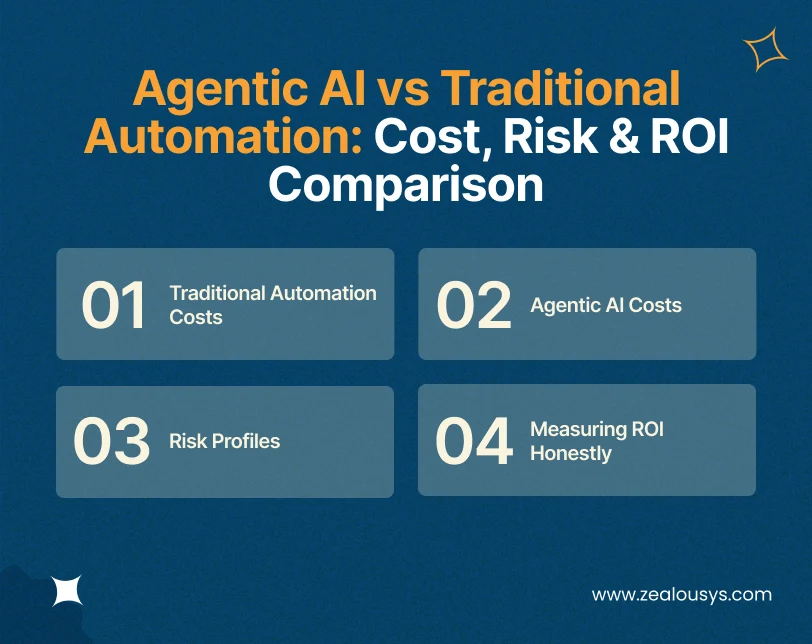
Cost comparisons between the two are less straightforward than vendor decks suggest, because the cost structures are fundamentally different.
These costs are front-loaded and predictable: licenses, development, and infrastructure. The hidden expense is maintenance. Every process change, system update, or interface redesign can break bots, and large RPA estates often require dedicated teams just to keep workflows running. Over a three-year horizon, that upkeep frequently exceeds the original build cost, so factor it into any comparison from the start.
Agent costs are usage-based. You pay for compute and model calls as the agent works, which means expenses scale with volume rather than sitting flat. Initial builds are often faster than scripting an equivalent rule set, but monitoring infrastructure and human review time add their own overhead. Cost governance matters here: set spending limits and alerts on day one, because a loosely scoped agent can quietly consume budget by taking steps it never needed to take.
Traditional automation risk is rigidity. Bots fail when reality changes, and while those failures are usually visible and fixable, they interrupt operations and pile up maintenance debt over time.
Agentic AI risk is unpredictability. Agents can misinterpret goals, take unexpected actions, or produce confident-sounding errors. Guardrails, audit logs, and human review checkpoints are mandatory, especially in regulated environments where every decision must be explainable.
Be honest about the baseline. Gartner’s warning that over 40% of agentic AI projects will be canceled by the end of 2027 traces back to a recurring mistake: applying agents to processes that never needed agency in the first place. A stable, structured, high-volume task automated with simple rules will beat an agent on cost and reliability every time. Measure agentic AI ROI where it genuinely differs: exception resolution rates, work recovered from tasks that were previously manual, and reduced maintenance on brittle rule sets.
Forget the technology for a moment and look at the process. Five questions will point you to the right answer almost every time.
Choose rule-based automation when the process is stable, the data is structured, volumes are high, and compliance demands a complete, predictable audit trail. Payroll, scheduled reporting, system-to-system data transfers, and regulatory filings all fit here. Newer does not mean better for this work, and replacing a working deterministic system with an agent adds risk without adding value.
Knowing when to choose agentic AI over traditional automation comes down to the shape of the work itself. Invest in agentic AI when work involves unstructured inputs, frequent exceptions, judgment calls, or reasoning across multiple systems. Support triage, document-heavy operations, research tasks, and exception handling are the proven starting points. Gartner’s practical guidance matches this split: use AI agents where decisions are needed, and automation for routine Agentic AI workflows.
Whether it sits inside a wider digital transformation program or stands on its own, a sensible 2026 automation strategy follows a sequence, not a leap. Six steps take you from inventory to scale.
List your top 15 to 20 processes by volume and cost. For each one, note the data type, the exception rate, and how expensive an error would be. This inventory becomes the foundation for every decision that follows, and most teams complete it in under two weeks.
Run every process through the five questions from the previous section. You’ll end up with three buckets: rules, agents, and hybrid. Expect a surprise here. Most enterprises find that a large share of their list still belongs firmly in the rules bucket.
Choose a process where mistakes are cheap and results are measurable, such as internal ticket triage or research support. Avoid customer-facing or regulated processes for your first attempt. One focused pilot teaches you more than five parallel experiments ever will.
Define what the agent may do on its own, what needs human approval, and how every action gets logged. Set spending limits on compute from the start. Governance built early costs a fraction of governance retrofitted after something goes wrong.
Compare cycle time, resolution rate, error rate, and cost per task against how the work happened before the pilot. Without a baseline, every result looks like a success, and that is exactly how failing projects survive longer than they should.
Expand successful agents into adjacent processes, and leave healthy rule-based automation alone. Retiring reliable systems for the sake of modernity is how automation budgets get wasted.
Most enterprises that follow this path end up with a layered setup: rules handle the predictable core, agents handle the messy edges, and humans handle what genuinely requires them. Analysts often call this combination hyperautomation, though the label matters far less than the fit.
No, and it shouldn’t. The two solve different problems. Traditional automation remains the cheaper, more reliable choice for stable, structured, high-volume tasks, while agentic AI handles judgment, exceptions, and unstructured data. Most businesses in 2026 run both, with agents layered on top of existing rule-based workflows rather than replacing them.
Traditional automation follows fixed if-then rules written in advance and only works with structured data. Agentic AI pursues goals: it plans steps, uses tools, interprets unstructured information, and adapts when conditions change. In short, one executes instructions while the other works toward outcomes.
Yes, and this hybrid pattern is the most common production setup today. Rule-based workflows process the predictable majority of cases at low cost, and AI agents pick up the exceptions, interpret messy inputs, and hand results back into the structured workflow. Each covers the other’s weakness.
It depends on the process. For stable, high-volume, structured tasks, traditional automation is almost always cheaper because its costs are fixed and maintenance is the only ongoing expense. For exception-heavy or judgment-based work, agents are more cost-effective because the alternative is manual human effort, not a rule-based bot.
Traditional automation examples include payroll processing, scheduled report generation, and moving data between systems. Agentic AI examples include customer support triage, invoice exception investigation, IT incident diagnosis, and sales research. The dividing line is simple: fixed procedure versus situational judgment.
The agentic AI vs traditional automation debate has a clear answer for 2026, and it isn’t a winner. Match the tool to the process. Rules for repetition, agents for judgment, humans for what matters most. Businesses that classify their workflows honestly will spend less, break less, and automate more than those chasing either extreme.
The harder part is execution: choosing the right pilot, designing guardrails, and connecting agents to the systems you already run. At Zealous System, we partner with businesses to plan and build exactly this kind of layered automation strategy, from workflow audits to production-grade AI agent development services. If you’re mapping out your 2026 automation roadmap and want a second opinion on where agentic AI genuinely fits, our team is happy to talk it through.
Our team is always eager to know what you are looking for. Drop them a Hi!

Meet the Zealous Team – your dedicated source for cutting-edge insights on the latest technologies, digital transformation, and industry trends. With a passion for innovation and a commitment to delivering unparalleled expertise.




Comments