Quick Overview:
South African law firms and financial services companies handle thousands of documents every month: contracts, FICA packs, claims files, conveyancing bundles, and loan applications. Most of that work is still manual. This guide explains how AI document processing software development helps SA firms cut that workload, which use cases deliver the fastest returns, what features matter, how the build process works, and what it costs to develop, with realistic price ranges in USD and ZAR.
Ask any practice manager in Johannesburg or a compliance head in Cape Town where their team’s hours go, and you will hear the same answer: documents. Reading them, checking them, extracting details from them, and filing them for the next audit.
AI document processing changes that equation. Instead of a paralegal spending three hours assembling a FICA pack or a claims assessor retyping details from a hospital invoice, software reads the document, pulls out the data, checks it against your rules, and routes it to the right person. What used to take hours takes minutes.
This is not about replacing your people. It is about giving them their time back so they can do work that actually needs judgment.
The catch? Most off-the-shelf tools were built for American or European workflows. They do not understand FICA requirements, POPIA data residency rules, or how a South African conveyancing transaction actually works. That gap is why more SA firms are choosing to build custom AI document processing software instead. This guide walks you through the full picture, including what it costs.
Global SaaS tools promise quick setup, so why are SA firms increasingly building their own custom document automation software? Three reasons come up again and again.
Many international tools process documents on servers in the US or Europe. Under POPIA, transferring personal information across borders comes with strict conditions, and the Information Regulator has grown more active in enforcement. A custom-built solution lets you decide exactly where data lives and who can touch it. For banks, insurers, and law firms holding sensitive client information, that control is often the deciding factor.
FICA verification, FSCA reporting requirements, Deeds Office document standards: these are South African realities that global vendors rarely support properly. Custom software builds these rules in from day one instead of forcing your team to work around missing features.
A conveyancing practice in Pretoria and a short-term insurer in Sandton process documents in completely different ways. Off-the-shelf tools force both into the same template. Custom development fits the software to how your firm actually works, including integration with the practice management or core systems you already run. It is the main reason demand for legal document automation in South Africa now leans custom rather than off-the-shelf.
There is also a longer-term point worth making. When you build, you own the asset. There are no per-seat licence fees climbing every year in a weakening rand, and no vendor deciding to sunset a feature your team depends on.
The strongest business cases come from high-volume, repetitive document work. Here is where SA firms are seeing real results.
AI reads contracts and flags key clauses, missing terms, unusual indemnities, and renewal dates. A review that took a junior associate half a day gets a first pass in minutes, with the associate checking the flagged items instead of reading every page.
In M&A or property transactions, data rooms can contain thousands of documents. Automated due diligence software classifies them, extracts the important details, and surfaces red flags, so your team focuses on analysis rather than sorting.
Conveyancing runs on paperwork: offers to purchase, bond documents, FICA packs, rates clearance certificates. Automation assembles, checks, and tracks these bundles, reducing the back-and-forth that delays registration. For many practices, it is the first practical step toward a paperless law firm.
Machine learning document analysis sorts discovery bundles by relevance, date, and party, cutting the manual review load on large matters. It is legal workflow automation applied where firms bleed the most hours.
KYC document verification software reads IDs, proof of address, and company registration documents, verifies the details, and builds a complete audit trail. Onboarding that took days happens in hours, and your FICA files are always inspection-ready.
Insurers receive claims documents in every imaginable format: photos of invoices, scanned reports, emailed PDFs. AI extracts the details, validates them against the policy, and routes clean claims for fast approval while flagging suspicious ones for review.
Bank statements, payslips, and financial statements get read and summarised automatically, so credit teams work from structured data instead of stacks of PDFs.
Document processing for FSPs can compile the records and evidence needed for FSCA submissions, reducing the scramble before reporting deadlines.
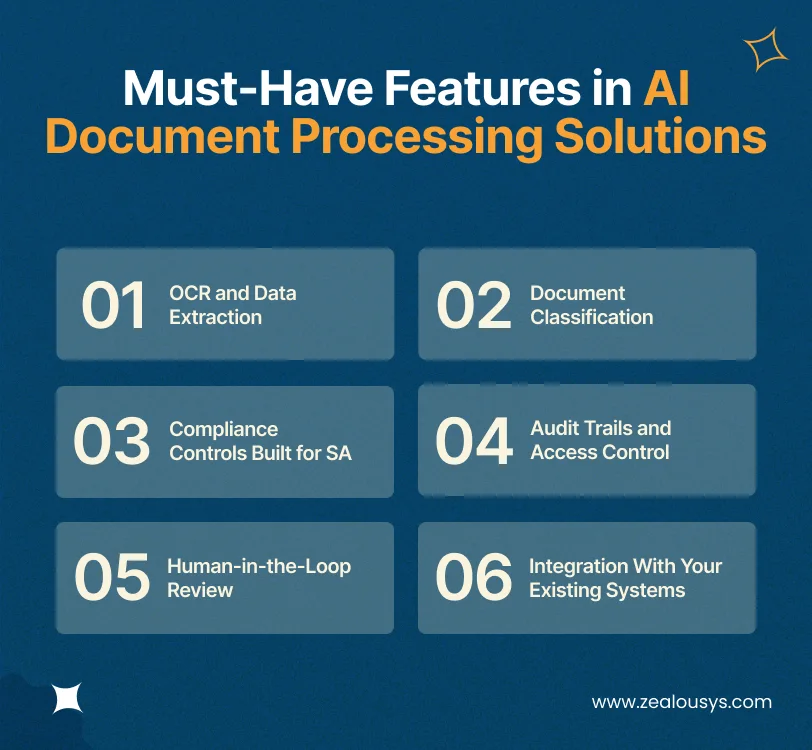
Whether you are a boutique law firm or a national insurer, certain capabilities separate software that gets used from software that gets abandoned.
The foundation of any intelligent document processing (IDP) system. It must handle scanned documents, photos taken on a phone, and handwritten forms, because that is what actually arrives in a South African inbox.
The system should recognise what a document is (an ID, a bank statement, a title deed) and route it accordingly, without a human sorting files into folders first.
POPIA-compliant AI document processing means local data hosting options, consent tracking, retention rules, and the ability to prove compliance to the Information Regulator. FICA checks and record-keeping should be part of the workflow, not an afterthought.
Every action logged, every document version tracked, and role-based permissions so a candidate attorney and a managing partner see different things. Auditors and regulators will thank you.
AI handles the volume; people handle the judgment calls. Good systems make it easy for staff to review, correct, and approve extractions, and the software learns from those corrections.
The solution must talk to your practice management system, document management system, or core insurance and banking platforms. If staff have to copy data between systems, adoption dies quickly.
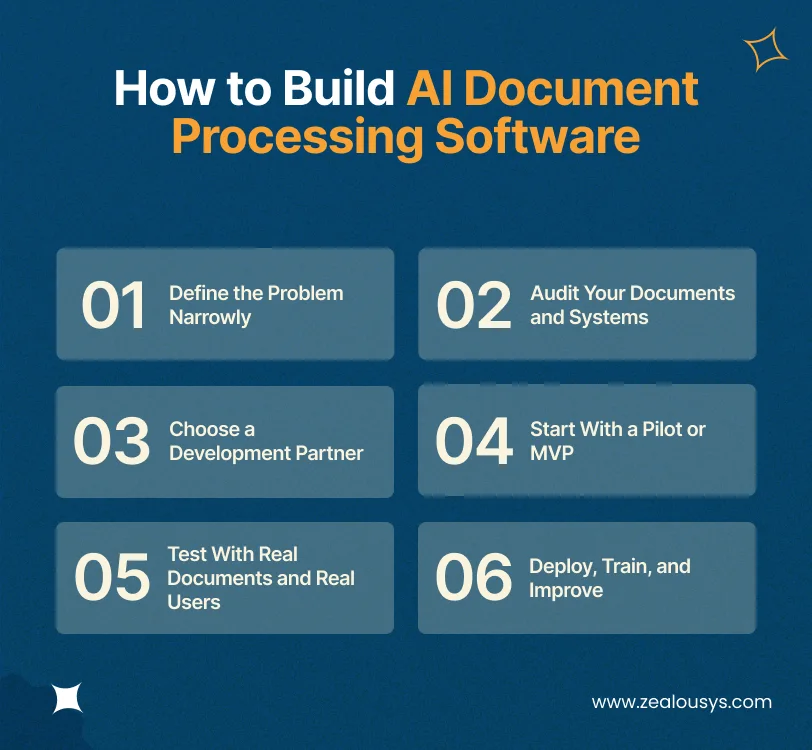
You do not need to be technical to run this project well. Here is the process from a client’s perspective, step by step.
Do not try to automate everything at once. Pick one document-heavy process, such as FICA onboarding or contract intake, and define what success looks like in numbers: hours saved, turnaround time, error rate.
Gather samples of the real documents your team handles, including the messy ones. Identify which systems the new software must connect to. This step shapes everything that follows.
Look for a team with proven AI and document processing experience, a clear approach to data protection, and references you can actually call. Ask how they handle POPIA requirements specifically; a vague answer is a warning sign. This is also the stage where many firms choose to hire AI developers on a dedicated basis rather than commissioning a fixed-scope project, which works well when requirements are still taking shape.
A focused first version proves the concept on one document type or one department. You get working software in weeks, not a big-bang launch after a year.
Accuracy on clean sample files means little. Test with the crumpled, skewed, badly scanned documents your team actually receives, and involve the staff who will use the system daily.
Roll out, train the team, and keep refining. AI systems improve with feedback, so plan for ongoing tuning rather than treating launch day as the finish line.
From the first workshop to a working MVP, expect roughly 3 to 4 months. Mid-range builds typically take 4 to 7 months, and larger multi-department systems take 7 to 12 months.
How much does it cost to develop document automation software? It is the question every decision-maker asks first, and the one most articles dodge. Costs vary with scope, but market estimates fall into recognisable tiers. The figures below are ballpark ranges for custom development, shown in USD with approximate ZAR equivalents at current exchange rates.
Cost: $10,000 to $20,000 (roughly R190,000 to R380,000)
A focused solution handling one or two document types with core OCR and data extraction, a simple review interface, and basic reporting. Suited to a firm automating a single workflow, such as FICA pack capture, to prove the concept before investing further.
Cost: $20,000 to $45,000 (roughly R380,000 to R850,000)
Multiple document types, document classification, human-in-the-loop review workflows, audit trails, role-based access, and integration with one or two existing systems, such as your practice management platform. This tier covers most law firm and mid-size FSP requirements.
Cost: $45,000 to $75,000 (roughly R850,000 to R1.4 million)
Enterprise-grade builds: high document volumes, many document types, deep integrations with core banking or policy administration systems, advanced analytics, custom-trained models for specialised documents, and stringent compliance and security requirements. Typically, banks, insurers, and large firms operate at this tier.
Here is how the three tiers compare:
| Solution Type | Core Features | Cost (USD) | Cost (ZAR, approx.) | Best Suited For |
|---|---|---|---|---|
| Basic MVP | OCR and data extraction for 1–2 document types, basic classification, core POPIA controls, 1 system integration, human review | $10,000 – $20,000 | R190,000 – R380,000 | Single process, one team; boutique firms and small FSPs |
| Mid-Range Solution | 3–6 document types, automated FICA/KYC verification, full audit trails and retention rules, 2–3 integrations, review with feedback learning | $20,000 – $45,000 | R380,000 – R850,000 | Growing firms automating multiple workflows |
| Advanced / Enterprise | Unlimited document types including handwriting and poor scans, self-improving classification, full FICA case management, enterprise governance, legacy integrations, analytics | $45,000 – $75,000+ | R850,000 – R1.4M+ | Banks, insurers, and large multi-department firms |
ZAR figures are approximate conversions and will shift with the exchange rate. Treat all figures as market estimates rather than quotes; your actual cost depends on your specific requirements.
Why does one project land at $15,000 and another at $70,000? These are the main drivers:
One more comparison worth doing: an off-the-shelf tool at $50 per user per month for 40 staff costs around $24,000 a year, every year, in a currency that moves against you. A custom build is a once-off investment in an asset you own. For document-heavy SA firms, the maths often favours building by year two or three.
At Zealous System, we have spent over a decade building software for legal, financial, and insurance businesses, and AI document processing sits squarely in that experience. Our teams have delivered OCR and data extraction systems, KYC verification software, and workflow automation for clients across multiple markets, and we understand that compliance is not a feature you bolt on at the end. It is a design decision you make on day one.
We work the way this guide describes: start with your actual documents and workflows, prove value with a focused MVP, then scale what works. Whether you need a fixed-scope project or want to hire dedicated AI developers to work as an extension of your team, our End-to-End AI Software Development Services cover the full journey from discovery to deployment and ongoing support.
Market estimates range from $10,000 to $20,000 (roughly R190,000 to R380,000) for a basic MVP, $20,000 to $45,000 for a mid-range solution, and $45,000 to $75,000 or more for advanced enterprise systems. The final figure depends on document types, integrations, and compliance requirements.
A focused MVP typically takes 3 to 4 months. Mid-range solutions take 4 to 7 months, and large multi-department systems can take 7 to 12 months.
It can and should be. Because you control the architecture, a custom build lets you keep data hosted in South Africa, set retention rules, track consent, and maintain the audit trails the Information Regulator expects. That control is one of the main reasons SA firms build custom rather than use global SaaS.
Yes. Integration is usually a core part of the project scope. Well-built solutions push extracted data directly into your practice management, document management, insurance, or banking systems so staff never re-enter information.
No. AI handles the repetitive reading, extraction, and sorting. Your people review flagged items, handle exceptions, and make the judgment calls the software cannot. Most firms redeploy saved hours into billable or client-facing work.
Buy if your needs are generic and volumes are low. Build if you handle high document volumes, need FICA and POPIA compliance built in, must integrate with existing systems, or want to own the asset instead of paying rising licence fees indefinitely.
Document work is where South African law firms and financial services companies quietly lose the most hours, and it is also where AI delivers the clearest, most measurable returns. The firms getting ahead are not the ones with the biggest budgets. They are the ones who picked a single painful process, built a focused solution around their own documents and compliance obligations, and expanded from there.
If you are weighing up a project like this, start small: choose one document-heavy workflow, gather real samples, and get a proper scoping conversation done. At Zealous System, we are happy to have that conversation with you. As a trusted AI software development services provider, we can assess your workflow, give you a realistic estimate, and show you what a pilot would look like for your firm, with no obligation attached.
Our team is always eager to know what you are looking for. Drop them a Hi!

Pranjal Mehta is the Managing Director of Zealous System, a leading software solutions provider. Having 10+ years of experience and clientele across the globe, he is always curious to stay ahead in the market by inculcating latest technologies and trends in Zealous.


Comments