Quick Overview:
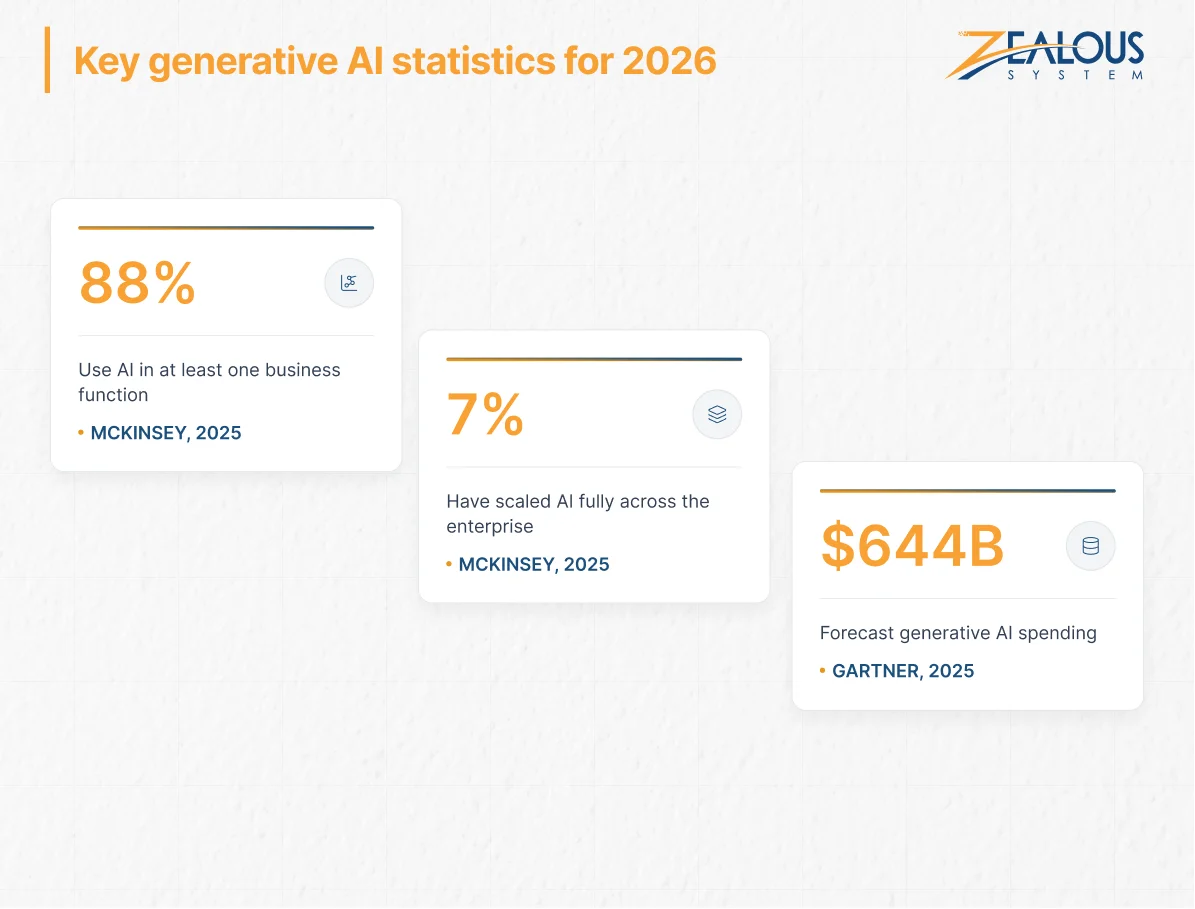
Generative AI statistics for 2026 paint a picture of a technology that has moved past the hype stage into daily operations. Globally, 88% of organizations now use AI in at least one business function, and generative AI spending is on pace to cross $644 billion. ChatGPT alone processes over 2.5 billion prompts a day, while Gemini and Claude are closing the gap fast. Yet only 7% of companies report AI fully scaled across the enterprise, and most still struggle to convert adoption into measurable profit. This roundup breaks down the numbers behind market size, industry adoption, ROI, jobs, and the risks businesses can’t afford to ignore.
Why Generative AI Statistics Matter More in 2026 Than Ever
Most companies aren’t asking whether to use generative AI anymore. They’re asking how to get a return from it, and the gap between those two questions has become the defining story of 2026.
The data below is sourced from McKinsey, Gartner, Deloitte, Stanford HAI, Bloomberg Intelligence, and others. Every generative AI statistic in this roundup is dated, linked, and pulled from the original source. Where research firms disagree on estimates, we’ve shown the range rather than picking the number that sounds best.
Generative AI Market Size & Investment Statistics
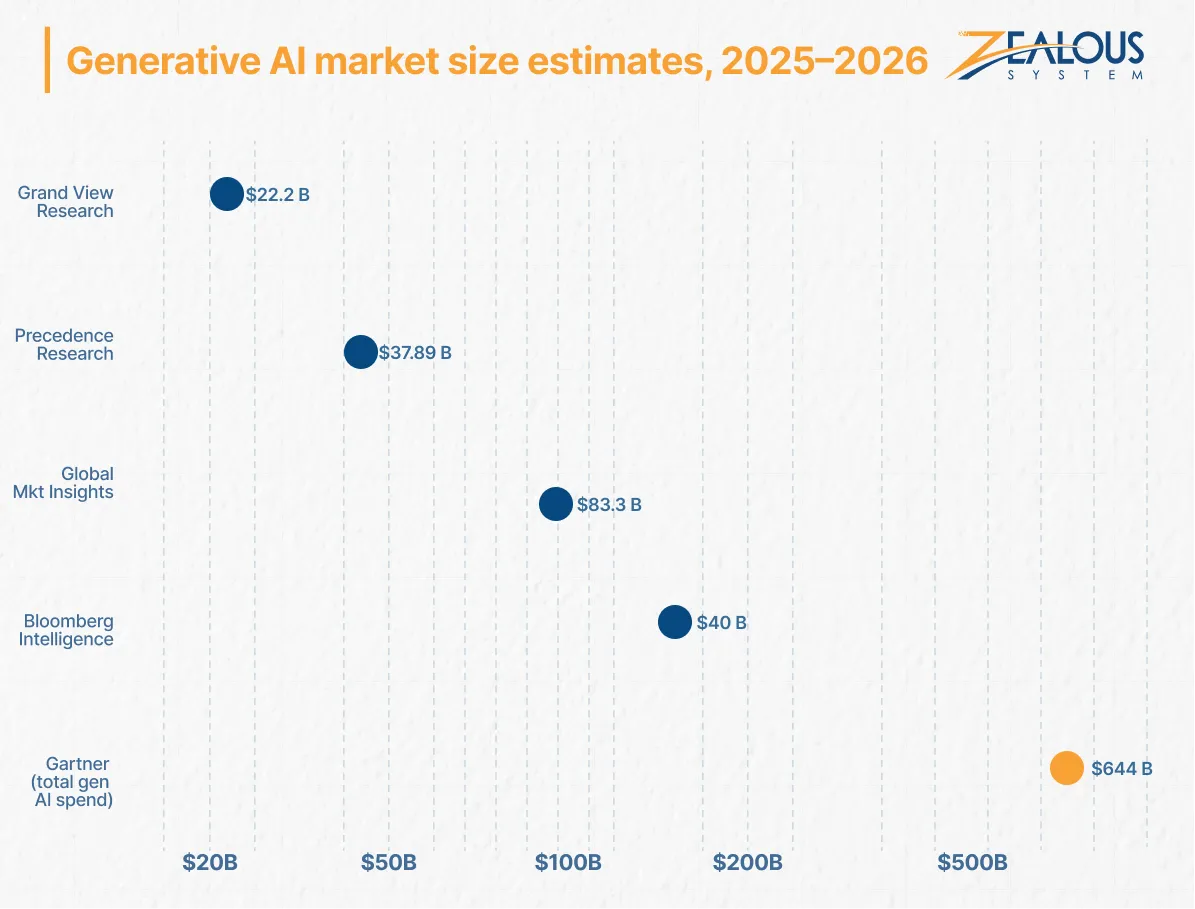
Market size figures for generative AI vary widely depending on what each research firm counts: foundation model APIs only, or the full stack of software, services, and infrastructure spend. That spread is worth understanding before you quote a single number in a board meeting.
Market valuation and growth rate
Worldwide generative AI spending is set to hit $644 billion in 2025, a 76.4% rise compared to 2024, according to Gartner.
Zooming out to the broader AI category, which includes infrastructure and services, total worldwide AI spend is forecast to reach $2.59 trillion in 2026, a 47% year-over-year jump (Gartner, May 2026).
Bloomberg Intelligence pegs the generative AI market at roughly $40 billion in 2022 and projects it to reach $1.3 trillion by 2032, implying a nearly 42% compound annual growth rate over that decade.
Grand View Research values the 2025 generative AI market at $22.2 billion and forecasts expansion to $324.7 billion by 2033 at a CAGR of 40.8%.
Precedence Research sets the 2025 baseline at $37.89 billion and projects the market will reach $1.2 trillion by 2035 at a CAGR of 36.97%.
Global Market Insights estimates the 2026 market at $83.3 billion, growing to $988.4 billion by 2035.
The gap between these projections, from roughly $30 billion to more than $140 billion for 2026 alone, comes down to scope. Narrower estimates count only direct product revenue; broader ones, like Gartner’s, fold in implementation services, infrastructure, and bundled AI features.
Investment and funding
In 2024, private investors channeled $33.9 billion into generative AI companies, 18.7% more than in 2023, part of $252 billion in total AI funding worldwide.
A year earlier, venture and private equity funding in generative AI startups reached $21.8 billion across 426 deals in 2023, more than three times the 2021 level.
92% of companies plan to increase their AI budgets over the next three years, even as most still struggle to show bottom-line impact.
Among large organizations actively deploying generative AI, estimated enterprise investment in the technology averaged around $110 million in 2024.
Regional and market share data
North America held the largest revenue share of the generative AI market, at roughly 40-41%, in 2025 across multiple market research reports.
Asia Pacific is projected to grow at the fastest regional CAGR through 2035, in the 27-35% range, driven by local model development and mobile-first adoption.
OpenAI led the generative AI vendor landscape with over 23.6% market share in 2025, with the top five players, OpenAI, Anthropic, NVIDIA, Adobe, and Microsoft, collectively holding 58.1%.
Generative AI Adoption Statistics by Industry
The generative AI adoption statistics across industries tell a consistent story: the tipping point has passed. The harder question in 2026 isn’t whether companies use generative AI, but how deeply it’s embedded into actual workflows.
Overall adoption rate
88% of organizations now regularly use AI in at least one business function, up from 78% the year prior, based on the state of AI survey of 1,993 participants by McKinsey, 2025.
McKinsey’s year-over-year tracking shows how fast this shifted: gen AI use went from 33% in 2023 to 71% in 2024 to 79% by 2025.
50% of organizations now run AI across three or more business functions, up from single-use-case experimentation that dominated as recently as 2022.
Despite near-universal experimentation, only 7% of organizations report that AI has been fully scaled across the enterprise.
Adoption by industry
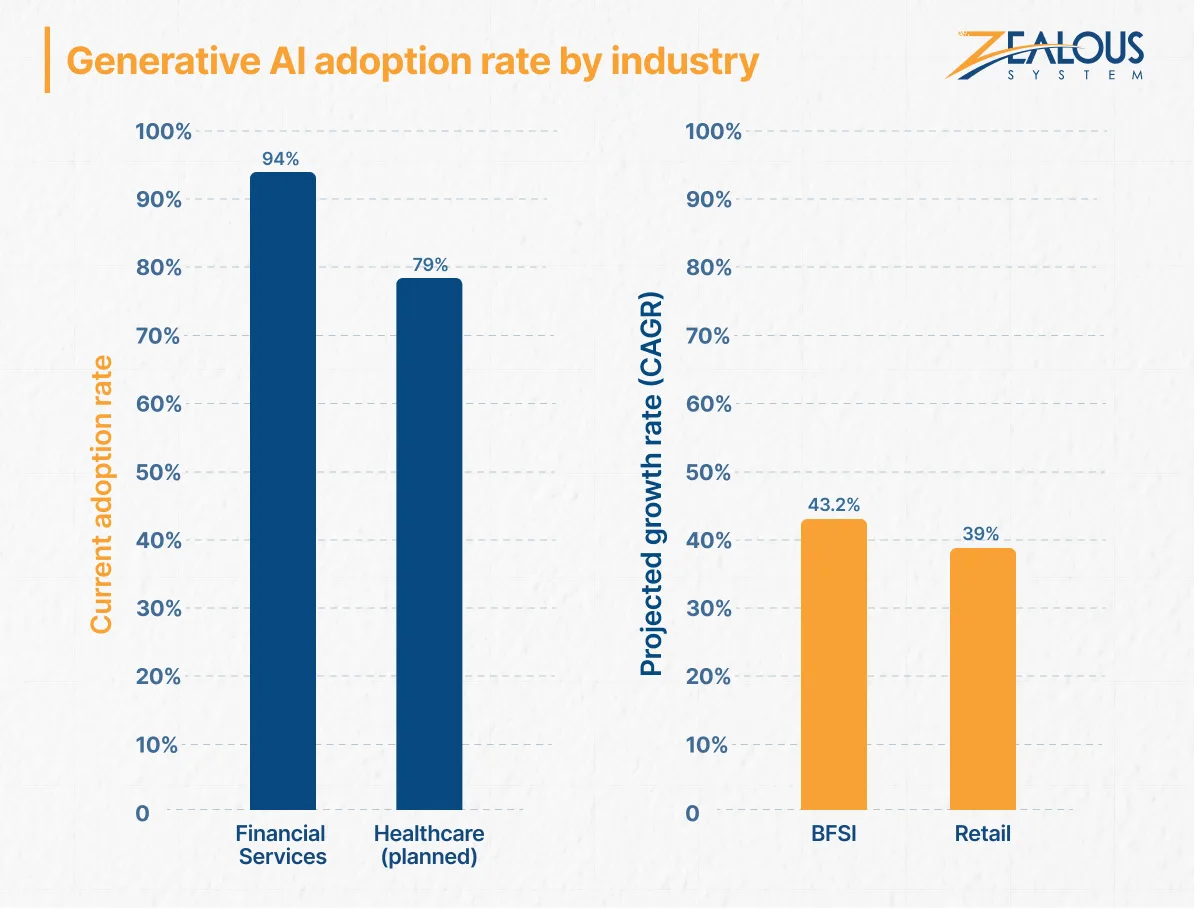
100% of healthcare CIOs plan to implement AI in some form by 2026, with 79% of healthcare players specifically planning to adopt generative AI.
Retail AI adoption is growing at a 39% CAGR, with applications spanning CRM, dynamic pricing, and fraud detection.
The BFSI (banking, financial services, and insurance) segment is expected to post the fastest generative AI growth of any industry vertical, at a 43.2% CAGR through 2033.
94% of financial services firms reported using some form of AI by late 2023, leaving just 6% reporting no AI usage at all, as per Statista.
Media and entertainment generated over $1.5 billion in generative AI-driven revenue in 2023, representing more than 34% of category revenue at the time.
Adoption by company size
As per Insight Mark Research, large organizations with more than 5,000 employees show meaningfully higher AI deployment rates, 83%, than companies with 50-499 employees at 42%, a gap that has persisted across every major survey since 2023.
Small and mid-sized businesses are catching up, largely through SaaS tools that embed AI by default rather than companies deliberately building their own AI stack.
Larger organizations are more than twice as likely as smaller peers to have a defined roadmap for generative AI adoption, including phased rollouts and dedicated transformation teams.
How Businesses Are Using Generative AI
Knowing the adoption rate only tells half the story. What people actually do with these tools looks different depending on whether you’re asking a consumer, a knowledge worker, or an enterprise IT team.
Top use cases
Content creation, code generation, and generative AI customer service automation consistently rank as the top three enterprise use cases, with customer-facing deployments showing the fastest cost-reduction results in early adopter data.
According to the NBER working paper, the most common ChatGPT use cases break down as practical guidance (28.3%), writing and editing (28.1%), and information seeking (21.3%), based on OpenAI usage data.
In finance specifically, top use cases by Google Cloud include virtual assistants (80%), financial document search (78%), personalized recommendations (76%), and capital market analysis (72%).
27% of organizations report that employees review all AI-generated content before it’s used, while the remainder rely on partial or spot-check review processes.
Tool and platform market share
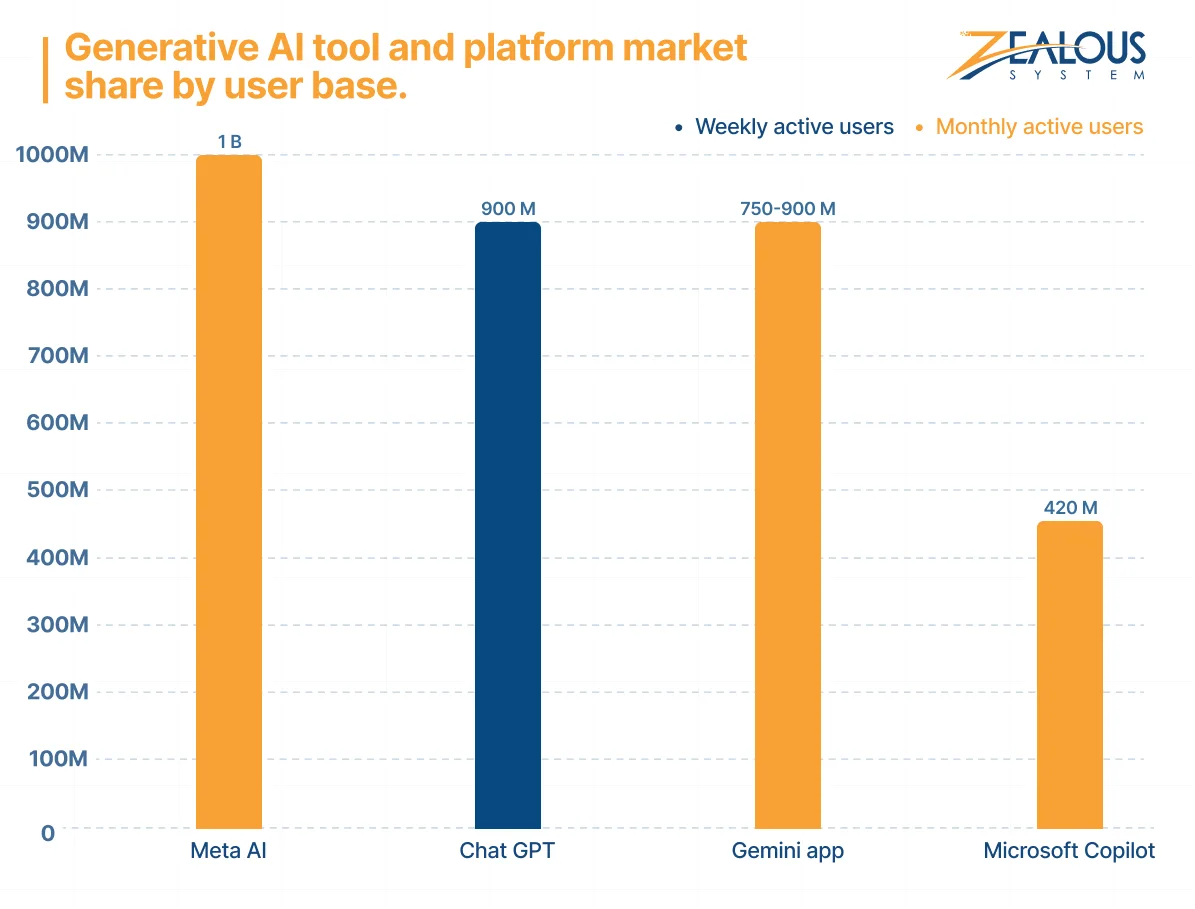
ChatGPT reached over 900 million weekly active users by February 2026, more than double the 400 million reported a year earlier.
ChatGPT processes over 2.5 billion prompts per day globally, with roughly 330 million coming from the United States.
Google’s Gemini app passed 750-900 million monthly active users in 2026, depending on the measurement window, and Gemini-powered AI Overviews reach an estimated 2.5 billion people monthly.
ChatGPT’s share of generative AI web traffic fell from roughly 87% in early 2025 to the 46% – 68% range by mid-2026, depending on the tracking source, as Gemini and Claude gained ground.
Anthropic’s enterprise win rate against OpenAI in head-to-head deals reached approximately 70%, according to Ramp’s spending data, even as ChatGPT retains a much larger consumer user base.
Meta AI reported 1 billion monthly active users across Meta’s family of apps.
92% of Fortune 500 companies use OpenAI’s generative AI tools somewhere across their organization.
Search behavior shift
37% of consumers say they now begin their searches with AI tools rather than a traditional search engine, per Eight Oh Two research.
About 50% of Google searches already include AI-generated summaries, and some researchers project that this could exceed 75% by 2028.
60% of Americans use generative AI for search at least occasionally, rising to 74% among adults under 30.
Generative AI ROI & Business Impact Statistics
Of all the generative AI statistics businesses ask about, ROI figures are where honest numbers diverge most sharply from the marketing copy. Adoption is nearly universal. Measurable, scaled financial return is still rare.
Breaking down generative AI ROI by use case, the data shows productivity gains are arriving first, while revenue growth remains a later-stage outcome for most organizations.
Where ROI is real
66% of organizations report measurable productivity and efficiency gains from generative AI, the most commonly achieved benefit so far, based on a survey of 3,235 leaders across 24 countries (Deloitte, State of AI in the Enterprise 2026).
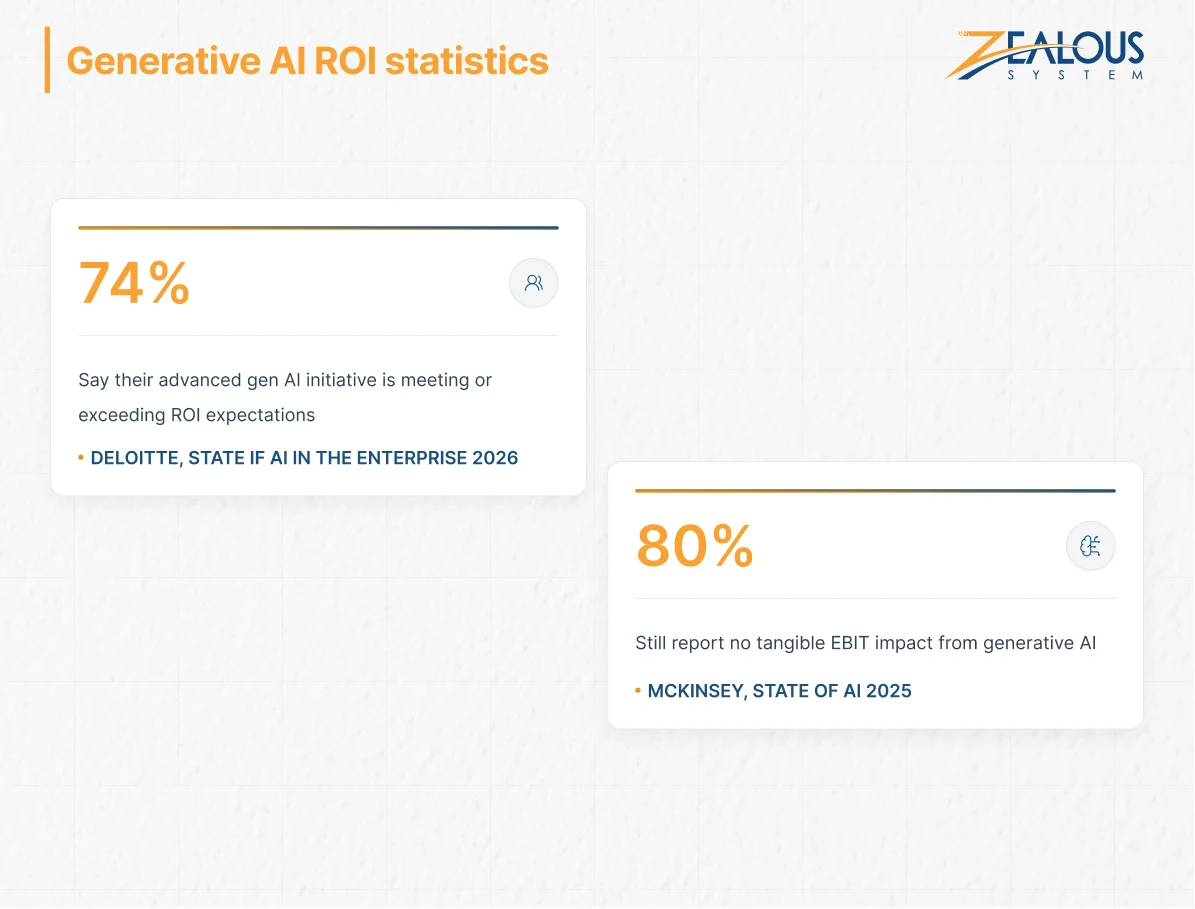
74% of organizations say their most advanced generative AI initiative is meeting or exceeding ROI expectations.
About 20% of organizations report specific AI projects delivering more than 30% return on investment.
As per an EY survey, companies allocating more than 5% of their IT budget to AI see 70-75% of projects yield positive results, compared to just 50-55% among lower spenders.
Generative AI boosted productivity by 20-30% for junior employees and 10-15% for senior staff in consulting and professional services.
AI high performers achieve returns exceeding $10.30 per dollar invested, nearly three times the average return reported by other organizations.
Where the gap shows up
More than 80% of organizations still report no tangible EBIT impact from generative AI, despite widespread adoption.
Just 6% of organizations qualify as McKinsey’s “AI high performers,” defined as attributing more than 5% of EBIT to successful AI deployment.
Only 1% of company executives in developed markets describe their generative AI rollouts as “mature”.
The journey from AI pilot to production remains the hardest stretch. Deloitte’s 2026 report notes that scaling to strong ROI typically takes 6 to 12 months or longer, and most early pilots prioritize learning over deployment.
Only 20% of organizations are actively measuring generative AI ROI at all, even though 95% expect AI to become central to how they work within five years.
Revenue growth remains aspirational for most: 74% of organizations hope to grow revenue through AI initiatives, but only about 20% report actually doing so today.
That gap between running pilots and rebuilding processes around them is where most implementations stall, and it’s the core problem a generative AI development solutions provider is engaged to solve.
Generative AI’s Impact on Jobs & the Workforce
The labor market data tells a more nuanced story than either “AI will take your job” or “nothing is changing” headlines suggest.
Net job creation versus displacement
The World Economic Forum projects AI and related technologies will create approximately 170 million new jobs globally by 2030, while displacing around 92 million, for a net gain of roughly 78 million positions.
86% of employers expect AI to fundamentally change how their businesses operate by 2030.
Job disruption is projected to touch 22% of all jobs globally by 2030, a mix of roles changing rather than simply disappearing.
Goldman Sachs estimates that around 300 million full-time jobs globally could be affected by generative AI, with administrative, legal, and office-based roles facing the highest exposure.
McKinsey Global Institute suggests up to 30% of hours worked in the U.S. economy could be automated by 2030.
Wage and skills impact
Workers with advanced AI skills earn a 56% wage premium over peers in identical roles without those skills, up from a 25% premium the year before.
Mentions of “GPT” in job postings increased roughly 21-fold within a single year, reflecting surging demand for AI-fluent talent.
GPT-4o’s accuracy on that benchmark dropped from 98.2% to 64.4% under certain conditions, illustrating how performance can swing based on how a question is framed.
When a false statement is presented as something the user themselves believes, model accuracy collapses noticeably compared to when the same false claim is attributed to a third party.
In legal research specifically, purpose-built legal AI tools still hallucinated 17% to over 34% of the time on challenging queries, according to a Stanford RegLab and Stanford HAI study.
ECRI, an independent patient safety organization, ranked AI chatbot misuse as the single greatest health technology hazard for 2026.
Only 8% of organizations globally have a comprehensive AI governance framework in place, dropping to just 2% among small firms (Evolvance Market Research).
The share of organizations with no responsible AI policy at all fell from 24% to 11% year over year, suggesting governance is catching up, slowly.
Gartner predicts 25% of enterprise generative AI applications will experience at least five minor security incidents per year by 2028, up from 9% in 2025.
76% of enterprises cite data privacy and security as their top concern when scaling AI deployments.
35% of organizations admit they could not shut down a rogue AI agent if one emerged in their environment, according to Writer’s governance research.
Generative AI Trends to Watch Through 2027–2030
Agentic AI is the clearest throughline connecting every forecast for the next several years, alongside a parallel wave of regulation trying to keep pace.
Gartner predicts 40% of enterprise applications will feature task-specific AI agents by the end of 2026, up from less than 5% in 2025.
By 2027, Gartner expects over 40% of current agentic AI projects to be canceled due to rising costs, unclear value, or weak risk controls, a sobering counterpoint to the adoption hype.
By 2028, Gartner expects 33% of enterprise software applications to carry agentic AI capabilities, up from under 1% in 2024, and at least 15% of day-to-day work decisions are projected to be made autonomously through agentic AI by the same year.
Gartner projects that by 2030, 80% of enterprise software will handle text, images, audio, and video natively, up from less than 5% in 2024.
The global AI agents market alone is projected to exceed $50 billion by 2030, growing at a 44.9-46.3% CAGR, and AI agents are projected to intermediate more than $15 trillion in B2B spending by 2028.
Only 17% of organizations have deployed AI agents as of the 2026 Gartner CIO survey, yet more than 60% expect to do so within two years, the most aggressive adoption curve of any emerging technology Gartner currently tracks (Gartner, 2026 Hype Cycle for Agentic AI).
Key Takeaways
A few patterns hold steady across nearly every source in this roundup. Adoption has become close to universal, with 88% of organizations using AI somewhere in the business, but only 7% have scaled it fully. Market size estimates vary by as much as 5x depending on methodology, so treat any single headline figure with appropriate skepticism. Real ROI exists and is well-documented, but it concentrates heavily among a small group of high performers who redesigned workflows rather than bolting AI onto old processes.
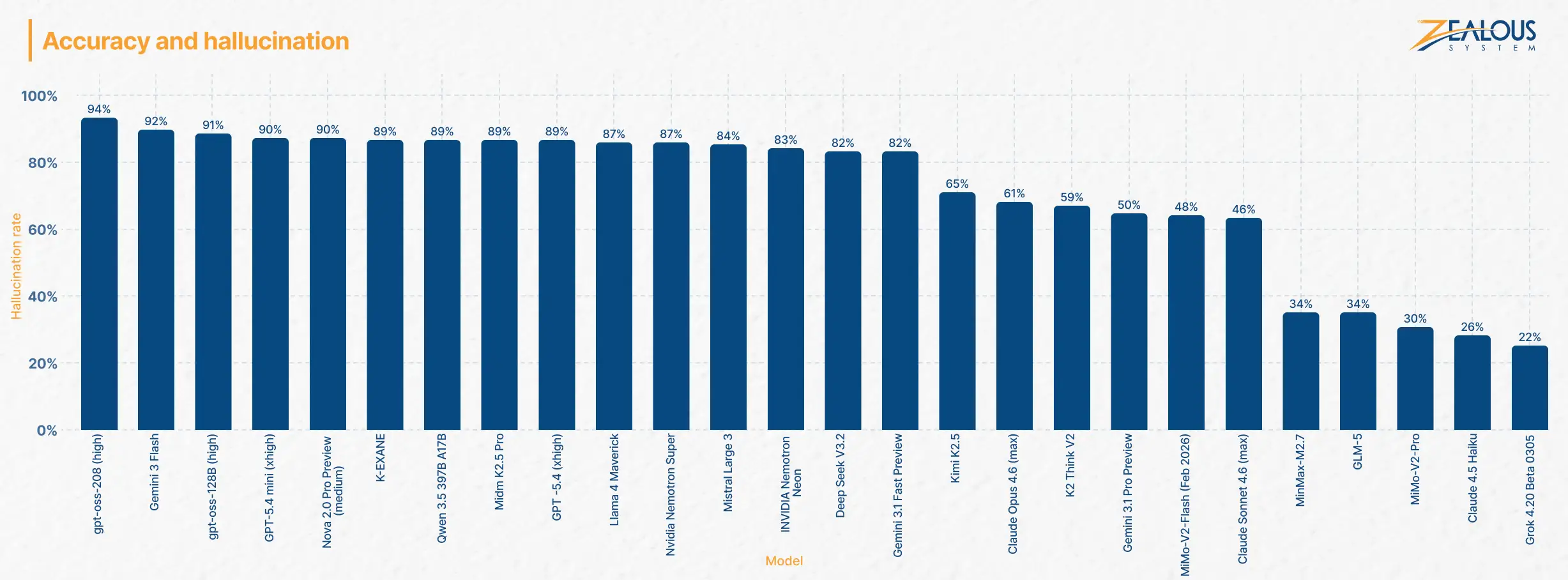
The labor market shows net job creation on paper, though the workers displaced and the workers hired rarely overlap, which is the actual reskilling challenge businesses face. And the risk data, hallucination rates as high as 94% on certain benchmarks, and governance frameworks still missing at most organizations make a strong case that scaling generative AI responsibly is now a bigger competitive differentiator than simply adopting it first.
If you’re evaluating where generative AI fits into your own roadmap, the data points in one direction: pilots are cheap and plentiful, but the businesses capturing real value are the ones treating AI as an operational redesign, not a tool swap. At Zealous System, our generative AI development services focus on that exact shift, moving teams from scattered AI experiments to systems that hold up in production.
We are here
Our team is always eager to know what you are looking for. Drop them a Hi!
Pranjal Mehta is the Managing Director of Zealous System, a leading software solutions provider. Having 10+ years of experience and clientele across the globe, he is always curious to stay ahead in the market by inculcating latest technologies and trends in Zealous.




Comments