Quick Overview:
A healthcare AI voice agent is a phone system that holds a natural conversation with a patient, completes a task inside your clinical systems, and hands off to staff when it hits something it should not handle alone. It answers, it does the work, and it writes the result back. That last capability is what healthcare AI voice agent development is actually about.
The economics are not subtle. The 2025 CAQH Index found that U.S. healthcare still has a $21 billion savings opportunity sitting inside manual and partially manual administrative transactions. Meanwhile, the 2025 AMA Prior Authorization Physician Survey found that physicians and their staff spend an average of 13 hours every week on prior authorization alone, and 94% say it contributes to burnout.
The phone is where a lot of that time goes. This guide covers what these systems actually do, how they get built, what they cost, and where projects tend to fall apart.
A healthcare AI voice agent uses speech recognition, a large language model, and text-to-speech to hold an open-ended conversation with a caller. It understands free-form speech instead of menu selections, pulls live data from your systems, takes action, and escalates when needed.
You will also see these systems called AI receptionists, AI phone agents for clinics, or simply conversational AI. The labels differ by vendor; the underlying architecture is the same.
An IVR system, by contrast, routes. It presents options, collects keypresses, and moves the caller somewhere else. Useful in 2005. Frustrating now.
The practical difference shows up in what happens after the caller states their problem.
| Capability | Traditional IVR | Voice Bot (Scripted) | AI Voice Agent |
|---|---|---|---|
| Input Method | Keypad and fixed phrases | Limited voice commands | Natural, open-ended speech |
| Handles Interruptions | No | Rarely | Yes, through barge-in support |
| Live EHR Data Access | No | Read-only, if any | Read and write |
| Completes the Task | No, it transfers | Sometimes | Yes, in most Phase 1 workflows |
| Handles Unexpected Phrasing | Fails | Fails | Resolves or escalates cleanly |
| Setup Effort | Low | Moderate | High |
The distinction matters commercially, too. An IVR deflects calls. A well-built AI voice agent for healthcare finishes them, which is the difference between annoying your patients and actually reducing your staff workload.
Every healthcare voice agent runs the same three-stage loop, several times per call, in under a second.
The call arrives through a SIP trunk or a provider like Twilio, and audio streams to a speech-to-text engine that transcribes as the patient talks rather than waiting for them to finish.
An orchestration layer tracks what the patient wants and where the conversation sits. It passes the transcript to the model along with context pulled from your scheduling rules or policy documents, a retrieval-augmented generation (RAG) step that keeps answers grounded. The model picks an action, and function calling turns that choice into a real write against your EHR or eligibility service. This layer, not the model, enforces what the agent may and may not do.
The reply goes to a text-to-speech engine and back to the caller. The full round trip needs to land under roughly 800 milliseconds, and comfortably under 500 for the conversation to feel natural.
That budget is tighter than it sounds. On the builds we have measured, telephony alone consumes 100 to 150 milliseconds before your own code runs.
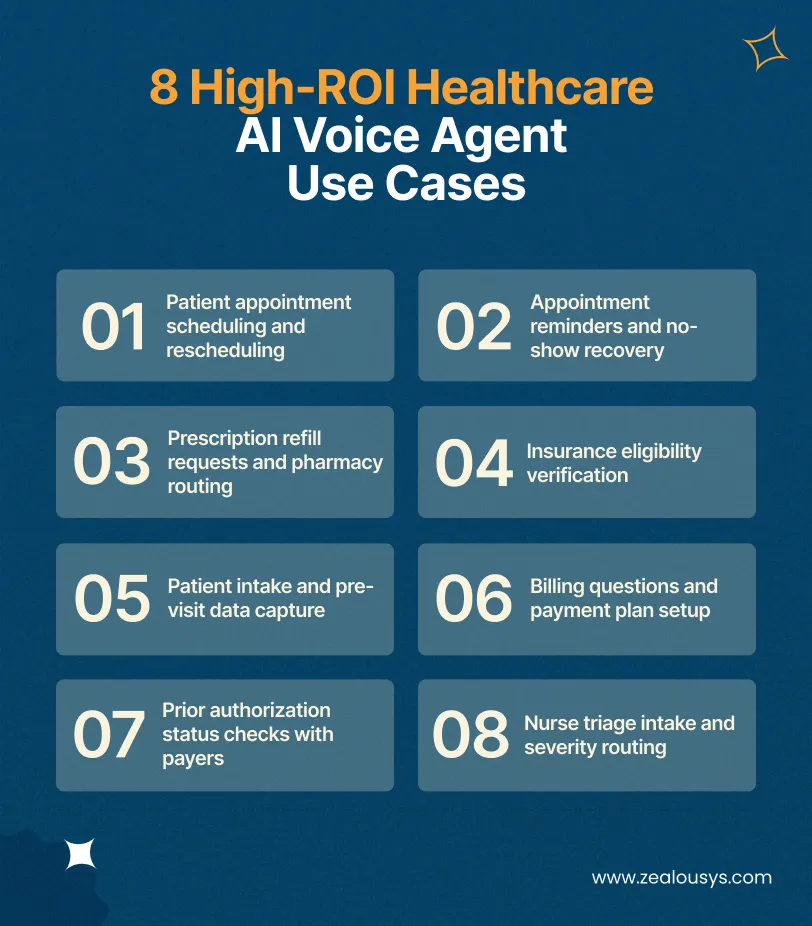
Not every workflow deserves automation on day one. Sort candidates by three things: how much call volume they represent, how much clinical risk they carry, and how easily you can undo a mistake.
Scheduling scores well on all three. Triage does not. The eight below run roughly in the order most practices should build them.
When to build: Phase 1. High volume, low clinical risk, fully reversible.
Scheduling is the largest single category of inbound calls in most practices, and it is the safest place to start. It also picks up after-hours calls that currently reach voicemail or a paid medical answering service, which is often where the clearest cost comparison sits. The agent verifies identity, checks live availability, books or moves the slot, and writes the record back. If it gets something wrong, staff simply move the appointment. That safety margin is why almost every successful deployment begins here.
When to build: Phase 1. Outbound, low clinical risk.
This workflow generates revenue rather than saving cost, which makes it the easiest business case to take to a CFO. Missed appointments leave slots that could have been refilled, and recall lists usually sit untouched because nobody has the staffing to work them. An agent that confirms appointments, offers a reschedule on the spot, and refills the vacated slot attacks your no-show rate and your empty-slot problem at the same time. Note that outbound calls carry a consent requirement that inbound calls do not. The compliance section below covers it.
When to build: Phase 1. Moderate volume, low-to-medium clinical risk.
Refill requests are repetitive, well-structured, and rarely need clinical judgment at the intake stage. The agent captures the medication, confirms the pharmacy, checks the last fill date, and queues the request for provider approval. The clinical decision stays with a human; only the data collection is automated. Practices running pharmacy management software development projects often find this the easiest workflow to connect.
When to build: Phase 1. Moderate volume, low clinical risk.
Patients call to ask what their plan covers, and staff spend the call looking it up. An agent connected to your eligibility service answers immediately, and because the response comes from a lookup rather than the model’s own knowledge, the risk of a wrong answer stays low. Ground these responses in retrieval rather than letting the model generate them.
When to build: Phase 2. Moderate volume, low clinical risk.
The agent calls ahead of the visit to collect demographics, insurance updates, medication lists, and reason for visit, then writes it to the chart. Clinicians walk into the room with a completed record instead of spending the first five minutes on data entry. This one needs careful confirmation loops, since a misheard medication name carries real consequences.
When to build: Phase 2. Moderate volume, low clinical risk.
Balance inquiries and payment arrangements are high-frequency, low-complexity calls that tie up billing staff. The technical work here is less about conversation design and more about a clean, audited connection to your revenue cycle system.
When to build: Phase 2. Staff-facing, medium clinical risk.
This is an outbound agent that calls payers, so your staff does not sit on hold. The 2025 AMA Prior Authorization Physician Survey found practices spend an average of 13 hours a week on prior authorization, with 40% of physicians employing staff dedicated exclusively to it. Payer phone trees are unpredictable, so expect this workflow to need more tuning than any inbound equivalent.
When to build: Phase 3, if at all. Lower volume, high clinical risk.
Triage is the workflow everyone asks about first and should build last. An agent can reasonably collect symptom information and route the call, but the moment it starts assessing severity, you have moved into clinical decision support with the regulatory questions that brings. Most organizations get better returns from perfecting the seven workflows above.
A voice agent is a pipeline, and pipelines fail at their weakest stage. Here is what sits in each layer and what tends to go wrong.
| Layer | Common Choices | What Catches Teams Out |
|---|---|---|
| Telephony | Twilio, Amazon Connect, SIP or WebRTC into existing PBX | BAA coverage varies by product tier, not just by vendor |
| Speech-to-Text | Deepgram, AWS Transcribe Medical, Azure AI Speech, fine-tuned Whisper | Clinical terms fail at much higher rates than overall accuracy suggests |
| Orchestration | LangGraph, Rasa, custom state machine | Unconstrained agents drift; healthcare needs bounded state transitions |
| Reasoning Model | GPT-class, Claude, or a hosted open model in your VPC | Zero-retention terms are mandatory, not a nice-to-have |
| Retrieval | pgvector, Pinecone, Azure AI Search | Ungrounded models invent coverage rules, which is your biggest liability |
| Text-to-Speech | ElevenLabs, Azure Neural TTS, PlayHT | Cloning a real staff member’s voice creates consent problems |
| Integration | FHIR R4, HL7 v2, Epic and Cerner APIs, custom middleware | Write scopes are usually the longest item in the schedule |
| Observability | OpenTelemetry, Datadog, immutable storage | Retention policy must match your state law, not just the HIPAA floor |
One finding deserves specific attention when you choose a speech engine.
Researchers evaluating ASR models on accented clinical English, published at Interspeech 2024, found that models with respectable overall word error rates still made disproportionately high errors on drug names, diagnoses, and lab results. Fine-tuning on accented clinical speech improved medical word error rate by 25% to 34% relative.
Separately, a 2026 study in npj Digital Medicine found Whisper error rates were significantly higher for non-native English speakers, though a language-model post-processing step recovered much of the lost accuracy.
Read together, those two papers say something practical: budget for domain fine-tuning, and test your accuracy separately for accented callers. “Hydralazine” and “hydroxyzine” are one phoneme apart.
Feature lists in vendor decks run long. In practice, nine capabilities decide whether the agent survives contact with real patients.
Patients talk over the agent constantly. If it cannot stop mid-sentence and start listening, callers hang up. This rests on turn detection, meaning the agent works out when someone has genuinely finished speaking instead of counting a fixed pause.
Longer gaps make people say “hello?” into silence. Latency is a design constraint that shapes your hosting, retrieval, and model choices, so lock the target before you pick anything else.
Medical terminology is where generic speech models break. Drug names, provider names, and diagnosis terms need custom lexicons layered on top of the base engine.
This is a patient safety requirement, not a polish item. Audit accuracy by demographic segment, not just in aggregate.
No PHI gets spoken aloud until the agent has confirmed who is on the line, using at least two identifiers.
The agent escalates on low confidence, distress signals, or clinical keywords, and passes the full transcript so the staff member does not start from zero. Human-in-the-loop escalation belongs in the design from week one rather than bolted on after the pilot goes sideways.
Reading availability is straightforward. Writing a confirmed appointment, updating a note, and firing a task to the right queue is where the real work sits.
Every turn, every intent, every write, timestamped. You will need this at audit time.
Containment rate, escalation reasons, and intent-level accuracy, visible to your operations team without filing a data request.
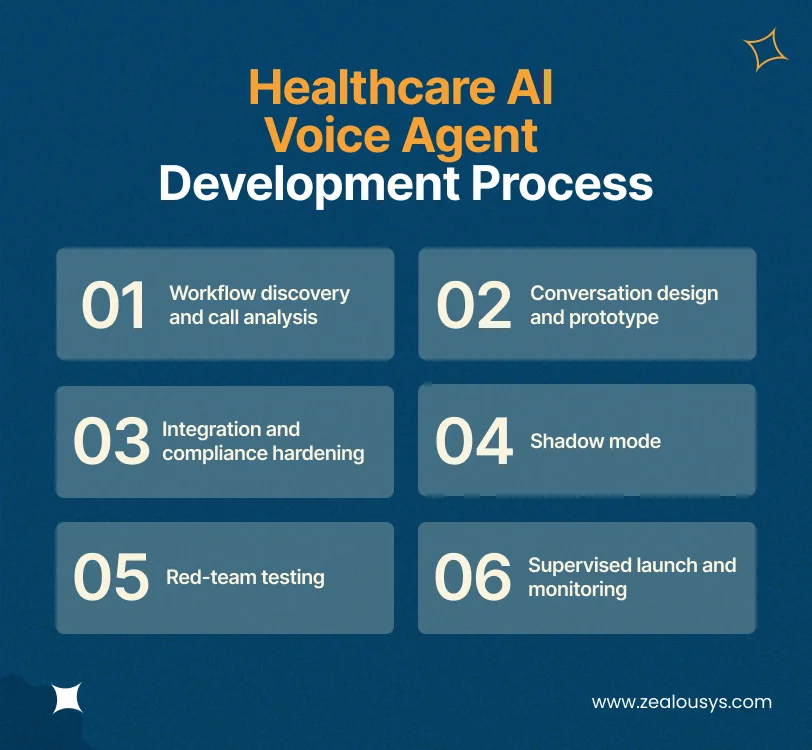 The sequence below is not arbitrary. Teams that start with model selection almost always rebuild their integration layer later.
Pull three months of call data and categorize by reason, volume, and handle time. This is where you build your intent taxonomy, which becomes the specification everything else follows. Two weeks.
Design the dialogue flows, confirmation loops for high-stakes data like date of birth and member ID, and escalation triggers. Get a working conversational loop running before touching the EHR. Two to three weeks.
Connect to your EHR and practice management system through middleware, sign the BAAs, and implement encryption, access controls, and audit logging. Four to eight weeks, and usually longer than planned.
The agent listens to live calls and drafts what it would have said while humans handle the actual conversation. You compare, you tune, and no patient is affected. Skipping this step is the most common reason a pilot gets pulled in week three.
Deliberately test the ugly cases: callers in distress, heavy background noise, code-switching mid-sentence, hearing-impaired callers, and someone trying to extract another patient’s information. Two weeks.
Go live on one workflow at two or three locations rather than one workflow everywhere. Track containment, first-call resolution, escalation reasons, intent accuracy, and handle time on escalated calls weekly. If containment climbs while escalated handle time also climbs, the agent is punting hard calls late instead of early. Fix the handoff trigger, not the model.
Read access through FHIR R4 is well supported across Epic, Cerner, athenahealth, and eClinicalWorks. Write access is a different conversation, involving your EHR vendor’s app review process, your security team, and often your CMIO. In our experience, sandbox access and vendor certification take six to twelve weeks on their own, running in parallel with your build if you start early enough.
Three rules worth applying: never let the agent write directly to a clinical record, keep a local read cache for availability lookups so a slow EHR does not add seconds to every turn, and version your intent-to-action mapping so scheduling rule changes produce a diff rather than a mystery. Teams already investing in EHR and EMR software development should sequence the voice agent after that interoperability work lands.
Healthcare AI voice agent development typically costs between $20,000 and $250,000 or more. The spread is wide because two projects with the same description can differ tenfold in integration depth. The ranges below come from our own project scoping rather than published benchmarks, since almost nobody publishes real numbers for this work. Treat them as a planning baseline, not a quote.
In our experience, the budget splits into engineering, integration, and compliance work, with compliance taking around a quarter of the total. That quarter is the first thing procurement cuts and the most expensive thing to retrofit.
| Tier | Scope | Timeline | Cost Range |
|---|---|---|---|
| MVP/Pilot | One workflow, single location, read-only EHR access | 6 to 10 weeks | $20,000 to $45,000 |
| Mid-Complexity | Two to four workflows, bidirectional EHR write, multi-location | 3 to 5 months | $45,000 to $110,000 |
| Advanced | Five or more workflows, multilingual, payer integrations | 5 to 8 months | $110,000 to $250,000 |
| Enterprise | Full patient access replacement, multi-site health system, dedicated model hosting | 8 to 14 months | $250,000 and up |
One workflow, usually scheduling, at a single location. The agent reads availability from the EHR but does not write back, so a staff member confirms bookings. This tier exists to prove your containment rate on real calls before you commit further budget, and it is the right starting point for practices testing whether voice works for their call mix at all. Expect 6 to 10 weeks. An MVP development company approach fits this tier well, since the goal is validated numbers rather than a finished product.
Two to four workflows with bidirectional EHR write access across multiple locations. This is where most production deployments land. The jump in cost from the pilot tier comes almost entirely from write-scope approval and the middleware layer that sits between the agent and your clinical record. Budget 3 to 5 months, and start the EHR vendor approval process before development begins.
Five or more workflows, multiple languages, and payer-side integrations for eligibility or prior authorization. Complexity rises faster than the workflow count suggests, because each additional language needs its own clinical vocabulary work and accuracy testing, and payer systems are far less predictable than your own. Plan for 5 to 8 months.
A full patient access replacement across a multi-site health system, typically with dedicated model hosting inside your own environment rather than shared APIs. At this scale, the voice agent becomes one component of a broader automation program, sharing a governance layer and audit trail with other agents. Timelines run 8 to 14 months, with EHR and security approvals accounting for a large share of that.
Bidirectional EHR write access is the single largest swing factor and can add tens of thousands on its own. After that: each additional production language, whether you are retrofitting compliance onto an existing prototype, your monthly call volume, and whether you host the model on shared APIs or in a dedicated VPC.
Budget roughly 18% to 25% of build cost annually. Inference and telephony are metered, so your run-rate rises as the agent handles more calls. Model that curve before signing a multi-year budget, because success and cost move in the same direction here.
Voice is the highest-risk modality you can deploy in healthcare, and most teams underestimate it. Audio is biometric. Transcripts are PHI. Model context windows raise retention questions that nobody asks until legal does.
Every subprocessor that touches audio or transcripts needs a signed Business Associate Agreement. The common failure is partial coverage: the telephony provider has a BAA, the speech engine has one, and the text-to-speech vendor does not. Map the full path a single utterance takes and check each hop. Ask for a SOC 2 Type II report alongside each BAA: the agreement tells you what a vendor promises, the audit tells you what they actually run.
Your model provider must contractually agree not to retain or train on your data. For higher call volumes or stricter security postures, a VPC deployment gives you the retention guarantee by architecture rather than by contract.
HHS published a Notice of Proposed Rulemaking on January 6, 2025, that would make encryption at rest and in transit, multi-factor authentication, and regular vulnerability testing mandatory rather than “addressable.” Worth being precise here: as of mid-2026, this remains proposed. No final rule has been issued, and the current Security Rule stays in effect. Most healthcare organizations are building to the proposed standard anyway, because retrofitting these controls later costs multiples of designing them in.
Inbound calls carry implied consent. Outbound automated calls do not. Reminder and recall campaigns need documented consent and a working revocation path, and this catches teams who treat outbound as a simple extension of an inbound agent.
HIPAA does not preempt stricter state privacy law. Several states regulate voiceprints and biometric data separately, and two-party recording consent varies. You also need an accessible path for callers the agent cannot serve, including TTY and relay support.
The largest clinical liability is not a data breach. It is an agent inventing a copay amount or a coverage rule. Ground every policy answer in retrieval against your actual documents, and design the agent to refuse and escalate rather than guess. Any team building healthcare software development projects under HIPAA will recognize this pattern from other contexts, but voice raises the stakes because the answer is spoken with confidence and never reviewed.
Most articles on this topic argue for a custom build, which is convenient for the agencies writing them. The honest answer is that buying is often correct.
Two categories exist. Healthcare-specific voice platforms include Assort Health, Parakeet Health, Infinitus Systems, and Hyro, several of which Grand View Research identifies among the leading vendors in this space. These arrive with scheduling logic, EHR connectors, and BAAs already in place. Horizontal platforms like Retell AI, Vapi, and Bland give you the voice infrastructure but leave the healthcare layer, and often the compliance work, to you.
Many organizations start on a platform to prove the containment numbers, then build custom for the workflows the platform handles badly. That sequence is cheaper than committing to a full build before you know which calls the agent can actually finish. An AI agent development company worth working with will tell you which category you fall into before quoting.
Most agencies can build a working voice demo in two weeks. Very few can get one through a hospital security review. Ask about the second thing.
Ask which EHRs they have shipped bidirectional write access against, and what the approval process looked like. Vague answers here predict schedule overruns.
Ask when compliance work starts. If the answer is anything other than the first week, expect a retrofit.
Ask for their turn-time budget on a previous build, broken down by pipeline stage. Teams who have not measured this have not shipped a voice agent that felt natural.
Ask how they run shadow mode and what their red-team scenarios cover. If distress detection and identity-extraction attempts are not on the list, keep looking.
Voice agents drift as scheduling rules, payer policies, and staffing change. Confirm who owns tuning after go-live and what that costs. Firms offering AI integration services alongside development are generally better set up for this than pure build shops.
Not by default. A HIPAA-compliant AI voice agent is a property of your whole architecture rather than a feature any vendor supplies. You need signed BAAs with every subprocessor touching audio or transcripts, encryption at rest and in transit, role-based access control, immutable audit logs, a documented retention policy, and zero-retention terms with your model provider.
A single-workflow pilot runs $20,000 to $45,000. A production system with two to four workflows and bidirectional EHR write access lands between $45,000 and $110,000. Multilingual deployments with payer integrations run $110,000 to $250,000, and enterprise patient-access replacements go beyond that. Add 18% to 25% of build cost annually to run it.
Yes. Read access through FHIR R4 is well supported across Epic, Cerner, athenahealth, and eClinicalWorks. Write access requires scope approval from the EHR vendor plus security sign-off, and certification alone can take six to twelve weeks. Route writes through a middleware queue with idempotency keys rather than letting the agent touch the clinical record directly.
A single-workflow pilot takes 6 to 10 weeks, a multi-workflow production system with EHR write-back runs 3 to 5 months, and enterprise deployments span 8 to 14 months. Write-scope approval is almost always the longest item, so start it on day one.
An IVR routes calls through fixed menus and keypad input, then transfers the caller to a person. An AI voice agent understands natural speech, retrieves live data from your clinical systems, completes the task, writes the result back, and escalates only when needed. IVR deflects work. A voice agent finishes it.
Administrative agents handling scheduling, reminders, refill routing, and billing generally do not meet the definition of a medical device. Agents that assess symptoms or recommend a level of care may fall within FDA guidance on Clinical Decision Support Software, depending on how the output is presented and whether a clinician can independently review its basis. Take this to regulatory counsel before you build.
Yes, and for most U.S. providers, Spanish belongs in the first production release rather than a later phase. Each additional language adds meaningfully to the build through clinical vocabulary work and accuracy testing. Test specifically for code-switching, since patients frequently move between languages mid-sentence.
Ask any vendor for accuracy broken down by intent and by caller demographic rather than a single headline number. Aggregate word error rate hides the failures that matter, since research consistently shows clinical terms and accented speech perform worse than the overall figure suggests.
Healthcare AI voice agent development succeeds or fails on decisions made before anyone writes code. Pick workflows you can reverse. Set your latency budget first. Start EHR write approval early. Design compliance in rather than bolting it on. Run shadow mode even when the launch date is tight.
And be honest about whether you should be building at all. A practice with standard scheduling on a mainstream EHR will often get more value from a platform than from a custom system, and knowing that upfront saves a great deal of money.
At Zealous System, we build custom AI voice agents and healthcare software for organizations where the packaged option genuinely does not fit, and we will say so when it does. If you are weighing this decision, starting with your own call data rather than a feature list tends to produce a much clearer answer.
Our team is always eager to know what you are looking for. Drop them a Hi!

Pranjal Mehta is the Managing Director of Zealous System, a leading software solutions provider. Having 10+ years of experience and clientele across the globe, he is always curious to stay ahead in the market by inculcating latest technologies and trends in Zealous.


Comments