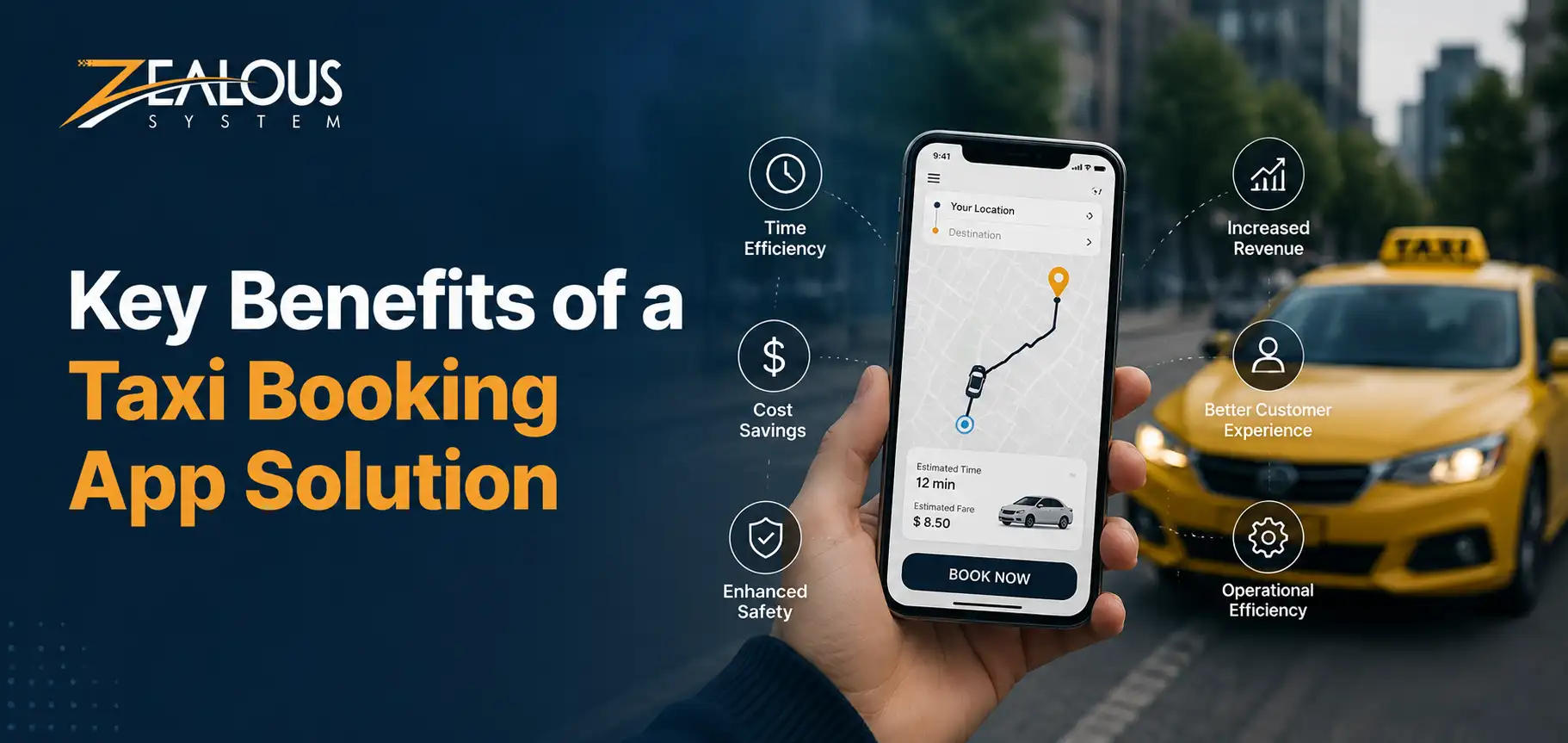
Not long ago you got a taxi by standing at the curb with your arm out, or by ringing a local number and hoping someone was free. Plenty of places still work like that. But in most cities the whole thing has moved onto the phone. You see the fare before you agree to it, watch the car close the distance on a map, and get out without anyone hunting for change.
A taxi app built around how the business actually runs takes the repetitive part off your hands finding the nearest free driver, quoting the fare, confirming the trip and shows you what the fleet is doing while it happens. The passenger gets a ride they can follow. You get something you can actually manage.
A taxi booking app is really three apps wearing one name. Passengers get one view, drivers get another, and whoever runs the business gets a third. Each side only sees what it needs to do its job.
The passenger side is the simple one. Open it, type where you are and where you’re going, look at what’s on offer, pick something. Then you watch the car get closer on the map and pay when you climb out. The driver’s version is a different rhythm: a request pings, you take it or you let it go. If you take it, you navigate to the pickup, tap to start the trip, tap again when it’s done, and check at the end of the shift what the day was worth.
The admin panel is where the business actually sits. A manager logs in and sees bookings landing in real time, which drivers are online and where they are, what the fare rules are doing to margins, and what the week’s transactions add up to.
Convenience is what actually gets people off the phone. Try describing the building you’re standing outside to a dispatcher who’s never been to that part of town. You’ll be there a while, and half the time the car still ends up on the wrong side of the road. A pin takes two seconds and it’s right.
It gets easier still once the app knows your usual places, or lets you book ahead. Someone catching a 6am flight can lock the ride in the night before, instead of standing outside at 3:40 wondering if anyone’s going to turn up.
On the operator’s side the win is quieter but bigger. Fewer calls to take, and nothing to retype. What the passenger enters is what the driver sees no more, sending a car to the wrong Church Street because two people heard the same address differently.
Managing a fleet becomes difficult when driver information is scattered across phone calls, spreadsheets, and separate communication channels. A taxi application brings much of this information into one place.
Open the admin panel and the whole fleet is right there, free, mid-trip, clocked off. And you decide how jobs get handed out. Nearest car wins is the usual default, but you can route by vehicle type instead, or mix the two if that’s closer to how your dispatchers already think.
This can help reduce unnecessary driver movement. Rather than manually contacting several drivers to find someone for a particular booking, the system can identify suitable drivers and send the request through the application.
Better visibility also makes it easier for managers to identify operational issues, such as long idle periods or areas where vehicles are frequently in short supply.
Passengers generally want to know where their driver is after placing a booking. Live GPS tracking gives them that visibility.
Once a driver accepts, the passenger watches the car move and knows roughly when it’ll arrive. The driver gets turn-by-turn to the pickup and then to the drop, which matters most in the parts of town where the lanes all look the same.
For the business, the map is a live picture of where the work is. You can see every active trip and where your cars are clustered at four in the afternoon.
It’s also what you fall back on when something goes wrong mid-ride. A passenger calls in upset, and instead of asking them to describe where they are, you already have the trip, the driver, and the route in front of you.
Payment flexibility can make a noticeable difference to the booking experience. Different customers have different preferences, so limiting passengers to one payment method may create unnecessary friction.
A modern taxi platform can support options such as:
Automated fare calculation can further simplify the process. Once a trip is completed, the passenger can receive a digital receipt and view the transaction history within the application.
For operators, digital transactions also make financial records easier to organize. Instead of manually reconciling every booking, payment information can be connected to individual trips and customer accounts.
The relationship doesn’t end when the passenger closes the door. That’s usually where operators lose it, though the ride finishes, the app goes quiet, and the next booking goes to whoever shows up first in the search results.
An app gives you somewhere to keep that connection alive. Passengers rate the driver, say what went wrong or right, pull up an old trip to check a fare, or reach support when something needs sorting. Notifications carry the rest: booking confirmed, driver two minutes away, trip done, here’s 15% off your next ride.
And then loyalty points, referral credit, a promo aimed at people who haven’t booked in six weeks. All of it works because the app already knows who they are.
Three things doing the heavy lifting here: the paragraph openers no longer all start with a noun phrase, the four-verb lists are broken up, and I put in specific numbers (eleven complaints, six weeks, 15%). Concrete detail is the single strongest signal against detection, because generative text drifts toward the general.
A taxi company deals with dozens or even hundreds of small operational decisions throughout the day. Which driver should receive a booking? How many vehicles are active? Which area is generating demand? How much revenue came from completed trips?
Handling these questions manually takes time and makes it harder to maintain an accurate picture of the business.
An on-demand taxi app solution can centralize operational information so managers can work from current booking and driver data. An administrative dashboard can provide access to trip records, driver activity, customer information, pricing settings, and transaction details.
This lets the operations team spend more time handling exceptions and customer concerns instead of routine administrative work.
A digital taxi platform can support multiple income sources. The exact model depends on the business, local market, and type of service being offered.
For instance, an operator may charge a booking fee, take a commission from drivers, or use different pricing structures for different vehicle categories. Premium rides can provide another revenue stream for customers who are willing to pay more for larger or higher-end vehicles.
Scheduled transportation can also open additional opportunities. Airport transfers, business travel, event transportation, and recurring employee rides may provide demand beyond ordinary point-to-point bookings.
Some operators may also introduce subscription plans or corporate accounts. These models can create more predictable revenue while giving frequent customers an alternative to paying separately for every trip. For operators still evaluating the business model, a guide to starting a taxi business can help clarify the operational and financial considerations before investing in a booking platform.
The key point is that the application provides the infrastructure to test different commercial models without changing the entire booking process.
Most fleets start small six drivers, one part of town, everyone knows everyone. Then it works, and suddenly you’re covering three more neighborhoods and eyeing the next city. The software has to survive that, and a lot of it doesn’t.
What surviving looks like in practice: more drivers and more bookings without the dispatch slowing to a crawl, and enough control in the admin panel to run each market on its own terms. Airport surcharges in one city, none in another. A premium tier where the demand supports it, standard-only where it doesn’t. Zones drawn to match how the city actually moves, not a circle on a map.
That’s the argument for building on a platform rather than starting fresh each time you expand. New city, same system, different settings not a second technology project competing for the same budget.
Branding matters here too, more than operators expect. If your app looks like everyone else’s app, the only thing left to compete on is price, and that’s a race nobody in this business wins.
Build for what the business actually runs on, not for a spec sheet you can wave at investors. That said, a handful of things show up in almost every working fleet:
Having the features isn’t the point. Building them well is. A driver fumbling through three screens to mark a trip complete will stop doing it properly by week two, and GPS that drops the pin half a block off turns every pickup into a phone call.
Passenger experience is made of small things, and most of them happen in the gaps.
Booking has to be quick, that part’s obvious. What matters more is the next thirty seconds: a confirmation, a name, a number plate, a photo. Then the wait, which is where most anxiety lives. A car moving on a map is the difference between waiting and wondering whether anyone’s coming. During the ride, the route and the running fare are both visible, so nobody’s doing mental arithmetic in the back seat. At the end, digital payment and a receipt that lands on its own. No cash, no asking for a bill.
None of that is impressive on its own. Together it’s the whole thing. When booking, tracking, paying, and getting help all just work, a passenger has no particular reason to go looking at another app and that’s most of what retention actually is in this business.
A taxi booking platform changes two things at once how customers reach you, and how you run the place. Passengers get a faster way to get a car. You get real handles on drivers, bookings, money, and whether any of it is working.
The app itself was never the point. What matters is that information stops needing a human to carry it. The pickup address the passenger typed is the address the driver sees. The trip the driver closed is the payment that clears and the number that shows up in your weekly figures. Nobody retypes anything, and nothing gets lost between the phone and the spreadsheet.
For an operator deciding what to build on, the question is fairly narrow: does this thing bend to how I already run the business, and will my drivers still be using it properly in six months? A platform that fails the first is a straitjacket. One that fails the second gets quietly abandoned, whatever it costs.
Our team is always eager to know what you are looking for. Drop them a Hi!

Hardik Gupta is the Team Lead for Mobile App Development at Zealous System. He specializes in creating innovative mobile applications for iOS and Android, focusing on delivering high-performance solutions and staying ahead of industry trends.


Comments