
Quick Overview
Most pharmacy systems running in the UAE today were designed for a simpler job: ring up a sale, print a receipt, track stock at batch level. That job has changed.
A pharmacy in Dubai now sits inside a connected health data environment, reports serialised medicine movement to a federal traceability platform, exchanges prescription and claim data with payers, and serves customers who expect an Arabic interface and same-day delivery. Software written before those requirements existed cannot be patched into compliance, which is why pharmacy software development in the UAE now starts with the regulatory surface rather than the feature list.
This guide covers what a pharmacy software development project in the UAE actually involves: the features that matter, where AI genuinely earns its place, the regulatory and integration work involved, realistic costs, and how long a build actually takes. It is written for people scoping a project, not shopping for a product.
Not every pharmacy needs a custom build. These four groups usually do.
Once you pass three or four outlets, the cracks show up in the same places: stock that cannot be moved between branches without a phone call, sales figures that take a week to consolidate, and no single view of near-expiry inventory. Fixing that means a multi-branch pharmacy management system that treats branches as nodes on one platform rather than separate installations sharing a logo, backed by inventory management software that holds one stock picture across every outlet.
E-pharmacy app development means running two systems at once: a consumer-facing ordering experience and a regulated dispensing operation behind it. Prescription upload, pharmacist verification, delivery restrictions on certain medicine categories, and payment flows all have to work together. For founders working on online pharmacy app development in Dubai or medicine delivery across the emirates, off-the-shelf retail software rarely handles the regulated half.
An in-house pharmacy inside a licensed facility needs to talk to the hospital management software and clinical records already in place. The integration work, not the pharmacy module itself, is usually where these projects succeed or stall.
Distributors carry the heaviest traceability burden in the supply chain, since serialisation and aggregation events have to be reported accurately at every handoff. That pushes them toward warehouse systems built around serialised stock and a customer-facing ordering portal for the pharmacies they supply.
This deserves an honest answer before you spend anything.
A single-location pharmacy with mostly cash customers, standard billing, straightforward stock control, and no plans to add delivery or a patient app will usually be well served by a licensed product. You get a working system in weeks instead of months, and the vendor handles regulatory updates. Paying for custom development here is paying for flexibility you will not use.
The signs are specific rather than strategic. You cannot trace why a batch of claims was rejected. Your system tracks batches but not serial numbers, so Tatmeen reporting is manual. Branch data does not reconcile without someone rebuilding it in a spreadsheet. You want an Arabic patient app, and your vendor cannot build one. Or you asked for a health information exchange connection and were told it is not on the roadmap.
Any one of those is survivable. Three or four together means you have outgrown the product, and each workaround is costing staff hours every day.
| Consideration | Off-the-shelf | Custom Build |
|---|---|---|
| Time to Launch | Weeks | 4 to 12 months |
| Upfront Cost | Low, subscription-based | Higher, capital investment |
| Integrations | Limited to vendor’s roadmap | Built to your requirements |
| Regulatory Updates | Vendor handles | Your team or partner handles |
| Multi-branch Control | Often basic | Designed around your structure |
| Ownership | Vendor holds the data and roadmap | You hold both |
A middle path worth considering: keep the off-the-shelf core and build only the pieces it cannot handle, connected through a software integration layer. This works well when the existing system handles counter operations acceptably, and the gap is in reporting, integration, or the customer-facing side.
Feature lists get long quickly, so here they are grouped by who actually uses them.
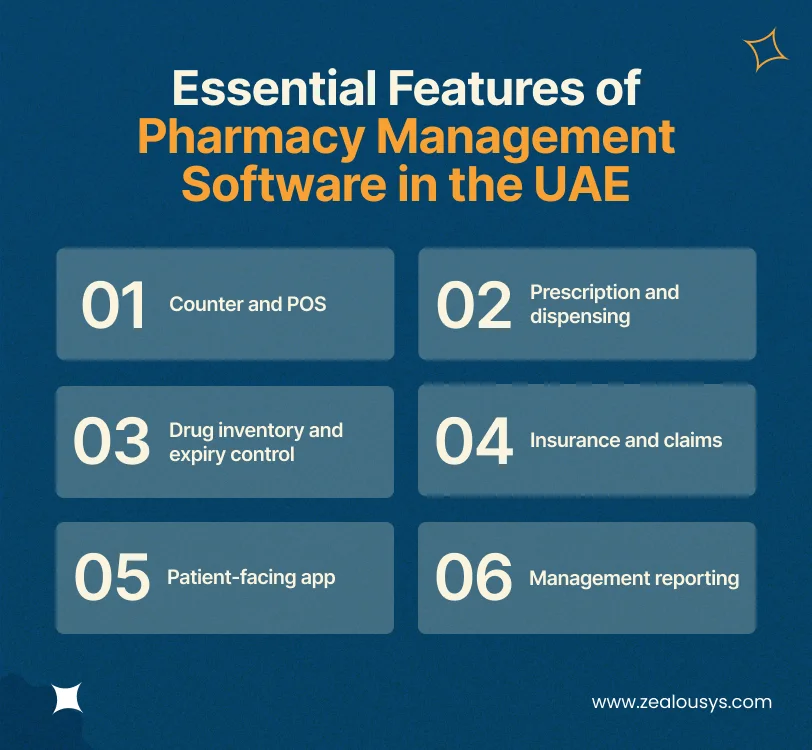
Pharmacy POS software has to handle barcode and DataMatrix scanning, split payments across cash, card, and insurance co-pay, returns, discounts, VAT handling, and receipt printing in Arabic and English. The counter has to keep working when connectivity drops, which means local caching and a sync queue rather than a purely cloud-dependent design.
Prescription capture, pharmacist verification, substitution rules, refill tracking, and controlled substance workflows with their own approval path and audit trail. Dispensing records need to carry the prescriber’s licence details, patient identifiers, and ICD-10 diagnosis coding, because that data is what payers check.
Pharmacy inventory management software needs serial, batch, and expiry tracking, near-expiry alerts with enough lead time to act, inter-branch transfers, supplier returns, and reorder logic based on consumption rather than fixed thresholds. Expiry write-offs are one of the largest avoidable losses in retail pharmacy, and the software either prevents them or does not.
Eligibility checks, prior authorisation, claim submission, remittance handling, and resubmission tracking. Rejections need to be visible by reason code so patterns get fixed rather than reworked one at a time.
Prescription upload, order placement, refill reminders, delivery tracking, and order history, in Arabic and English with proper right-to-left layout. Bilingual support is a design decision, not a translation task added at the end.
Branch-level profit and loss, stock movement, prescription volumes, rejection rates, and shrinkage. The useful version of this answers questions without anyone exporting to a spreadsheet first.
AI belongs in pharmacy software where it removes repetitive judgement calls, not where it makes clinical decisions. These are the applications that hold up.
Consumption patterns in the UAE are seasonal and local. Ramadan shifts demand, summer changes footfall in expatriate-heavy areas, and respiratory illness follows its own cycle. Models trained on branch-level history predict this far better than a static reorder point.
A model trained on your own rejection history can flag a claim before submission when it resembles ones that were denied. Fixing the data at the counter costs minutes. Reworking a rejected claim costs weeks of cash flow.
Handwritten and scanned prescriptions arrive in both Arabic and English, with brand names, generic names, and abbreviations used interchangeably. Machine reading with pharmacist confirmation cuts entry time and catches mismatches, and pairing it with AI software development work already tuned for document handling shortens the build considerably.
Rather than alerting you that stock expires in sixty days, the system suggests which branch can actually sell it based on local demand, and generates the transfer.
Timed reminders in the patient’s preferred language, based on dispensing history rather than a generic schedule. This lifts repeat purchase rates and genuinely helps patients stay on treatment.
Routine purchase orders, supplier price comparison, and invoice reconciliation are rules-heavy and repetitive, which makes them a reasonable fit for AI agent development with a human approving anything above a set value.
One boundary worth holding: interaction and allergy checking should stay rule-based against a maintained drug database. Clinical safety logic needs to be auditable and deterministic, and a pharmacist has to be able to see exactly why an alert fired.
Pharmacy software requirements in the UAE are layered. Federal rules apply everywhere, and your emirate’s authority adds its own on top.
| Emirate | Regulator | Health Information Exchange |
|---|---|---|
| Dubai | DHA (DHCC for the free zone) | NABIDH |
| Abu Dhabi and Al Ain | DoH | Malaffi |
| Sharjah, Ajman, RAK, Fujairah, UAQ | MOHAP | Riayati |
| Nationwide | MOHAP | Tatmeen applies to all |
These exchanges are connected to each other, so data quality matters beyond your own walls. The Dubai Health Authority reported that NABIDH held over 10.41 million medical records by the end of June 2025, covering 1,888 licensed facilities and 91 connected EMR systems. In Abu Dhabi, Malaffi announced passing 3.5 billion clinical records representing 12.7 million patient profiles. Records your system sends are read by clinicians elsewhere in the country.
MOHAP regulates pharmacies in the Northern Emirates and sets federal rules that apply nationally. Systems operating under MOHAP jurisdiction connect to Riayati, follow federal pharmaceutical regulations, and handle controlled substances under the relevant ministerial resolutions.
Dubai pharmacies exchange dispensing and prescription data with NABIDH, and prescriptions carry a defined data set including the prescribing clinician’s licence, the patient’s Emirates ID, the generic drug name under its international nonproprietary name (INN), and ICD-10 diagnosis coding. Pharmacist licensing records sit in the DHA’s Sheryan system.
Abu Dhabi pharmacies connect to Malaffi, submit claims through Shafafiya, and report on the DoH’s cadence. Entities in the emirate also work within ADHICS v2, the Abu Dhabi Healthcare Information and Cyber Security standard, which sets controls around access, encryption, logging, and incident handling that shape how the system is built rather than how it is used.
Tatmeen is the national track-and-trace platform run by MOHAP, and the UAE government describes it as tracking medicines from production to end use through a unique serialised 2D matrix barcode. In practice, that barcode carries the GTIN, serial number, batch number, and expiry date. Transport units are identified with SSCC codes, and supply chain participants register through BrandSync to obtain a GLN. Pharmacies sit at the end of the chain as dispensaries, responsible for reporting dispensing events.
Tatmeen integration for pharmacy software carries a significant consequence. Your inventory model has to work at serial level, not batch level, and dispensing has to generate a reportable event. Retrofitting this into a system designed around batch tracking usually means rebuilding the inventory core.
Federal Decree-Law No. 45 of 2021, the UAE’s Personal Data Protection Law (PDPL), governs how personal data is collected and processed. Federal Law No. 2 of 2019 on the use of information and communications technology in health fields covers health data specifically, including restrictions on storing and processing health data outside the country, with Cabinet Resolution No. 32 of 2020 adding further detail. Data residency is an architecture decision, so it belongs in the first design conversation rather than a pre-launch review.
Beyond VAT, the UAE is moving to structured electronic invoicing built on the Peppol network using the PINT AE format, with invoices exchanged through accredited service providers and reported to the Federal Tax Authority (FTA). A voluntary phase opened in July 2026, with mandatory adoption arriving in stages from January 2027 for larger businesses and mid 2027 for the rest. Any pharmacy POS being specified now should treat structured invoicing as a requirement rather than a later upgrade.
A note on wording you will see elsewhere: no UAE authority certifies pharmacy software as a product. Facilities are licensed, and software is built to meet the requirements those facilities carry. Treat “approved software” claims with some caution.
Integrations carry most of the technical risk in these projects, and most of the schedule risk too, since approvals and credentials often sit outside your control.
Sequence these deliberately. Health exchange and claims connections have the longest lead times, so starting them late is the most common cause of a delayed launch.
The architecture that works here separates concerns into four layers.
Presentation holds the pharmacist workstation, admin console, and patient app, each with role-appropriate access and bilingual support.
Application logic runs dispensing rules, inventory movement, pricing, and claim preparation, written so that a single dispensing action updates stock, generates the traceability event, and prepares the claim record consistently.
The data layer stores patient records, serialised inventory, transactions, and audit logs, with residency and retention rules applied at design time.
Integration and compliance deserve the most attention of the four. Isolating exchange connectors, the Tatmeen event queue, the claims engine, and the e-invoicing connection behind their own interfaces means a regulatory change affects one component instead of rippling through the whole system. Given how often UAE health and tax requirements have shifted in recent years, that isolation pays for itself.
Two decisions matter more than they first appear: the counter must function offline and reconcile afterwards, and every branch must be addable through configuration rather than deployment.
The sequence below reflects how these projects actually run rather than a generic delivery methodology. The main difference from a standard software build is that compliance and integration decisions come early, because both constrain the architecture rather than sitting on top of it.
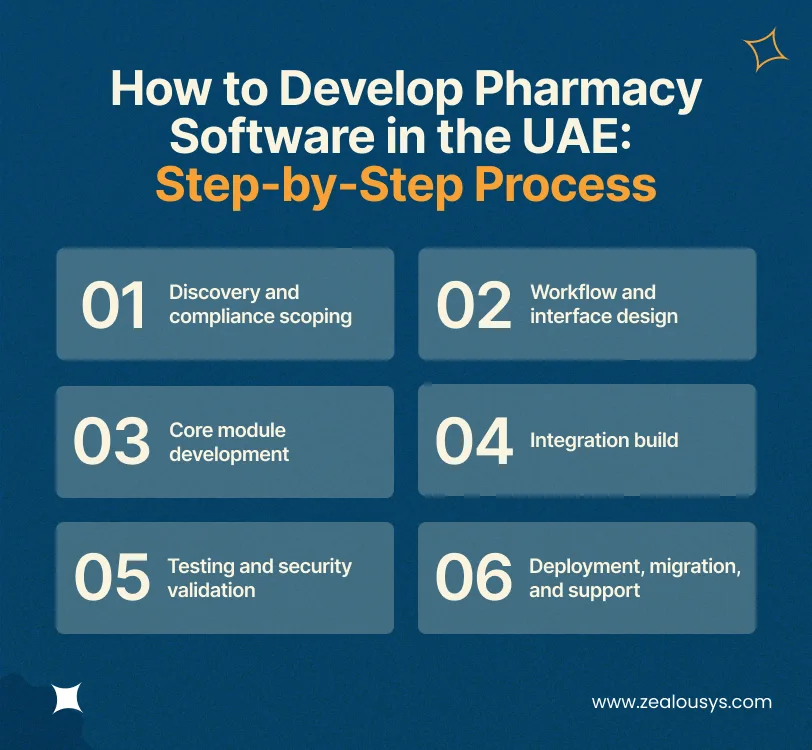
Map current workflows, identify your regulator and required integrations, and confirm data residency constraints. Compliance decisions made here are cheap; the same decisions made in month six are not.
Design around the tasks staff repeat hundreds of times a day. Counter dispensing speed matters more than dashboard polish, and Arabic layout has to be designed rather than translated.
Build inventory, dispensing, and billing first, since everything else depends on them. Serial-level inventory belongs in this phase, not a later one.
Connect the health information exchange, claims rails, Tatmeen reporting, payments, and identity services. Start credentialing early, because approvals take longer than the code.
Test complete workflows rather than isolated modules, including claim submission and rejection handling, traceability reporting, and access controls under each user role.
Migrate historical records with proper cleansing and validation, which is where data migration experience earns its keep. Roll out to a pilot branch, resolve what surfaces, then move to the rest of the network.
Pharmacy software development in the UAE generally runs from $20,000 to $250,000+ (AED 73,000 to AED 918,000+). Pharmacy software development cost in Dubai tends to sit toward the upper half of that band, since Dubai projects usually carry health exchange and claims integration from the start. The ranges below are engineering estimates based on typical scope rather than published market rates, so treat them as a planning starting point.
| Platform Type | Estimated Cost (USD) | Estimated Cost (AED) |
|---|---|---|
| Single Pharmacy, Core Operations | $20,000 to $45,000 | AED 73,000 to AED 165,000 |
| Small Chain with Health Exchange and Claims | $45,000 to $100,000 | AED 165,000 to AED 367,000 |
| Multi-branch Platform with Patient App and Delivery | $100,000 to $180,000 | AED 367,000 to AED 661,000 |
| Enterprise Platform with AI and Full Integration Coverage | $180,000 to $250,000+ | AED 661,000 to AED 918,000+ |
A single-pharmacy system typically takes four to six months. A small chain with health exchange and claims integration runs six to nine months. A multi-branch platform with a patient app, delivery, and AI features generally lands between nine and fourteen months.
Integration approvals sit on the critical path and are not fully within a development team’s control, so schedules should carry contingency there rather than in the build phases.
Compare the investment against what a broken system costs annually. Rejected claims tie up cash and staff time. Expiry write-offs are pure loss. Stock-outs send customers to the pharmacy next door. Manual reconciliation consumes hours every week across every branch. For a mid-sized chain, those figures often exceed the annual cost of the platform.
Whether you are hiring a pharmacy software development company in Dubai or working with an offshore team, these questions separate real experience from a polished deck:
The last one matters more than sector-specific pharmacy experience. Multi-role healthcare platforms with regulated data and external system connections, such as a pathology laboratory web application serving patients, lab staff, doctors, and administrators, or a patient management system built for an embassy, exercise the same engineering muscles a pharmacy build requires.
At Zealous System, we build healthcare software where the hard part is usually the connections rather than the interface: systems that handle sensitive records, serve several user roles with different permissions, and exchange data with platforms we do not control.
That is the shape of a UAE pharmacy build. Our work spans pharmacy management software development and EHR and EMR systems, along with AI development for teams adding forecasting and automation to platforms already in production.
If you are scoping a pharmacy platform and want a second opinion on the integration surface or the budget range, a conversation costs nothing.
Between $20,000 and $250,000+ (AED 73,000 to AED 918,000+). A single-pharmacy system sits at the lower end. Multi-branch platforms with health exchange integration, claims processing, a patient app, and AI features sit at the upper end. Integration count usually drives the number more than feature count.
Requirements depend on your emirate and licence category. Dubai facilities work with NABIDH, Abu Dhabi facilities with Malaffi, and Northern Emirates facilities with Riayati, with the three exchanges connected federally. Confirm current obligations with your regulator, since scope and timelines have expanded steadily.
Yes. Tatmeen applies across the pharmaceutical supply chain, and pharmacies sit at the end of it as dispensaries responsible for reporting dispensing events. In practice, this means your software must read GS1 DataMatrix codes and track stock at serial level. Confirm your current reporting obligations directly with MOHAP.
The eRx reference number links a prescription to the claim that follows it, and claims arriving without a valid one are rejected automatically. Other common causes are mismatched patient identifiers, absent ICD-10 coding, or drug details that do not match the prescription. Software that validates at the point of dispensing catches these before submission.
The DHA for Dubai, the DoH for Abu Dhabi and Al Ain, and MOHAP for Sharjah, Ajman, Ras Al Khaimah, Fujairah, and Umm Al Quwain. Dubai Healthcare City facilities follow DHCC rules. Tatmeen applies regardless of location.
Health data is subject to restrictions on storage and processing outside the country under Federal Law No. 2 of 2019 and related resolutions. Because this shapes your hosting architecture, resolve it during design and take legal advice on your specific setup.
Not in the way the phrase suggests. UAE authorities license healthcare facilities and set requirements those facilities must meet. Software is built to satisfy those requirements, but it does not receive a product certification, so treat “approved software” marketing claims carefully.
Eventually, yes. Mandatory adoption of structured Peppol-based e-invoicing begins in phases from January 2027, starting with larger businesses. Any POS being built or replaced now should be designed to handle it rather than retrofitted later.
Our team is always eager to know what you are looking for. Drop them a Hi!

Pranjal Mehta is the Managing Director of Zealous System, a leading software solutions provider. Having 10+ years of experience and clientele across the globe, he is always curious to stay ahead in the market by inculcating latest technologies and trends in Zealous.




Comments