
AI agents are autonomous software systems that plan, reason, and execute multi-step business tasks without continuous human oversight. In 2026, they have moved from a niche research topic to a core operational tool for Australian businesses across healthcare, fintech, logistics, retail, and construction.
This guide covers what AI agents actually are, which use cases deliver the highest ROI for Australian companies, what development costs look like in AUD, how to navigate Privacy Act compliance, and how to take your first practical step today.
An AI agent is autonomous software that pursues a defined business goal by planning sequences of actions, executing them across multiple tools and systems, observing results, and adjusting when something goes wrong. Where a chatbot waits for a prompt and replies, an AI agent takes a goal such as “process this purchase order from enquiry to invoice” and works through every step required to achieve it, calling APIs, reading documents, updating CRM records, sending emails, and making judgement calls along the way.
The practical difference for an Australian business owner is significant. A chatbot can answer “what is my account balance?” An AI agent can detect an overdue payment, cross-reference the customer’s order history, draft a personalised follow-up email, log the interaction in your CRM, and escalate to a human only if the account is flagged as high-risk. These are entirely different categories of software solving entirely different categories of problems.
The three defining characteristics of an AI agent are autonomous multi-step reasoning, the ability to interact with external systems and APIs, and the capacity to handle exceptions it has never encountered before. Standard automation tools like Zapier or n8n can follow a fixed rule. AI agents can navigate ambiguity.
Several forces have converged to make 2026 a decisive year for AI agent adoption in Australia. The first is economic pressure. Rising labour costs, particularly in states like New South Wales and Victoria, are pushing businesses toward automation of repetitive multi-step workflows that were previously handled by admin staff.
The second force is regulatory support. The Australian Government’s National AI Plan, which targets AI infrastructure development, workforce training, and responsible legislative frameworks, has created a nationally supported technology investment environment. For businesses investing in custom AI development, the 43.5% R&D Tax Incentive means eligible companies can offset nearly half of their development costs when solving technical uncertainties in AI model fine-tuning or custom integration.
The third force is competitive urgency. According to research from FlowWorks Australia, companies deploying AI agents effectively in 2026 operate at a fundamentally different level of efficiency than those waiting. In industries with thin margins like logistics and retail, this efficiency gap compounds quickly.
The fourth factor is cost. Foundation models from OpenAI, Anthropic, and Google have matured to the point where custom AI agent development no longer requires training a proprietary model from scratch. Businesses can build on top of existing models and achieve production-ready agents in 8 to 16 weeks at a fraction of the cost from three years ago.
Understanding where AI agents deliver measurable ROI within Australia’s leading industries helps businesses prioritise their first build and avoid investing in use cases that are not yet mature enough to pay back reliably.
Healthcare AI Agent Applications
Australian healthcare providers are deploying AI agents primarily for patient triage, clinical admin automation, appointment scheduling, and medical document processing. A patient-facing triage agent takes an incoming enquiry across email, web form, or phone, assesses urgency against clinical protocols, routes the patient to the appropriate care pathway, and sends confirmation and pre-appointment instructions without any staff involvement for routine cases.
AI agents are also being used to process clinical documentation, pulling relevant patient history from Electronic Health Records, drafting referral letters, and flagging incomplete compliance documentation before a human clinician reviews the file. The Privacy Act 1988 and Australian Digital Health Agency guidelines govern data handling requirements, which means healthcare AI agents must be built with strict role-based access controls and audit logging from day one.
Outcome: Up to 40% reduction in admin hours per clinician per week
FinTech AI Agent Applications
Australia’s fintech sector uses AI agents primarily for fraud detection, CDR (Consumer Data Right) compliance automation, loan application processing, and real-time customer communication. A fraud detection agent monitors transaction streams, cross-references behavioural baselines, flags anomalies, and initiates a verification workflow automatically, reducing false positives compared to traditional rule-based systems.
CDR compliance is a uniquely Australian use case. Under the Consumer Data Right framework, financial institutions must respond to data sharing requests within defined timeframes. AI agents can automate the intake, verification, and fulfilment of CDR requests end-to-end, reducing compliance risk and operational overhead simultaneously. APRA-regulated businesses must ensure their AI agents meet CPS 234 information security standards.
Outcome: 60% faster loan processing and 35% reduction in CDR compliance overhead
Logistics AI Agent Applications
Logistics providers across Australia are deploying AI agents for fleet dispatch optimisation, supplier communication, last-mile routing, and freight document processing. A fleet dispatch agent monitors vehicle locations, delivery schedules, traffic conditions, and driver hours simultaneously, adjusting route assignments autonomously when delays occur or new urgent deliveries arrive.
Warehouse operators are using AI agents for inbound shipment reconciliation, automatically matching purchase orders to delivery receipts, flagging discrepancies, and updating inventory systems without manual data entry. For 3PL providers managing dozens of client accounts simultaneously, AI agents handling routine supplier communication and exception reporting can reduce administrative headcount requirements significantly.
Outcome: 25 to 40% reduction in manual data entry and 15% improvement in on-time delivery
Retail AI Agent Applications
Australian retailers are seeing the strongest AI agent returns in inventory demand forecasting, loyalty programme workflow automation, and returns processing. A demand forecasting agent pulls sales data, supplier lead times, and seasonal trend signals, generates reorder recommendations, and submits purchase orders automatically when stock falls below defined thresholds, eliminating stockouts without overstocking.
Customer service agents handling returns and exchanges resolve 60 to 80% of requests without human intervention [4], accessing order history, processing refunds or replacement requests, updating fulfilment systems, and sending confirmation emails as a single autonomous workflow. For multi-vendor marketplace operators, AI agents can also handle seller onboarding, document verification, and payment reconciliation at scale.
Outcome: 60 to 80% of customer enquiries resolved without human intervention
EdTech AI Agent Applications
Registered Training Organisations (RTOs) in Australia face unique administrative burdens around ASQA compliance documentation, student enrolment processing, and competency assessment tracking. AI agents are being used to automate enrolment workflows, generate compliance reports, track assessment submissions, and send personalised learner communications at each stage of a training program.
Universities and corporate L&D teams are deploying AI agents as internal knowledge assistants, trained on SOPs, policy documents, and course materials. Staff or students ask questions and receive accurate, cited answers instantly rather than waiting for a response from a subject matter expert. This model works particularly well for distributed or FIFO workforces common in mining and resources companies.
Outcome: 70% reduction in routine student enquiry handling time for RTOs
Construction AI Agent Applications
Australian construction firms are using AI agents to automate RFQ processing, subcontractor onboarding, compliance documentation tracking, and project status reporting. A subcontractor onboarding agent collects licence information, insurance certificates, and bank details, verifies documents against defined requirements, and flags incomplete submissions before a project manager is ever involved.
PropTech businesses building platforms that compete with REA Group and Domain are using AI agents to automate property listing management, tenant enquiry routing, lease renewal workflows, and maintenance request triage. Given the volume of enquiries a property management business handles daily, AI agents resolving routine requests autonomously directly impacts profitability per property managed.
Outcome: 50% reduction in subcontractor onboarding time and 30% faster project compliance audits
Not all AI agents are architecturally identical. Understanding the main categories helps you match the right agent type to your specific business workflow and cost budget.
| Agent Type | What It Does | Common Australian Use Cases | Build Cost (AUD) |
|---|---|---|---|
| Customer Service Agent | Handles enquiries across email, chat, and phone. Resolves routine cases autonomously and escalates complex issues with full context. | Healthcare patient enquiries, retail returns, RTO student support | $4,500 to $12,000 |
| Sales Qualification Agent | Monitors CRM for inbound leads, qualifies prospects against the ideal customer profile (ICP), sends personalized sequences, and books meetings automatically. | B2B SaaS, professional services, fintech | $8,000 to $20,000 |
| Document Processing Agent | Extracts data from invoices, contracts, forms, and reports. Validates, routes, and logs information without manual review. | Construction compliance, logistics freight documentation, healthcare referrals | $10,000 to $25,000 |
| Internal Knowledge Agent | Trained on SOPs, pricing rules, and company policies to provide employees with instant, accurate answers. | Mining FIFO workforces, corporate training, distributed retail teams | $5,000 to $15,000 |
| Workflow Orchestration Agent | Manages multi-step business processes across CRM, ERP, calendars, and communication platforms. | Supply chain, PropTech, financial services operations | $25,000 to $100,000+ |
| Multi-Agent System | Coordinates multiple specialized AI agents, such as lead qualification, quote generation, and appointment scheduling, in a seamless workflow. | Enterprise healthcare, large logistics networks, regulated banking | $150,000 to $600,000+ |
According to Source Digital’s 2026 analysis of Australian SMB deployments, single-agent builds still solve the highest-ROI problems for most businesses, with multi-agent systems becoming relevant once you are automating workflows that span three or more business functions.
Cost is the question most Australian business leaders ask first. The honest answer is that it varies significantly based on workflow complexity, the number of systems the agent needs to integrate with, data quality, and compliance requirements. Here is a realistic breakdown based on 2026 delivery rates.
| Build Tier | Cost (AUD) | Timeline | What You Get | Best For |
|---|---|---|---|---|
| Basic Single-Task Agent | $15,000 to $25,000 | 6 to 8 weeks | Automates a single workflow, integrates with 1–2 systems via APIs, and includes basic reporting. | Proof of concept (PoC) projects and first-time AI deployments for SMEs. |
| Custom Integrated Agent | $40,000 to $100,000 | 8 to 16 weeks | Supports multiple workflow steps, CRM/ERP integration, exception handling, testing, and business automation. | Mid-market businesses with established workflows. |
| Enterprise AI Agent | $150,000 to $600,000+ | 3 to 9 months | Includes multi-agent orchestration, compliance-focused architecture, audit trails, advanced security, and staff training. | ASX-listed companies and organizations in regulated industries. |
| Offshore Development Partner | 40% to 60% less than the above options | Same timelines | Delivers comparable quality with expertise in Australian business requirements, compliance, and scalable AI solutions. | Startups, cost-conscious SMEs, and Series A businesses. |
Three factors drive AI agent development costs more than any other: data complexity, integration depth, and compliance requirements. Data preparation alone can consume 30 to 40% of a project budget when data is spread across multiple systems in inconsistent formats. An agent that connects to a single clean database costs meaningfully less than one reading from an ERP, writing to a CRM, and syncing with a legacy accounting system simultaneously.
One financial factor Australian businesses frequently overlook is the R&D Tax Incentive. Businesses investing in AI agent development that involves solving genuine technical uncertainties in model fine-tuning or custom integration can claim back 43.5% of those costs through the federal incentive program. For a $100,000 development investment, that represents a $43,500 offset.
You should also budget 15 to 25% of your initial build cost annually for maintenance and improvement. An agent processing 10,000 requests per day has meaningful compute costs, and as your business workflows evolve, the agent needs to evolve with them.
This is the most important decision before committing a budget. The short answer from practitioners who have deployed dozens of Australian AI agent projects in 2026 is this: buy when the workflow is generic, build when the workflow is your competitive advantage.
You should buy an off-the-shelf agent or use a SaaS-based AI automation tool when your workflow is something every business does similarly (such as meeting notes or basic email triage), when your task volume is under 10,000 per month for most categories, and when your integration needs are minimal. Off-the-shelf tools in 2026 cost $20 per seat upward and can be deployed in days.
You should build a custom AI agent when the workflow is your competitive moat and sharing it with a vendor would expose your advantage to competitors using the same platform, when your task volume exceeds 50,000 per month making per-task vendor pricing expensive, when your data sensitivity requires on-premises hosting or specific compliance architecture such as APRA CPS 234, or when off-the-shelf tools miss a critical behaviour your workflow depends on.
The most successful 2026 deployments in Australia use a hybrid approach: custom orchestration logic built over foundation models like GPT-4 or Claude. You get the reasoning capability of a frontier model without the cost of training a custom model, combined with proprietary integration logic that cannot be replicated by a competitor using the same off-the-shelf vendor.
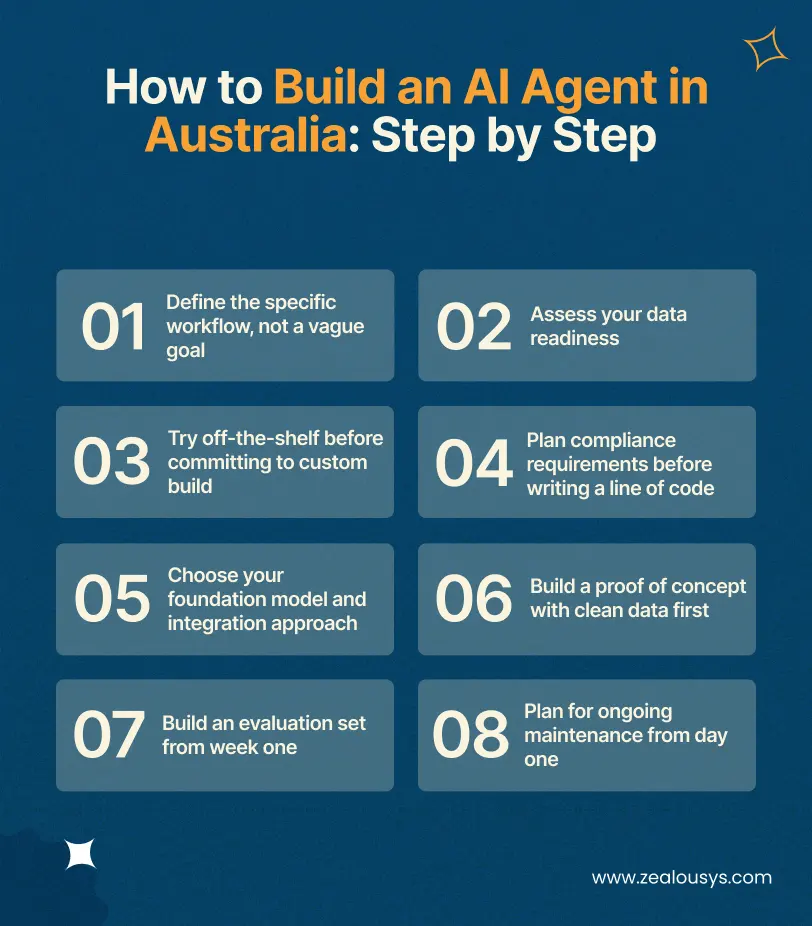
The most common reason AI agent projects fail is not technical. It is starting with the wrong scope. Here is the step-by-step process that leads to production AI agents that deliver measurable ROI.
Do not start with “AI for customer service.” Start with “an agent that takes inbound warranty claims from our email inbox, checks the purchase date against our database, determines eligibility, sends an approval or rejection email, and logs the outcome in our CRM.” The more precisely you define the workflow, the faster and cheaper the build. If you cannot write a one-sentence description of what the agent does from trigger to output, you are not ready to evaluate solutions yet.
The quality of your data determines the ceiling on what your agent can do. If your customer records are incomplete, inconsistent, or spread across five systems with different naming conventions, budget 30 to 40% of your project timeline for data preparation before any agent logic is written. Garbage in means garbage out for AI agents just as much as for any other software.
Even if a commercial tool covers only 70% of what you want, testing it validates the use case and reveals edge cases you had not anticipated. This insight makes your eventual custom build significantly better. Many Australian businesses discover that a $200 per month SaaS tool handles 80% of their workflow, and custom development is only required for the remaining 20% that drives actual competitive value.
For Australian businesses in healthcare, financial services, or any sector handling personal data, compliance architecture must be designed before development begins, not retrofitted after. Determine which obligations apply: Privacy Act 1988 transparency mandates, APRA CPS 234 for financial institutions, TGA requirements for medical software, or the Cyber Security Rules 2025. A development partner without Australian regulatory experience will cost you more in retrofitting than their lower initial rate saves.
For most Australian business applications, building on top of an existing foundation model such as GPT-4, Claude, or Gemini is the right technical choice. Custom model training is only justified for highly specialised domains with proprietary data at very high scale. Define which external systems the agent must read from and write to, and map out the API access requirements and authentication strategy for each.
Start with a single, well-scoped workflow and the cleanest subset of your data. A proof of concept answers one question: can this work with our data and constraints? A PoC for a straightforward use case with clean data typically costs AUD 20,000. With messier data or regulated environments, expect AUD 40,000 to 50,000. The PoC gives your board or investors evidence before committing a full development budget.
The single biggest predictor of AI agent success in 2026 is whether the project has a measurable evaluation set from the beginning. Define upfront how you will measure whether the agent is performing correctly. This means real examples of inputs and expected outputs, edge cases, and failure modes. Without this, you cannot tell if the agent is improving or regressing as you iterate.
Budget 15 to 25% of your initial build cost annually for maintenance. Your business processes will change, your systems will be updated, and the AI models powering your agent will evolve. Agents that are not actively maintained degrade over time. Assign an internal business owner for the agent on day one so that long-term maintenance has a clear accountable party inside your organisation.
The Privacy Act 1988 requires that AI agents handling personal data respect transparency mandates, purpose limitation, and the right of individuals to access and correct their information. The 2024 amendments to the Privacy Act have strengthened these requirements, and AI agents that collect, process, or share personal data without a proper privacy-by-design architecture create significant regulatory exposure for the businesses deploying them.
For businesses in financial services, APRA’s Prudential Standard CPS 234 on information security applies to AI systems that access or process regulated data. This standard requires that information security capabilities scale with the nature and extent of threats to data assets, which means AI agents in banking, insurance, and superannuation need independent security assessment and ongoing monitoring.
The Cyber Security Rules 2025 introduced mandatory security controls for businesses operating critical infrastructure or handling sensitive data at scale. AI agents that interface with operational technology, government systems, or national infrastructure must comply with these rules, which include incident reporting obligations and minimum security control standards.
Sovereign data hosting has become a non-negotiable requirement for 82% of Australian financial and healthcare institutions in 2026. This means that AI agents processing sensitive Australian data must run on infrastructure hosted within Australian borders or in approved regions, rather than defaulting to US-based cloud infrastructure.
For AI agents in healthcare specifically, the Australian Digital Health Agency’s FHIR standards govern how clinical data is structured and shared. An AI agent accessing Electronic Health Records must operate within these data standards to maintain interoperability and compliance with digital health regulations.
From a governance perspective, enterprise AI agent deployments in 2026 require that agents can explain why actions were taken, which data sources were used, and how decisions were reached. This explainability requirement, driven by board-level accountability expectations and regulatory guidance, is why enterprise AI agent architectures need audit logging built in from the beginning rather than added later.
A chatbot responds to inputs with pre-set or pattern-matched replies and waits for the next prompt. An AI agent reasons through complex, multi-step tasks autonomously, accesses multiple business systems, makes decisions, takes actions, and handles situations it has never encountered before. AI agents manage entire workflows end-to-end. Chatbots handle single-turn interactions.
AI agent development in Australia ranges from AUD 15,000 to 25,000 for a basic single-task agent (6 to 8 weeks), AUD 40,000 to 100,000 for a custom integrated agent with CRM or ERP connections (8 to 16 weeks), and AUD 150,000 to 600,000 or more for enterprise multi-agent systems with full compliance architecture. Offshore development partners with Australian market experience can reduce these costs by 40 to 60% without sacrificing quality.
A basic AI agent with a single, well-defined workflow and clean data can be delivered in 6 to 8 weeks. A custom agent with deep integration into your CRM, ERP, or legacy database typically takes 8 to 16 weeks. Enterprise multi-agent systems with compliance requirements and multi-stakeholder testing cycles can take 4 to 9 months from scoping to production.
Yes. AI agents built with proper architecture can fully comply with the Privacy Act 1988, APRA CPS 234, and the Cyber Security Rules 2025. This requires role-based access controls, Retrieval-Augmented Generation (RAG) architecture to enforce data boundaries, encrypted storage and transmission, audit logging for all agent actions, and sovereign cloud hosting for financial and healthcare applications. Compliance must be designed in from the start, not retrofitted after deployment.
Yes. The Australian Government’s 43.5% R&D Tax Incentive applies to AI agent development projects that involve solving genuine technical uncertainties in AI model fine-tuning, custom integration logic, or novel agent architecture. Eligible Australian businesses can offset nearly half of qualifying development expenditure. A registered tax agent or R&D specialist can assess eligibility for your specific project before you commit a budget.
Build in-house only if you have senior AI engineers already on staff and the workflow you are automating is a true competitive moat. For most Australian SMEs, an offshore development partner with demonstrated Australian market experience and regulatory knowledge delivers the same production quality at 40 to 60% less cost, with faster delivery timelines of 8 to 16 weeks. The key is choosing a partner who understands Australian compliance requirements, not simply the lowest-cost provider.
No. Building on top of existing foundation models such as GPT-4, Claude, or Gemini is the most cost-effective and reliable approach for the vast majority of Australian business applications in 2026. Custom model training is only justified for highly specialised domains with enormous volumes of proprietary data. For most workflows, foundation model plus custom integration logic delivers the best ROI with far lower development cost and risk.
Healthcare, fintech, logistics, retail, edtech, and construction all see strong measurable returns from AI agents in 2026. Healthcare uses agents for patient triage and clinical admin. FinTech deploys them for fraud detection and CDR compliance. Logistics uses fleet dispatch and supplier communication agents. Retail benefits from inventory forecasting and customer service agents. EdTech and RTOs use agents for student support and compliance workflows. Construction applies agents to subcontractor onboarding and document processing.
Australia is at an inflection point with AI agent technology. Businesses that treat agentic AI as a future consideration are already falling behind competitors who are processing thousands of tasks autonomously, reducing operational costs, and scaling without adding headcount. The question for most Australian businesses in 2026 is no longer whether to invest in AI agent development but where to start and who to build it with.
The industries covered in this guide, from healthcare and fintech to logistics, retail, edtech, and construction, share one common thread. The highest-returning AI agent deployments are not the most technically complex ones. They are the ones built around a precisely defined workflow, with clean data, proper compliance architecture from day one, and a realistic maintenance budget beyond launch. Getting these foundations right matters more than which foundation model you choose or how sophisticated your orchestration layer is.
For Australian SMEs and startups evaluating their options, the offshore model deserves serious consideration. Partnering with an experienced AI agent development company that understands Australian regulatory requirements, including the Privacy Act 1988, APRA CPS 234, and the Consumer Data Right framework, delivers the same production-ready outcomes as local development at 40 to 60% less cost. The 43.5% R&D Tax Incentive further reduces the net investment, making now one of the most financially favourable moments in Australian history to invest in custom AI development.
Zealous System provides AI software development services purpose-built for the Australian market, combining deep technical capability in agentic AI architecture with firsthand experience navigating Australian compliance requirements across healthcare, fintech, construction, and logistics. From a focused proof of concept to a full multi-agent system, every engagement starts with a scoping call where we define the exact workflow, map your integration landscape, and give you a realistic timeline and cost estimate before any commitment is made.
Our team is always eager to know what you are looking for. Drop them a Hi!

Pranjal Mehta is the Managing Director of Zealous System, a leading software solutions provider. Having 10+ years of experience and clientele across the globe, he is always curious to stay ahead in the market by inculcating latest technologies and trends in Zealous.


Comments