
Quick Overview:
If you run a fruit or vegetable export business, you already know the paradox of this industry. The opportunity has never been bigger, and the margin for error has never been smaller. That tension is exactly why ERP for fresh produce exporters in South Africa has moved from a nice-to-have to a board-level conversation.
The numbers tell the growth side of the story. South Africa’s agricultural exports reached a record US$15.1 billion in 2025, up 10% from the previous year, according to Agbiz. The citrus industry alone packed a record 203.4 million cartons for export in the 2025 season, making South Africa the world’s largest citrus exporter by volume, ahead of Spain.
The pressure side is harder to see in headlines, but you feel it every season. More volume means more pallets to trace, more phytosanitary certificates to issue, more consignments to reconcile, and more growers waiting on accurate pool payments. Spreadsheets and disconnected legacy systems were never designed to carry that load.
This guide walks through what a fresh produce export ERP actually does, which features matter for South African exporters specifically, and how to avoid the mistakes that derail implementations.
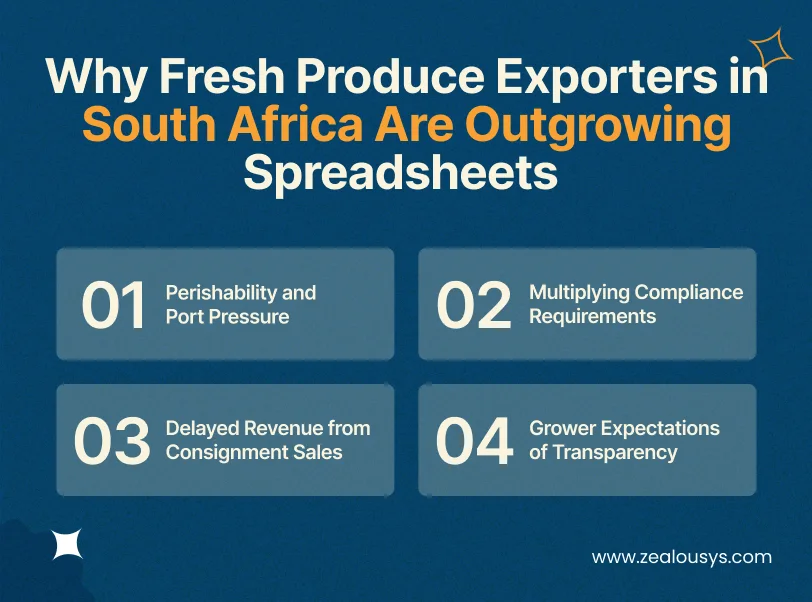
Every export business starts somewhere. Usually, it’s Excel, an accounting package, and a packhouse system that doesn’t talk to either of them. That setup works at 50 containers a season. At 500, it starts to crack. Here’s why the cracks appear faster in fresh produce than in almost any other export industry.
A container of table grapes sitting at the Port of Cape Town because of a documentation error isn’t just late. It’s losing shelf life, value, and possibly the entire sale. Agbiz noted that challenges at the Port of Cape Town in late 2025 added real financial strain for the fruit industry, even in a record year. When port windows are tight, your paperwork has to be right the first time.
PPECB inspections, phytosanitary certification through eCert, GLOBALG.A.P. audits, and market-specific protocols for the EU, China, and the USA all demand accurate, retrievable records. A single failed traceability audit can cost you access to a premium market. Pulling that evidence together from five different spreadsheets, two email inboxes, and a packhouse server is a recipe for sleepless nights before every audit.
Most South African fruit is sold on consignment. You ship in week 10 and only learn your actual return in week 16, after the receiver’s account sale arrives. Until then, your “revenue” is an estimate. Multiply that across dozens of receivers, markets, and currencies, and manual reconciliation becomes a full-time job that still produces stale numbers.
Whether you export your own fruit or handle produce for dozens of growers, pool accounting and final payments have to be defensible down to the pallet. One disputed payment can sour a grower relationship that took years to build.
Individually, each of these is manageable. Together, they explain why so many export businesses hit a ceiling: not because the fruit or the market ran out, but because the admin did.
An agri-export ERP system is business management software built around the specific workflow of fresh produce exports: intake from the farm, grading and packing, cold storage, container loading, export documentation, shipment tracking, account sales, and grower payments. One database, one version of the truth, from orchard to port and through to the final pool distribution.
A standard ERP, the kind built for manufacturers or distributors, assumes you sell products at a known price, invoice them, and get paid. Fresh produce exports break every one of those assumptions.
Stock ages, degrades, and changes grade. A generic system sees a static SKU. You need batch, orchard, and pallet-level identity that follows the fruit through repacking and mixing.
Consignment and minimum guaranteed price deals need estimated returns, account sale capture, and final reconciliation. Generic ERP has no concept of this. It expects an invoice with a fixed value on the day the goods leave the door.
No off-the-shelf manufacturing ERP ships with PPECB workflows, eCert integration, or PhytClean and Titan connectivity for the citrus sector. These are not optional extras in this industry. They are the licence to trade.
Pool accounting, grower advances, and profit distribution per variety and market are foreign concepts to standard finance modules. In fresh produce, they are the heart of the finance function.
Can a generic ERP be customised to do all this? Technically, yes. In practice, you end up rebuilding half the system at consulting rates, and every future upgrade risks breaking your customisations.
This is why exporters increasingly choose between industry-specific platforms and custom-built ERP systems designed around their exact operation from day one.
Not every system marketed as fresh produce export software covers the full journey. Use this section as a checklist when you evaluate options.
Traceability software for fruit exporters has to work at multiple levels at once: production unit, orchard block, batch, carton, and pallet. When a receiver in Rotterdam flags a quality issue, you should be able to trace that pallet back to the specific orchard and spray record within minutes, not days.
Pallet tracking software for packhouses should also handle the messy reality of repacking, mixed pallets, and pallet splits without losing the audit trail. If the system forces you to work around it during peak season, the traceability chain breaks exactly when you need it most.
Good packhouse management software captures fruit intake, grading results, pack-out percentages, and real-time stock on hand, ideally through barcode or RFID scanning on the floor. This matters for two reasons.
First, pack-out data drives grower payments and your own margin analysis. Second, accurate stock by grade, size, and market specification is what lets your sales team commit to programmes with confidence instead of guesswork.
Documentation is where hours disappear. A capable system generates commercial invoices, packing lists, and certificates from the same shipment data, so nothing is retyped and nothing mismatches. Integration with PPECB processes and electronic phytosanitary certification (eCert) removes another layer of manual capture.
For citrus exporters, any citrus export management software worth shortlisting should connect with industry platforms such as PhytClean and Titan. If your ERP can exchange data with the systems the industry already runs on, your compliance workload drops sharply.
This is the feature that separates real agri-export systems from pretenders. Consignment accounting for produce exporters means the system tracks estimated versus actual returns per consignment, captures account sales from receivers, allocates costs (freight, cold storage, levies, commission) at pallet level, and calculates each grower’s share of the pool.
Done manually, final pool payments take weeks and invite disputes. Done in the system, they take days and come with a full cost breakdown any grower can verify.
Cold chain management software capability inside your ERP should cover reefer container bookings, load planning, vessel tracking, and temperature protocol records per market. When a vessel is delayed or a port stack opens early, you want one screen that shows every affected container and consignment, not a scramble through emails.
You sell in euros, pounds, dollars, and yuan. You pay growers in rand. A multi-currency ERP for exporters handles exchange rate movements between shipment, account sale, and payment, and keeps your SARS customs documentation and Incoterms consistent across every deal. Your CFO gets margin per shipment in real currency terms rather than a quarter-end surprise.
Features are easy to list. Directors and CFOs approve budgets based on outcomes, so let’s talk about those.
When invoices, packing lists, and certificates all come from one shipment record, transposition errors disappear. Every container that clears without a query is money protected.
GLOBALG.A.P. compliance and market protocol audits stop being fire drills when every record is already linked and retrievable. For businesses supplying EU retail programmes, this is not a soft benefit. It’s the difference between keeping and losing the contract.
Most exporters know their overall result. Far fewer know they made strong returns on lemons to the Middle East and quietly lost money on a specific receiver in the Far East. Agriculture ERP software in South Africa should give you consignment-level profitability, so you allocate next season’s fruit based on evidence.
Growers who trust your numbers give you their best fruit first. Transparent pool statements, generated from the same data that ran the operation, build that trust season after season.
The Citrus Growers’ Association’s Vision 260 strategy targets 260 million export cartons by 2032. Volumes across the fruit sector are heading one direction. An ERP lets your existing team handle that growth instead of adding administrative staff every time volumes jump 20%.
Plenty of fruit export ERP projects stumble, and the reasons repeat. Learn from other people’s expensive lessons.
Never switch systems in the middle of your packing window. Plan implementation for the off-season, run parallel for a period, and give your team time to build confidence before the fruit arrives.
Years of grower records, orchard registrations, product specifications, and customer terms live in spreadsheets with inconsistent formats. Cleaning and migrating that data is often the largest single task in the project. Budget for it honestly.
If scanning a pallet takes six taps on a laggy screen, your floor staff will find workarounds, and your data integrity dies quietly. Insist on seeing the intake and scanning workflows demonstrated at realistic speed, and ask how the system behaves when rural connectivity drops.
Your ERP touches people outside your walls: growers submitting delivery data, agents sending account sales. If they can’t interact with the system easily, you’ll end up recapturing their data manually, which defeats the point.
A demo showing 200 features means little if the five workflows that run your business need “customisation to be scoped later.” Anchor every evaluation to your own operation: your commodities, your markets, your pool structures.
The software matters. The partner behind it matters more because fresh produce is unforgiving of slow support and half-finished integrations. Treat partner selection as a structured evaluation, not a demo beauty contest. The framework below covers the five areas where partners genuinely differ.
A partner who has worked with export documentation, PPECB processes, and pool accounting will save you months of explaining your own business. Ask for at least two references from packhouses or FPEF-member export businesses of a similar size, and phone them yourself. Go beyond “are you happy?” Ask what broke during the first season, how long fixes took, and what they would negotiate differently in the contract. The answers to those three questions tell you more than any sales deck.
Your ERP will need to exchange data with eCert, PhytClean, Titan, your financial system, and possibly receiver platforms abroad. The difference between “we integrate with that” and “here is a client where that integration runs daily” is the difference between a project that lands on time and one that stalls for six months. Ask to see each critical integration working at a reference site, and get the integration scope written into the contract with named systems, not vague categories.
Your peak weeks are non-negotiable, so your support agreement shouldn’t be either. Establish who answers when a pallet won’t scan at 22:00 in February, what the guaranteed response times are for critical issues, and whether support staff understand the export domain or just read the software manual back to you. A partner in your time zone, with escalation paths you can name, is worth a premium over a cheaper offshore helpdesk that opens after your packing shift ends.
Many packhouses operate in areas with unstable connectivity, and load shedding remains a planning factor. Interrogate how the proposed architecture behaves when the line drops mid-shift: does floor scanning continue offline and synchronise later, or does the packhouse stop? Cloud, on-premise, and hybrid models each have a place. What matters is that the partner has deployed their answer in conditions like yours, not that they can whiteboard it.
Year-one pricing hides more than it reveals. Build a five-year comparison across every shortlisted option covering licences, implementation, integrations, training, annual support, hosting, and a realistic allowance for change requests as your business grows. Ask each partner what a typical change request costs and how long it takes. Systems with low entry prices and expensive change cycles often cost the most by year three.
This decision deserves honest treatment rather than a sales answer. If your operation fits a standard model, a proven industry package may serve you well, with faster deployment and shared product development costs. But many South African exporters run unique combinations of their own production, grower pools, procurement trading, and multi-commodity programmes that no packaged system fits cleanly.
In those cases, a custom-built ERP, designed around your exact workflows and integrated with the industry platforms you already use, often costs less over five years than bending a package out of shape. Whichever route you take, the evaluation criteria above apply equally.
The honest answer is that there is no single price, because cost follows scope. An exporter running one packhouse with a handful of growers needs a very different system from a multi-commodity business with grower portals and five integrations. Anyone quoting a fixed number before understanding your operation is guessing.
What you can do is understand the drivers, then use market ranges to budget realistically.
Based on prevailing market rates for custom ERP development, budgets typically fall into three tiers:
Treat these as planning figures, not quotes. Rand estimates reflect current exchange rates and will move with the currency. A proper scoping exercise, where a development partner maps your workflows before pricing, is the only reliable way to land on a real number, and it also protects you from the change-request costs that inflate loosely scoped projects later.
| Scope | USD (approx.) | ZAR (approx.) |
|---|---|---|
| Core packhouse and traceability system: intake, grading, pallet tracking, stock control | $15,000 – $25,000 | R250,000 – R410,000 |
| Mid-scope export ERP: adds export documentation, consignment accounting, cold chain visibility, and key integrations | $25,000 – $50,000 | R410,000 – R820,000 |
| Full multi-commodity platform: adds grower portals, pool accounting, multi-currency finance, and multi-site support | $50,000 – $75,000+ | R820,000 – R1.25 million+ |
Budgets depend on modules, integrations, and site count. The cost section above gives indicative market ranges, from core packhouse systems to full multi-commodity platforms. A scoping exercise is the only way to get a firm number.
Yes, provided the system is built or configured for the South African export environment. These integrations are well established in the citrus sector. Confirm the specific integration experience of any partner you shortlist, and ask to see it working at a reference site.
A focused implementation for a mid-sized exporter typically runs three to nine months, depending on data migration complexity and the number of integrations. The golden rule: work backwards from your next off-season window and leave time for parallel running.
It can be, if the system is designed for intermittent connectivity. Look for offline-capable scanning and capture at the packhouse, with automatic synchronisation once the connection returns. Pure cloud systems with no offline mode are risky in remote growing regions.
Packhouse software manages intake, grading, packing, and stock inside the facility. A full export ERP extends that data through logistics, export documentation, consignment sales, finance, and grower payments. Many exporters start with packhouse software and hit its limits the moment consignment accounting and pool payments enter the picture.
Fresh produce exporters in South Africa are competing in a market that rewards precision. Record volumes, tighter compliance, congested ports, and consignment complexity all point to the same conclusion: the businesses that control their data will control their margins.
An ERP built for produce exporters give you that control: farm-to-port traceability, automated export documentation, honest consignment accounting, and grower payments nobody has to argue about.
If your current systems are holding your growth back, and a packaged product doesn’t fit the way your operation actually works, a custom-built solution is worth exploring. At Zealous System, we design and build custom ERP software around each client’s specific workflows, integrations, and growth plans. If you’d like to talk through what that could look like for your export operation, we’re happy to have that conversation.
Our team is always eager to know what you are looking for. Drop them a Hi!

Pranjal Mehta is the Managing Director of Zealous System, a leading software solutions provider. Having 10+ years of experience and clientele across the globe, he is always curious to stay ahead in the market by inculcating latest technologies and trends in Zealous.


Comments