Most AI legacy system integration budgets cover the visible parts: the model, the licenses, a proof of concept and a few months of engineering. Then the project meets the ERP that has run finance since 2009, and the numbers start to drift.
That drift is where the real cost of AI integration sits. The model is only one line on the bill. In older environments, data preparation, connectors, security, testing and running two stacks side by side can match or even overtake the AI spend itself.
AI rarely replaces a legacy system on day one. It adds a layer on top, so for months or years you pay to run both. This guide shows where those costs hide, how to estimate them and how to decide whether to integrate, modernize or replace.
Legacy systems were never cheap. Their costs were just quiet: support contracts, a small team that knows the codebase, the occasional patch. It all sat in a steady line on the IT budget.
AI breaks that quiet. A model needs clean, timely data through interfaces older systems were never built to expose. Batch exports that suit monthly reporting fall over when a fraud model needs an answer in seconds.
Much of this cost already existed. In a McKinsey survey, CIOs reported that 10 to 20 percent of the technology budget meant for new products is diverted to resolving tech debt. The same research warns that a company spending over half its IT project budget on integrations and legacy fixes is likely only servicing the debt. That’s where technical debt and AI collide, because most AI projects land right in that zone.
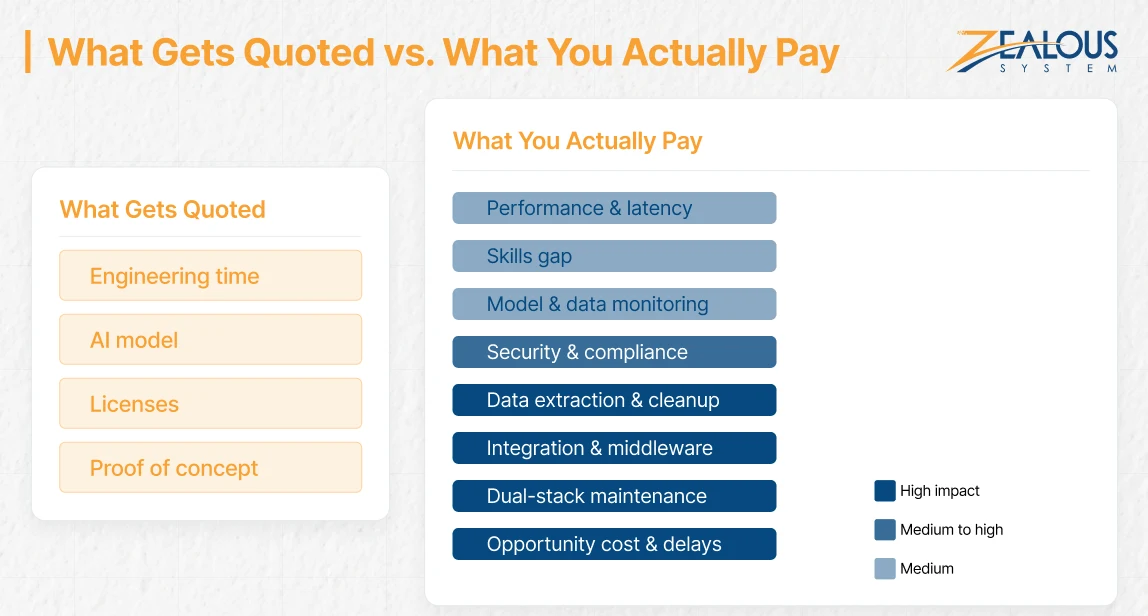
These are the hidden costs of AI implementation that most legacy budgets miss. Use the matrix to spot which ones already show up in your environment, then read the detail below.
| Cost | Where It Hides | Warning Sign | Relative Impact | How to Estimate | How to Reduce |
|---|---|---|---|---|---|
| Data Extraction and Cleanup | “POC” or “data prep” line | Months of prep before modeling | High | Sources × data quality score | Reusable data layer first |
| Integration and Middleware | “Just a few APIs” | No documented legacy interfaces | High | Touchpoints × complexity | One standard integration layer |
| Performance and Latency | Infrastructure budget | Batch jobs collide with live inference | Medium | Load test at production volume | Caching, async queues, events |
| Dual-Stack Maintenance | Opex across teams | Two on-call rotations, one workflow | High (recurring) | People × parallel-run months | Decommission date before launch |
| Security and Compliance | Found during audit | No lineage for model inputs | Medium to High | Gap assessment vs. regulations | Governance from sprint one |
| Skills Gap | Hiring and contractor spend | Teams can’t review each other’s work | Medium | Roles × market rate | Blended team or partner |
| Model and Data Monitoring | Post-launch, unbudgeted | Accuracy complaints after launch | Medium (recurring) | Tooling + review hours | Automated drift alerts |
| Opportunity Cost and Delays | Never on a spreadsheet | Pilot with no production date | High | Delayed value × months | Phase around one high-value use case |
Impact ratings are relative. They reflect how heavily each cost tends to weigh on total effort and recurring spend in legacy-heavy environments. Your mix depends on system age, data quality and regulatory exposure.
Legacy data was shaped for the application that created it, not for a model. Expect inconsistent formats, duplicate records and business rules buried in stored procedures. Cleanup is often the longest phase, yet it rarely gets its own budget line.
The stakes are real. In early 2025, Gartner predicted that organizations would abandon 60% of AI projects unsupported by AI-ready data through 2026.
Few legacy systems have clean, documented APIs. So someone builds wrappers, queues or a full application integration layer, then keeps it working through every vendor patch and schema change. The build is visible. The upkeep usually isn’t.
Many legacy platforms were built for overnight batch runs and limited concurrent users. When a model starts making live calls, response times slip and the infrastructure team asks for more capacity. That spend lands in the infrastructure budget, so it rarely gets traced back to the AI project.
This is the cost that compounds. Running AI and legacy side by side means two release cycles, two monitoring setups and often two on-call rotations for one business process. A short parallel run is normal. An open-ended one becomes permanent overhead nobody planned for.
Every new path into legacy data needs controls, logging and an audit trail. In BFSI, healthcare and insurance, regulators will also ask which data shaped a model’s decision. Retrofitting that lineage after launch costs far more than building an AI governance framework from the start.
The people who understand your COBOL batch jobs or a heavily customized SAP instance rarely build retrieval pipelines or monitor model drift. Bridging that gap means hiring, contracting or long handovers. It also creates a quiet risk: one legacy expert holding context the whole project depends on. That’s why mainframe AI integration and ERP AI integration projects often stall on staffing before they stall on technology.
Legacy systems change in small, undocumented ways. A field gets repurposed or a code table is updated, and model accuracy erodes without anyone noticing. Catching this takes drift alerts and a named owner who reviews them, a cost rarely found in the original business case.
Every month spent on plumbing is a month the business waits for the outcome it paid for. Sponsors lose patience and the pilot that impressed in a demo never reaches production. This cost never appears on a spreadsheet, but it is often the largest.
Once these costs are visible, the next question is what your AI should sit on. Most teams frame it as modernize vs. integrate legacy systems, but replacement is a third realistic path. The condition of the system underneath decides which fits.
| Criterion | Integrate | Modernize Incrementally | Replace |
|---|---|---|---|
| Core System Stability | Stable, low change rate | Stable but hard to extend | Failing or unsupported |
| Data Accessibility | APIs or clean exports exist | Trapped but recoverable | Can’t serve AI |
| Vendor Support | Active and long-term | Active but limited | Ending or ended |
| AI Use Cases Planned | One or two | Several over multiple years | Many, across the business |
| Time to First AI Value | Fastest | Medium | Slowest |
| Long-Term Cost Trend | Rises with dual-stack costs | Falls after transition | High upfront, lowest later |
Integrate when the core system is healthy and the use case is narrow. Value arrives quickly, but if the parallel run never ends, this slowly becomes the most expensive path.
Modernize incrementally when AI is a multi-year plan and the same constraints will block every new use case. Phased application modernization replaces modules one at a time, so each initiative lands on a cleaner foundation. In one legacy system modernization project for an Australian environmental services firm, Zealous System re-engineered the core billing modules instead of replacing the system. Invoice cycles became 3x faster, and manual billing work dropped by 75%.
Replace when vendor support is ending or the data model can’t serve AI. Running AI on end-of-life software adds security risk on top of every cost above.
Use these five questions to pressure-test your AI legacy system integration plan before you commit budget.
Generic price ranges won’t help, because the cost drivers are specific to your systems. Build the estimate from the pieces that create cost, with engineering, data and finance leads in the same room.
Then put it into one view:
Real cost = AI build + integration build + compliance work + (dual-stack running cost × parallel-run months) + monitoring
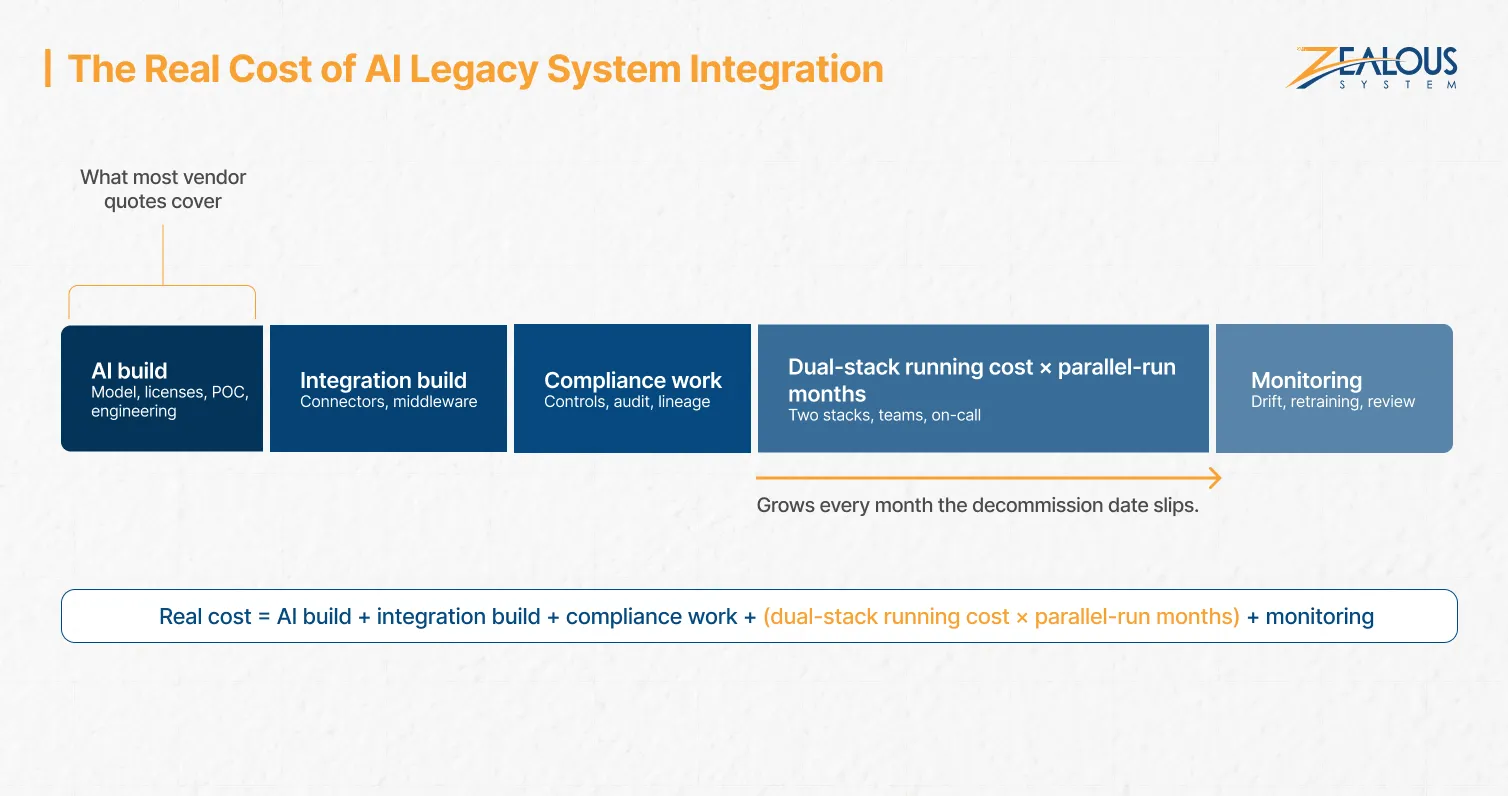
Most vendor quotes cover only the first term. The parallel-run term is the one teams underestimate most. It grows with every month the decommission date slips.
Legacy isn’t the problem by default. Plenty of legacy cores are stable and cheap to run, and coexistence is often the smartest financial choice when:
Here’s an example. A multi-store retailer had inventory in spreadsheets and customer data split across sales channels, but didn’t want to replace the tools its teams relied on. Zealous System built AI-powered demand forecasting that worked alongside those tools. It pulled data from Salesforce and Shopify Plus into one data layer and sent recommendations back into the software store managers already used. Forecast accuracy rose from 61% to 79%, and end-of-season overstock fell by 23%.
The existing systems stayed, and costs stayed contained because the data layer was built once and every output flowed back into familiar tools. For the technical side of this approach, see this guide to AI agent legacy system integration.
AI legacy system integration can be a sound strategy, as long as you see the whole bill. The costs that sink these projects are rarely the model. They’re the data work, the connectors, the parallel run and the monitoring nobody planned for.
Zealous System helps CTOs and IT leaders weigh integration against legacy system modernization with AI across SAP, Oracle, mainframe, AS/400 and custom ERP environments. If you’re considering AI integration services for an older estate, book a call with our team to review your integration surface before committing budget.
Yes. Many AI use cases run well alongside legacy platforms through APIs, middleware or a dedicated data layer. This works best when the core system is stable, data can be extracted reliably and the scope is narrow. Replacement is needed mainly when the platform is unsupported or its data model can’t serve AI.
The cost of AI legacy system integration depends more on your systems than on the model. The main drivers are data preparation, integration touchpoints, compliance requirements, the length of the parallel run and post-launch monitoring. A credible estimate comes from mapping those drivers against your environment, not from a generic price range.
The most common AI integration challenges are poor data quality, undocumented interfaces and performance limits in batch-oriented platforms. Security gaps around new access paths and a shortage of people who understand both legacy stacks and modern AI come close behind. Most surface after the pilot, which is why many projects stall before production.
A narrow use case on a stable, well-documented system can reach production in a few months. Estates with poor data, many touchpoints or strict regulation take considerably longer. Data readiness and integration work usually set the timeline, so assess both before committing to a launch date.
Not always. If your core system is stable and its data is accessible, integrating AI first delivers value faster. Modernize first when the platform is near end of life or its data model blocks AI use cases. The same applies if several planned AI initiatives would hit the same constraints. In those cases, legacy system modernization cost is often lower than years of dual-stack maintenance.
Our team is always eager to know what you are looking for. Drop them a Hi!

Nandini Pare is a CAPM® Certified Business Analyst at Zealous System, specializing in business analysis, Agile delivery, and helping organizations build technology solutions that solve real business challenges.


Comments