
Quick Overview:
Your board asked a simple question: are we compliant? Three weeks later, someone was still building a spreadsheet of every model, copilot, and vendor feature running in production. The list kept growing, because nobody had ever owned it.
That gap is the actual problem, and it is what an AI governance framework in the UK exists to close. Not regulation, not ethics, but a system of record for what your AI does and who signed off on it.
That scramble is close to standard. ONS figures put AI use among UK businesses with 250 or more employees at 49% as of June 2026, up 13 points in a year. IBM’s 2026 Cost of a Data Breach Report, covering 602 organizations, found that more than 20% had already suffered a breach targeting AI models or applications. The leading causes were compromised APIs and plug-ins, and cloud misconfigurations around AI workloads. In other words, the models were rarely the weak point. The scaffolding around them was.
This guide covers what UK enterprises are on the hook for right now, the ten components a working framework needs, and an eight-step process for building one. It is written for the people who have to implement it, not the people who write the policy.
An AI governance framework is the operating structure that controls how your organization designs, approves, deploys, monitors, and retires AI systems. It defines who decides, what evidence supports each decision, and what happens when a model behaves in a way nobody planned for.
A framework turns scattered practice into something auditable. It answers four questions on demand: what AI do we run, what could each system do to someone, who approved it, and how would we know if it broke.
Policy documents do not achieve this on their own. A paragraph instructing engineers to apply meaningful human oversight is a statement of intent. A gate in your deployment pipeline that blocks release until a named reviewer signs off is a control. Regulators and enterprise buyers both ask for the second one.
These three terms get used interchangeably inside most large organizations, and that habit is how accountability quietly disappears.
| Discipline | Core Question | Typical Owner | Primary Output |
|---|---|---|---|
| AI Governance | Who decides, and on what evidence? | Executive Sponsor | Policies, approval workflows, escalation paths |
| AI Compliance | Have we met the legal requirement? | Legal, DPO | Impact assessments, technical documentation, audit evidence |
| AI Risk Management | What could go wrong, and how badly? | Risk Function, CRO | Risk register, impact assessments |
Compliance is narrow and backward-looking. Risk management puts numbers against exposure. Governance is the structure that makes both visible to someone senior enough to act on them. Without it, a control failure gets absorbed by whichever team happened to find it.
Who Owns AI Governance in an Enterprise
One named executive should answer for AI outcomes at board level. When ownership floats between legal, IT, and data science, it lands nowhere, and three business units end up applying three different standards to three similar systems.
Below that, every AI system in production needs a named system owner. A person, not a team.
UK AI regulation does not sit in one place, and that is exactly what catches people out. Before you can decide how to govern AI systems in the UK, you need a clear picture of who is watching and what they actually expect.
No. The UK has not passed AI-specific legislation, and no AI Bill is currently before Parliament. AI is regulated through laws and regulators that already exist.
That position was reinforced in May 2026, when the King’s Speech announced a Regulating for Growth Bill creating statutory sandbox powers and pushing regulators toward supporting innovation, with no standalone AI bill included. Ministers have been consistent that the UK will handle AI through incremental changes to existing law.
People often read this as good news. It is not. Instead of one law telling you exactly what to do, you get broad principles that each regulator applies to your sector in its own way. There is no checklist to point at when someone asks why your credit model treated two similar applicants differently, so the job of proving you acted reasonably falls on you.
Enforcement is distributed. Whichever regulator already covers your sector now covers your AI.
| Regulator | What It Oversees in AI |
|---|---|
| ICO | Personal data in AI systems, automated decision-making, transparency |
| FCA | AI in financial services, model risk, Consumer Duty obligations |
| PRA | Financial stability expectations for AI used in risk models |
| MHRA | AI that supports diagnosis or treatment decisions |
| Ofcom | AI in online services and content systems under the Online Safety Act |
| CMA | Fair competition, including pricing behavior driven by AI |
The ICO’s AI and data protection guidance is the closest thing to a general rulebook here. If you operate in a regulated sector, your own regulator’s published guidance sits on top of it. It matters far more to your roadmap than any future AI bill.
This is the change most UK enterprises have not fully absorbed. It concerns decisions made about a person by software alone, with no human involved, in situations that affect them meaningfully. Think loan approvals, job application screening, or an insurance claim being rejected.
Old UK GDPR automated decision-making rules under Article 22 largely restricted this. The Data (Use and Access) Act 2025 replaced that with new Articles 22A to 22D, in force from February 2026, and the effect was to permit these decisions in more situations. The catch is the condition attached. You have to tell people the decision was automated, give them a route to a human review, let them challenge the outcome, and document all three.
That last word is the one that costs money. Documented means evidence you can produce on request, and evidence gets generated by systems, not promised in a policy.
So if you run automated credit decisions, recruitment screening, insurance pricing, or claims triage, two things have to exist. A Data Protection Impact Assessment, meaning a written risk review, completed before the system goes live. And a working way for someone to contest the result afterwards. Teams that have already built GDPR compliant software will recognize the shape of this, though AI adds a harder requirement: explainability, meaning you can show how the system reached its answer.
Often, yes. The test is EU market impact, not where your company is registered. If your AI systems are used by people in the EU, or produce outputs affecting them, you are likely in scope.
The timeline shifted this year, which means a lot of published guidance is now wrong. The European Parliament endorsed the final Digital Omnibus text in June 2026, and the Council approved it shortly after. The corrected schedule looks like this:
| Date | What Applies | In Plain Terms |
|---|---|---|
| 2 August 2026 | Article 50 transparency duties, except Article 50(2) for systems already on the market | Tell people when they are dealing with AI or seeing AI-generated content |
| 2 December 2026 | Article 50(2) extends to older systems, plus new banned uses | Same transparency rules now cover systems you launched earlier |
| 2 December 2027 | High-risk rules for standalone Annex III systems | AI used on its own for hiring, credit scoring, education, or critical infrastructure |
| 2 August 2028 | High-risk rules for Annex I systems | AI built into products already regulated for safety, such as medical devices or machinery |
Do not read the delay as a reprieve. It changes the sequence rather than the substance, and it makes the paperwork you build now more valuable, not less. Proving a high-risk system meets the standard, a process called conformity assessment, takes longer than most teams expect, because the evidence has to cover how the system was built, not just how it looks on the day you submit it.
Regulators are not the only ones asking. Corporate buyers now want to see governance evidence before they sign a contract, and the companies that can hand it over get through vendor checks faster.
The cost of not having it shows up in three ordinary places. Releases stall in review because nobody can find the paperwork. Deals slow down while your team assembles answers to a customer’s security questionnaire. And shadow AI, meaning tools your staff started using without telling anyone, sits in your business carrying obligations you have never looked at. The financial exposure is measurable. IBM found AI-enabled breaches cost an average of $6 million in 2026, roughly £4.7 million, which is about $1 million above the global average. Such attacks rose 56% year on year.
Together they give you model lifecycle management that survives an audit. Each component below covers what it is, the evidence it produces, and what breaks without it. Build them in parallel rather than in sequence. Teams that treat governance as a phase after development spend longer unwinding decisions than they would have spent designing around them.
The operating model sets out who decides what, at which risk tier, and who answers at board level. It also defines AI governance roles and responsibilities across legal, engineering, risk, and the business units running the use cases.
Without it, approval defaults to whoever is closest to the deployment.
Evidence produced: a documented decision structure, a RACI matrix showing who is responsible and who signs off, and a board reporting line.
A live register of every system in use, including models embedded in SaaS tools nobody formally procured. A quarterly spreadsheet cannot keep pace with how fast new capability appears inside software your teams already license.
Ask leadership how many models are in production. If the honest answer is a range rather than a number, start here.
Evidence produced: a queryable register with owner, purpose, data sources, and status per system.
A consistent tiering method, usually four levels, based on what would happen if the system malfunctioned or was misused. A recommendation engine suggesting the wrong product is not the same category of problem as a system declining a mortgage.
Tiering is what makes proportionate control possible.
Evidence produced: an AI risk register with a defensible rationale for each classification.
Each system mapped to the specific duties that apply to it, whether that is UK GDPR automated decision-making rules, FCA expectations, or EU AI Act compliance requirements. Generic mapping at the organization level is not enough, because obligations attach to systems, not companies.
Without this, teams either over-comply everywhere or discover a gap during an audit. Algorithmic accountability starts here, because you cannot answer for a decision you never mapped to a rule.
Evidence produced: an obligations matrix linking each system to named requirements.
Structured assessment at design, again before deployment, and then on a recurring cycle. This extends your DPIA process with AI-specific questions about training data, foreseeable misuse, and affected groups.
One assessment at go-live is not a framework; it is a formality.
Evidence produced: completed impact assessments with mitigation decisions and sign-off dates.
Training and inference data traceable back to source and consent basis, with documented fairness testing on any system making decisions about people. Data lineage is the component teams most often postpone and most often regret postponing.
When someone challenges an output eighteen months from now, lineage is what lets you answer.
Evidence produced: lineage records, retention rules, and bias test results per model version.
Model cards, technical documentation, and decision logs generated as build artifacts rather than written retrospectively. Documentation assembled from memory after an audit request is both slower and less credible than documentation your pipeline produces automatically.
Evidence produced: versioned model cards, a record of what data trained each version, and evaluation metrics.
Mandatory gates before production, with the depth of review scaling to risk tier. Push low-risk internal tools through the same review as a regulated credit engine, and teams will simply route around governance.
This is where policy becomes enforceable.
Evidence produced: an auditable approval trail tied to each release.
Human oversight of AI systems means a defined escalation path, letting employees and customers challenge an automated decision and reach a human reviewer inside a set window. This is a direct regulatory expectation under the current automated decision-making rules, and it is also plain operational sense.
A contest route that dies in a ticket queue does not count.
Evidence produced: documented escalation paths, reviewer records, and response times.
Continuous observation of performance, drift, and anomalous behavior, with alerts routed to the named system owner. Pair this with AI audit trail and logging that captures inputs, outputs, and human interventions in a form you cannot quietly edit later.
The EU AI Act calls this post-market monitoring, and it expects the watching to continue for as long as the system is live. Retirement belongs here too. Most organizations plan how a system launches and never plan how it is safely switched off.
Evidence produced: monitoring dashboards, immutable logs, incident records, and decommissioning plans.
| # | Component | Typical Owner | Evidence It Produces |
|---|---|---|---|
| 1 | Operating Model | Executive Sponsor | Decision structure, RACI, board reporting |
| 2 | System Inventory | Data or Platform Lead | Live register with owners |
| 3 | Risk Classification | Risk Function | AI risk register |
| 4 | Obligation Mapping | Legal, DPO | Obligations matrix |
| 5 | Risk Assessment | Product and Risk | Completed impact assessments |
| 6 | Data Governance | Data Engineering | Lineage records, bias test results |
| 7 | Documentation | Engineering | Model cards, technical documentation |
| 8 | Approval Gates | Engineering, Risk | Auditable approval trail |
| 9 | Human Oversight | Business Owner | Escalation records, response times |
| 10 | Monitoring and Logging | Platform, Engineering | Dashboards, immutable logs, incident records |
Components 1 to 5 map closely to the management system requirements in ISO/IEC 42001. Components 6 to 10 are where engineering work lives, and where most frameworks fall apart.
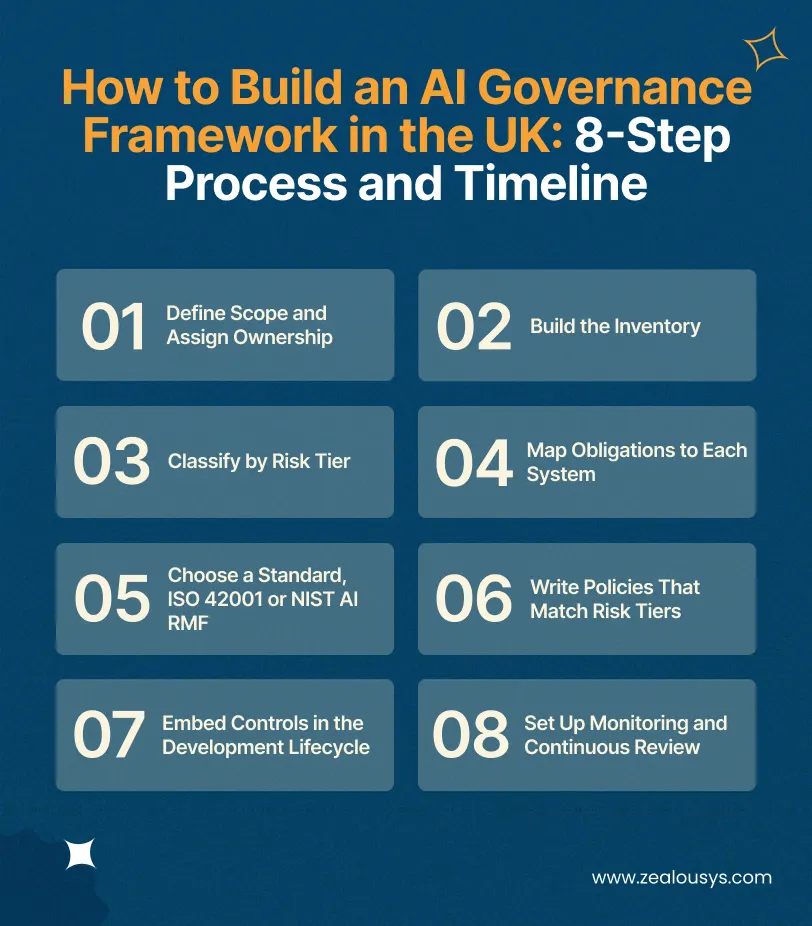
This is the sequence most teams follow, and it answers the practical question underneath it: how to manage AI risk in the UK when no single rulebook exists.
Name the accountable executive before anything else. Then decide what counts as an AI system for your purposes, including embedded vendor features and internally built automation, because an unclear scope produces an inventory nobody trusts.
Run discovery across procurement records, cloud accounts, API gateways, and SaaS licenses, then interview business units directly. Expect the count to exceed the initial estimate by a wide margin, and expect the surprises to come from tools rather than models.
Apply your tiering method to every system on the list. This is where the inventory stops being an asset list and starts driving decisions, because tier determines how much process each system carries from here on.
Work through the tiers from highest down, attaching specific regulatory duties to each system. Systems making decisions about individuals, particularly in employment, credit, and insurance, deserve the closest reading.
The NIST AI Risk Management Framework is voluntary and not certifiable, which makes it a useful way to organize your thinking but a weak answer to a procurement questionnaire. The ISO 42001 AI management system standard, often shortened to AIMS, is certifiable through third-party audit, which is why UK enterprises with EU exposure or enterprise customers usually pick it as the spine and use NIST for structure underneath.
Draft acceptable use, data handling, and model approval policies per tier rather than one document covering everything. A single policy governing both an internal writing assistant and a customer-facing pricing engine ends up too loose for one and too heavy for the other.
Push checks into CI/CD: automated scanning, access controls, documentation generation, and compliance gates that block a release rather than warn about it. Controls that depend on someone remembering get skipped, usually during the release where it mattered.
Stand up drift and performance monitoring, route alerts to system owners, and put fixed review intervals in the calendar. Regulation moves and models degrade, so a framework that fit twelve months ago will not fit now without maintenance.
| Phase | Window | Focus | Output |
|---|---|---|---|
| 1 | Days 1 to 30 | Discovery and Ownership | Named owner, complete inventory, scope definition |
| 2 | Days 31 to 60 | Classification and Mapping | Risk register, obligations matrix, gap list |
| 3 | Days 61 to 90 | Controls and Documentation | Policies live, approval gates in CI/CD, model cards generating |
| 4 | Ongoing | Monitoring and Assurance | Dashboards, incident process, scheduled reviews, certification readiness |
Ninety days gets you a defensible AI governance framework for UK businesses across your highest-risk systems. Full coverage across a large organization typically runs six to twelve months, depending on how much technical debt sits underneath.
Enterprise AI governance implementation usually comes down to two decisions: what you license, and what you build yourself. Getting the split wrong is expensive in both directions.
If your AI systems are fairly standard, your obligations are mostly UK GDPR and ISO 42001, and you need something running this quarter, buy. Commercial platforms handle inventory, risk registers, and documentation templates well, and rebuilding that from scratch is rarely a good use of engineering time.
Custom wins when governance has to reach into systems a platform cannot see. Proprietary model pipelines, unusual data architectures, sector-specific evidence requirements, and legacy systems without modern APIs all fall into this category.
The same reasoning applies here as in any build vs buy decision for AI systems: buy the commodity, build the part that is genuinely yours.
In practice, most enterprises buy the registry and build the integration layer. The platform holds the record, and custom work connects it to CI/CD, ticketing, data catalogs, and monitoring so the record stays current without manual updating.
That integration layer is the real project. Where legacy infrastructure cannot support the monitoring or access control that governance requires, application modernization usually has to happen first, and pretending otherwise produces a framework that looks complete and reports nothing.
For most UK enterprises, implementation lands somewhere between £20,000 and £150,000 or more. Three factors move you along that range: how many AI systems you run, how many of them are currently undocumented, and whether your existing infrastructure can generate evidence automatically or needs work first.
At the lower end sits a focused 90-day program covering your highest-risk systems, with a platform holding the register and light integration work. At the upper end sits organization-wide implementation, custom tooling, remediation of legacy systems, and preparation for certification.
Platform licensing is usually the smallest line item. Discovery, integration, and cleaning up systems nobody documented account for most of the spend, which mirrors the pattern across custom software development costs in the UK more broadly.
FCA AI regulation in financial services, alongside PRA expectations, requires firms to show that automated credit, pricing, and risk models do not discriminate and do not drift unnoticed through market stress. Two things make that possible: decision logs that cannot be edited after the fact, and the ability to show what would have changed the outcome. You need to reconstruct why a specific decision landed the way it did.
The FCA’s Consumer Duty, which requires firms to deliver good outcomes for customers, adds a second dimension. Firms building fintech software should treat outcome monitoring across customer segments as a governance control, not a reporting exercise.
Security exposure compounds the regulatory kind. IBM found 62% of AI-driven attacks targeted critical infrastructure, with financial services the most concentrated and breaches in the sector averaging $6.3 million. The access controls and audit trails that satisfy the FCA are the same ones that limit that damage.
Where AI supports diagnosis or triage, MHRA rules on medical devices may apply, and clinical validation sits alongside data protection rather than replacing it. A human in the loop is not optional in this sector. The clinician must retain final sign-off on any AI-assisted decision.
Governance for healthcare software also has to cover data minimization in training sets, which is a harder engineering problem than it sounds when your source is an electronic health record system.
Recommendation engines, dynamic pricing, and automated service tools attract ICO and CMA attention for different reasons. Personalized pricing that produces different outcomes for different groups is the exposure most retailers underestimate.
Give shoppers a clear opt-out from automated profiling and run bias checks on pricing logic on a schedule, not just at launch.
Predictive maintenance and quality inspection models that control physical processes bring safety obligations that software-only systems do not carry. Governance here needs hard limits the model cannot exceed, live monitoring of the equipment, and manual override that acts faster than the automation it interrupts.
Vision systems on a line also raise workforce data questions if cameras capture people alongside product.
Governance that lives in a policy document, separate from the systems it governs, rarely survives contact with scale. We at Zealous System approach it as engineering work: discovery and inventory tooling that finds what is actually running, risk classification wired into your existing data stack, approval gates and evidence generation inside CI/CD, and monitoring infrastructure that catches drift before a customer does.
That work sits on 17 years of delivery since 2008, more than 1,500 projects across clients in the UK, Europe, the US, and Australia, and a team of over 100 engineers and consultants. Recent AI delivery includes RAG-based conversational systems, generative AI features inside enterprise platforms, and computer vision deployments, each of which carried its own documentation and oversight requirements.
If your inventory is incomplete, or your framework exists on paper but not in the pipeline, that is the gap worth closing first. Talk to our team about a governance readiness assessment, or read more about our AI consulting services and AI software development work.
No. The UK has not passed AI-specific legislation, and no AI Bill is before Parliament. AI is governed through existing regimes including UK GDPR, the Data (Use and Access) Act 2025, and sector regulators such as the ICO, FCA, and Ofcom.
Enforcement is distributed across sector regulators. The ICO covers personal data and automated decision-making, the FCA and PRA cover financial services, the MHRA covers AI as a medical device, Ofcom covers online services, and the CMA covers competition effects.
Frequently. Scope depends on EU market impact rather than company domicile. If your AI is used by people in the EU or produces outputs affecting them, you are likely in scope and should work to the current compliance timetable.
No. It is a voluntary international standard, but it is certifiable, which makes it the most practical way to evidence governance maturity to regulators and enterprise buyers. Many UK organizations adopt it as the backbone of their framework.
Discovery, classification, and policy definition typically run six to eight weeks. Embedding technical controls, logging, and monitoring across a full enterprise usually takes six to twelve months depending on infrastructure maturity.
Most UK enterprises spend between £20,000 and £150,000 or more, depending on how many AI systems they run, how much is undocumented, and how ready their infrastructure is. Platform licensing is usually the smallest component. Discovery, integration, and cleaning up undocumented systems account for most of the investment.
One named executive should carry board-level accountability, supported by system owners for each deployed model. Distributed ownership without a single accountable person is the most common structural cause of governance failure.
Two things. UK rules on solely automated decision-making changed in February 2026 under the Data (Use and Access) Act 2025, and the EU Digital Omnibus moved high-risk AI obligations to December 2027 while leaving transparency duties in force from August 2026.
Start with scope and ownership, then inventory and risk classification, and only then write policy. A strategy drafted before you know what you run is guesswork. Most organizations sequence it as discovery, classification, obligation mapping, and controls.
Our team is always eager to know what you are looking for. Drop them a Hi!

Pranjal Mehta is the Managing Director of Zealous System, a leading software solutions provider. Having 10+ years of experience and clientele across the globe, he is always curious to stay ahead in the market by inculcating latest technologies and trends in Zealous.


Comments