| Criteria | Build | Buy | Integrate |
|---|---|---|---|
| Best for | Regulated industries, AI-as-product | Standard support, fast deployment | Development teams needing flexibility and data access |
| Time to Deploy | 3–6 months | 2–4 weeks | 6–10 weeks |
| Year-1 Cost (Estimated) | $40k–$150k+ | $5k–$30k | $15k–$50k |
| Data Control | Full | Limited | High |
| Customization | Unlimited | Platform limitations | High |
| Main Risk | Higher development and maintenance costs | Vendor lock-in | Requires in-house development expertise |
Most companies approach the chatbot decision backwards. They find a tool they like, sign up, and then discover six months later that it does not do what they actually need. Or they greenlight a full custom build, burn through budget, and launch 14 months later, after a competitor already shipped something.
The build vs buy vs integrate question is not new. But in 2026, it is genuinely more complicated than it was two years ago. The arrival of production-grade LLM APIs, specifically OpenAI, Claude, and Gemini, created a third path that did not meaningfully exist before. You can now wire a capable AI brain into your existing systems in weeks, without building a model from scratch or accepting the ceiling of a SaaS platform.
That changes the calculus. And most guides have not caught up.
This article is written for the person making the actual decision: CTOs, product leads, solution architects, and founders who need a clear framework, not a vendor pitch. We cover what each path involves, what it costs, and where each one breaks down. By the end, you will know which option fits your situation.
Before comparing paths, it helps to be precise about what each one actually means. These terms get used loosely, and the differences matter.
Build means developing a chatbot on your own infrastructure: your codebase, your model (whether fine-tuned or self-hosted), and full ownership of conversation data and system behaviour. You control everything. You are also responsible for everything.
Buy means licensing a SaaS chatbot platform such as Intercom, Zendesk, Freshchat, or Tidio. You configure the product they built. They host it, maintain the underlying model, and handle infrastructure. You adapt your requirements to what the platform supports.
Integrate means using an LLM API as the reasoning layer, connected to your existing systems and data via middleware, and exposed through your own interface. You own the product layer. You rent the model. This is the path that has changed most dramatically in the last two years.
Each path suits a different set of constraints. None of them is universally right.
Building from scratch makes sense in a narrower set of situations than most teams initially assume. It is the right call when the chatbot touches regulated data, when it is a core product feature rather than an ops tool, or when your requirements consistently exceed what any platform can support.
A custom build gives you three things no platform can fully replicate.
Your conversation logs, user inputs, and model outputs never touch a third-party server. For companies operating under HIPAA, GDPR, SOC 2, or financial regulations, this is not a nice-to-have. It is often a legal requirement.
You define the exact tone, refusal logic, escalation rules, and persona. There is no risk of a vendor shipping a model update that changes how your chatbot responds to sensitive queries. You own that layer entirely.
A custom build can connect to any internal system, not just the services listed in a platform’s marketplace. If your use case involves pulling from proprietary databases, internal APIs, or legacy systems with no standard connectors, building is often the only clean path.
Cost is where many build decisions fall apart. The numbers are real, and they compound.
Based on industry estimates across software development projects in 2025–2026:
MVP build (basic NLP, core integrations, no fine-tuning): $40,000–$120,000 in engineering time, typically 3–6 months
Fine-tuned LLM deployment: An additional $15,000–$60,000 for data preparation, training runs, and evaluation
Infrastructure and hosting: $2,000–$8,000 per month depending on traffic and model size
Ongoing maintenance: A minimum of 0.5 to 1 dedicated engineer for model drift, retraining, security patches, and feature work
Opportunity cost: Engineering time pulled from your core product. This one rarely appears in budget conversations but consistently appears in retrospectives.
The build path is not expensive because it is inefficient. It is expensive because it is thorough. You are building something no one has built exactly before, for a use case only you understand. That has a price.
Healthcare organizations, financial institutions, defense contractors, and companies where the chatbot is the product rather than a support layer generally cannot take the SaaS route without serious compromise. Each of these operates under data residency, regulatory, or competitive constraints that no third-party platform can fully satisfy. For them, the question is not whether to build. It is how to build responsibly.
Buying a platform is the rational choice for more companies than those who end up choosing it. The stigma around “off-the-shelf” is mostly unfounded at the early and mid-stages of chatbot deployment. Platforms exist because the problems they solve are common, and common problems have been solved well.
Speed is the most underrated advantage. Most teams live within two to four weeks, not months. You also get pre-built integrations with Salesforce, HubSpot, Shopify, and most major helpdesks. Managed uptime, security patches, compliance certifications, and a vendor support team come with the package. If your core business is not AI, paying for someone else’s years of iteration makes complete sense.
The platforms themselves have matured considerably. Intercom’s Fin, Zendesk’s AI agents, and Freshchat’s Freddy AI are not basic rule-based bots. They are LLM-powered, handle nuanced queries, and integrate with your knowledge base out of the box.
| Platform | Starting Price (Approx.) | AI Model | Key Strength | Best Fit |
|---|---|---|---|---|
| Intercom (Fin) | ~$74/seat/month | Proprietary + OpenAI | High resolution rate and omnichannel support | Mid-market to enterprise support teams |
| Zendesk AI | ~$55/agent/month | OpenAI-based | Ticketing integration and workflow automation | Support-heavy enterprise teams |
| Freshchat (Freddy) | ~$19/agent/month | Proprietary NLP | Affordable pricing and easy setup | Small and mid-market businesses |
| Tidio | From ~$29/month | Lyro (Claude-based) | E-commerce-focused AI with live chat capabilities | SMBs, Shopify, and e-commerce businesses |
| Drift | Custom pricing | Proprietary | B2B sales engagement and pipeline generation | Revenue teams and B2B SaaS companies |
Pricing based on publicly available information as of early 2026. Verify current pricing directly with vendors.
This is the part that catches companies off guard. Platform lock-in is real, and it operates on several levels at once.
When you decide to leave, can you export your full conversation history in a usable format? Most platforms offer CSV exports of limited scope. Structured conversation data, training feedback, and intent classifications are often locked inside the vendor’s system with no clean export path.
Seat-based pricing that looks reasonable at ten agents becomes a serious line item at one hundred. Platforms know that switching costs increase with scale, and pricing structures often reflect that.
You can change tone, conversation flows, and escalation rules. You cannot change model behaviour, refusal logic, or underlying architecture. If your requirements evolve past what the platform supports, you are either paying for custom development on top of the platform or starting over.
When a vendor updates their underlying model, your carefully configured responses can change in ways you did not approve. This has happened to real teams running customer-facing chatbots. You have no rollback option.
This is the path most decision guides skip or underexplain. It sits between building from scratch and buying a platform, but it is not a compromise. It is a genuinely different architecture with its own advantages.
Integration means using an LLM API, whether OpenAI’s GPT-4o, Anthropic’s Claude, or Google’s Gemini, as the reasoning and language layer. You connect it to your existing data and systems via a middleware layer, then expose it through your own interface or an existing helpdesk.
You are not building a model. You are not accepting a platform’s ceiling. You own the product behaviour, the data pipeline, and the user experience. You pay the model provider per token, not per seat.
Companies like Notion, Linear, and numerous B2B SaaS products have taken this path to add AI features without committing to either a full custom build or a third-party platform. For many product teams in 2026, it has become the default starting point.
Five components work together in a typical integration architecture.
This handles language understanding and generation. You send it a prompt that contains context, conversation history, and retrieved data, and it returns a response. GPT-4o, Claude 3.5 Sonnet, and Gemini 1.5 Pro are the most commonly used in production as of 2026.
RAG stands for retrieval-augmented generation. It connects the model to your actual knowledge base: your documentation, product data, support history, or internal knowledge. Without RAG, the model answers from its training data. With RAG, it answers from yours.
Pinecone, Weaviate, or pgvector on PostgreSQL stores your content as searchable embeddings. When a user asks a question, the system retrieves the most relevant chunks of your content and passes them to the model as context. This is how the chatbot knows things specific to your business.
LangChain, LlamaIndex, or a custom implementation manages conversation state, tool calls, memory, and routing logic. It is the connective tissue that makes the components work as a system.
The chatbot lives inside your product or support surface. You are not deploying a separate widget from a vendor. The experience is native.
At 10,000 conversations per month, LLM API costs for a mid-complexity chatbot using GPT-4o or Claude run approximately $80–$250 per month in API fees, depending on average conversation length and context window usage. A comparable SaaS platform at the same conversation volume typically costs $800–$2,500 per month in seat or usage fees.
The crossover, where integration becomes cheaper than buying, typically occurs somewhere between 8,000 and 15,000 monthly conversations. Below that threshold, the engineering time to build the integration may not justify the savings. Above it, the economics shift clearly in favour of integration.
These are industry-level estimates. Your actual numbers will depend on your conversation length, your chosen model, and your engineering costs.
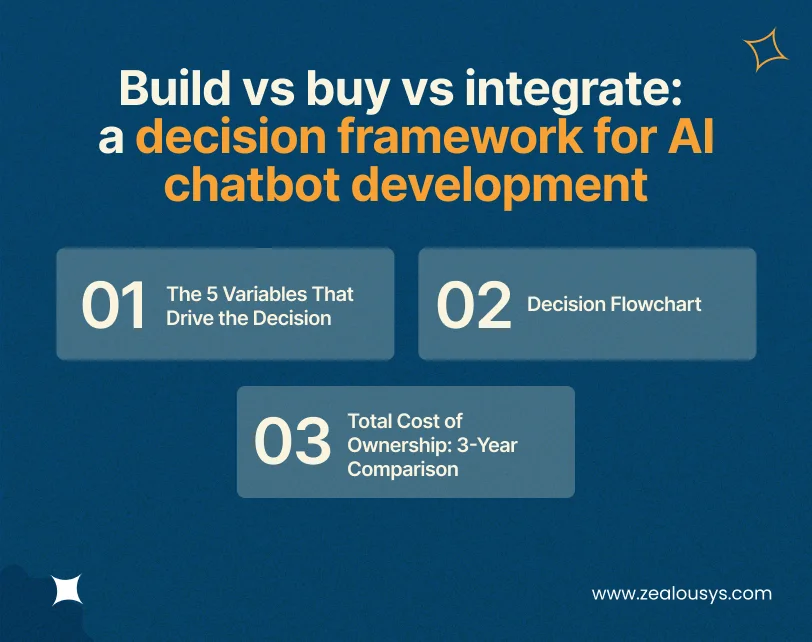
After three sections on what each path offers, this is the part that tells you which one to actually choose. The decision comes down to five variables. Answer these honestly, and the right path usually becomes clear.
1. Data Sensitivity
Does your chatbot handle regulated data, such as patient records, financial transactions, personal data under GDPR, or proprietary IP that legally cannot leave your infrastructure? If yes, build. If your data is internal but not regulated, integrate with appropriate controls. If your chatbot handles generic support queries with no sensitive data, buy.
2. Timeline
Need something live in under four weeks? Buy. Have six to ten weeks and a development team? Integrate. Building a product-grade chatbot that will serve as a core feature of your business? Plan for three to six months and build.
3. Team Capability
No engineers or ML expertise on staff? Buy a platform and save the complexity for later. Have developers but no ML background? Integrate. Modern LLM APIs do not require ML expertise to use effectively. Have an ML or NLP team with available capacity? Build.
4. Scale Trajectory
Staying small, under 50 agents with predictable volume? A SaaS platform is rational and cost-effective. Growing fast with unpredictable usage curves? Integration scales with you at a lower marginal cost. Building an enterprise product where the chatbot is a differentiator? Build for the long term.
5. Budget Structure
Prefer low upfront cost and predictable monthly spend? Buy. Have engineering capacity and want to manage long-term costs? Integrate. Have capital budget, a strategic use case, and a multi-year horizon? Build.
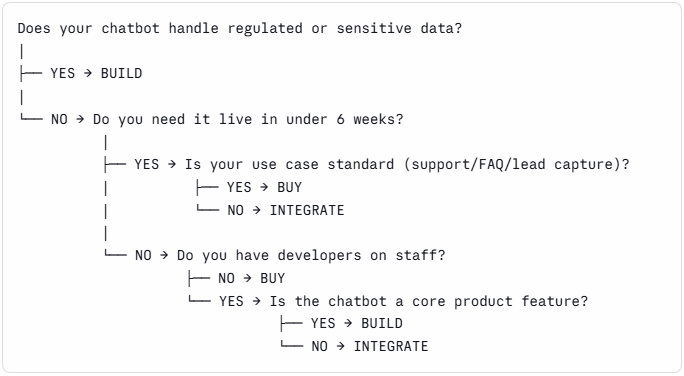
Year-one numbers often drive the decision. But this is a multi-year investment, and the full cost picture only becomes visible over time. The reason a 3-year view matters: the build and integrate paths carry front-loaded costs that flatten significantly in years two and three, while SaaS platform costs compound as seat counts and conversation volume grow. A single-year comparison would make buying look the cheapest in almost every scenario, which gives a misleading signal for a decision with long-term consequences.
| Criteria | Build | Buy (Mid-Market) | Integrate |
|---|---|---|---|
| Year 1 | $80k–$180k | $12k–$36k | $25k–$65k |
| Year 2 | $30k–$60k | $15k–$45k | $15k–$30k |
| Year 3 | $25k–$50k | $18k–$54k | $12k–$25k |
| 3-Year Total (Estimated) | $135k–$290k | $45k–$135k | $52k–$120k |
| Break-even vs Buy | Year 2–3 at scale | Baseline | Year 1–2 at scale |
These are industry-level estimates based on typical project scopes in 2025–2026. Actual costs vary significantly based on team size, geography, conversation volume, and chosen tech stack. Use these as order-of-magnitude guides, not project budgets.
The pattern is consistent: buying is cheapest in year one, building is most expensive upfront but flattens out, and integrating sits between the two across all three years while offering more flexibility than buying at comparable cost.
A company should build its own AI chatbot when it handles regulated or sensitive data that cannot leave its own infrastructure, when the chatbot is a core product feature that customers directly interact with, or when it has consistently hit the customization limits of SaaS platforms. If the chatbot touches patient records, financial transactions, or proprietary business logic that defines a competitive advantage, building is not just a preference. It is often the only responsible option.
Buying is cheaper in year one, often significantly so. At a small to medium scale, a SaaS platform will cost less across all three years. At higher conversation volumes, typically above 10,000 to 15,000 per month, integrating via LLM API becomes cheaper than buying, and building becomes cost-competitive by year two or three. The right comparison is total cost of ownership over three years, not the initial implementation cost.
A chatbot platform is a pre-built product you configure. You adjust tone, set up flows, and connect available integrations, but the underlying model, architecture, and infrastructure belong to the vendor. A custom chatbot is software you own entirely, built to your specifications, running on infrastructure you control, with model behaviour you define. The practical difference is that with a platform, you work within its limits. With a custom build, you set the limits.
Yes, and the basic version is less complex than most teams expect. A minimal integration using the OpenAI or Claude API, with a simple UI and basic prompt design, can be done by a developer in one to two weeks. A production-grade integration with RAG, conversation memory, CRM hooks, and proper error handling typically takes six to ten weeks. Neither requires ML expertise. What it does require is solid software engineering and a clear understanding of what the chatbot needs to know and do.
Three practices make a meaningful difference:
There is no universal right answer here, and anyone who tells you otherwise is selling something. The right path depends entirely on your data requirements, your team, your timeline, and where the chatbot sits in your business.
If speed and simplicity matter most and your use case is standard, buy a platform. If you are handling regulated data or building AI as a product feature, build from scratch. If you have developers, proprietary data, and want flexibility without a full custom build, integrating via an LLM API is where most companies in 2026 should default.
The mistake most teams make is treating this as a permanent decision. It is not. Many companies start with a platform, outgrow it, and migrate to an integrated or custom solution. What matters is making the right call for your current constraints while keeping an eye on where those constraints are headed.
At Zealous System, we have helped companies across all three paths: building custom AI chatbots for regulated industries, integrating LLM APIs into existing products, and advising on platform selection for teams that need speed over control. As an experienced chatbot development company, we help businesses choose, build, and scale AI chatbot solutions that align with their goals. If you are at that decision point and want a second opinion from people who have worked through each of these paths, we are open to that conversation.
Read Also:
Our team is always eager to know what you are looking for. Drop them a Hi!

Ruchir Shah is Technology Head at Zealous System with hands-on expertise in AI/ML, Microsoft Azure, .NET, Node.js, Python, React, and Angular. He leads enterprise software development, champions digital transformation, and mentors developers building the future of intelligent apps.


Comments