
The question has changed.
In 2023, product teams asked, “Should we experiment with AI?” By 2024, it became, “How do we actually deploy it?” Now, in 2026, it’s blunter: “Can you prove this is working?”
That’s the pressure most product leaders are sitting with today. Not whether AI is useful, that debate is settled. The real issue is whether the investment is showing up in actual output. According to McKinsey’s 2025 State of AI report, only 39% of organisations report measurable bottom-line impact from AI at the enterprise level. The gap between what teams are spending on AI and what they are getting back is the defining challenge in product development right now.
This guide is written for people trying to close that gap. CTOs deciding which AI tools to standardise across their teams. Product leads figuring out where AI fits in the lifecycle and where it does not. Founders weighing whether to build AI-native from day one or layer it in later.
What follows is a practical look at how AI fits across the full product development lifecycle, what agentic AI actually means for how engineers work, what the EU AI Act requires from product teams, real examples from projects we have shipped at Zealous, and a cost framework to help you decide where to start.
The numbers paint a clearer picture than the headlines do.
IDC’s FutureScape research projects that by 2026, 40% of G2000 job roles will involve direct interaction with AI systems, fundamentally reshaping how entry, mid-level, and senior jobs are structured.
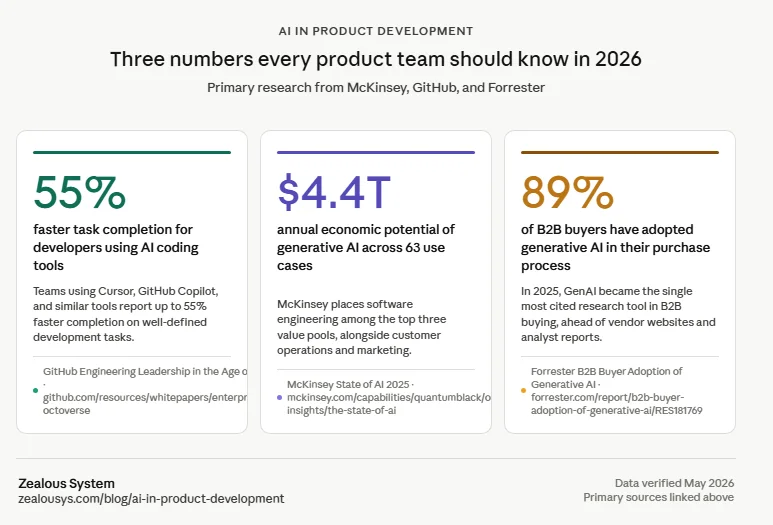
McKinsey’s analysis of generative AI’s economic potential puts the value at $2.6 to $4.4 trillion annually across 63 identified use cases, with software development consistently in the top three. According to GitHub’s Engineering Leadership research, developers using AI coding tools complete tasks up to 55% faster on well-defined work.
Here is the figure that matters most for product companies evaluating AI right now: Forrester’s 2024 Buyers’ Journey Survey found that 89% of B2B buyers have adopted generative AI, naming it one of the top sources of self-guided information across every phase of their purchase process.
By 2025, it became the single most cited research tool in B2B buying. Your potential clients are using AI to research, compare, and shortlist vendors before they ever contact you. Visibility in that process is no longer a differentiator. It is a baseline requirement.
The more meaningful shift is qualitative. Teams that have moved beyond tool adoption into actual process redesign are seeing compounding advantages. Faster prototyping, earlier defect detection, tighter feedback loops. Taken together, these produce a velocity gap between teams that have genuinely embedded AI and teams still treating it as a useful add-on.
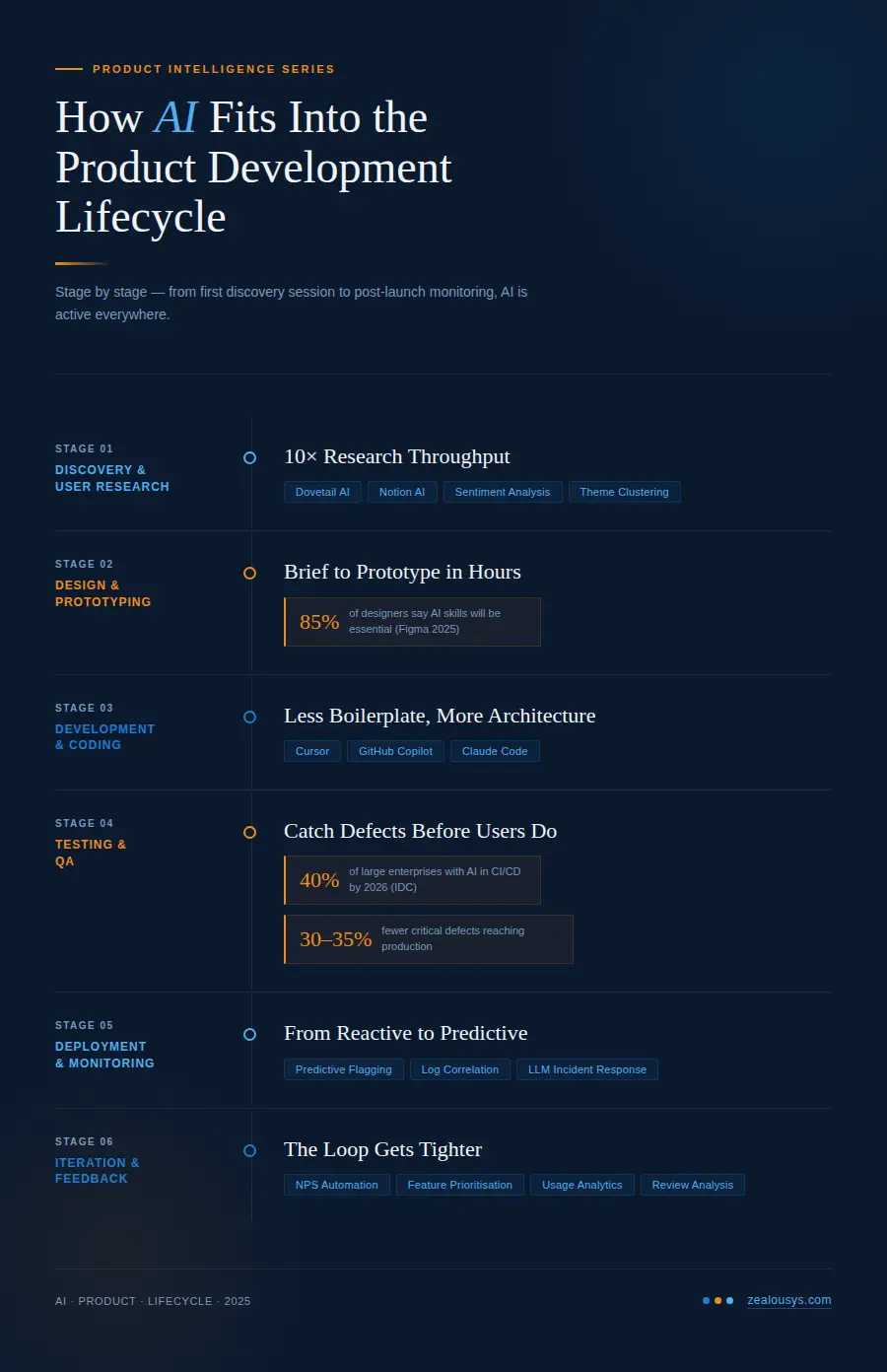
Most conversations about AI in product development focus on code generation. The reality is broader. AI is active across every stage of the lifecycle, from the first discovery session to post-launch monitoring. Here is what it actually looks like at each stage.
Tools like Dovetail AI and Notion AI now process interview recordings, tag themes automatically, and surface patterns across dozens of sessions in minutes. AI-assisted sentiment analysis can handle thousands of support tickets or app reviews in the time a researcher would spend on a handful. The outcome is not replacing researchers; it is giving them ten times the throughput so they can focus on the interpretive work that actually requires human judgment.
Figma’s 2025 AI report found that 85% of designers and developers say learning to work with AI will be essential to their future success. That tracks with how design workflows have shifted on the ground. Figma AI and tools like v0 by Vercel let teams generate working UI prototypes from a written brief. What once took a full day of layout work now takes a few hours of direction, review, and refinement.
The speed gain shows up most clearly in the design-to-development handoff. AI-generated components that arrive already structured and coded cut the back-and-forth that typically absorbs a week from every sprint.
This is where change is most visible in day-to-day work. Cursor, GitHub Copilot, and Claude Code have moved from experiment to standard equipment on high-velocity product teams. Engineers using these tools spend less time on boilerplate and more time on architecture and complex problem-solving.
One honest framing: AI coding tools are most effective when the engineers using them are experienced enough to review, refine, and redirect the output. Teams that treat AI-generated code as a first draft that needs evaluation ship better products than teams that treat it as a finished product. The tool raises the floor. The engineer raises the ceiling.
AI makes a strong case for itself in QA. ML models embedded in tools like Testim and Katalon analyse telemetry and flag anomalies before users report them. AI-generated test cases consistently cover edge cases that manual QA routinely misses. IDC forecasts that by 2026, 40% of large enterprises will have AI assistants embedded directly in their CI/CD workflows, with research showing ML-based predictive models reducing critical defects reaching production by 30 to 35%.
AI-powered CI/CD pipelines flag code changes that are statistically likely to cause performance issues before they reach production. LLM-assisted incident response tools correlate logs, errors, and recent deployments automatically, cutting the time engineers spend diagnosing problems. A stage that used to be almost entirely reactive is becoming increasingly predictive.
Post-launch is where AI’s value compounds. Automated review and NPS analysis keeps product managers current on user sentiment without manual cycles, and AI-assisted feature prioritization weighs user requests against usage data and revenue impact in near real time. The loop between what users experience and what the team builds next gets meaningfully tighter.
For the past two years, AI in product development mostly meant helping individual team members work faster. Generate a code snippet. Summarise a document. Suggest a test case. That model is being replaced by something qualitatively different.
Agentic AI refers to AI systems that plan and execute multi-step tasks with minimal human input at each step. Rather than answering a single question, an AI agent receives a goal, determines the steps required to reach it, uses tools and external APIs to carry out those steps, and reports back with a result.
GitHub Copilot Workspace takes a GitHub issue and produces a full implementation plan, including file changes, test cases, and a pull request description. The engineer reviews and adjusts the plan. They are not starting from a blank screen.
Cursor Agent opens a codebase, understands its structure, makes multi-file changes to implement a feature, and flags where it needs human guidance. Claude Code operates with a full codebase context, executes terminal commands, runs tests, and iterates based on the output it receives. For teams building more complex workflows, frameworks like LangChain, CrewAI, and Microsoft AutoGen allow specialised agents to hand tasks to each other. One agent handles research, another handles code generation, and a third runs validation.
The human role shifts from executing each task to directing the system that executes them.
The term “vibe coding” entered the technical vocabulary in 2025. It describes a workflow where a developer describes what they want in natural language and lets AI handle the implementation details. For solo founders and small teams building MVPs or internal tools, this has genuinely compressed timelines.
Startups that would previously have needed a three-person engineering team to build a working prototype are shipping functional products with one technical founder and AI handling implementation. Time-to-MVP has gone from months to weeks in many cases.
That said, vibe coding has real limits worth being honest about. Production-grade systems in regulated industries, products with complex distributed architectures, and anything requiring deep security review still need experienced engineers making the core decisions. AI accelerates implementation. It does not replace the architectural judgment that prevents expensive problems downstream.
EY’s analysis of this shift is direct: in the near future, serious enterprise systems could be run by a small number of human actors, with AI handling execution and humans handling intent-matching and verification. The engineer’s role becomes less about writing every line and more about directing AI systems precisely and catching errors before they reach users.
For product teams, the most valuable skill in 2026 is not knowing how to code. It is knowing how to direct AI systems, evaluate their output critically, and build governance into the workflow so speed does not come at the cost of reliability.
The clearest way to understand what AI delivers in product development is to look at what it has delivered.
A prominent Croatian tourism brand came to Zealous with a specific problem: their customer service system could not keep up with international inquiries arriving in Croatian, English, and German. Travelers were receiving outdated answers, booking queries were getting delayed, and the manual workload on the support team was growing.
We built a conversational AI chatbot using GPT-4o-mini, LangChain, and a RAG pipeline grounded in ChromaDB. The RAG model pulled from live campsite data, booking policies, and weather APIs so that every response reflected current information rather than static content. A FastAPI backend handled real-time weather lookups and routed maintenance requests via WhatsApp alerts through Twilio. The entire system was deployed on Azure Container Apps with auto-scaling for peak tourist season loads.
The results: multilingual response accuracy reached 95% after prompt refinement with LangSmith, maintenance issue response time dropped to under 10 minutes, retrieval speed improved by 40% after re-chunking the vector store, and the system handled 500+ concurrent users without performance degradation.
A corporate training platform was facing a content bottleneck. Skilled instructors were spending most of their time on the mechanical work of structuring and formatting course modules rather than on the design of the learning experience itself.
Zealous built a generative AI module directly into the LMS. Instructors enter a course topic and a set of learning objectives. The system generates a structured draft covering section content, quiz questions, and module summaries. Instructors review and refine the output rather than building from scratch. The AI layer was integrated using the OpenAI API within the platform’s existing React and Node.js stack, keeping the change transparent to end users.
A social platform client needed AI capabilities at three points in their product: automated content moderation at scale, personalised feed recommendations, and trend detection across a high-volume stream of posts. Manual moderation had become the primary operational bottleneck, and rule-based filters were producing too many false positives.
Zealous built an AI layer handling all three functions. Content moderation used a classification model trained on the client’s own moderation history, significantly reducing false positive rates compared to the previous rule-based system. Personalisation and trend detection ran on a separate inference pipeline to keep feed load times fast. A human review queue handled edge cases flagged by the model with low confidence.
Each of these projects started with a specific problem, not a technology assumption. The AI approach was chosen because it was the right fit for the problem, not because the client wanted to ship something AI-powered.
Building something with a similar profile in travel, education, or social? Take a look at how we approach these projects before reaching out.
The benefits of AI in product development are real. The failure modes are too. Here is what product teams run into most often, and what to do about each.
Large language models produce incorrect outputs with high confidence. This is not a bug being patched in the next release. It is a structural characteristic of how these systems work. The risk is not that AI will obviously fail. It is that AI will fail in ways that look correct until a user hits the problem in production.
The solution is not to avoid LLMs. It is to build output validation into the product architecture from day one. This means grounding model responses in retrieved, verified data using RAG, running automated fact-checking layers where accuracy is critical, and building human review into workflows where the cost of a wrong answer is high. These layers are far more expensive to add after launch than to design in from the start.
Building your product’s AI layer on a single API provider creates a dependency that becomes costly to unwind. Pricing, rate limits, and model capabilities change. A product deeply integrated with one provider faces real switching costs if that provider’s terms shift in the future.
The mitigation: design your AI layer with provider abstraction from the start. Use open-source models (Llama 3, Mistral, Phi-3) where performance requirements allow. Build retrieval architectures that work across providers rather than fine-tuning on a single model’s embeddings.
The EU AI Act came into full force in August 2025. If your product serves European users or processes data about them, it applies to you.
The Act uses a risk-tier system. Most software products fall into the minimal risk category, which carries basic transparency obligations: primarily disclosing to users when they are interacting with an AI system. High-risk AI systems face significantly stricter requirements. These include products used in hiring, credit scoring, medical diagnosis, and education. For these, the Act requires documented risk assessments, technical documentation, human oversight mechanisms, and conformity assessments before deployment.
If you are building AI features for a high-risk application category, compliance needs to be part of the architecture from the start. The documentation requirements alone, including training data logs, model performance records, and oversight procedures, take significant time to implement correctly. They cannot be bolted on at the end.
The most common AI product failure is not technical. It is strategic. Teams build AI features because they are technically interesting or because a competitor has shipped one, without first validating whether users actually want them. The result is a sophisticated feature with near-zero adoption that adds maintenance overhead and dilutes the product’s value.
The fix is straightforward in principle and genuinely hard to enforce: prototype the AI feature’s output and test it with real users before writing production code. A week of user testing will tell you more than a month of development.
When you send user data to a third-party LLM API, that data leaves your infrastructure. For products handling health records, financial data, or proprietary business information, this creates both legal and reputational exposure.
Options include private cloud deployment of open-source models, on-premise LLM hosting for the most sensitive use cases, and data anonymisation layers that strip personally identifiable information before anything reaches an external API. The right choice depends on your data sensitivity level and infrastructure budget.
Most teams do not need a lengthy AI strategy document. They need an honest answer to a direct question: are we ready to build this? Here is a practical framework.
The 5-Question Readiness Check
Work through these five questions before committing to an AI feature.
AI systems are only as good as the data they rely on. If your data is scattered, inconsistent, or incomplete, that is the first problem to solve before writing a single prompt.
“We want to use AI” is not a use case. “We want to cut customer support resolution time by 30% using an AI-first triage system” is.
Not everyone needs to be an ML engineer, but someone on the team needs to understand how these systems fail, not just how they perform when everything goes right.
How will you monitor for accuracy degradation over time? What happens when the model starts producing wrong or harmful outputs? Who is responsible for catching it?
Particularly relevant for regulated industries and any product serving EU-based users under the AI Act.
Four or five yes answers means you are ready to build. Two or three means a short readiness sprint focused on data quality and governance will save significantly more time than starting development immediately.
One of the most common questions product teams ask is: what does this actually cost? Here is a three-tier framework built on what we have seen across real engagements.
| Tier | What it Covers | Typical Cost | Timeline |
|---|---|---|---|
| Tier 1: AI-assisted developer tools | Cursor, GitHub Copilot, Notion AI, and Figma AI added to your existing team workflow. No custom development. | $50 to $500 per developer per month | Productivity impact in 2 to 4 weeks |
| Tier 2: Embedded AI features | An LLM-powered search, RAG knowledge system, recommendation engine, or AI-assisted workflow built into your product. Requires API integration, prompt engineering, retrieval architecture, and error handling. | $15,000 to $80,000 | 6 to 16 weeks, depending on complexity |
| Tier 3: Custom AI model development | Fine-tuning a base model on proprietary data, custom training pipelines, or on-premise LLM deployment for data sovereignty. | $100,000 and above | 4 to 9 months |
Most product teams belong in Tier 1 or Tier 2. Jumping from Tier 1 to Tier 3 without first validating what Tier 2 can deliver is one of the most common and expensive mistakes we see.
Use Tier 1 tools immediately and start your product’s AI features with an API integration rather than custom training. Your goal is a working prototype that validates user value, ships fast, and learns from real usage.
Pick one high-impact workflow, implement AI there, measure the outcome clearly, and use that result to build the case for the next step. Trying to add AI everywhere at once is how pilots stall.
Start with a pilot that has a clear success metric and a team willing to work through the rough edges, then use it as the blueprint for your governance model before expanding. At this scale, the bigger risk is moving fast on the wrong use case, not moving too carefully.
Unsure which tier fits your product and team situation? Reach out to our team, and we can walk through what realistic AI integration looks like for your specific context.
AI-driven product development is an approach where AI tools and techniques are integrated across the product lifecycle, from user research and design through development, testing, and post-launch iteration.
Rather than using AI for one isolated task, AI-driven teams use it across multiple stages to speed up decisions, reduce manual work, and improve output quality. In 2026, this increasingly means using agentic AI systems that can execute multi-step tasks autonomously rather than responding to individual prompts.
Costs depend on what you are building. AI-assisted developer tools cost $50 to $500 per developer per month and deliver measurable productivity gains with minimal setup time. Embedding a custom AI feature into an existing product typically costs $15,000 to $80,000 with a timeline of six to sixteen weeks.
Custom model development starts at $100,000 and is justified only when standard models cannot solve the problem or when data sensitivity requires on-premise deployment. Most teams should start at Tier 1 or Tier 2 before considering Tier 3.
For coding: Cursor, GitHub Copilot, Claude Code. For design and prototyping: Figma AI, v0 by Vercel. For user research and synthesis: Dovetail AI, Notion AI. For testing and QA: Testim, Katalon AI. For AI workflows and agent orchestration: LangChain, CrewAI, Microsoft AutoGen. The right combination depends on your team size, product stage, and where the biggest time bottlenecks are in your current workflow.
Yes, if your product serves or processes data from EU-based users. The Act uses a risk-tier system. Most software products sit in the minimal or limited risk tier and require basic transparency obligations, including disclosing AI use to end users. High-risk applications, including products used in healthcare, HR, credit assessment, and education, face stricter requirements: risk assessments, technical documentation, human oversight mechanisms, and conformity assessments before deployment. The Act came into full force in August 2025.
AI-assisted development uses AI tools to help humans work faster. Code completion, automated testing, and research synthesis. Humans make every decision, and AI reduces the effort each decision requires.
AI-native development means AI is embedded in the product’s architecture from the start, not added later. The product’s core value depends on AI capabilities rather than using AI only to accelerate the build process. Most products today are AI-assisted. AI-native products are becoming the standard in categories like customer support, personalization, and content generation.
Agentic AI refers to AI systems that plan and execute multi-step tasks with minimal human oversight at each step. Unlike a standard AI assistant that responds to a single prompt, an AI agent receives a goal, determines the steps required to reach it, uses tools and APIs to carry out those steps, and reports back with a result.
In product development, this shows up in tools like GitHub Copilot Workspace, which turns a GitHub issue into a full implementation plan, and Cursor Agent, which makes multi-file code changes based on a natural language instruction.
The product teams that will have a real advantage in 2028 are not necessarily the ones spending the most on AI today. They are the ones building repeatable processes now, while most competitors are still running pilots that never become products. A team that has figured out how to ship AI reliably, govern model outputs, and measure what actually changed will be 18 months ahead of a team that starts the same work next year. That lead is hard to close.
One specific problem, solved well, with a measurable outcome, is worth more than ten AI experiments that produce learnings but no shipped product. Every project we have built started exactly there, not with “we want to use AI,” but with a real cost the client could not afford to keep carrying. As a digital product development company that has been building AI across healthcare, travel, and education, we know the difference between a well-framed AI problem and a poorly framed one. The difference in outcome is significant.
If you have a specific problem and want to know whether AI is the right fit, tell us what it is. We will be straight with you about what it would take.
Our team is always eager to know what you are looking for. Drop them a Hi!

Pranjal Mehta is the Managing Director of Zealous System, a leading software solutions provider. Having 10+ years of experience and clientele across the globe, he is always curious to stay ahead in the market by inculcating latest technologies and trends in Zealous.


Comments