Building a multilingual AI chatbot for the travel industry requires more than just plugging in a language model. When we built one for a Croatian tourism brand serving English, German, and Croatian speakers, the real challenges were accuracy across languages, real-time data freshness, and routing urgent maintenance requests to the right people instantly. Here is exactly how we solved each one, what broke along the way, and what the final system looks like running in production.
Our client is a well-known tourism brand in Croatia offering immersive travel experiences including campsite bookings and local travel services. As their international customer base grew, their digital support system started breaking down in ways that hurt the business.
Travelers from Germany, the UK, and across Europe were asking questions the support team could not answer fast enough. Queries came in multiple languages. The existing system had no way to pull live campsite availability or real-time weather information. Maintenance requests like “broken shower at Site 3” went into a general inbox with no automatic routing to the right team.
The specific problems they brought to us were:
International inquiries were growing faster than the support team could handle. Responses in Croatian, English, and German were inconsistent in quality and speed.
Customers asking about campsite availability, local regulations, or weather conditions were getting answers based on static documentation that had not been updated.
Equipment issues and service complaints had no automated routing. Staff found out about urgent problems only when someone called, which was often too late.
Every summer the team was overwhelmed. The same questions got answered hundreds of times manually. There was no automation layer to absorb repeat queries.
These are not unique problems to this client. Most travel companies with a growing international customer base hit these exact walls. We had seen them before, which is why we had a clear idea of the right approach before the first workshop ended.
Before writing a single line of code, we had to answer the most important architecture question: do we fine-tune a language model or build a RAG system?
Both approaches are valid. Fine-tuning trains the model on your specific data so it bakes your knowledge into its weights. RAG, which stands for Retrieval-Augmented Generation, keeps the language model general and instead retrieves relevant information from your knowledge base at query time before generating a response.
For this travel client, fine-tuning was the wrong choice and here is why.
Campsite data changes constantly. Availability, pricing, regulations, and local guidelines update weekly or even daily during peak season. A fine-tuned model would need to be retrained every time the underlying data changed. That is expensive, slow, and operationally impractical for a tourism business.
RAG solved this elegantly. We stored the campsite data in a vector database called ChromaDB. When a traveler asked a question, the system retrieved the most relevant, up-to-date chunks from that database and passed them to the language model as context. The model generated an answer based on current data, not data it was trained on months ago.
The difference in practice was significant. Fine-tuning would have given the client a chatbot that knew a lot about their business as it existed at training time. RAG gave them a chatbot that knows what their business looks like right now.
Here is a direct comparison to make this clearer:
| Factor | RAG | Fine-Tuning |
|---|---|---|
| Data freshness | Real-time updates | Requires full retraining |
| Setup cost | Moderate | High upfront |
| Ongoing maintenance | Update the knowledge base | Retrain the model |
| Best for | Dynamic, frequently changing content | Fixed domain expertise |
| What we used for this client | Yes | No |
For any travel or hospitality business where content changes frequently, RAG is the right architectural choice. This is not an opinion. It is what the use case demands.
Getting the tech stack right for a multilingual, real-time, production-grade chatbot required deliberate choices at every layer. Here is what we used and the reasoning behind each decision.
GPT-4o-mini for the language model
We chose GPT-4o-mini over full GPT-4 because it offered strong multilingual capability at significantly lower per-token cost. For a tourism client with thousands of queries per day during peak season, this cost difference matters at scale. The model performed well across Croatian, English, and German once we addressed the language-specific quirks discussed later.
LangChain connected all the components: the user query, the retrieval step, the language model call, and the response. It handled the orchestration logic cleanly and gave us flexibility to add new tools and integrations without rebuilding the pipeline.
Not every query is a simple one-shot question and answer. Some conversations involve follow-up questions, multi-step lookups, or conditional routing. LangGraph handled these more complex conversation flows in a way that LangChain alone does not support as cleanly.
LangSmith logged every conversation and made it possible to identify where the chatbot was giving wrong or low-quality answers. This feedback loop was critical for improving multilingual accuracy after launch.
We ingested the client’s campsite data, FAQs, pricing tables, and local guidelines into ChromaDB as vector embeddings. At query time, the system retrieved the most semantically relevant chunks in milliseconds. After chunking, adding metadata, and fine-tuning the embeddings, retrieval speed improved by 40 percent compared to the initial setup.
The backend handled chatbot logic, external API calls, and alert routing. Python was the natural choice given the AI tooling ecosystem. FastAPI gave us the performance and async capabilities we needed for real-time responsiveness.
Real-time weather was one of the client’s explicit requirements. The backend made live API calls whenever a traveler asked about weather at a specific campsite location. This replaced the outdated static weather information that had been causing confusion before.
When a traveler reported a maintenance issue through the chatbot, the system categorized the request, determined urgency, and sent a WhatsApp alert to the appropriate maintenance team via Twilio. End to end, this happened in under 10 minutes from user input to staff notification.
We embedded a Chainlit-based chat widget directly into the client’s existing website. Combined with TypeScript and Copilot for UI enhancements, the interface was responsive and intuitive without requiring major changes to the client’s existing site design.
Load testing revealed the system struggled beyond 300 concurrent users in the initial setup. Moving to Azure Container Apps with auto-scaling and Redis caching solved this completely. The production system handles 500 or more concurrent users with sub-second response times.
Every conversation was logged through LiteralAI, giving the client full visibility into what users were asking and how the chatbot was responding. This data is also fed back into the continuous improvement process.
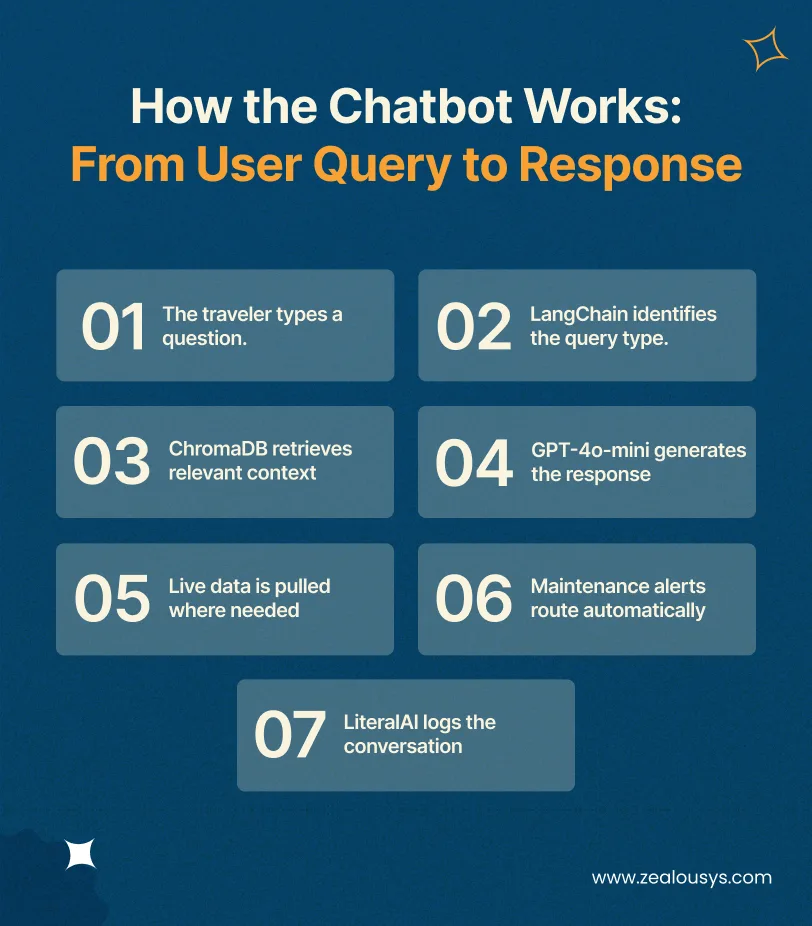
Understanding the flow from a traveler typing a question to receiving an accurate, helpful answer is important for anyone considering a similar build. Here is how the system works step by step.
A German traveler visiting the site types “Gibt es noch freie Plätze am Campingplatz Split?” which translates to “Are there still free spots at Campsite Split?”
The orchestration layer classifies the incoming query. Is this a booking inquiry, a weather question, a maintenance report, or a general FAQ? Each type routes through a different processing path.
For a booking inquiry, the system queries ChromaDB using semantic search to find the most relevant campsite availability data and policy documents. This retrieval step takes milliseconds and returns the actual current data, not a cached or outdated version.
The language model receives the user’s question plus the retrieved context and generates a natural language response in the same language the user wrote in. The user gets a response in German without ever having to switch languages or specify their preference.
For weather queries, FastAPI makes a real-time call to the weather API and includes current conditions in the response context before generation. The traveler gets live weather information, not a generic forecast.
If the query contains a maintenance issue, FastAPI categorizes the request by type and urgency and triggers a WhatsApp notification to the relevant maintenance team. The staff gets the alert before the traveler has even closed the chat window.
Every interaction is stored for review and continuous improvement. LangSmith feedback loops help the team identify and fix low-quality responses over time.
The entire flow from question to response takes under two seconds in normal operation. During peak load with 500 or more concurrent users, Redis caching ensures response times stay below one second for repeat queries.
The honest story of building this system includes the parts that broke. These five challenges are the most valuable sections of this blog for anyone planning a similar build, because they are the problems you will also face and the solutions we found.
GPT-4o-mini performed well in English. Croatian was a different story. The model consistently misread regional idioms and local travel terms. The word “šator,” which simply means tent in Croatian, triggered confused responses. Regional campsite terminology that every Croatian traveler uses was being misinterpreted or ignored entirely.
The fix was not to switch models. The fix was prompt engineering and feedback loops. We built a library of regional travel slang and culturally specific terms into the system prompts. LangSmith gave us visibility into exactly which queries were producing wrong answers in Croatian. After two sprints of targeted prompt refinement, multilingual response accuracy reached 95 percent across all three languages.
The lesson here is that language model multilingual capability is not the same as regional language accuracy. General multilingual ability and understanding local idioms are two different things. Budget time for language-specific tuning, especially if your target market uses non-standard vocabulary.
A traveler typing “broken toilet at Campsite Split” or “šator not working at Site 7” is reporting a maintenance issue. But these messages arrive in completely unstructured natural language with no metadata, no priority level, no location standardization, and no routing information.
Initially the system received these messages and did nothing useful with them beyond acknowledging the complaint.
We built a FastAPI workflow that parsed maintenance reports, categorized them by type (plumbing, electrical, equipment, safety), assigned priority levels based on urgency signals in the text, formatted the request into a structured alert, and sent it via Twilio to the appropriate maintenance team’s WhatsApp. The entire routing process from user message to staff notification now takes under 10 minutes.
This feature alone justified the chatbot investment for the client. During the summer season, maintenance response time dropped significantly and customer satisfaction with issue resolution improved measurably.
The initial RAG setup used a snapshot of campsite data that was refreshed manually. During the first week of testing, a traveler asked about availability at a specific campsite. The chatbot gave a confident answer based on data that was three days old. The campsite in question was fully booked.
Static RAG gives you retrieval. It does not give you freshness. We rebuilt the data ingestion pipeline so ChromaDB synced with live campsite availability data automatically. Weather data came directly from real-time API calls rather than stored documentation. The chatbot now answers availability and weather questions based on current data, not a stale snapshot.
If you are building a RAG system for any business where data changes regularly, automatic sync pipelines are not optional. They are part of the architecture.
The client’s knowledge base included a lot of PDF documentation: campsite guides, local regulations, seasonal pricing tables, activity schedules. Ingesting these PDFs without preprocessing produced terrible retrieval results.
The search was returning entire sections of unrelated PDFs because the semantic similarity happened to be high at the document level even when the actual content was irrelevant to the query. A traveler asking about shower facilities was getting back chunks of a PDF about local hiking trails.
We fixed this through three steps. First, we chunked documents at the paragraph level rather than the page level. Second, we added metadata to every chunk including document type, campsite name, category, and date. Third, we fine-tuned the embedding parameters to weight metadata matches more heavily during retrieval. The result was a 40 percent improvement in retrieval speed and a dramatic improvement in result relevance.
Load testing before launch revealed a hard limit. At 300 concurrent users, response times degraded sharply. At 350 users, the system began dropping requests. For a Croatian tourism brand with peak summer traffic, 300 users was not enough headroom.
The solution was a combination of horizontal scaling and intelligent caching. We migrated the deployment to Azure Container Apps with auto-scaling configured to spin up new instances when load exceeded defined thresholds. We added Redis caching for common queries so the most frequently asked questions did not generate new LLM calls on every request.
The production system now handles 500 or more concurrent users with consistent sub-second response times. The auto-scaling configuration means it can go higher during unexpected traffic spikes without manual intervention.
After deployment on Azure with full CI/CD pipelines and a client-facing admin dashboard for content updates, the system delivered these measurable outcomes:
Based on what we built and what we learned, here is an honest assessment of when this architecture makes sense.
Your platform serves customers in two or more languages and support quality is inconsistent across those languages. Your support team handles a high volume of repeat questions that could be automated. You have dynamic content like availability, pricing, or weather that changes regularly and needs to be reflected in responses. You want to reduce customer support costs without reducing response quality. You receive operational requests like maintenance reports or service issues that need faster routing to the right people.
You have fewer than 500 customer support queries per month. Your content is fully static and rarely changes. You serve only one language market. You are pre-launch and do not yet have a real knowledge base to retrieve from.
The technology is mature enough that a well-built system can go from architecture decision to production in eight to twelve weeks for a scoped use case like this one. The harder work is the knowledge base preparation, the language-specific tuning, and the data pipeline setup. The model and retrieval infrastructure are the easier parts.
For travel companies interested in building something similar, here is a realistic picture of what the engagement looks like.
Total timeline is approximately 12 weeks for a production-ready multilingual AI chatbot. Scope, complexity, number of languages, and integration requirements affect this estimate.
A RAG chatbot, or Retrieval-Augmented Generation chatbot, retrieves relevant information from your own knowledge base before generating a response. For travel businesses, this means the chatbot answers questions using your actual campsite data, availability information, pricing, and local guidelines rather than relying solely on what a language model learned during training. This approach is ideal for travel because the underlying data changes frequently.
For a scoped travel industry use case similar to the one described in this blog, a production-ready multilingual AI chatbot takes approximately 10 to 12 weeks from discovery to deployment. This includes knowledge base setup, language-specific tuning, integration development, load testing, and cloud deployment.
A RAG-based chatbot using GPT-4o-mini or similar models can support a wide range of languages including English, German, French, Spanish, Italian, Croatian, and many others. The key challenge is not the language model’s general multilingual capability but rather regional idiom accuracy and local vocabulary. Budget additional time for language-specific prompt tuning for any non-English languages in your target market.
For travel businesses with frequently changing content like availability, pricing, and seasonal regulations, RAG is the better choice. Fine-tuning embeds knowledge into the model’s weights and requires full retraining when the underlying data changes. RAG retrieves current information at query time from an updatable knowledge base. If your content is dynamic, RAG is the right architecture.
The cost depends on scope, number of languages, integrations required, and cloud infrastructure choices. A focused multilingual chatbot with RAG, real-time data integration, and production deployment typically ranges from $25,000 to $60,000 USD for initial development. Ongoing costs include cloud hosting, language model API usage, and knowledge base maintenance. We provide detailed estimates after a scoping conversation.
Yes, with the right architecture. The chatbot described in this blog integrates live weather APIs and real-time campsite availability data through FastAPI backend calls. When a traveler asks about weather at a specific location or campsite availability on a specific date, the system queries live data sources and includes that current information in the response. Static RAG alone cannot do this. Real-time data integration requires explicit API connections in the backend layer.
Based on our production experience, the stack that works well for this use case is GPT-4o-mini for the language model, LangChain for orchestration, ChromaDB for the vector store, FastAPI with Python for the backend, Chainlit for the chat UI, and Azure Container Apps for scalable cloud deployment. LangSmith is essential for ongoing monitoring and improvement. This stack is mature, well-documented, and well-supported by the open-source community.
We built this for a Croatian tourism brand. We can build it for yours.
Whether you run an OTA, a hospitality platform, a tour operator, or a campsite network, the architecture described in this blog is adaptable to your specific use case, your languages, and your data.
Our team has built production-grade AI chatbots across travel, healthcare, education, and retail. We know where the hard parts are and we know how to solve them without burning time on problems that have already been solved.
If you are evaluating whether a multilingual RAG chatbot makes sense for your travel business, start with a free 30-minute technical consultation. We will tell you honestly whether the investment is right for your current stage and what a realistic scope looks like.
Talk to our AI team at Zealous System
Related reading: RAG-Enabled Multilingual AI Chatbot for Travel Industry (Case Study) | AI Software Development Services | Generative AI Development | Chatbot Development
Our team is always eager to know what you are looking for. Drop them a Hi!

Meet the Zealous Team – your dedicated source for cutting-edge insights on the latest technologies, digital transformation, and industry trends. With a passion for innovation and a commitment to delivering unparalleled expertise.


Comments