The cost to build an AI agent for your business in 2026 typically falls between $10,000 and $500,000+, depending on the complexity of the agent, the integrations required, the underlying model used, and the scale at which it operates. A focused MVP agent solving one core workflow may cost $15,000 to $40,000.
A multi-agent system with enterprise-grade security, custom data pipelines, and deep third-party integrations can push well past $200,000. This guide breaks down exactly what you’re paying for and what to watch out for.
Every few months, a technology comes along that forces executives to ask a simple but loaded question: “How much will this actually cost us?” AI agents are at that point right now. They are, in practical terms, the most deployable form of generative AI applications in enterprise settings today.
Unlike AI chatbots, which mostly answer questions, AI agents actually do things. They take instructions, reason through steps, call tools, make decisions, and execute tasks with minimal human oversight. That distinction matters enormously for pricing.
You can find vague estimates everywhere online. Ranges like “$5,000 to $1 million” are technically accurate but practically useless. This guide takes a different approach. Whether you are a CTO scoping out a proof of concept, a founder weighing build versus buy, or an operations director trying to understand total cost of ownership, the goal here is to give you numbers that you can actually use in a planning conversation.
Before discussing costs, it is worth making sure we are talking about the same thing.
A chatbot takes input, retrieves or generates a response, and sends it back. That is the entire loop. It is stateless, mostly reactive, and largely limited to language.
An AI agent is something more. It maintains memory across a session or across time, decides which tools to use, sequences actions based on intermediate outputs, and can loop back when something does not go as planned. In practical terms, an agent might:
This is what the industry calls agentic AI: autonomous workflow automation driven by large language models and connected to real business systems. In some industries, these are also referred to as intelligent virtual agents, though the underlying principle is the same: an AI system that acts, not just responds.
The moment you understand this distinction, you understand why the cost to build an AI agent is categorically different from the cost of deploying a chatbot. You are not just paying for language understanding. You are paying for reasoning, integration, orchestration, safety guardrails, and ongoing reliability.
Not all AI agents are built the same. The architecture you choose determines much of your budget before a single line of code is written.
Estimated Cost: $10,000 – $40,000
This type of agent handles one well-defined workflow end-to-end. Examples include a document summarization agent, an email triage agent, or a scheduling assistant connected to your calendar system. These are ideal starting points for businesses running their first AI project. Development is relatively predictable, integration scope is narrow, and the risk of scope creep is manageable.
Estimated Cost: $30,000 – $90,000
A Retrieval-Augmented Generation (RAG) agent queries your internal knowledge base (documents, manuals, databases, past reports) to ground its responses in your proprietary data. These agents are increasingly common in legal, healthcare, finance, and professional services, where accuracy and source traceability matter. The additional cost comes from building the retrieval pipeline, embedding models, vector databases, and chunking strategies.
Estimated Cost: $80,000 – $300,000+
Multi-agent systems involve several specialized agents working together, with an orchestrator coordinating the overall workflow. Think of it as a team of AI workers, each with a defined role. One agent researches, another drafts, another verifies, and a fourth executes. These systems are powerful but architecturally complex. Testing, debugging, and maintaining inter-agent communication adds significant cost.
Estimated Cost: $150,000 – $500,000+
At the enterprise end, you are building a production-grade system with role-based access controls, audit trails, integration with multiple enterprise platforms (ERP, CRM, ITSM, data warehouses), custom fine-tuning or model adaptation, and full compliance documentation. These projects typically run six to twelve months and require a cross-functional team including AI engineers, backend developers, and security architects.
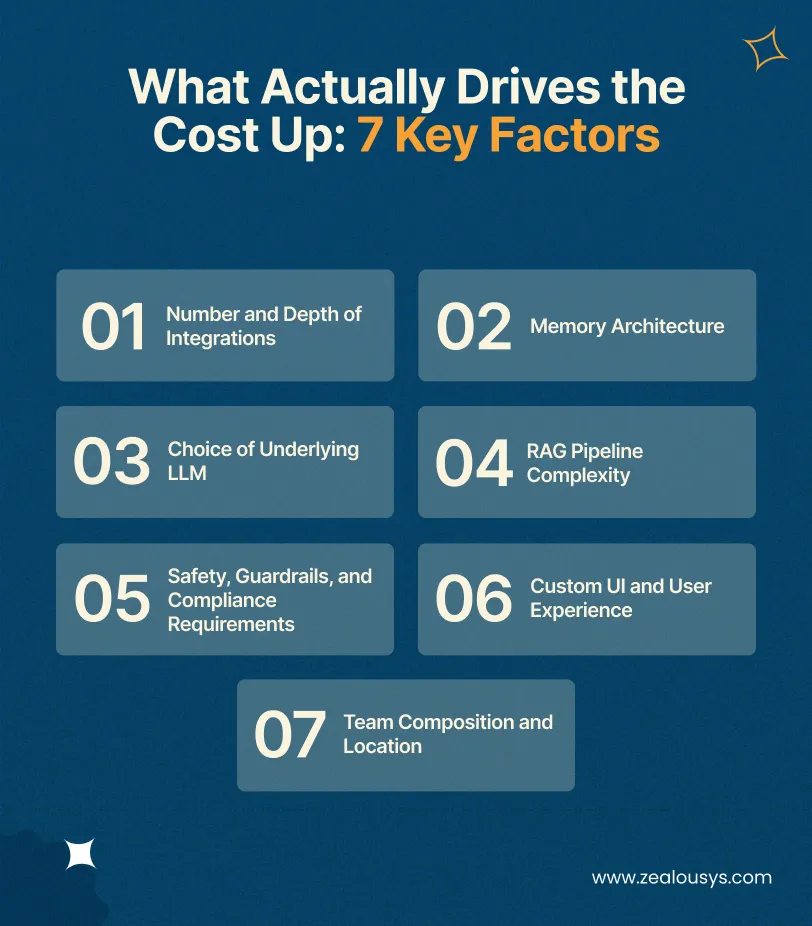
Most cost discussions stop at “complexity.” But that is too broad to be useful. Here are the seven specific variables that drive the cost most significantly.
Every system your agent connects to adds cost. A read-only connection to a single API is inexpensive. A bidirectional integration with a legacy ERP that has no public API, requires custom middleware, and needs real-time sync can cost tens of thousands on its own. The more your agent needs to interact with your existing tech stack, the more integration work piles up.
Does your agent need to remember a user across multiple sessions? Does it need to track the state of a long-running workflow over days or weeks? Short-term memory (within a session) is relatively straightforward. Long-term memory requires a persistent store, careful retrieval logic, and mechanisms to prevent the agent from acting on outdated context. The more sophisticated the memory design, the higher the build cost.
Not all language models are priced equally. GPT-4o, Claude, Gemini Ultra, and Llama-based open-source models each come with different API costs, performance profiles, and licensing terms. A high-frequency production agent making thousands of calls per day will accumulate significant inference costs over time. This is both a development consideration and an ongoing operational one.
If your agent needs to work with your internal data, building a reliable RAG pipeline is non-trivial. Decisions around chunking strategy, embedding model selection, vector database choice (Pinecone, Weaviate, pgvector, etc.), and re-ranking mechanisms all affect both accuracy and cost. A poorly designed RAG pipeline will produce an agent that confidently gives wrong answers. That is far worse than no agent at all.
Autonomous agents acting on your behalf need guardrails. In regulated industries, those guardrails are not optional. They are a compliance requirement. Building input/output filtering, rate limiting, action confirmation workflows, and full audit logging adds significant development time. For healthcare or finance deployments, this layer alone can account for 20-30% of the total project cost.
Some agents work entirely in the background. Others need a frontend: a dashboard for human-in-the-loop review, a conversational interface, a monitoring panel. Building polished, usable interfaces for non-technical end users adds frontend development cost on top of the core agent engineering.
An AI agent project requires a specific blend of skills: LLM prompt engineering, backend API development, database design, DevOps, and domain expertise in the business area you are automating. Building this team in-house in Sydney, London, or New York commands significantly higher day rates than working with an experienced offshore AI development team. This single factor can reduce your total project cost by 50-65% without a proportional drop in quality, provided you choose the right partner.
Many businesses underestimate the total cost of ownership because they budget only for development. Here are the costs that appear after launch.
Industry context shapes what an AI agent needs to do, and therefore what it costs to build.
Agents in fintech and banking typically require strong compliance frameworks, encrypted data handling, and integration with core banking or trading platforms. Expect costs toward the higher end: $80,000 – $400,000 for production-grade deployments.
Clinical and administrative healthcare agents must contend with HIPAA (in the US), or equivalent privacy regulations in Australia, the UK, and Europe. Integrations with EHR systems like Epic or Cerner are notoriously complex. Budget $100,000 – $500,000+ for anything touching clinical workflows.
Document intelligence agents for contract review, due diligence, or compliance monitoring are popular in this space. Accuracy requirements are high, and hallucination risk must be managed carefully. Typical range: $40,000 – $200,000.
Agents handling product recommendations, inventory management, customer service automation, and dynamic pricing are relatively well-suited to existing APIs and data structures. Cost range: $20,000 – $120,000, depending on integration depth.
Tech companies building agents into their own products (AI copilots, workflow automation features) have the most variable costs, ranging from $30,000 for an MVP agent to $300,000+ for a platform-embedded multi-agent capability.
Supply chain agents, route planning agents, and predictive maintenance agents require integration with operational databases and real-time data feeds. Expect $50,000 – $250,000, with costs driven heavily by data infrastructure complexity.
This is a decision that every leadership team faces, and there is no universal right answer.
Tools like Zapier’s AI features, Make, Microsoft Copilot Studio, and various drag-and-drop agent builders have lowered the floor for AI automation. For simple, template-driven workflows, these tools can deliver value at $500-$5,000 per month in subscription costs. The constraint is customization. When your workflow diverges from what the platform was designed for, you hit walls quickly. These tools also tend to create hidden long-term costs in the form of platform lock-in and per-operation pricing that scales badly.
Vendors like Salesforce Einstein, ServiceNow AI, and various vertical-specific AI tools offer pre-built agents for defined use cases. If your needs map cleanly to one of these products, this route can be faster and cheaper than custom development. The trade-off is flexibility. You are adopting the vendor’s data model, their update schedule, and their pricing trajectory.
Custom development is the right choice when:
Custom development has a higher upfront cost, but it gives you an asset you own, adapt, and extend as your business evolves. Done with the right partner, it does not have to mean inflated timelines or runaway budgets.
Spending on an AI agent is a capital investment. You should be able to model a return before the project starts.
Start with this framework:
How many hours per week does this workflow consume? What is the fully loaded cost of the people performing it?
Not every task in a workflow will be fully automated. A realistic automation rate for most business workflows is 60-80% of steps. Build this assumption into your model conservatively.
Manual processes have error rates. What does a mistake cost you in rework, customer impact, or regulatory exposure? Agents with well-designed guardrails often outperform humans on consistency, and that consistency has a dollar value.
Some agents do not just cut costs. They create capacity. A sales development agent that qualifies leads 24/7 generates pipeline that would not otherwise exist. A customer support agent that resolves tickets in minutes rather than hours improves satisfaction and retention.
If your agent costs $80,000 to build and saves you $12,000 per month in operational costs, your simple payback period is under seven months. Annualized ROI at that rate is substantial.
The key discipline is building the model before committing to the budget. Not after, when sunk cost bias tends to colour the analysis.
Timeline varies with complexity, but here are realistic reference points.
| Agent Type | Timeline |
|---|---|
| Simple single-task agent (MVP) | 4 – 8 weeks |
| RAG agent with knowledge base integration | 8 – 14 weeks |
| Multi-step workflow agent with 3-5 integrations | 12 – 20 weeks |
| Multi-agent system | 20 – 36 weeks |
| Enterprise-grade autonomous agent | 6 – 12 months |
These timelines assume a skilled, dedicated team. They compress when requirements are clearly defined upfront, and the technology stack decisions are made early. They extend when requirements shift mid-project, integrations have undocumented APIs, or the business domain requires domain-specific training and evaluation.
One pattern worth highlighting: ship an MVP first. A focused, narrow agent deployed in eight weeks at $30,000 teaches you more about real-world performance than a six-month planning exercise. Most enterprise AI projects that succeed in 2026 started with a tight MVP that then got expanded based on observed usage.
At Zealous System, we scope AI agent projects differently from standard software engagements. The first conversation is always about the business problem and the workflow it sits within. Not the technology stack. That sequence matters, because the right architecture for an AI agent is always dictated by the real-world constraints of the process being automated. It is the same discipline that separates good AI software consulting from generic technical delivery.
Our team covers the full build spectrum: LLM integration, RAG pipeline design, multi-agent orchestration using frameworks like LangGraph and AutoGen, vector database setup, API and enterprise system integration, and frontend development for human-in-the-loop interfaces. We work with clients across Australia, the UK, the US, and Europe, predominantly in financial services, healthcare, legal, and technology sectors.
For teams with limited AI experience internally, we typically recommend starting with a Discovery and Architecture workshop before committing to a full build. This produces a scoped architecture document, a cost estimate with stated assumptions, and a phased delivery plan. That way, you go into the project with clear expectations on both sides.
A functional, production-ready single-task agent can be built for $15,000–$30,000 with a focused scope and clear requirements. Below that threshold, you are generally looking at no-code tools or heavily constrained prototypes rather than maintainable production software.
Plan for 15–20% of your development investment per year. This covers model monitoring, dependency updates, performance tuning, and iterative improvements based on user feedback and usage data.
Open-source models can reduce ongoing API inference costs significantly. However, hosting and serving them requires infrastructure investment and engineering expertise. The total cost comparison depends on your scale. At moderate call volumes, hosted APIs from OpenAI or Anthropic are often more cost-effective. At high volume, self-hosted models start to make economic sense.
A straightforward FAQ chatbot can be deployed for $5,000–$15,000. An AI agent that actually executes business processes starts at $15,000 for a narrow MVP and scales upward with workflow complexity. The gap widens when you factor in the testing, integration, and guardrail work that agents require.
Yes, if you have AI engineers with LLM application experience on your team. The more common challenge is not technical capability but bandwidth. Most engineering teams are already carrying product roadmap commitments. Offshore AI agent development with a specialist partner lets you run the AI project in parallel without pulling your core team off other priorities.
When shortlisting an AI agent development company, avoid evaluating on hourly rate alone. Look at the team’s depth in LLM application development specifically (not just general software development), ask for case studies in your industry, and request a scoped estimate with written assumptions rather than a generic range. The difference between a $60,000 project and a $120,000 project often comes down to how well requirements were defined and scoped at the start.
The cost to build an AI agent for your business in 2026 is not a single number. It is a function of your workflow complexity, your existing infrastructure, your compliance requirements, and the team you work with. A well-scoped single-task agent can deliver meaningful ROI at $20,000. A poorly planned enterprise project can consume $400,000 and still fall short.
The businesses that get the most value from AI agents right now are not the ones with the biggest budgets. They are the ones with the clearest problem definition. Before you commit to a build, get the workflow on paper, model the return, and start with the smallest viable scope.
If you are working through those decisions, Zealous System’s team can help you scope, architect, and build AI agents that fit your operational reality and your budget. We have done this across financial services, healthcare, legal, e-commerce, and technology. We know how to structure a project so it does not spiral.
Our team is always eager to know what you are looking for. Drop them a Hi!

Pranjal Mehta is the Managing Director of Zealous System, a leading software solutions provider. Having 10+ years of experience and clientele across the globe, he is always curious to stay ahead in the market by inculcating latest technologies and trends in Zealous.


Comments