Healthcare teams today handle massive volumes of clinical and genomic data, but they often struggle to turn that data into clear, actionable decisions. An AI Agent in precision medicine helps solve this problem by analyzing complex datasets and delivering personalized treatment insights in real time. Healthcare startup founders, CTOs, product managers, and hospital innovation teams now explore precision medicine AI Agent solutions to improve diagnosis, speed up decision-making, and reduce manual effort. These systems do not just process data but they guide clinicians toward better, data-driven outcomes.
Many organizations still face challenges when they try to adopt AI. They struggle to prove ROI, manage compliance requirements like HIPAA and GDPR, and build reliable systems without strong in-house expertise. An AI Agent in personalized healthcare addresses these gaps by combining advanced analytics, automation, and clinical intelligence into one scalable solution. It helps data scientists, consultants, and biotech teams move from raw data to meaningful recommendations without adding operational complexity.
In this blog, you will learn how AI agents are used in precision medicine through real-world use cases, measurable ROI, and a clear implementation strategy. You will see how these systems turn fragmented healthcare data into accurate treatment decisions and how your organization can adopt them step by step.
An AI Agent in precision medicine is a smart software system that can understand patient data, reason over it, and take meaningful actions. It does more than just analyze information. It actively supports doctors, researchers, and product teams in making better healthcare decisions.
Unlike traditional AI models that give static outputs, an AI agent works like a continuous assistant. It can gather data from multiple sources such as electronic health records, genomic reports, and wearable devices. It can then process this data in real time and generate clear, actionable insights. This approach helps solve a common problem where teams have too much clinical or genomic data but struggle to turn it into decisions.
Traditional AI focuses on one task at a time. For example, it might predict disease risk or classify medical images. It usually requires human input at every step and cannot adapt easily to new data.
An AI agent in personalized healthcare works differently. It can:
This shift makes precision medicine AI agent solutions more practical for real-world healthcare systems where decisions depend on complex and evolving data.
AI agents play a direct role in improving clinical decisions. They analyze patient-specific data and suggest personalized treatment options. They help clinicians reduce guesswork and save time.
For example, an AI agent can:
This is how AI agents are used in precision medicine to turn raw data into clear recommendations. Teams can move faster from analysis to action, which improves patient outcomes and operational efficiency.
AI agents sit at the center of modern healthcare technology. They connect different systems and make them work together more effectively.
They integrate with:
This integration allows healthcare organizations, startups, and pharma teams to build intelligent workflows without relying only on manual processes. It also helps address key challenges like proving ROI, managing compliance requirements, and reducing dependency on large in-house AI teams.
Precision medicine has moved from concept to reality, but the scale of data has grown faster than the ability to use it. Healthcare teams now handle massive volumes of genomic, clinical, and patient-generated data every day. This shift creates a clear need for an AI Agent in precision medicine that can turn complex data into clear, actionable insights.
Healthcare startups, hospital innovation teams, and pharma companies generate huge datasets from genomics, EHR systems, and diagnostics tools. Data scientists and product teams often struggle to connect these data points in a meaningful way.
An AI Agent in personalized healthcare can process and analyze this data at scale. It helps teams move from raw data to treatment insights without delays. This approach supports faster innovation and better decision-making across healthcare organizations.
Clinical teams and engineers cannot manually analyze millions of data points with speed and accuracy. Manual workflows slow down diagnosis and increase the risk of missed insights.
CTOs and engineering leaders often face challenges when they try to scale traditional systems. This is where precision medicine AI Agent solutions add value. These systems automate complex analysis, reduce human error, and improve consistency in decision-making.
Doctors and healthcare platforms need fast and reliable recommendations to deliver personalized care. Delayed insights can impact patient outcomes and increase treatment costs. Many organizations also struggle to prove the ROI of AI without real-time impact.
When teams understand how AI agents are used in precision medicine, they can see clear benefits. AI agents analyze patient data in real time and suggest tailored treatment options. This capability improves clinical outcomes and supports data-driven healthcare strategies.
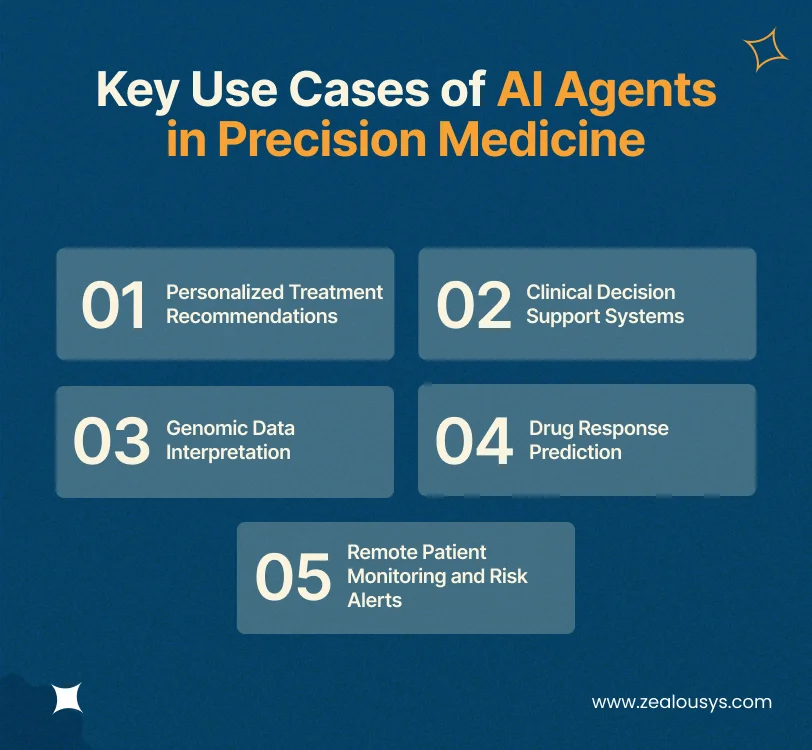
Healthcare teams today face massive volumes of clinical and genomic data, yet they often struggle to turn it into clear decisions. An AI Agent in precision medicine helps bridge this gap. It processes complex datasets, delivers actionable insights, and supports faster and more accurate care. These capabilities matter for healthcare startup founders, CTOs, product managers, hospital innovation teams, and pharma leaders who want scalable and compliant solutions without building everything in house.
Below are the most impactful use cases where precision medicine AI Agent solutions deliver real value.
AI agents analyze patient genetics, medical history, and lifestyle data to suggest tailored treatment plans. They match therapies with individual genetic profiles and help clinicians choose the most effective options.
This approach reduces trial and error in treatment selection and improves patient outcomes. It also helps teams move from data overload to clear recommendations. For organizations building AI Agent in personalized healthcare, this use case directly addresses the challenge of turning complex data into meaningful decisions.
AI agents assist doctors by providing real time, data backed insights during diagnosis and treatment planning. They combine clinical guidelines, patient records, and latest research to support better decisions.
This reduces the cognitive load on clinicians and improves consistency in care. It also helps hospitals and healthcare platforms demonstrate measurable ROI from AI investments. Many healthcare leaders adopt AI Agent in precision medicine to strengthen decision support while maintaining compliance with standards like HIPAA and GDPR.
AI agents process large scale sequencing data much faster than manual methods. They identify patterns, mutations, and biomarkers that influence disease and treatment response.
This speeds up research and clinical workflows, especially for genomics and diagnostics startups. It also helps data scientists and biotech teams extract value from complex datasets without building heavy infrastructure. This is one of the core ways how AI agents are used in precision medicine to turn raw genomic data into actionable insights.
AI agents predict how different patients will respond to specific drugs based on genetic and clinical data. They help reduce adverse reactions and improve treatment success rates.
This capability supports pharma and biotech innovation teams in designing better therapies and clinical trials. It also enables healthcare providers to personalize medication plans with higher confidence. By improving accuracy and reducing risks, precision medicine AI Agent solutions make treatment planning more reliable and efficient.
AI agents continuously monitor patient data from wearables, medical devices, and health apps. They detect early warning signs and trigger alerts for potential risks.
This helps healthcare teams take proactive action instead of reacting late. It improves patient safety and reduces hospital readmissions. For digital health startups and hospital IT leaders, this use case shows how AI Agent in personalized healthcare can extend care beyond clinical settings while maintaining real time visibility.
Healthcare leaders want clear outcomes before investing in new technology. An AI Agent in precision medicine delivers measurable value by turning complex clinical and genomic data into real decisions. It helps healthcare startup founders, CTOs, product managers, hospital innovation teams, and pharma innovators move from experimentation to real impact.
It also directly addresses key challenges. It reduces data overload, proves ROI with clear metrics, supports compliance-ready workflows, and removes the need for large in-house AI teams through scalable precision medicine AI Agent solutions.
AI agents process genomic data, patient history, and clinical records in minutes. Doctors receive faster insights and take quicker action. This reduces delays in critical treatment decisions.
AI agents recommend the most effective therapies early. This avoids unnecessary tests and ineffective treatments. Healthcare providers control costs while improving care quality.
AI Agent in personalized healthcare matches treatments to individual patient profiles. Patients receive targeted therapies that increase success rates and reduce side effects.
AI agents automate data analysis and clinical workflows. Teams spend less time on manual tasks and focus more on patient care and innovation.
Hospitals and healthcare platforms allocate staff, tools, and infrastructure more effectively. AI-driven insights help teams prioritize high-risk patients and critical cases.
Startups that use AI Agent in precision medicine solutions launch faster and scale smarter. They attract investors and partners by showing real outcomes and strong differentiation.
Organizations that implement AI agents in precision medicine often see measurable improvements:
These numbers help decision-makers understand how AI agents are used in precision medicine to deliver both clinical and business value.
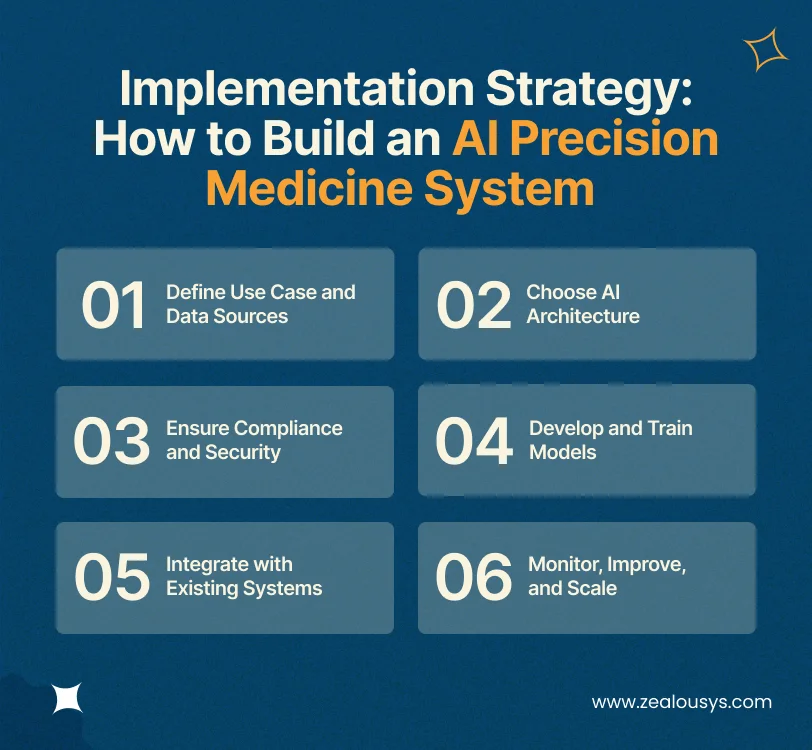
Building an AI Agent in precision medicine requires a clear, practical approach. Many healthcare startup founders, CTOs, product managers, and innovation teams face the same challenge. They deal with massive clinical and genomic data but struggle to turn it into actionable insights. A structured implementation strategy helps you solve this problem and move from experimentation to real outcomes
Start with a focused use case. Do not try to solve everything at once. Choose a problem that directly impacts patient care or operational efficiency.
For example, you can build an AI Agent in personalized healthcare that recommends treatments based on patient genetics.
Identify the right data sources early:
Clear data selection reduces noise and improves accuracy. This step helps healthcare companies avoid one of the biggest pain points, which is too much data with no clear direction.
Select an architecture that supports real clinical decision-making. Most modern precision medicine AI Agent solutions combine multiple technologies.
A common approach includes:
This combination helps answer a key question many teams ask: how AI agents are used in precision medicine in real scenarios. It allows the system to process data, retrieve relevant insights, and generate recommendations in a structured way.
Healthcare data requires strict protection. You must design your system with compliance in mind from the beginning.
Follow standards such as:
This step builds trust with hospitals, pharma companies, and clinical teams. It also reduces legal risks and removes a major barrier to adoption.
Build strong data pipelines to collect, clean, and structure your data. High-quality data improves model performance.
Train your models using:
Validate outputs with domain experts. This step ensures your AI Agent in precision medicine produces reliable and clinically relevant insights. It also helps teams overcome the lack of in-house AI expertise by following a structured development process.
Your solution must fit into existing workflows. Seamless integration increases adoption.
Connect your AI system with:
When your AI agent works inside familiar systems, doctors and healthcare teams use it more confidently. This step bridges the gap between innovation and real-world usage.
AI systems improve over time. You must continuously monitor performance and update models.
Track:
Use this data to refine your models and expand use cases. Start with a pilot, prove value, and then scale across departments or regions.
This approach helps organizations clearly demonstrate ROI, which remains one of the biggest challenges in healthcare AI adoption.
Building an AI Agent in precision medicine sounds promising, but real-world implementation brings clear challenges. Healthcare startup founders, CTOs, product managers, and clinical teams often face these barriers when they move from idea to production.
Healthcare data is highly sensitive. Teams must protect patient records, genomic data, and clinical insights at every stage. Regulations like HIPAA and GDPR require strict compliance, and any gap can create legal and reputational risks.
An AI Agent in personalized healthcare needs secure data pipelines, encrypted storage, and controlled access. Many healthcare startups struggle here because they lack experience with compliance-ready systems. This challenge often slows down innovation and delays product launches.
Precision medicine depends on clean and connected data. In reality, healthcare data sits in different systems like EHRs, lab platforms, and wearable devices. These systems often use different formats, which creates silos.
When teams build precision medicine AI Agent solutions, they must first unify this data. Poor data quality leads to weak insights, and disconnected systems limit the value of AI. CTOs and data scientists spend a large amount of time cleaning, structuring, and integrating data before AI can deliver results.
AI models learn from historical data. If the data contains gaps or biases, the model can produce inaccurate or unfair recommendations. In precision medicine, this risk directly impacts patient outcomes.
Teams must actively test and validate models across diverse patient groups. They must also monitor model performance over time. Many organizations exploring how AI agents are used in precision medicine underestimate this step, which can reduce trust in AI-driven decisions.
Doctors and clinical teams want reliable and transparent systems. If an AI system feels like a black box, clinicians hesitate to trust it.
An AI Agent in precision medicine must provide clear explanations and actionable insights, not just predictions. Product managers and healthcare leaders need to design systems that support clinicians instead of replacing them. Training, usability, and workflow integration play a key role in adoption.
Getting started with an AI Agent in precision medicine does not require a massive upfront investment. You can begin with a focused approach and scale based on results.
Choose one clear problem where an AI Agent in personalized healthcare can deliver quick value. For example, you can start with genomic data interpretation or clinical decision support for a specific condition.
This approach helps you turn complex clinical or genomic data into actionable insights without overwhelming your team. It also allows healthcare startup founders, product managers, and clinical IT leaders to validate real impact early.
Develop a minimum viable product that solves your selected use case. Focus on integrating key data sources such as EHRs or genomics datasets. Keep the system simple and measurable so you can track improvements in diagnosis speed, treatment accuracy, or operational efficiency.
Once you validate outcomes, you can expand your precision medicine AI Agent solutions across more workflows, patient groups, or clinical systems. This step-by-step approach reduces risk and helps you prove ROI, which remains a major concern for CTOs and healthcare decision-makers.
You should plan for HIPAA and GDPR compliance from the beginning. Secure data handling and proper governance build trust with hospitals, pharma teams, and healthcare providers. You should also focus on improving data quality and interoperability so your AI agent can deliver reliable results.
Many healthcare organizations lack in-house expertise to build production-ready systems. A reliable partner can help you design, develop, and deploy scalable AI Agent in precision medicine solutions faster.
An experienced AI-powered software development company can guide you through architecture, model development, compliance, and system integration. This partnership helps you avoid common mistakes and move from idea to implementation with confidence.
AI Agent in precision medicine is helping healthcare teams turn complex clinical and genomic data into clear, actionable decisions. Healthcare startup founders, CTOs, product managers, and hospital innovation leaders now use these systems to improve diagnosis speed, reduce costs, and deliver more personalized care. Instead of struggling with data overload, teams gain practical insights that directly support better treatment outcomes.
AI agents also make it easier to prove the value of AI investments. Organizations can connect results to real ROI, such as faster decision-making and improved patient outcomes. At the same time, teams must address key challenges like compliance with HIPAA and GDPR and the lack of in-house expertise to build production-ready systems.
Our team is always eager to know what you are looking for. Drop them a Hi!

Pranjal Mehta is the Managing Director of Zealous System, a leading software solutions provider. Having 10+ years of experience and clientele across the globe, he is always curious to stay ahead in the market by inculcating latest technologies and trends in Zealous.


Comments