Artificial intelligence has evolved rapidly over the last few years. Businesses first adopted AI for simple automation tasks like chatbots, recommendation engines, and customer support systems. Later, generative AI tools like ChatGPT changed how companies create content, write code, analyze data, and improve productivity. Now, the AI industry is moving toward more advanced systems called AI agents and agentic AI.
Today, many businesses want AI systems that can do more than answer prompts. They want AI that can plan tasks, make decisions, use tools, analyze information, and complete workflows with minimal human involvement. This growing demand has increased interest in AI agents for business automation and enterprise use cases of agentic AI across industries like healthcare, finance, retail, logistics, and software development.
As companies explore autonomous AI systems, many leaders still ask the same question: what is the difference between AI agents and agentic AI? Although people often use these terms interchangeably, they do not mean the same thing. Understanding the difference between AI Agents and Agentic AI helps businesses choose the right AI strategy, architecture, and automation model for their goals.
In simple terms, AI agents usually perform specific tasks based on instructions, prompts, or predefined workflows. Agentic AI goes a step further. It can independently plan actions, adapt to changing situations, make decisions, and execute multi-step goals with limited human guidance. In other words, AI agents focus on task execution, while agentic AI focuses on autonomous goal achievement.
As AI technology continues to evolve, businesses will increasingly compare Agentic AI vs AI Agents to understand which approach delivers better scalability, efficiency, and long-term value.
AI agents are software systems that perform tasks, answer questions, and make decisions based on user input or predefined goals. These systems use artificial intelligence, machine learning, and large language models (LLMs) to interact with users and complete actions automatically.
Most AI agents focus on specific tasks. They follow instructions, process data, and generate responses in real time. Businesses use AI agents to improve productivity, automate repetitive work, and deliver faster customer experiences.
AI agents collect input from users, systems, or connected applications. They analyze that information, understand the request, and generate the most relevant response or action.
Most AI agents follow a simple workflow:
For example, a customer support AI agent receives a customer query, searches relevant information, and replies with an accurate answer within seconds.
Modern AI agents also connect with APIs, databases, CRMs, and business tools. This integration helps businesses automate workflows more efficiently.
AI agents offer several important capabilities that make them useful for business automation and enterprise AI solutions.
AI agents usually focus on specific tasks such as answering questions, generating reports, scheduling meetings, or processing customer requests.
Most AI agents process information quickly and provide instant responses. This speed improves customer experience and operational efficiency.
AI agents automate repetitive business processes and reduce manual work for teams.
Advanced AI agents understand user intent and maintain conversational context during interactions.
AI agents connect with software platforms, APIs, and enterprise systems to perform actions automatically.
Some AI agents improve performance over time by learning from user interactions and feedback.
Businesses across industries already use AI agents for different operational and customer-facing tasks.
AI chatbots answer customer questions, provide product recommendations, and handle basic support requests on websites and mobile apps.
AI copilots help users write code, generate content, analyze data, and improve productivity. Tools like coding assistants and writing assistants fall into this category.
Customer service AI agents resolve tickets, track orders, answer FAQs, and manage support conversations 24/7.
Many businesses use AI agents to automate scheduling, email management, workflow approvals, and data entry tasks.
Businesses now use AI for everything from customer support to workflow automation. However, many people still confuse AI agents with agentic AI. Both technologies use artificial intelligence, but they work very differently.
AI agents usually handle specific tasks based on prompts, rules, or instructions. Agentic AI goes a step further and makes decisions, plans actions, and completes multi-step goals with minimal human input.
The table below explains the difference between AI agents and agentic AI in a simple way.
| Comparison Point | AI Agents | Agentic AI |
|---|---|---|
| Autonomy | AI agents follow predefined instructions and workflows. | Agentic AI works more independently and can take actions on its own. |
| Decision-Making | AI agents make limited decisions based on prompts or rules. | Agentic AI analyzes situations and makes goal-based decisions dynamically. |
| Memory | Most AI agents have short-term or session-based memory. | Agentic AI uses long-term memory and learns from past interactions. |
| Workflow Complexity | AI agents usually handle simple or single-step tasks. | Agentic AI manages complex workflows with multiple steps and dependencies. |
| Human Involvement | Humans often guide AI agents throughout the process. | Agentic AI requires less human supervision after setup. |
| Learning Capability | AI agents improve mainly through updates or training changes. | Agentic AI continuously adapts and improves based on outcomes and context. |
| Real-Time Adaptation | AI agents respond to inputs but struggle with unexpected changes. | Agentic AI adjusts strategies in real time based on changing conditions. |
| Use Cases | Chatbots, virtual assistants, AI customer support, and task automation. | Autonomous research systems, AI operations, intelligent workflow automation, and multi-agent systems. |
| Scalability | AI agents scale well for repetitive and structured tasks. | Agentic AI scales better for enterprise-level automation and decision-making. |
Businesses across industries now use AI to automate tasks, improve customer experiences, and increase operational efficiency. However, many decision-makers still confuse AI agents with agentic AI. While both technologies use artificial intelligence, they work in very different ways.
Understanding the difference between AI agents and agentic AI helps CTOs, startup founders, and enterprise leaders choose the right AI strategy for their business goals.
AI agents usually work in a reactive way. They respond when users give commands, ask questions, or trigger specific actions. For example, a customer support chatbot answers queries only after a customer sends a message.
Agentic AI works differently. It acts more autonomously and makes decisions based on goals, context, and changing situations. Instead of waiting for instructions, agentic AI can plan tasks, evaluate outcomes, and take the next step on its own.
This difference makes agentic AI more suitable for complex enterprise automation. Businesses that want intelligent decision-making systems often prefer agentic AI over traditional AI agents.
Most AI agents focus on one specific task at a time. They can book appointments, answer FAQs, generate content, or summarize documents. These systems usually follow predefined workflows and complete limited actions.
Agentic AI focuses on achieving larger goals instead of handling only one task. It can break a complex objective into smaller steps and execute them independently. For example, an agentic AI system can research competitors, analyze market data, prepare reports, and suggest business strategies without constant human input.
This goal-oriented execution gives businesses more flexibility and scalability in AI automation.
AI agents often require regular human guidance. Users need to provide prompts, approve actions, or manually manage workflows. The system depends heavily on user instructions to continue operating effectively.
Agentic AI reduces that dependency. It can make decisions, prioritize tasks, and adapt workflows with minimal supervision. Businesses can use agentic AI to automate operations that previously required continuous human monitoring.
This capability makes agentic AI highly valuable for enterprises that want smarter and more autonomous AI systems.
Traditional AI agents usually follow fixed workflows. They perform well in structured environments where rules and processes stay predictable.
Agentic AI introduces workflow intelligence. It can analyze situations, choose the best action, and modify workflows dynamically. If conditions change, the system can adjust its behavior without requiring developers to rewrite rules manually.
For example, an AI agent may simply send notifications based on predefined triggers. In contrast, an agentic AI system can analyze customer behavior, predict engagement patterns, and personalize communication strategies automatically.
This advanced workflow intelligence helps businesses improve efficiency and make faster decisions.
AI agents often have limited context awareness. Many systems only process the current request without understanding long-term history, business goals, or broader operational context.
Agentic AI uses memory, reasoning, and contextual understanding to make smarter decisions. It can remember previous interactions, analyze patterns, and use historical information to improve future actions.
For example, in enterprise AI automation, agentic AI can track project progress, understand team priorities, and recommend the next best action based on ongoing business activities.
This deeper context awareness improves personalization, productivity, and decision-making accuracy.
Most standard AI agents work independently. Each agent usually handles a single function without collaborating with other systems.
Agentic AI supports multi-agent collaboration. Different AI agents can communicate, share information, and coordinate tasks to achieve a larger objective.
For example, one agent may collect data, another may analyze it, and a third may generate recommendations. Together, these autonomous AI systems create intelligent workflows that improve enterprise operations.
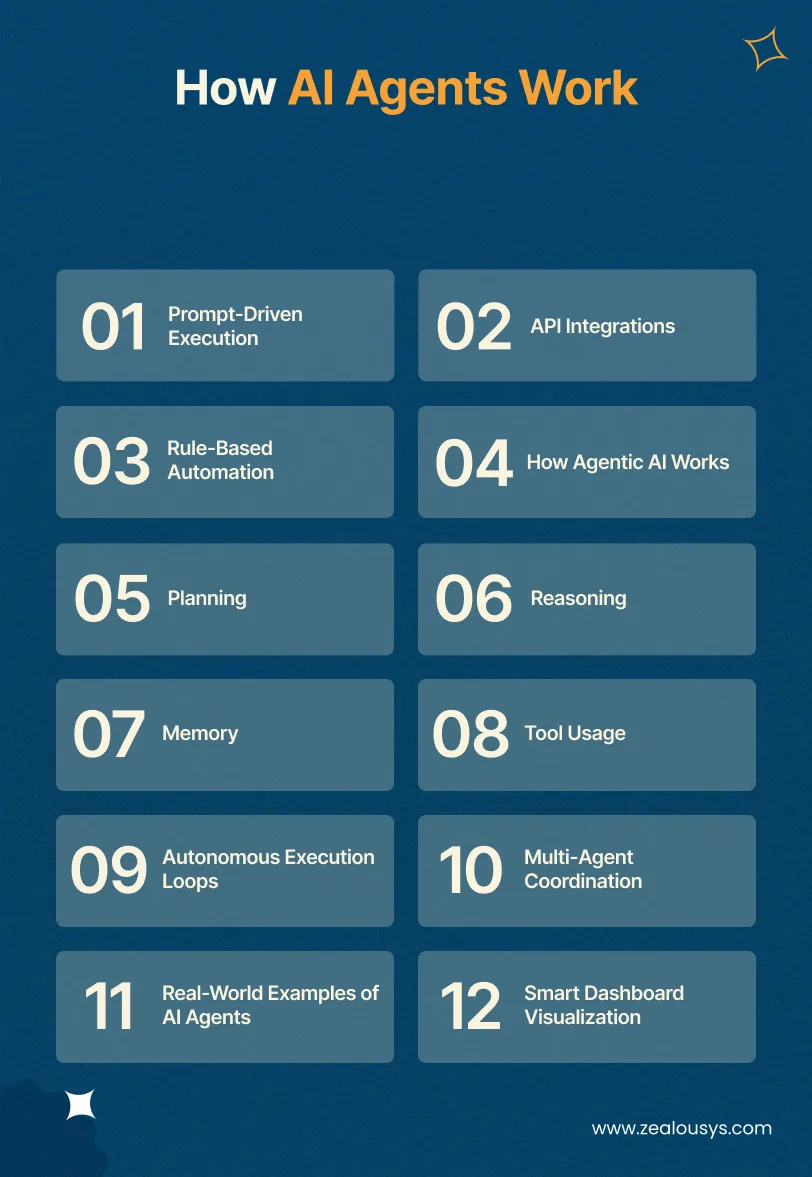
AI agents follow a simple workflow. They receive an input, process the request, and generate an output. Users usually interact with AI agents through prompts, commands, or voice instructions. The system then analyzes the request and performs the required task.
For example, an AI customer support agent receives a customer query, checks connected systems for data, and provides a response automatically.
Most AI agents work through prompts. Users provide instructions, and the AI generates responses based on the given context and training data. Better prompts usually produce more accurate results.
For example, AI coding assistants can generate code when developers describe their requirements in simple language.
Businesses connect AI agents with APIs, CRMs, databases, and third-party applications to automate tasks and access real-time data. These integrations help AI agents perform actions instead of only generating responses.
For instance, an AI support agent can connect with Shopify or Salesforce to check orders, create tickets, or process customer requests automatically.
Many AI agents still rely on predefined rules and workflows. Developers set conditions and actions that guide how the AI should respond in different situations.
For example, an AI banking assistant may follow fixed rules for fraud detection or loan verification. If the request falls outside the workflow, the system forwards it to a human agent.
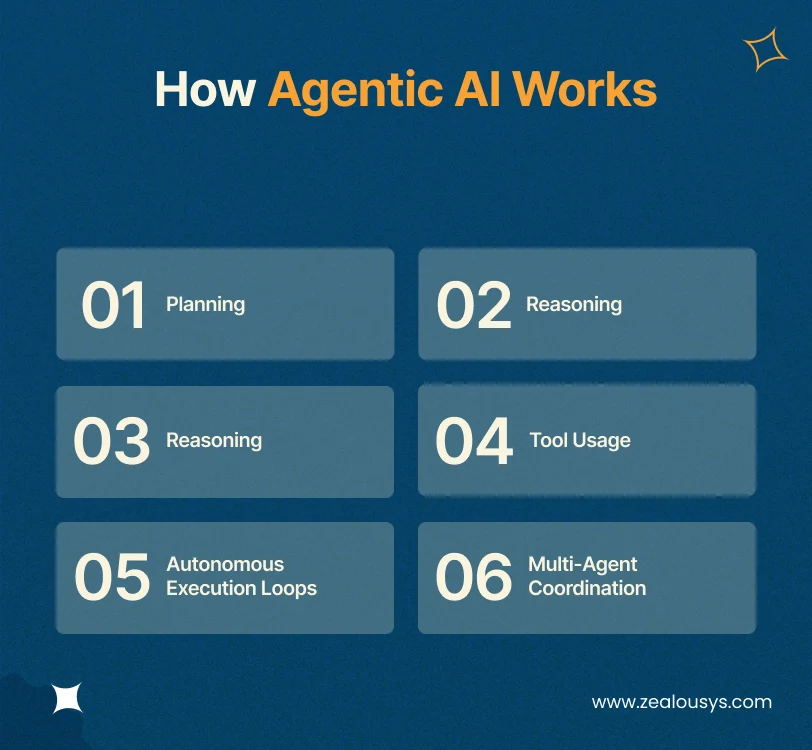
Agentic AI goes beyond simple task execution. It can plan tasks, make decisions, remember past actions, use external tools, and improve results without constant human input. Unlike traditional AI agents that respond to one instruction at a time, agentic AI systems work toward a larger goal and adapt along the way.
Here’s how agentic AI works behind the scenes:
Agentic AI starts by creating a plan to achieve a goal. Instead of waiting for step-by-step instructions, it breaks a complex task into smaller actions and decides the best order to complete them.
For example, if a business asks an agentic AI system to analyze customer feedback and improve support operations, the system can collect data, identify common complaints, suggest solutions, and generate reports automatically.
This planning capability makes agentic AI more useful for enterprise AI automation and long workflows.
Agentic AI uses reasoning to make smarter decisions during execution. It evaluates different options, understands context, and adjusts actions based on changing situations.
For example, an AI-powered supply chain system can detect delays, compare alternative routes, and choose the fastest delivery option without human intervention.
This ability helps businesses build autonomous AI systems that can solve problems in real time.
Memory allows agentic AI to remember previous interactions, decisions, and outcomes. The system uses this information to improve future responses and maintain context across multiple tasks.
For example, an AI customer support assistant can remember past conversations with a customer and provide more personalized recommendations during future interactions.
Memory also improves long-term AI workflows and reduces repetitive instructions.
Agentic AI can connect with external tools, APIs, databases, and software platforms to complete tasks efficiently. It does not rely only on text generation. Instead, it performs actions in real business environments.
For example, an agentic AI system can:
This capability makes agentic AI highly valuable for SaaS companies and enterprise automation projects.
Agentic AI can continuously monitor progress and take the next action automatically until it reaches the final goal. This process is called an autonomous execution loop.
The system checks results, identifies gaps, improves outputs, and retries tasks when needed. It keeps working without requiring constant human supervision.
For example, an AI software development agent can write code, test functionality, fix errors, and redeploy updates in a continuous cycle.
This autonomous behavior separates agentic AI from traditional AI agents.
Many advanced agentic AI systems use multiple AI agents that work together to complete large workflows. Each agent handles a specific responsibility while sharing information with other agents.
For example:
This multi-agent coordination improves speed, scalability, and decision-making for complex enterprise operations.
As businesses adopt AI agents for business automation, multi-agent systems will play a major role in the future of agentic AI.
Today, businesses across industries use AI agents to automate repetitive tasks, improve productivity, and deliver faster customer experiences. Unlike agentic AI systems, most AI agents focus on specific tasks and follow predefined instructions. Let’s look at some common real-world examples of AI agents that companies already use.
Many businesses use AI customer support agents to handle common customer queries. These AI agents answer FAQs, track orders, reset passwords, and guide users through simple processes. Companies integrate these agents into websites, mobile apps, and messaging platforms to provide 24/7 support.
For example, an eCommerce company can use an AI support agent to help customers check delivery status or return products without human involvement. This approach reduces response time and improves customer satisfaction. Many enterprises now use AI agents for business automation in customer service because they lower operational costs and handle large volumes of requests efficiently.
Sales teams use AI agents to automate lead qualification, follow-ups, and customer engagement. These AI sales assistants analyze customer behavior, recommend products, and send personalized responses based on user interactions.
For instance, a SaaS company can use an AI sales assistant to identify high-intent leads from website visits and automatically schedule product demos. These AI agents help sales teams save time and focus on closing deals instead of managing repetitive tasks manually.
As businesses compare AI Agents vs Agentic AI, AI sales assistants represent a practical example of task-focused automation rather than fully autonomous decision-making.
Developers now rely on AI coding assistants to write code faster and improve productivity. These AI agents suggest code snippets, detect errors, generate documentation, and help developers debug applications in real time.
Tools like GitHub Copilot and similar AI-powered coding assistants help software teams accelerate development workflows. Startups and enterprises use these AI agents to reduce development time and improve code quality.
This example clearly shows the difference between AI Agents and Agentic AI. Coding assistants support developers during specific tasks, but they still depend on human instructions and approvals before executing major actions.
AI scheduling agents help businesses manage calendars, meetings, and reminders automatically. These tools check availability, suggest meeting slots, send invitations, and even reschedule appointments when conflicts occur.
For example, a product manager can use an AI scheduling assistant to coordinate meetings across multiple teams without manually checking everyone’s calendar. Businesses use these AI agents to improve productivity and reduce administrative workload.
Businesses across industries now use agentic AI to automate complex workflows, improve decision-making, and reduce manual effort. Unlike traditional AI agents that mainly respond to prompts, agentic AI systems can plan tasks, make decisions, and take actions with minimal human involvement. Here are some real-world examples of agentic AI in action.
Many companies now use autonomous research systems to collect, analyze, and summarize information automatically. These systems can search the web, compare multiple data sources, identify patterns, and generate insights without constant human guidance.
For example, a market research company can use agentic AI to track industry trends, analyze competitors, and prepare reports in real time. Instead of manually reviewing hundreds of documents, teams can get faster and more accurate insights. This approach helps businesses improve decision-making and save valuable time.
Modern AI software development agents can write code, test applications, fix bugs, and even deploy updates automatically. These systems do much more than simple code suggestions. They understand project goals, break tasks into smaller steps, and complete workflows independently.
Many SaaS companies now use AI-powered development agents to speed up product releases and reduce development costs. For CTOs and product managers, this creates faster development cycles and improves team productivity. This example clearly shows the growing difference between AI agents and agentic AI systems.
Businesses now use agentic AI to automate operations like invoice processing, customer onboarding, employee management, and workflow approvals. These systems can analyze business data, make decisions, and trigger actions across multiple software platforms.
For example, an enterprise can use agentic AI to review incoming support tickets, assign priorities, notify teams, and generate responses automatically. This level of intelligent automation improves efficiency and reduces repetitive manual work. Many enterprises now consider agentic AI a major part of digital transformation strategies.
Supply chain management involves many moving parts, including inventory tracking, demand forecasting, shipping coordination, and supplier communication. Agentic AI helps businesses manage these processes more efficiently.
An AI-powered supply chain system can predict inventory shortages, suggest alternative suppliers, optimize delivery routes, and respond to market changes automatically. Retail and manufacturing companies increasingly use these autonomous AI systems to reduce operational costs and improve customer satisfaction.
Cybersecurity teams face thousands of threats every day. Agentic AI systems help businesses monitor networks, detect unusual behavior, and respond to security risks in real time.
For example, an autonomous cybersecurity system can identify suspicious activity, isolate affected systems, notify security teams, and start recovery actions automatically. This proactive approach helps businesses reduce security risks and respond to threats much faster than traditional systems.
Businesses across industries now use AI agents to improve efficiency, reduce manual work, and deliver faster services. Unlike traditional automation tools, AI agents can understand inputs, process information, and respond intelligently in real time. This makes them useful for customer support, workflow automation, sales operations, and many other business functions.
AI agents help businesses automate repetitive tasks much faster than manual processes. They can answer customer queries, schedule meetings, process requests, and generate responses within seconds. Teams no longer need to spend hours handling routine operations.
For example, an AI customer support agent can instantly respond to common customer questions without waiting for a human representative. This improves response time and keeps operations running 24/7. Many companies now use AI agents for business automation to increase productivity and speed up daily workflows.
AI agents help companies reduce operational costs by automating time-consuming tasks. Businesses can handle more customer interactions and internal processes without constantly increasing team size.
Startups and enterprises also use AI agents to reduce support costs, minimize human errors, and improve resource utilization. Instead of assigning employees to repetitive work, teams can focus on strategic and high-value tasks. This creates better efficiency while lowering overall operational expenses.
Modern customers expect quick responses and personalized interactions. AI agents help businesses deliver faster and more consistent customer experiences across websites, apps, and support channels.
For instance, AI-powered chatbots and virtual assistants can answer customer questions instantly, recommend products, and provide real-time assistance. Many AI agents can also understand customer intent and maintain context during conversations. This creates smoother and more engaging interactions for users.
Businesses that use AI agents often improve customer satisfaction because customers receive faster support without long waiting times.
Many businesses choose AI agents because they are easier to implement compared to complex autonomous AI systems. Companies can integrate AI agents into existing workflows, CRM platforms, customer support systems, and business applications without rebuilding their entire infrastructure.
Several AI tools and frameworks now allow businesses to deploy AI agents quickly with minimal technical complexity. Startups and SaaS companies often begin with AI agents before moving toward advanced agentic AI systems.
Businesses now want AI systems that can do more than respond to prompts. They want intelligent systems that can plan, decide, adapt, and execute tasks with minimal human involvement. This is where agentic AI stands out from traditional AI agents.
Agentic AI can complete tasks on its own without waiting for constant human instructions. Instead of handling only one prompt at a time, it can analyze goals, create action plans, and execute multiple steps automatically.
For example, an agentic AI system can monitor customer queries, collect relevant data, generate responses, escalate critical issues, and update CRM records without human intervention. This level of autonomous execution helps businesses save time and improve operational efficiency.
Traditional AI agents usually follow predefined workflows. In contrast, agentic AI can evaluate situations, compare options, and make context-aware decisions in real time.
For example, in supply chain management, agentic AI can identify delays, analyze inventory levels, suggest alternative suppliers, and optimize delivery routes automatically. This capability helps enterprises handle complex business processes more effectively.
Many businesses still spend significant time on repetitive operational tasks. Agentic AI reduces this dependency by automating workflows that normally require constant monitoring and supervision.
Teams can focus on strategy, innovation, and customer experience while agentic AI handles routine operations in the background. This benefit makes agentic AI highly valuable for enterprise automation and AI-driven business transformation.
Agentic AI supports large-scale automation across departments, systems, and workflows. It can connect with APIs, databases, business applications, and external tools to manage operations across an entire organization.
For example, enterprises can use agentic AI for customer support automation, IT operations, cybersecurity monitoring, financial reporting, and intelligent workflow orchestration. This scalability makes agentic AI a strong choice for growing businesses and digital enterprises.
One of the biggest advantages of agentic AI is its ability to learn from interactions and improve performance over time. It can analyze outcomes, identify inefficiencies, and optimize future actions automatically.
This continuous optimization helps businesses improve productivity, reduce operational costs, and deliver better customer experiences. As organizations adopt more AI-powered systems, this capability will play a major role in the future of agentic AI and enterprise automation.
Read Also: Agentic AI for Manufacturing
Businesses use AI to automate tasks, improve customer experience, and increase efficiency. However, choosing between AI agents and agentic AI depends on your business goals, workflow complexity, budget, and scalability needs.
AI agents work best for businesses that need focused automation for specific tasks. Agentic AI suits organizations that want autonomous systems capable of handling complex workflows with minimal human involvement.
Choose AI agents when your business wants to automate repetitive and well-defined tasks. AI agents follow instructions and complete specific actions within a limited workflow.
Businesses commonly use AI agents for:
AI agents work well for startups and growing businesses because they require lower investment and faster implementation. If your team needs quick automation with predictable results, AI agents provide a practical solution.
Businesses should adopt agentic AI when they need systems that can plan, reason, and execute multi-step tasks independently.
Companies use agentic AI for:
Large enterprises benefit the most from agentic AI because it can manage complex workflows across multiple systems and departments.
AI agents usually cost less because they focus on single-task automation. Businesses can deploy them faster with fewer technical challenges.
Agentic AI requires a higher investment because it involves advanced AI models, orchestration systems, and continuous learning capabilities. However, it offers better long-term scalability for enterprises managing large-scale operations and complex workflows.
Businesses with simple automation needs often achieve strong ROI with AI agents. Companies planning enterprise-wide automation may benefit more from agentic AI systems.
Retail and eCommerce
Retail businesses use AI agents for customer support and product recommendations. Larger enterprises adopt agentic AI for inventory and supply chain management.
Healthcare
Healthcare providers use AI agents for appointment scheduling and patient communication. Agentic AI helps with diagnostics support and workflow automation.
Finance
Banks use AI agents for customer assistance. Financial institutions implement agentic AI for fraud detection, compliance monitoring, and risk analysis.
SaaS and Technology
SaaS companies use AI agents for onboarding and support automation. Tech enterprises adopt agentic AI for DevOps automation and intelligent operations.
AI agents perform specific tasks based on prompts or predefined workflows. Businesses often use them in chatbots, virtual assistants, and automation tools.
Agentic AI works more autonomously. It can plan, reason, make decisions, and complete multi-step tasks with minimal human involvement.
In simple terms, AI agents react to instructions, while agentic AI works toward goals independently.
ChatGPT mainly works as an AI agent because it responds to user prompts and instructions.
However, businesses can connect ChatGPT with tools, APIs, memory, and workflows to create agentic AI systems that handle tasks more autonomously.
So, ChatGPT alone is not fully agentic AI, but it can become part of an agentic AI solution.
Businesses use agentic AI in many advanced automation systems.
Common examples include:
These systems can make decisions, coordinate tasks, and improve workflows with limited human input.
Yes, developers can make AI agents more autonomous by adding memory, reasoning, planning, and tool integrations.
Traditional AI agents follow instructions. Agentic AI systems can analyze situations, make decisions, and complete tasks independently.
This evolution is driving the growth of enterprise AI automation.
Many industries benefit from agentic AI because it improves automation and operational efficiency.
Key industries include:
For example, retail companies use agentic AI for inventory management and personalized customer experiences.
Yes, agentic AI is becoming the next stage of intelligent automation.
Traditional automation follows fixed rules, while agentic AI can adapt, reason, and make decisions in real time.
Many businesses now invest in agentic AI to reduce manual work, improve productivity, and automate complex operations.
Yes, AI agents usually cost less because they are simpler to build and manage.
Agentic AI systems require advanced workflows, memory, reasoning, integrations, and monitoring systems, which increase development costs.
However, agentic AI can provide greater long-term value for enterprise automation.
Businesses start by identifying workflows that need automation and decision-making.
The implementation process usually includes:
Many companies also work with AI development firms to build custom agentic AI solutions.
AI agents and agentic AI may sound similar, but they serve different purposes. AI agents usually handle specific tasks based on prompts or predefined workflows, while agentic AI can plan, reason, and complete multi-step goals with minimal human involvement. Businesses already use AI agents for automation, customer support, and productivity, often by partnering with an experienced AI agent development company, while enterprises now explore agentic AI for more autonomous and intelligent operations.
If your business needs faster automation for repetitive tasks, AI agents can offer a practical starting point. However, if you want systems that can make decisions, adapt to changing situations, and manage complex workflows, agentic AI can provide greater long-term value. Understanding the difference between AI agents and agentic AI can help businesses choose the right strategy and prepare for the future of intelligent automation.
Our team is always eager to know what you are looking for. Drop them a Hi!

Ruchir Shah is Technology Head at Zealous System with hands-on expertise in AI/ML, Microsoft Azure, .NET, Node.js, Python, React, and Angular. He leads enterprise software development, champions digital transformation, and mentors developers building the future of intelligent apps.


Comments