
AI auction software is an online bidding platform that uses machine learning to handle work auction teams used to do by hand: valuing lots, catching fraudulent bids, writing catalog entries, and adjusting bidding rules while an auction is still running. It sits on top of a standard auction engine and makes decisions from data rather than from fixed settings. Auction houses, marketplaces, remarketing firms, and procurement teams use it to run higher volumes with smaller teams. The difference from traditional auction software comes down to one thing: traditional systems follow the rules you write, and AI systems learn rules from what your bidders actually do.
Quick Overview:
AI auction software is a bidding platform where machine learning models sit alongside the auction engine and take over judgment calls. Instead of an administrator setting a starting price from experience, a model reads comparable sales and suggests one. Instead of a moderator reviewing flagged accounts on Monday morning, a scoring service checks every bid as it lands.
The auction mechanics stay the same. Someone lists an item, people bid, the highest bid wins, money moves. What changes is how many of the surrounding decisions happen without a person in the loop, a shift we traced in more detail across online auction platforms.
A chatbot bolted onto a listing site is not AI auction software. Neither is a dashboard with a few charts on it. Plenty of tools sold as automated auction software or AI bidding software are scheduled tasks with a new label. The test is whether a model is making or influencing a decision that affects the outcome of an auction. If no model touches pricing, fraud, cataloging, or bidder matching, you have a conventional platform with an AI label on the marketing page.
Four groups keep asking for an AI-powered auction platform: marketplace founders outgrowing a white label tool, engineering leads whose bidding engine cannot handle peak load, remarketing teams drowning in manual valuation, and procurement leads running reverse auctions out of spreadsheets or SAP Ariba.
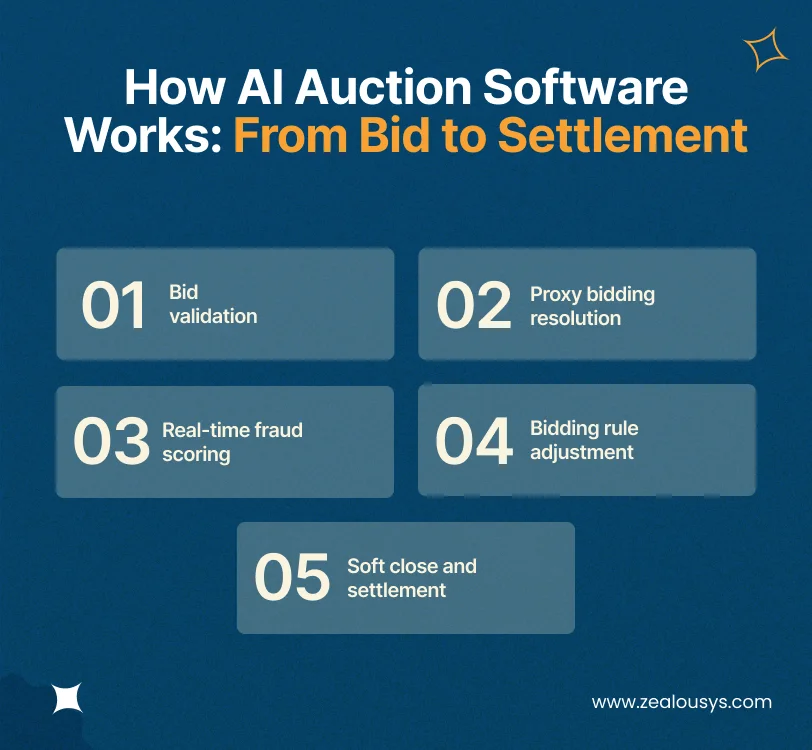
Following a single bid through the system explains more than a feature list does.
Every bid gets checked against the auction rules first: is the auction open, is the bidder verified, does the amount clear the current high bid plus the bid increment. Boring, and where most platforms break under load, because it has to be fast and correct at once.
Proxy bidding lets someone set a maximum and have the system bid for them, going only as high as needed. When two proxies overlap, the engine must resolve them in the right order and land on the correct visible price. Getting this wrong produces disputes that are expensive to unwind.
As the bid lands, a model scores it against the bidder’s history and everyone else’s behaviour. Timing patterns, account age, device fingerprint, and account relationships all feed in. High scores can hold a bid for review rather than rejecting it, which matters more than it sounds.
Models watch engagement and can widen or narrow increments, extend a slow auction, or reorder upcoming lots. This is where dynamic pricing lives, and where you need guardrails, because a model that reacts too aggressively will spook bidders.
A soft close extends the end time whenever a late bid arrives, removing the reward for last-second sniping. Once bidding stops, the platform calculates the final amount including any buyer’s premium, moves funds through a payment provider or an escrow service for high-value lots, then triggers invoicing.
The format you pick shapes the whole build. Pricing models, database design, and fraud logic all change with it.
The familiar ascending format. Bids go up, the highest wins, everyone sees the current price. Most consumer marketplaces, livestock and agricultural sales, and charity fundraising platforms run this. Simplest to build, hardest to differentiate.
The price starts high and falls until someone accepts. Common in flower markets, wholesale produce, and some financial offerings. The challenge is a countdown that stays in sync across every client, because half a second of drift means two people think they won.
Everyone submits once, privately, and bids stay hidden until the deadline. Vickrey auctions award the item at the second-highest price, which discourages bid shading and pushes people to bid what the item is genuinely worth to them. Government tenders and government surplus sales use these formats.
Buyers post a requirement, and suppliers compete downward on price. The backbone of e-sourcing and e-procurement platforms. It needs supplier qualification, weighted scoring across price and delivery terms, and integration with whatever ERP the buyer runs.
Bidders pay a fee per bid, and each bid nudges the price up and resets a timer. The mechanics are simple. The regulatory exposure is not, since several jurisdictions treat these as gambling. Get legal advice before you write a line of code.
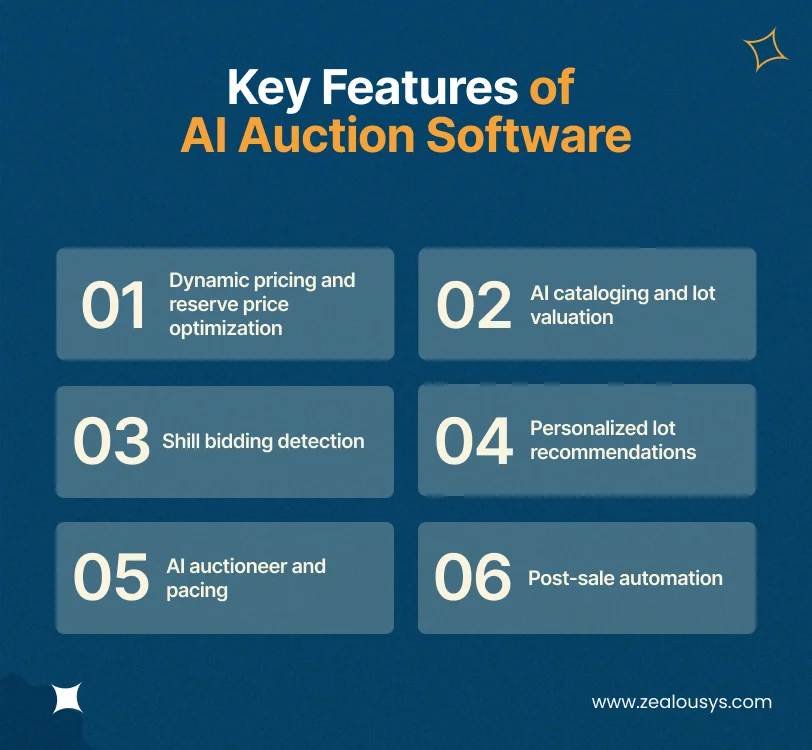
Six capabilities do the real work. Everything else is packaging.
Models read comparable sales, seasonality, and current bidder interest to recommend starting prices and reserve levels. A reserve price set too high kills bidding; set too low, it leaves money behind. One of the few places a decent model reliably beats an experienced human across a large catalog.
Computer vision reads photographs to identify condition, damage, and category, while language models draft descriptions. Lotting hundreds of items a week by hand is the biggest bottleneck in liquidation, and removing it is usually the largest single throughput gain a remarketing team will see.
Shill bidding means a seller or an associate bids on their own item to push the price up. It is the hardest case in auction fraud detection, because in isolation the behaviour looks legitimate. Models catch it through graph relationships between accounts, repeat patterns across a seller’s listings, and bidders who withdraw just below the winning price.
A recommendation engine surfaces lots a bidder is likely to want. In large catalogs, discovery is the difference between three bidders on a lot and thirty.
Software that adjusts the rhythm of a live auction: how long to hold a lot open, when to prompt watchers, when to move on. It replaces the read a good human auctioneer has for a room.
Invoicing, payment capture, shipping labels, ownership transfer, and dispute intake. Unglamorous, high volume, and where automation pays back fastest, because none of it requires judgment.
These problems show up after launch, when the platform meets real traffic.
Hundreds of bids can arrive in the final moments of a popular lot, all needing correct ordering. Serialize bids per lot through a single writer or queue, and build idempotency into the bid endpoint so a retried request never counts twice.
A model that blocks legitimate bidders costs more than one that occasionally misses fraud, because a banned buyer rarely comes back. Use tiered responses: score, then hold for review, then block. Track precision on your review queue, not just how much fraud you caught.
Pricing models need comparable sales, and one-of-a-kind items have none. Fall back to category-level models with wide confidence intervals, show the range instead of a single number, and let a specialist override it. Pretending to precision you do not have damages trust with sellers.
Every connected bidder needs the current price within a few hundred milliseconds. Persistent connections beat polling, but they hold state, which makes scaling harder. Plan the connection layer early rather than retrofitting it when traffic arrives.
Valuation models price properties from comparable sales, market movement, and property records. Foreclosure and distressed-asset platforms lean on this heavily, since volume is high and traditional appraisal is slow. Our real estate software development work covers the data integrations these platforms need.
Wholesale vehicle auctions move enormous inventory, and condition assessment from photographs is now standard. Models grade damage, flag inconsistencies against vehicle history, and set opening prices by region. The same techniques run through automotive software development generally.
Specification-heavy items with thin comparable data. AI helps most with cataloging and with matching lots to the small pool of buyers who want a particular machine, not with pricing.
Authentication is the job here. Vision models compare materials, construction detail, and provenance against known examples, then flag items for expert review rather than issuing verdicts. The right division of labour in a market where a wrong call is costly.
Fundraising auctions mix bidding with pledges, donations, and raffles in one event, across currencies. We covered this in our online auction website build for businesses and charities, where multi-currency payments and real-time bid tracking across time zones were the hard parts.
The trade-off is speed against control. Here is how the two options compare on the criteria that actually decide it.
| White Label | Custom Build | |
|---|---|---|
| Time to Launch | 2 to 4 weeks | 3 to 7+ months |
| Upfront Cost | Low, typically a setup fee plus subscription | $20,000 to $150,000 and up |
| Ongoing Cost | Monthly subscription, sometimes a cut of sales | Hosting plus maintenance |
| Auction Formats | Whatever the vendor supports | Anything you can define |
| Custom Bidding Rules | Vendor roadmap decides | Yours to change |
| Integrations | Their connector list | ERP, CRM, anything with an API |
| Your Bidding Data | Held in their schema, export varies | Yours, and trainable |
| AI Models | Vendor’s, shared across all clients | Trained on your own auctions |
| Branding and UX | Templated, limited | Full control |
| Switching Cost Later | High, bid history is hard to move | None |
| Best For | First auctions, events, testing demand | Platforms where auctions are the business |
The row that decides it most often is the data one. If your bidding history is the asset you plan to build models on, a hosted tool that holds it in a schema you cannot export will block you two years from now.
The honest middle path: start hosted, learn what your auctions need, then build custom with real requirements instead of guesses. Plan the data export before you sign, and get the migration path in writing: which fields come out, in what format, and whether bid history survives. If you go custom, MVP development keeps the first version small enough to validate quickly.
Online auction software development cost depends more on bidding volume and auction format than on feature count. Figures below are in US dollars and reflect typical offshore and hybrid team rates. Onshore-only teams in the US, UK, or Australia generally run two to three times higher.
| Tier | Cost Range | Timeline | Best For |
|---|---|---|---|
| MVP Auction Platform | $20,000 to $45,000 | 12 to 16 weeks | Testing demand, single-vertical launches, fundraising events |
| Mid-Level Auction Platform | $45,000 to $90,000 | 4 to 7 months | Platforms with steady volume outgrowing a hosted tool |
| Enterprise AI Auction Platform | $90,000 to $150,000 and up | 7 months and beyond | Remarketing, liquidation, e-sourcing, regulated verticals |
$20,000 to $45,000
One format, usually English. Listings, registration, real-time bidding, one payment gateway, an admin dashboard, basic reporting. AI is limited to a rules-based pricing helper or a simple recommendation feed. Twelve to sixteen weeks, and enough to run real auctions and find out what your users actually do.
$45,000 to $90,000
Multiple formats, proxy bidding, soft close, mobile apps, multi-currency payments, and one or two trained models, typically pricing and fraud scoring. Add role-based access, seller subscriptions, and analytics. Four to seven months.
$90,000 to $150,000 and up
High-concurrency bidding, computer vision cataloging, several production models with retraining pipelines, ERP and CRM integration, audit-grade logging, and compliance work. AI reverse auction software and e-sourcing platforms usually land here because of supplier management. Seven months and beyond.
Format complexity, peak concurrent bidders, how many models you train versus buy, integration count, and regulatory scope. Two platforms with identical feature lists can differ by 60% because one handles 200 concurrent bidders and the other 20,000. Retraining and monitoring add roughly 15% to 25% of build cost per year, which teams routinely forget to budget.
The compliance picture in 2026 is tighter than it was two years ago, mostly around automated decisions and bidder data.
KYC and AML checks apply once lot values cross reporting thresholds, which vary by country. Vehicle, property, and luxury auctions almost always trigger them. Build verification into registration rather than checkout, where it kills conversion.
Taking card payments puts you in scope for PCI DSS. A hosted payment provider narrows that scope substantially, which is why most platforms use one. High-value lots often need escrow, and escrow licensing is jurisdiction-specific.
GDPR governs bidder behaviour data across the EU and UK, and profiling for personalization is explicitly covered. Bidders need to know what you collect and be able to have it deleted. Similar rules now apply in several US states.
The EU AI Act introduces obligations around automated systems that materially affect people, and pricing or eligibility decisions can fall within scope depending on use. Timelines are still settling, so verify the current position with counsel before launch rather than relying on a blog post, including this one.
Bid disputes and chargebacks get resolved on evidence. Log every bid with a server timestamp, the rule state at that moment, and any model output that influenced it. If a model set the price, you need to show why.
Architecture should match the tier you are building, not the tier you hope to reach in three years.
A conventional server framework such as Laravel or Node, a relational database, and WebSocket connections for live bid updates. Stripe or equivalent for payments. Handles hundreds of concurrent bidders comfortably and costs very little to run.
Add Redis for current bid state and read caching, so the database is not answering the same price query thousands of times a second. Separate the bid write path from everything else, and add a queue for notifications and post-sale work.
Kafka or a similar event stream to decouple bidding from fraud scoring and analytics, with events replayable for audit. Models served behind their own API so they update without redeploying the auction engine. Here, application integration with ERP, CRM, and logistics becomes a project in its own right.
Observability. You need bid latency, connection counts, and model output distribution visible in real time. Drift is silent: pricing recommendations degrade slowly, and nobody notices until sellers complain. Our machine learning development services work covers monitoring as much as training.
Format, increments, close behaviour, tie handling, cancellation policy. Ambiguity here surfaces as bugs later, usually in production, usually during a high-value lot.
No AI. Get bid ordering, concurrency, and settlement correct with a plain rules-based system. Every model you add later depends on this being right.
Models need your data, not generic data. A few months of real bidding history beats any pre-trained pricing model bought off the shelf.
Start with whichever bottleneck costs most. For liquidation businesses, that is cataloging; for marketplaces, it is usually fraud. Ship it, measure it, then move on.
Track model precision, override rates, and business outcomes side by side. A pricing model that looks accurate but has sellers rejecting its recommendations is not working.
Bidder behaviour shifts with seasons, inventory, and the market. Set a retraining cadence from the start and treat it as maintenance, not as a project.
We build auction platforms end to end, and we have shipped production bidding systems handling real-time bids, multi-currency payments, and global bidder bases for businesses and charities across the UK, US, UAE, Europe, and Australia. That work taught us where auction platforms actually break, which is rarely where teams expect.
Our AI software development company practice adds the pricing, fraud, and cataloging models on top, and our AI consulting services team helps decide which are worth building at your volume and which are not. If you are weighing a rebuild against a hosted tool, that conversation is worth having before requirements get written rather than after.
Models sit alongside the bidding engine and handle decisions a person would otherwise make: recommending prices, scoring bids for fraud, drafting catalog entries, adjusting rules mid-auction. The mechanics stay conventional.
Automated bidding on a user’s behalf is legal and common; that is what proxy bidding is. What draws scrutiny is undisclosed price manipulation and profiling without consent. Disclose automated pricing, keep audit trails, and check local rules for your format.
Yes, and it does this well when you have comparable sales data. For unique lots with no comparables, treat model output as a starting range for a specialist to adjust rather than a final number.
Through account relationships, repeated patterns across a seller’s listings, timing signatures, and bidders who pull out just short of winning. No single signal is conclusive, which is why these systems flag for review rather than auto-ban.
A bidder sets their maximum and the platform bids on their behalf in minimum increments, going only as high as needed to stay in front. The bidder does not have to watch the auction.
Soft close. Each late bid extends the auction by a fixed window, so there is no advantage to waiting until the final second.
Twelve to sixteen weeks for a working MVP, four to seven months for a multi-format platform with trained models, and seven months upward for enterprise builds with heavy integration and compliance work.
Use white label if you are testing demand, running occasional events, or need standard formats fast. Build custom when your auction rules are unusual, your integrations are specific, or the platform itself is your business.
If you run auctions at volume and your team spends its days on valuation, cataloging, and fraud review, AI auction software pays for itself reasonably quickly. If you run a handful of auctions a year, a hosted tool will serve you better.
The mistake worth avoiding is building the AI before the auction engine is solid. Models are the visible part, but a pricing recommendation sitting on a bidding system that mishandles the final ten seconds of a lot will not save you. Get the mechanics right, gather real bidding data, then add models where they remove actual work.
If you are somewhere in that decision, the team at Zealous System is happy to look at your requirements and give you a straight answer on scope, cost, and whether custom is worth it at your volume.
Our team is always eager to know what you are looking for. Drop them a Hi!

Pranjal Mehta is the Managing Director of Zealous System, a leading software solutions provider. Having 10+ years of experience and clientele across the globe, he is always curious to stay ahead in the market by inculcating latest technologies and trends in Zealous.


Very informative article! AI-powered auction platforms can make bidding processes faster, smarter, and more data-driven. These capabilities have strong potential in logistics, where automated freight bidding can help businesses compare offers and optimize transportation costs. This freight bidding marketplace software solution is a useful example of applying digital bidding concepts to the freight industry.