Building a GDPR compliant healthcare app in Europe is not just about adding features. You need to think about privacy, security, and user trust from day one. If you plan to build an RPM app in Europe, you must follow strict GDPR compliance in healthcare apps while still delivering a smooth user experience.
Many founders and product teams start with a simple idea, but they quickly realize that remote patient monitoring app GDPR requirements affect everything from data storage to consent management. Whether you focus on telehealth app development GDPR or a full-scale platform, you need a clear strategy for healthcare mobile app data protection and secure architecture.
CTOs and healthcare product managers also face tough decisions around scalability and compliance. They must balance performance with secure healthcare app development while understanding key differences like HIPAA vs GDPR healthcare apps. When you explore how to build a GDPR compliant remote patient monitoring app, you need to cover core areas like consent management, encryption, and data minimization.
At the same time, you should plan features, estimate the cost to build remote patient monitoring app in Europe, and address real challenges in medical app compliance Europe. This guide will walk you through the exact steps, key features, and security requirements needed to build a reliable and GDPR-ready RPM solution.
At a basic level, a remote patient monitoring app collects health readings from connected devices, like wearables, patches, or home monitors, and sends them to a clinical team, often syncing with EHR and EMR software to maintain a continuous patient record. A cardiologist sees heart rhythm trends. A diabetologist monitors glucose levels between visits. A nurse coordinator spots early signs of deterioration in a post-surgical patient living alone.
The technology behind this is straightforward. A sensor captures the reading, the app transmits it securely, and a dashboard presents it for clinical action.
What makes it complicated is not the transmission. It is everything that surrounds it. Who gave consent for which readings? How long is that data stored? Who inside a hospital can see it? What happens when a patient revokes consent mid-monitoring? These questions do not have simple answers, and they need to be built into the architecture, not bolted on afterward.
Many teams treat compliance as the final phase. Write the code, build the features, then hand the product to a lawyer. In healthcare, that sequence rarely works.
GDPR compliance in an RPM context shapes core technical decisions. How you structure your database determines whether you can satisfy a right-of-access request within a month. How you design consent flows determines whether data collection is lawful at all. Encryption choices directly affect breach impact and reporting obligations.
There is also the matter of scale. A single hospital in Germany may operate under federal data protection rules that go beyond the GDPR baseline. A deployment across five countries involves different supervisory authorities, different expectations around data localization, and different interpretations of what qualifies as medical device software under the EU Medical Device Regulation.
Miss the compliance layer early, and you are not just paying for a legal fix later. You are rebuilding systems that were never designed to support the rights patients are entitled to exercise, especially when integrating with legacy systems already in place across hospitals.
Health data falls under Article 9 of GDPR as special category data. That means stricter obligations than standard personal data, with specific rules around why you can collect it, how long you can keep it, and what patients can demand from you.
Every data point your app touches needs a documented reason for being collected. In healthcare, this usually rests on Article 9 of GDPR, which allows processing of special category data when it is necessary for medical diagnosis, treatment, or care. That sounds straightforward, but the basis must be tied to specific functions within the app.
Collecting blood pressure readings for a hypertension management programme? That has a clear clinical basis. Retaining those same readings for three years after a patient is discharged for purposes not mentioned in the original consent? That does not.
GDPR requires collecting only what is strictly necessary for the stated purpose. In an RPM context, this creates friction with clinical instincts. Clinicians often want more data. More readings, more history, more context. The system must enforce these limits automatically.
Build expiry rules and automatic deletion into the data pipeline. If a patient’s monitoring programme ends, the system should not continue to accumulate data by default.
Consent in healthcare apps cannot be a wall of text with a single checkbox at the bottom. It needs to be granular. A patient should be able to agree to share heart rate data while declining to share sleep patterns. Withdrawal needs to be as easy as the original agreement, which means a one-tap option, not a support ticket.
Every consent state must be logged with a timestamp and stored securely. If a regulator asks you to prove that a patient agreed to share a specific data type on a specific date, you need to be able to produce that record.
Patients have the right to access their records, correct inaccuracies, request deletion, and receive a portable export. These are not optional features. Your app needs to support all of them through an interface that does not require users to contact support.
For a small pilot with fifty patients, this is manageable manually. For a regional deployment with fifty thousand, you need automated processes that can locate, compile, and deliver or delete data across cloud instances, device caches, and backup systems within the statutory one-month window.
End-to-end encryption is the baseline requirement. Data must be protected in transit between the wearable and the app, and at rest in whatever cloud environment you use. Pseudonymisation should be applied wherever operationally feasible, meaning identifiers are replaced with codes so that a breach does not automatically expose who a patient is.
Role-based access controls determine who sees what. A physiotherapist has no reason to view a patient’s psychiatric medication history. An administrator managing billing should not have access to raw clinical readings. These controls need to be enforced at the data layer, not just the interface layer.
If a security incident puts patient data at risk, you have 72 hours to notify the relevant supervisory authority. High-risk incidents require direct notification to affected patients. That timeline is tight, particularly when the incident happens on a Friday evening and spans multiple cloud regions.
An incident response plan must be tested before deployment. An untested plan that lives in a document nobody has read does not.
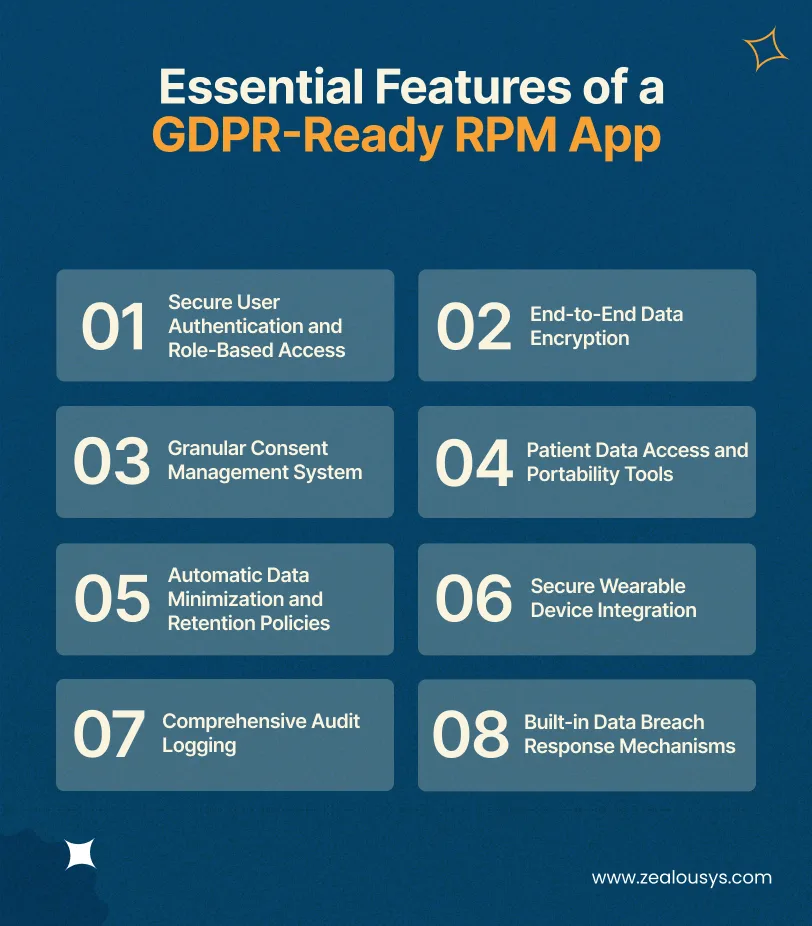
A GDPR-ready RPM app is defined by how it handles patient data during everyday use. The features below reflect how compliance shows up inside the product, without repeating the regulatory requirements already covered.
Access to patient data is typically structured through multi-factor authentication and clearly defined user roles. Clinicians, administrators, and patients each see a limited view based on their responsibilities. This separation reduces unnecessary data exposure and keeps access aligned with clinical needs.
Data moving between devices, mobile apps, and cloud systems remains encrypted throughout its lifecycle. Modern RPM platforms rely on established encryption standards for both transmission and storage, ensuring that intercepted data cannot be read or reused.
Patients decide exactly which data types they share and for how long. The interface shows plain-language explanations and one-tap options to withdraw consent. Every choice is logged with timestamps, giving you clear records for audits.
An in-app section lets users view, download, or delete their full health record anytime. The export format is machine-readable, so they can move data to another provider without friction. This directly supports data subject rights and builds confidence in the system.
The app collects only the vital signs required for the agreed care plan and deletes older records once they are no longer needed. Built-in timers enforce retention limits automatically. You avoid storing extra information that could create compliance risks later.
Connection to approved wearables happens through encrypted channels with device authentication, often requiring medical device software integration to ensure secure and compliant data exchange. Data flows straight into the patient’s profile without unnecessary third-party storage. This integration keeps the entire chain compliant and reliable.
Every action, including viewing a chart, changing consent, or exporting data, is recorded in the audit log. Clinicians and compliance teams can review activity quickly when needed. These logs prove that your remote patient monitoring app follows the rules consistently.
If something goes wrong, the system detects the issue, isolates affected records, and prepares the required notifications within the 72-hour window. Pre-set templates and contact lists speed up the process so you can respond without panic.
These features are not standalone additions. They reflect how compliance is built into the system’s daily operation, rather than applied as a separate layer.
GDPR governs how you handle data. Several other frameworks govern whether your app is allowed to operate as a medical product in Europe at all. These are not optional additions for later. They run in parallel with GDPR requirements throughout development.
Here are the main areas that go hand in hand with GDPR compliance:
| Framework | What It Governs | Applies When | Key Obligation |
|---|---|---|---|
| EU Medical Device Regulation (MDR) | Software that influences clinical decisions | App interprets data, generates alerts, or guides treatment | CE marking, conformity assessment, clinical evidence, post-market surveillance |
| HL7 FHIR | Health data exchange standards | Integrating with hospitals, EHR systems, or national platforms | Standardised data models and APIs for interoperable record exchange |
| NIS2 Directive | Cybersecurity for critical infrastructure | Healthcare providers operating at scale | Risk assessments, incident reporting, supply chain security obligations |
| ISO 13485 | Quality management for medical devices | Any MDR-regulated software | Documented quality management system covering design, production, and post-market review |
| ePrivacy Directive | Electronic communications data | Apps using cookies, device identifiers, or transmission monitoring | Consent obligations on top of GDPR for electronic communications |
| National telemedicine laws | Country-specific healthcare rules | Deploying in specific EU member states | It varies. Germany, France, and the Netherlands each have distinct requirements |
The MDR classification question is the one most teams answer too late. If your app displays raw readings only, it is likely not a medical device. If it interprets those readings, generates risk scores, or sends clinical alerts, it almost certainly is. The classification affects your development documentation requirements, your testing obligations, and your timeline. Getting a Notified Body involved early. Even a preliminary opinion is far cheaper than redesigning for compliance after the fact.
Every major European national health platform, Germany’s gematik, France’s Mon Espace Santé, and the NHS’s infrastructure operates on or is migrating toward FHIR-based exchange. Building to this standard from the start means your app connects to hospital management systems and national platforms without bespoke integration work for each one. It also means patient data exports are in a format that actually travels between providers.
Meeting these requirements alongside GDPR keeps your app legally sound and ready for real-world use in European healthcare settings.
Building an RPM app for European healthcare systems involves trade-offs between compliance, performance, and clinical usability that healthcare teams must balance in real-world deployments.
This is the hardest unsolved problem in compliant RPM development. Patients generate continuous data streams. GDPR requires specific consent for each data type and purpose. When a patient withdraws consent or consent expires, the system needs to pause collection immediately without creating a clinical safety gap.
There is no clean engineering solution to this. It requires joint input from clinical, legal, and development teams to define exactly what happens at the moment consent changes, and who bears responsibility for the monitoring gap that follows.
Encryption, audit logging, breach detection, and multi-factor authentication all add processing overhead. For most RPM use cases, the impact is manageable. For emergency alerting features where seconds matter, it requires deliberate architectural choices, hardware security modules, edge processing, and asynchronous logging to keep response times clinically acceptable without removing security layers.
Clinicians want more data. GDPR permits only what is necessary. This tension plays out repeatedly during development, and it cannot be resolved by technical teams alone. Clinical governance leads need to be involved in defining what “necessary” means for each monitoring programme, so the data pipeline is built around agreed limits rather than whatever a sensor can transmit.
Many cloud providers with EU data centres still route some processing through US-based infrastructure. Standard Contractual Clauses provide a legal mechanism for this, but they also require Transfer Impact Assessments that are not a one-time exercise. Legal changes like court decisions, adequacy decisions being revoked, can affect compliance of existing transfers without warning.
Building an RPM app that works across Germany, France, Spain, and the Netherlands means integrating with four different national health data platforms, four different identity verification systems, and four different interpretations of what telemedicine law requires. FHIR provides a common data model, but it does not eliminate the variation in how each country’s systems implement it.
Most failures happen where legal, clinical, and technical decisions are made in isolation. Coordination across these areas is what prevents rework later.
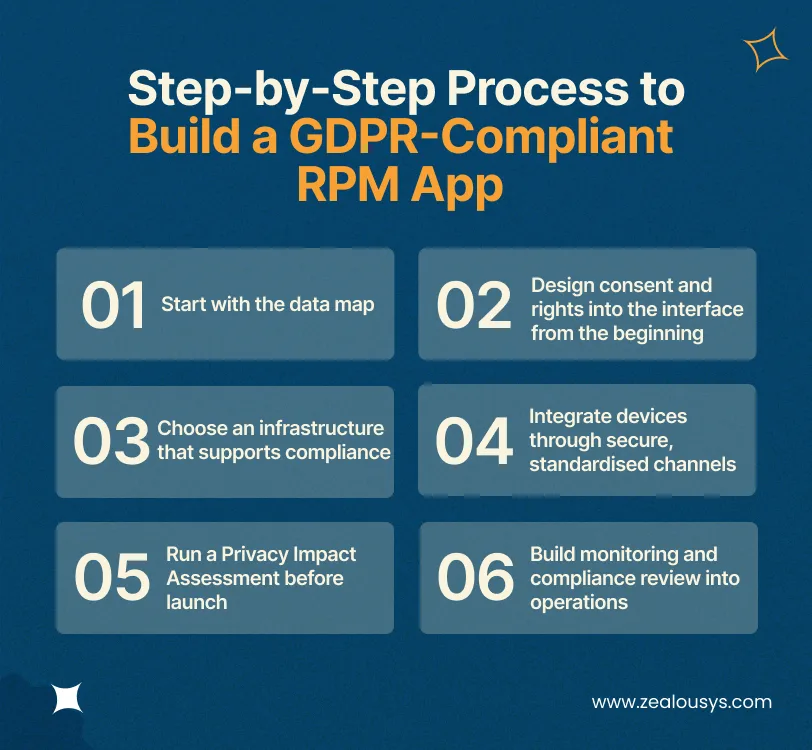
A structured approach reduces rework and keeps compliance aligned with development from the start.
Before any code is written, document every data type the app will collect, the lawful basis for each, where it will be stored, who will have access, how long it will be retained, and what triggers deletion. This is not a compliance document to file and forget. It becomes the reference point for every technical decision that follows.
Consent flows and rights management features are not features to add in the final sprint. They influence database schema, API design, and user journey architecture. Building them in from the wireframe stage is far simpler than trying to insert them into a system that was not designed to support them.
EU-based cloud hosting removes a significant layer of cross-border transfer complexity. Not all EU-based providers offer the same capabilities, so evaluate them against your specific requirements: encryption key management, access logging, data residency options, and the ability to delete data verifiably across regions.
Wearable device integration introduces an attack surface. Each connection between a device and the app backend is a potential vulnerability. Standardised protocols like HL7 FHIR provide a structured approach to health data exchange, making it easier to integrate EHR software and connect with hospital systems and national health platforms.
A Data Protection Impact Assessment is legally required for high-risk processing under GDPR. An RPM app that processes health data at scale qualifies. The assessment should be conducted by people with both technical and regulatory knowledge, and its findings should drive final development decisions, not just produce a document that demonstrates the assessment happened.
Launch is not the end of the compliance process. Regulations change. Court decisions reinterpret rules. Medical Device Regulation adds ongoing obligations for software that qualifies as a device. Build the capacity to respond to regulatory changes into your operational model from the start, not as something to figure out when the next change arrives.
A focused RPM app development MVP that covers core monitoring, consent tools, and basic data subject rights usually costs between €15,000 and €30,000 and takes around four to six months. The range varies because development costs across Europe differ based on team location and whether you manage compliance in-house or through external experts.
A mid-level RPM product that includes wearable integrations, electronic health record connections, and modules like pharmacy management software, along with advanced alerting, typically costs between €50,000 and €75,000. This stage usually takes six to nine months to complete.
Full enterprise RPM app deployments that support multiple countries, MDR certification, and advanced clinical features can reach €75,000 to €100,000 or more. These projects often take nine to fourteen months, depending on complexity and regulatory requirements.
These ranges reflect real-world European projects where GDPR and medical device rules are non-negotiable. Your final number will shift based on the exact features your patients and providers need.
New approaches in RPM focus on reducing data exposure while improving clinical response time. Several clear directions stand out for teams building the next generation of RPM solutions:
Instead of sending raw patient data to a central server, federated learning trains models locally on each device and shares only aggregated, anonymised parameters. This substantially reduces data transfer risk and aligns naturally with GDPR’s minimisation requirements. Several European health research consortia are already deploying it in production.
Processing vital signs on the device or a nearby gateway means faster clinical alerts without constant cloud transmission. It also means less data in transit, fewer transfer events, a smaller attack surface, and better alignment with minimisation principles.
Germany’s gematik, France’s Mon Espace Santé, and similar national platforms are building standardised FHIR-based exchange infrastructure. RPM apps that build to those standards now will connect without bespoke integration work as the platforms mature.
The emerging model gives patients direct custody of their own health data in a secure personal vault. They grant temporary, scoped access to clinicians as needed. This inverts the traditional data custody model and strengthens the practical reality of data subject rights, not just the legal assertion of them.
The teams that build successful RPM apps in Europe are not the ones that treat compliance as a constraint. They approach it as a design requirement, on par with clinical functionality and user experience. This is where working with a custom healthcare software development company that offers healthcare app development services often makes a difference, as both compliance and engineering decisions are handled together from the start. The result is an app that patients trust, hospitals can integrate without friction, and regulators can assess without concern.
That outcome requires investment upfront. It is still far less costly than rebuilding a remote patient monitoring system that was not designed with these fundamentals in place.
Our team is always eager to know what you are looking for. Drop them a Hi!

Raj Kewlani is a Project Manager and Mobile & Open Source Development Lead at Zealous System, specializing in agile-driven digital solutions. He focuses on delivering high-quality mobile apps and open-source projects that align with business goals.


Comments