
The founders who get to market fastest are rarely the ones with the biggest budgets. They’re the ones who knew exactly what to cut.
That sounds straightforward. In practice, it’s one of the hardest calls you make at the pre-seed or seed stage. Every feature on your list feels necessary. Every week of delay burns cash. And underneath all of it sits a question most early-stage founders wrestle with longer than they should: what does your product actually need to be in order to be worth putting in front of real users?
React Native MVP development has become the default starting point for a lot of mobile-first startups, and the reason is mostly practical. One team, one codebase, two platforms. You’re not paying to build the same product twice. But the technology choice is only part of the equation. What you decide to build, in what order, and with what team determines whether your MVP ships in 10 weeks or quietly dies somewhere around month five.
What follows is a step-by-step guide to building an MVP with React Native, without the vague ranges and padded timelines you’ll find on most agency pages. What belongs in your first release. What actually drives the cost up or keeps it in check. And a phase-by-phase timeline that reflects how these projects unfold in practice.
A minimum viable product is the simplest version of your app that still solves a real problem for a real user. Not the most polished version. Not the feature-rich version you’ve been sketching for months. Just the core, working product that lets you test your assumptions in the market.
In mobile app development, an MVP typically includes one or two primary user flows, essential UI, basic authentication, and just enough backend to make it functional. Everything else comes after you’ve learned from your first users.
The whole point of MVP app development is startup product validation. You build the minimum, release it to a target audience, gather feedback, and iterate. This cycle, popularized by Eric Ries in The Lean Startup, is what separates startups that survive from ones that spend 18 months building something nobody wanted.
A common mistake is treating “minimum” as “low quality.” That’s not what it means. Your MVP should work reliably and feel polished enough that users trust it. It just doesn’t need five dashboards, three integrations, and a custom onboarding flow on day one.
When you’re building a mobile app MVP for a startup, you’re working with two constraints that pull against each other: time and money. React Native is built almost perfectly for that situation.
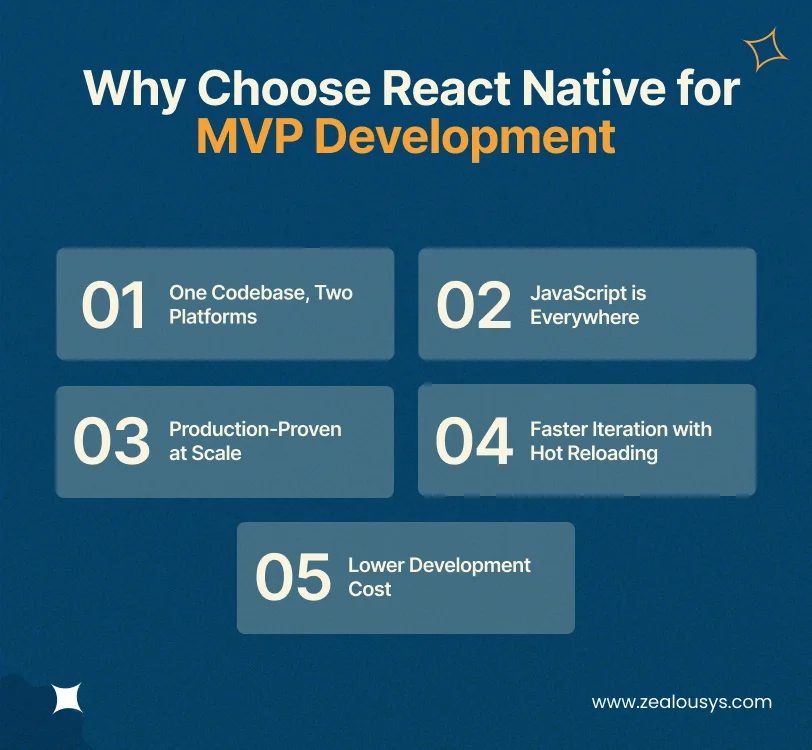
React Native lets you write a single JavaScript codebase that runs on both iOS and Android. For an MVP, this is significant. Instead of hiring two separate native teams or paying for two separate builds, you get cross-platform mobile development from a single shared foundation. A significant portion of the code is reusable across platforms, though the exact share depends on how platform-specific your UI requirements are.
For startups that need to reach both iOS and Android users from day one, this alone justifies the choice.
React Native uses JavaScript, which is the most widely used programming language in the world. This means the talent pool is large, onboarding is faster, and if you already have web developers on your team, the transition is relatively smooth. You’re not hunting for specialized native engineers in a competitive hiring market.
React Native is maintained by Meta and has been used in production by companies like Shopify, Discord, and Microsoft. For a startup founder worried about whether the technology is reliable, that’s a meaningful signal. You’re not betting on an experimental framework.
During MVP development, you’ll be making changes constantly. React Native’s hot reloading feature lets developers see updates in real time without rebuilding the entire app. This speeds up development cycles, which directly affects how quickly you can move from one iteration to the next.
Because you’re building for two platforms with one team, React Native app development for startups typically costs less than building two separate native apps. This is one of the biggest reasons it’s become the default choice for MVP mobile development.
That said, React Native is not always the right choice. If your app requires heavy use of device hardware (camera processing, AR, complex animations at a native level), pure native development might perform better. For most startup MVPs focused on data, user flows, and core product functionality, React Native is more than sufficient.
One of the most common traps in startup app development is building too many features into the MVP. The goal here is ruthless prioritization. What does your user absolutely need to get value from this product?
Here’s a practical breakdown of features worth including in most mobile app MVPs, along with what you can safely leave out for V2.
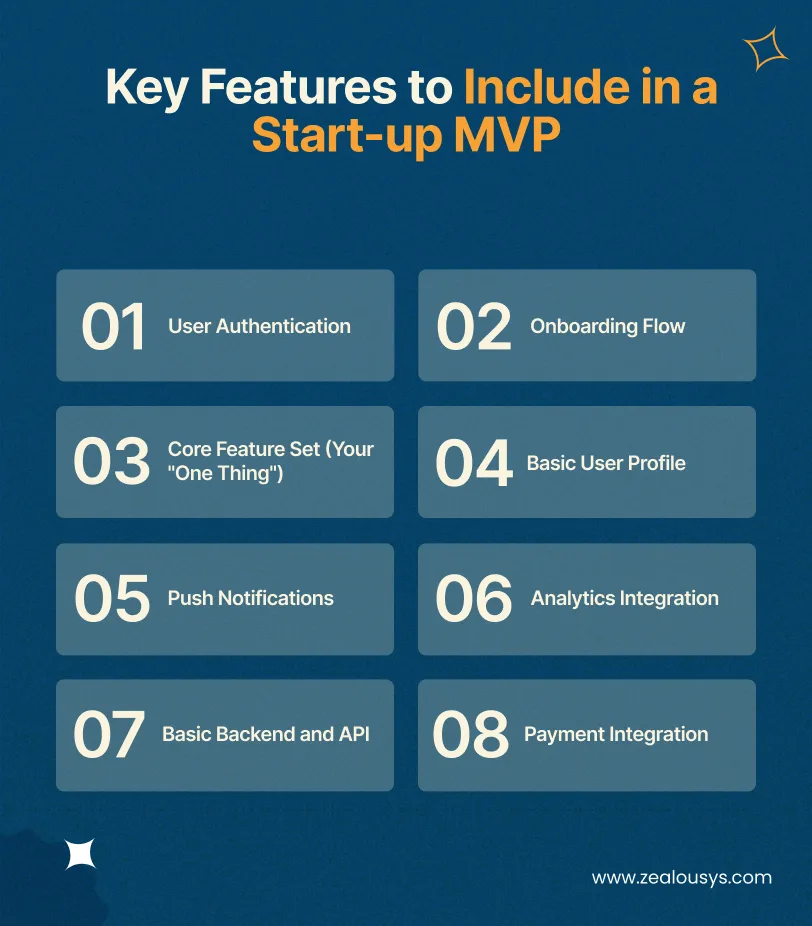
Every app needs a way to identify users. At the MVP stage, this means email/password login, and optionally, social login via Google or Apple. Keep it simple. Multi-factor authentication, SSO, and role-based access can come later.
New users need to understand your product quickly. A 2-3 screen onboarding that explains the core value proposition and collects essential user information is enough. You don’t need an elaborate interactive tutorial.
This is the most important part of your MVP. Every startup app has one primary action it wants users to take. A task manager wants users to create and complete tasks. A marketplace wants users to list or buy. A SaaS product wants users to connect their data and see insights.
Build that one thing well. Resist the urge to add secondary features until the primary one works and users actually use it.
Users need to manage their accounts. A profile screen with editable fields, profile picture upload, and settings is standard. Avoid overengineering this section.
Push notifications are one of the highest-ROI features in mobile development. They keep users engaged without requiring active marketing spend. At the MVP stage, basic push notifications (reminders, alerts, or update notifications) are worth including.
You cannot make good product decisions without data. Integrating a simple analytics tool like Mixpanel, Amplitude, or even Firebase Analytics during the MVP phase gives you visibility into how users actually use your app. This is not optional if you plan to iterate based on evidence.
Your app needs a server to handle data storage, authentication, and business logic. For an MVP, a straightforward REST API connected to a database (PostgreSQL, Firebase, or similar) is sufficient. You don’t need microservices or complex architecture at this stage.
If your business model depends on transactions, include payment processing from day one. Stripe is the standard choice for most startups and integrates well with React Native.
The cost to build an MVP using React Native varies based on your team, location, and scope. Region, feature list, and team structure all pull the number in different directions. Here is what each variable actually looks like in practice.
Break the project into simple, medium, or complex categories to match your startup stage and feature list. These ranges reflect typical 2026 quotes for cross-platform React Native work.
| Complexity Level | What It Usually Includes | Typical Timeline | Estimated Cost Range |
|---|---|---|---|
| Simple MVP | User login, core one-screen functionality, basic navigation | 2–4 months | $15,000 – $35,000 |
| Medium MVP | Authentication, payments, push notifications, basic analytics, dashboard | 4–6 months | $35,000 – $75,000 |
| Complex MVP | Real-time updates, multiple user roles, third-party API integrations, and advanced feedback tools | 6–9+ months | $75,000 – $150,000+ |
Your choice of team location has a direct impact on the final MVP development cost for startups. Rates differ by region, yet quality React Native talent exists across all of them.
USA, UK, Western Europe teams: Strong communication and market alignment. Expect total costs of $45,000 – $150,000, depending on complexity.
Eastern Europe or Australia/Canada teams: Good balance of expertise and value. Typical range sits between $25,000 – $100,000.
India or similar offshore teams: Most budget-friendly option while still delivering solid React Native MVP development. Total often lands at $15,000 – $60,000.
A medium-complexity MVP built by a US-based team will cost significantly more than the same product built by an equally competent team in Eastern Europe or India. Many startups at the pre-seed or seed stage work with nearshore or offshore development partners for this reason.
Beyond raw hourly rates, understanding what roles you need helps in startup app development cost planning.
For a lean MVP, developers often handle both frontend and backend (full-stack), and the PM role is sometimes covered by a tech lead. This reduces cost but increases coordination risk.
Understanding the React Native MVP development cost breakdown means knowing what actually drives the numbers up or down.
This is the biggest cost driver. Every feature you add extends the timeline and increases developer hours. A checkout flow with multiple payment methods costs more than a simple subscription toggle. Custom animations cost more than standard UI components.
Be specific about what “core” means for your product. Vague requirements lead to scope creep, which leads to budget overruns.
A simple, clean design using standard components costs less than a fully custom visual identity with bespoke interactions. Custom illustrations, micro-animations, and complex layouts all take time. For an MVP, a clean and functional UI is more important than a highly original one.
Every external service you connect to adds development time. Payment gateways, mapping APIs, CRM tools, analytics platforms, and social logins all require app integration work. Each one also needs error handling, testing, and maintenance.
A basic REST API with a straightforward database is relatively quick to build. If your product requires real-time features (live chat, live updates, collaborative editing), the backend complexity
increases significantly. WebSocket management, database optimization, and real-time sync all take more time and cost more to build correctly.
A senior React Native developer builds faster and makes fewer costly mistakes than a junior one. A well-structured team with clear responsibilities moves faster than a team where roles overlap. Paying slightly more for experienced developers often reduces total cost by avoiding rework.
Most cost estimates cover only the build phase. Factor in bug fixes, server costs, and a minimum of one or two post-launch iteration cycles. A common mistake is building an MVP at the edge of the budget with nothing left for the iteration phase.
If you want to know how to build an MVP with React Native, the timeline is as important as the budget. Here is a realistic phase-by-phase breakdown, assuming a focused team and a well-defined scope going into development.
This is where the product is defined on paper. The team reviews requirements, identifies unknowns, finalizes the feature list, and sets up the project infrastructure.
Deliverables: Technical specification, project roadmap, finalized feature scope
Wireframes are created first, reviewed, and approved before the visual design begins. High-fidelity mockups and a clickable prototype are produced before a single line of code is written.
Skipping or rushing this phase is one of the most common reasons MVPs go over budget. When developers have to make design decisions mid-build, it slows everything down.
Deliverables: Wireframes, high-fidelity designs, design system, approved prototype
This is the longest phase. Frontend and backend development happen in parallel. The React Native team builds the app screens and user flows, while the backend team builds the API and database.
Weekly builds are shared with the product owner for review. The earlier issues are caught, the cheaper they are to fix.
Deliverables: Working application builds (iOS + Android), API, database, admin access
The app is tested across multiple devices and operating system versions. Functional testing, performance testing, and basic security testing are conducted. Critical bugs are fixed, and regression testing confirms that fixes didn’t break anything else.
Deliverables: QA report, resolved bug list, production-ready builds
App Store and Google Play submissions are made (note: Apple review can take 1-3 days on average, sometimes longer). Backend is moved to production infrastructure. Monitoring tools are set up. The team hands over code, documentation, and access credentials.
Deliverables: Live app on both stores, codebase handover, documentation
Here’s a quick reference for everything above:
| Phase | Duration | Key Deliverables |
|---|---|---|
| Discovery & Planning | 1–2 weeks | Technical spec, roadmap, finalized scope |
| UI/UX Design | 2–3 weeks | Wireframes, high-fidelity designs, prototype |
| Development | 4–10 weeks | Working iOS & Android builds, API, and database |
| Testing & QA | 1–2 weeks | QA report, bug fixes, production-ready builds |
| Launch & Handover | 1 week | Live app on both stores, codebase, and documentation |
| Total | 9–18 weeks |
Building an MVP sounds straightforward in theory. In practice, several recurring mistakes cost startups time, money, and market position.
The word “minimum” is in the name for a reason. When founders start listing “must-have” features, the list rarely stays short. Every feature adds time. Every feature adds testing. Every feature adds cost. The MVPs that ship fastest are the ones where someone, at some point, said “not in V1” and meant it.
An MVP built on assumptions is a gamble. Before spending anything on development, talk to at least 15-20 potential users. Find out what problem they actually have, how they currently solve it, and what they’d genuinely pay to fix. This takes a week. Not doing it can cost months of misdirected development.
Startup MVP development is not like enterprise software development. The right MVP development services look very different from what works for a large enterprise build. You need a team that can move fast, communicate clearly, and flag problems early. A partner who goes quiet for two weeks before surfacing with issues is not the right fit for an MVP timeline.
Look for teams with a clear process, regular delivery milestones, and honest estimates. Cheap is not always economical if it comes with poor communication and unpredictable timelines.
React Native is performant for most use cases, but it requires thoughtful implementation. Heavy list rendering without virtualization, poorly managed state, and images that haven’t been compressed can make an app feel sluggish. Performance issues are far cheaper to prevent than to fix after launch.
The MVP is not the end product. It’s the starting point. Many startups spend their entire mobile app development budget on V1 and have nothing left to act on what they learn. Budget for at least two or three post-launch iterations before you commit to a development cost.
Apple and Google both have submission guidelines that, if ignored, can delay your launch by days or weeks. App Store screenshots, privacy policy pages, content descriptions, and permissions declarations need to be prepared in advance, not the day before submission.
The cost varies based on complexity, team location, and feature scope. A simple MVP typically falls in the $15,000–$35,000 range, while a medium-complexity product with integrations and custom design can reach $35,000–$75,000. Complex MVPs with real-time features or multi-role systems can exceed $100,000.
A focused team can deliver a simple MVP in 9–12 weeks. Medium-complexity projects typically take 12–16 weeks. The timeline to build a startup MVP using React Native depends heavily on how well-defined the scope is before development begins.
Yes, for most startup use cases. React Native allows a single codebase to run on both iOS and Android, which reduces development cost and time significantly. It’s a strong choice for apps centered on data, user flows, and standard mobile interactions.
Focus on user authentication, your core feature (the one thing users come for), a basic profile, push notifications, and analytics. Everything else can be added after you’ve validated the product with real users.
Yes. React Native apps follow the same App Store and Google Play update processes as native apps. Over-the-air updates through tools like Expo Updates can push certain changes without requiring a full store review.
A prototype is typically a clickable mockup used to test design and user flow assumptions, usually not functional. An MVP is a working product that real users can interact with, built to test whether your core value proposition holds in the market.
For most startups, React Native is the more cost-effective choice at the MVP stage. Native development makes more sense if your app requires deep hardware access, complex platform-specific interactions, or performance-intensive operations like real-time video processing. If you’re building a standard data-driven app, React Native handles it well.
React Native MVP development gives startups a practical path to market without committing to two separate native builds. The cost is manageable, the timeline is predictable when the scope is defined clearly, and the technology is solid enough to take you well beyond the MVP phase as your product grows.
The variables that most affect cost and timeline, including feature scope, team experience, and design complexity, are all within your control before development starts. The more clearly you define what your MVP needs to do, the more accurate your estimates will be.
If you’re working through these decisions and need a development partner with experience in React Native app development services for startup, the team at Zealous System has helped founders at various stages navigate exactly this process. They bring both technical depth and product thinking to MVP builds, which matters when every week of development time counts.
Our team is always eager to know what you are looking for. Drop them a Hi!

Hardik Gupta is the Team Lead for Mobile App Development at Zealous System. He specializes in creating innovative mobile applications for iOS and Android, focusing on delivering high-performance solutions and staying ahead of industry trends.


Comments