Key Takeaways:
If you are budgeting for ESG software right now, you probably need one number before anything else. Here it is: the cost to build ESG reporting software in Australia typically ranges between AUD 25,000 and AUD 400,000+, depending on scope. A compliance-focused MVP sits at the lower end. A multi-entity, AI-powered enterprise platform sits at the top.
That range is wide, and for good reason. Two companies in the same industry can receive quotes that differ by six figures based on the frameworks they report against, the systems their data lives in, and how much of the audit trail they want automated.
This guide breaks the range down properly: cost by tier, by feature, and by development stage, along with the factors that push a quote up or down. By the end, you should be able to build a realistic budget case for your board, whether you are a reporting entity racing a deadline or a founder planning an ESG SaaS product.
Sustainability reporting in Australia stopped being voluntary. Four forces are pushing companies toward proper reporting software at the same time.
Under the Australian Sustainability Reporting Standards (ASRS), large companies must now disclose climate-related financial information in line with AASB S2, the mandatory climate standard issued by the Australian Accounting Standards Board.
The obligation arrives in three waves:
You can check the exact thresholds and staged dates on the Treasury’s climate-related financial reporting guidance page and on the AASB S2 Knowledge Hub for implementation guidance.
Reporting errors now carry real consequences. ASIC has already taken greenwashing action against major financial institutions, and its enforcement priorities continue to include misleading sustainability claims. A published figure you cannot trace back to source data is a legal risk, not just an embarrassment.
Emissions figures, energy use, and supplier information sit scattered across ERPs, utility bills, fleet systems, and spreadsheets. Pulling that together manually each year is slow and error-prone. It also leaves no audit trail, which is precisely what assurance providers ask for first.
Most global sustainability reporting software was built for European CSRD or US frameworks. These platforms rarely handle NGER methodologies cleanly, and they seldom integrate with the accounting systems Australian mid-market companies actually run, such as Xero and MYOB. That gap is exactly why so many organisations are choosing to build custom ESG reporting software instead of forcing an overseas product to fit.
Here is the short answer, broken into the three tiers most projects fall into.
| Platform Tier | Estimated Cost (AUD) | Timeline | Best Suited For |
|---|---|---|---|
| ESG Reporting MVP | $25,000 – $60,000 | 3–4 months | Group 3 entities, consultancies validating a product idea |
| Mid-Complexity Platform | $60,000 – $150,000 | 5–8 months | Group 2 entities, growing SaaS products |
| Enterprise-Grade Platform | $150,000 – $400,000+ | 9–14 months | Group 1 entities, multi-entity groups, funded SaaS ventures |
An MVP at this level covers Scope 1 and 2 emissions tracking, a single reporting framework (usually AASB S2), manual and CSV-based data entry with validation, and basic report generation. It is enough to replace spreadsheets and get audit-ready for a first reporting cycle.
A mid-complexity build adds automated data collection through integrations, Scope 3 tracking for priority categories, dashboards, and mapping across two or three frameworks. Most Australian reporting entities land in this tier.
The enterprise tier is where multi-entity consolidation, supplier data portals, full fifteen-category Scope 3 coverage, immutable audit logging, and AI-driven analytics come in. If you are building a commercial ESG SaaS product rather than an internal tool, expect to start in this tier as well, since multi-tenancy and billing infrastructure add engineering weight.
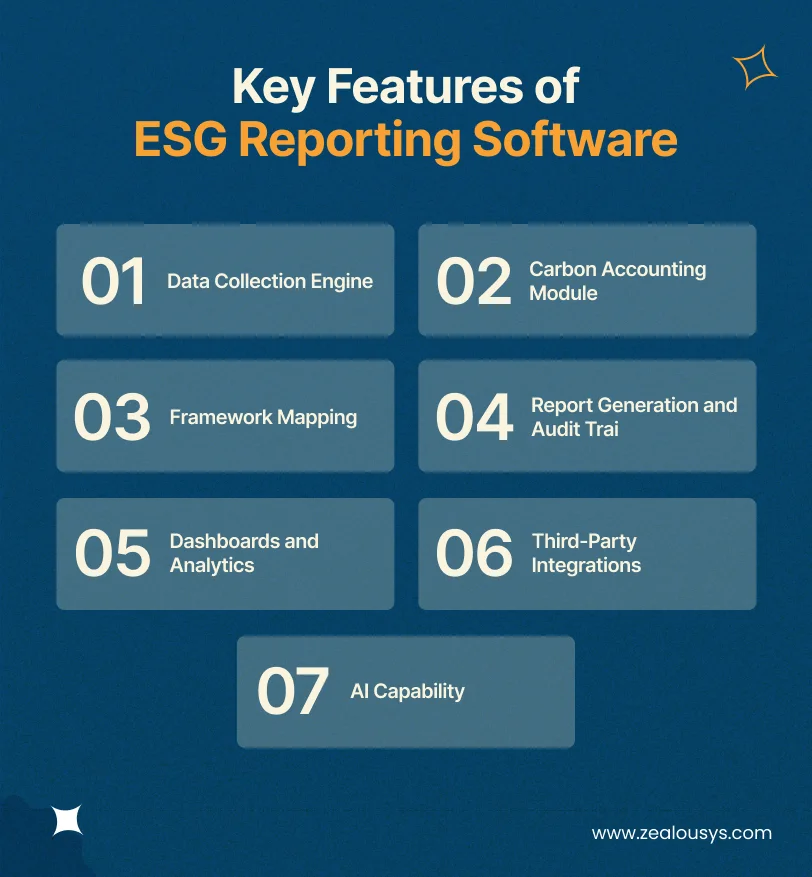
Every quote you receive is really a sum of feature modules. Understanding what each one does, and roughly what it costs, helps you cut what you do not need yet.
The foundation of any ESG data management platform. It ingests emissions and activity data from spreadsheets, forms, utility APIs, and connected systems, then validates it before anything reaches a report. Weak data collection is one of the most common reasons ESG reports fail assurance reviews.
This converts activity data into emissions using recognised factors, covering Scope 1, 2, and 3. Australian builds need NGER-aligned emission factors, which is a detail many off-the-shelf tools miss.
One dataset, multiple outputs. The mapping layer translates your data into AASB S2 disclosures, and optionally GRI, TCFD, or ISSB formats. Each additional framework increases mapping logic and testing effort.
Automated report drafting with time-stamped logs showing where every figure came from. This is the evidence trail external auditors test line by line.
Emissions trends, progress against targets, and board-ready visuals. Useful for turning a compliance obligation into something management actually uses.
Connections to ERPs (SAP, Oracle, NetSuite), accounting systems (Xero, MYOB), HR platforms, and utility providers. Cost scales almost linearly with the number of secure connections.
Anomaly detection in supplier data, automatic categorisation of emissions line items, and draft narrative generation. These features carry the highest per-module cost but remove the most manual work after launch.
Here is how the modules typically contribute to the total, using mid-tier builds as the reference point:
| Feature Module | Indicative Cost (AUD) |
|---|---|
| Data Collection Engine | $5,000 – $14,000 |
| Carbon Accounting (Scope 1, 2, 3) | $8,000 – $18,000 |
| Framework Mapping (Per Framework) | $4,000 – $10,000 |
| Report Generation & Audit Trail | $5,000 – $12,000 |
| Dashboards & Analytics | $4,000 – $9,000 |
| User Management & Role-Based Access | $2,500 – $5,000 |
| Third-Party Integrations (Per System) | $3,000 – $8,000 |
| AI Features (Anomaly Detection, Auto-Categorisation, Narrative Drafting) | $10,000 – $25,000 |
Treat these as building blocks, not a shopping list. A sensible MVP includes the first four modules and one integration, which is exactly how the $25,000 to $60,000 entry tier holds together.
Budgeting by stage matters as much as budgeting by feature, because it tells you when the money leaves your account and what you should have in hand before releasing the next tranche.
| Development Stage | Share of Budget | MVP Range (AUD) | Enterprise Range (AUD) | What You Get |
|---|---|---|---|---|
| Discovery & Compliance Research | 12% | $3,000 – $7,200 | $18,000 – $48,000 | Requirements, AASB S2 data mapping, architecture plan |
| UI/UX Design | 10% | $2,500 – $6,000 | $15,000 – $40,000 | Wireframes, dashboard and workflow design |
| Core Development | 48% | $12,000 – $28,800 | $72,000 – $192,000 | Backend, calculation engine, integrations, frontend |
| Testing & Security | 15% | $3,750 – $9,000 | $22,500 – $60,000 | QA, calculation validation, penetration testing |
| Deployment & Data Migration | 7% | $1,750 – $4,200 | $10,500 – $28,000 | Cloud setup, Australian data residency, legacy data import |
| Training & Handover | 8% | $2,000 – $4,800 | $12,000 – $32,000 | User onboarding, documentation, admin training |
One line item deserves special attention: discovery. Teams sometimes try to trim it to save money, and it is consistently the most expensive mistake in compliance software. Mapping your data sources against AASB S2 disclosure requirements before writing code is what prevents the mid-project scope changes that blow budgets apart.
Also plan for what comes after launch. Ongoing maintenance, hosting, and regulatory updates typically run 15 to 20 percent of the build cost per year. The reporting standards are still settling, and the AASB continues to issue amendments, so a platform without a maintenance budget will drift out of compliance.
Why does one company pay $40,000 and another pay $350,000 for what sounds like the same software? These are the variables that move your ESG reporting software development cost up or down.
Supporting AASB S2 alone keeps the mapping engine contained. Add GRI, TCFD, and investor-specific formats, and the logic multiplies, because each framework defines boundaries and materiality differently.
Scope 3 is the single most expensive capability on the list. Full coverage means supplier portals, emission factor libraries across fifteen categories, and reconciliation workflows for incomplete supplier data. Many Group 2 and 3 entities sensibly start with two or three priority categories.
Each secure connection to an ERP, HRIS, or utility provider adds build and testing time. Five integrations can add $15,000 to $40,000 compared with a manual-upload approach.
Manual data entry is cheap to build and expensive to run. Automated collection flips that equation: a higher upfront cost that pays back in staff hours every reporting cycle.
Immutable logs, role-based access controls, and evidence linking every figure to a source document require careful backend engineering. Listed entities and financial institutions cannot skip this.
Many Australian organisations require data stored onshore. That constrains cloud region choices and can affect infrastructure cost, though it rarely changes the build cost dramatically.
An internal tool serves one company. A commercial product needs tenant isolation, subscription billing, and self-service onboarding, which typically adds 30 to 50 percent to the engineering effort. If you are heading down the product route, a specialist SaaS application development approach handles this architecture from day one.
Who builds it, and where, changes the hourly economics more than any technical decision. More on this in the outsourcing section below.
A working ESG reporting MVP takes 3 to 4 months to build. Mid-complexity platforms take 5 to 8 months, and enterprise-grade builds run 9 to 14 months depending on integration count and Scope 3 depth.
| Platform Tier | Typical Timeline |
|---|---|
| ESG Reporting MVP | 3–4 months |
| Mid-Complexity Platform | 5–8 months |
| Enterprise-Grade Platform | 9–14 months |
The practical implication for reporting entities: count backwards from your first reporting period, and add a buffer for parallel running against your existing process. A Group 2 entity reporting on a financial year starting 1 July 2026 has little slack left for an enterprise build. A phased approach still works, though: launch an MVP covering mandatory Scope 1 and 2 disclosures first, then extend into Scope 3 and additional frameworks in later releases. Phasing also spreads the cost across financial years, which most finance teams appreciate.
AI changes the economics of a build like this in two distinct ways, and it is worth separating them because they affect different lines in your budget.
Development teams using AI-assisted engineering ship faster. Code generation handles boilerplate, automated test creation shortens QA cycles, and AI review tools catch defects earlier.
On a compliance platform full of repetitive calculations and mapping logic, the effect is significant: work that once justified a nine-month schedule can often land in six or seven. Since development hours are the largest cost component, a shorter schedule is a direct saving. This is the core reason quotes from an AI software development company often come in below traditional agency estimates for identical scope.
AI-powered ESG reporting features, such as automatic data extraction from utility bills, anomaly detection that flags a supplier figure ten times higher than last quarter, and first-draft disclosure narratives, all cost more to build upfront. What they buy you is a lower cost of ownership. Sustainability teams stop spending weeks on data cleanup before every reporting deadline, and the risk of a misstated figure reaching a published report drops.
One caution: add AI features where they remove measurable manual work, not because they look good in a demo. An anomaly detector on messy supplier data earns its cost quickly. A chatbot on top of a dashboard usually does not.
Honest answer: buying is the right call for some organisations, and it would be a disservice to pretend otherwise. Here is how the decision actually breaks down.
| Consideration | Off-the-Shelf | Custom Build |
|---|---|---|
| Upfront Cost | Low ($10,000 – $50,000+ per year in licences) | Higher ($25,000 – $400,000+ one-off) |
| Fit with Australian Standards (AASB S2, NGER) | Often partial | Exact |
| Integration with Your Systems | Limited to vendor’s connectors | Built for your stack |
| Scope 3 Supplier Data Collection | Rigid portals suppliers may not use | Designed around your supply chain |
| Data Ownership | Vendor’s platform, vendor’s terms | Fully yours |
| Long-Term Cost | Licence fees grow with users and modules | Maintenance only, no per-seat fees |
| Ability to Productise or Resell | None | Full |
Buy when your reporting needs are standard, your data sources are few, and you need something running within weeks. A Group 3 entity with simple operations may never need more than a good subscription tool. Licence fees stay manageable at low user counts, and the vendor carries the burden of regulatory updates.
Build when any of the following is true:
Consultancies fall into that last category often. If you are advising twenty clients on ESG compliance using spreadsheets, a white-labelled platform converts your methodology into recurring software revenue, and no off-the-shelf licence lets you do that.
A useful middle path exists too: start with a subscription tool for your first reporting cycle while a custom build progresses in parallel. You meet the immediate deadline without locking yourself into the wrong long-term architecture.
Now for the variable that changes your quote more than any feature decision: who builds it.
Hiring an in-house team for a compliance platform means recruiting senior engineers, a designer, a QA specialist, and a project lead in a persistently tight technology labour market. Australian senior developer salaries, plus recruitment time measured in months, make this hard to justify for what is often a fixed-scope project. Local agency rates carry the same underlying cost structure.
Outsourcing to an experienced partner resolves this in three ways:
The legitimate concern with outsourcing ESG compliance software development is data security and accountability. It is a fair question to put to any vendor, and the right answers are specific:
A partner who cannot produce those quickly is telling you something. Whether you hire dedicated developers to extend your own team or hand the full delivery to an ESG software development company serving Australian clients, those safeguards are non-negotiable for software your auditors will scrutinise.
Zealous System is an AI-powered software development company with over a decade of experience building compliance-heavy platforms for clients across Australia, and 300+ delivered projects spanning fintech, SaaS, and enterprise systems.
For ESG builds specifically, three things set the engagement apart. AI-assisted engineering shortens delivery schedules, which matters when a reporting deadline is fixed by legislation rather than preference. Flexible engagement models, from fixed-scope MVP builds to dedicated teams, let you match the commercial structure to your project stage. And an ISO-certified delivery process with full code ownership means the platform your auditors review is entirely yours.
If you want a number for your specific scope rather than a range, share your requirements, and you will receive a detailed estimate, feature by feature, with no obligation attached.
An ESG reporting MVP costs between AUD 25,000 and AUD 60,000 in Australia. That covers Scope 1 and 2 emissions tracking, AASB S2 report generation, data validation, and an audit trail. It is enough to replace spreadsheet-based reporting for a first mandatory reporting cycle.
A focused MVP takes 3 to 4 months. Mid-complexity platforms with integrations and Scope 3 tracking take 5 to 8 months, while enterprise-grade builds run 9 to 14 months. Phased delivery lets you meet a reporting deadline with core features while advanced modules follow.
AASB S2 is Australia’s mandatory climate disclosure standard. It applies in phases: Group 1 entities from January 2025, Group 2 from July 2026, and Group 3, companies above roughly AUD 50 million revenue, from July 2027. Check the Treasury’s thresholds to confirm your group.
Yes. Integration flexibility is one of the main reasons Australian companies build custom rather than buy. A custom platform can pull financial and activity data directly from Xero, MYOB, SAP, Oracle, or NetSuite, which removes manual data entry and reduces reporting errors.
Yes, provided the partner meets specific safeguards: ISO 27001 certification, contractual code ownership, no production data in development environments, and experience with regulated industries. Ask for evidence of each. Delivery location matters far less than delivery discipline.
The cost to build ESG reporting software in Australia comes down to three decisions: how many frameworks you report against, how deep you go on Scope 3, and who builds it. Get those right, and the range narrows quickly, from AUD 25,000 for a compliance-ready MVP to AUD 400,000+ for a full enterprise platform.
The regulatory clock is the one factor you cannot negotiate. Group 2 reporting starts with financial years from July 2026, and Group 3 follows a year later, so the organisations that scope their platforms now will report calmly while others scramble.
We at Zealous System build ESG and compliance platforms with AI-assisted engineering that keeps both the budget and the timeline shorter than traditional development. If you are weighing build against buy, or you simply want a credible number for your board paper, talk to our team for a free, feature-by-feature cost estimate.
Our team is always eager to know what you are looking for. Drop them a Hi!

Nandini Pare is a CAPM® Certified Business Analyst at Zealous System, specializing in business analysis, Agile delivery, and helping organizations build technology solutions that solve real business challenges.


Comments