The cost to develop an Energy Management System in Australia in 2026 ranges from AUD 25,000 for a focused MVP to AUD 400,000 and beyond for enterprise-grade platforms with AI forecasting and market integration. The exact energy management system development cost in Australia depends on your feature set, hardware integrations, compliance needs, and the team you hire.
Energy has become a board-level topic in Australia. Electricity prices remain volatile, demand tariffs punish businesses that cannot manage their peaks, and from 1 July 2026, a second wave of companies falls under mandatory climate-related financial reporting. At the same time, rooftop solar and home batteries are being installed at record rates, which means there is more distributed energy to monitor, coordinate, and monetise than ever before.
Software sits at the centre of all of it. Whether you are an energy retailer coordinating demand response events, a manufacturer trying to cut peak demand charges, or a startup building the next VPP platform, the question eventually lands on your desk: what will this actually cost to build?
This guide answers that question with real numbers. We break down pricing by project type, by development stage, and by the factors that push budgets up or down, so you can walk into vendor conversations knowing what a fair quote looks like.
An Energy Management System (EMS) is software that monitors, analyses, and controls how energy is generated, stored, and consumed across a site or a portfolio of sites. It collects smart meter data along with readings from sensors, inverters, and batteries, turns that data into real-time energy analytics, and in more advanced systems, automatically acts on it: shifting loads, dispatching batteries, or responding to price signals from the National Electricity Market (NEM).
The type of EMS you need has a direct bearing on cost because each serves a different user, scale, and integration environment.
A HEMS gives households visibility and control over rooftop solar, battery storage, EV charging, and major appliances, usually through a mobile app. For solar retailers and energy companies, a HEMS app is often the entry point into consumer-facing energy software.
A BEMS is energy management software for commercial buildings, managing HVAC, lighting, and plant equipment. In Australia, BEMS projects are frequently driven by NABERS ratings, since better energy performance directly affects a building’s rating, rental value, and appeal to institutional tenants.
Industrial EMS platforms serve manufacturing plants, mining operations, and data centres, where energy is one of the highest controllable costs. These systems track consumption per production line, flag anomalies, and manage peak demand to avoid punishing network charges. They often need to talk to SCADA systems and industrial protocols such as Modbus and BACnet, which makes them more integration-heavy than their commercial cousins.
At the top end sit platforms built for energy retailers, aggregators, and network operators. Think virtual power plant (VPP) orchestration, demand response coordination across thousands of devices, and integration with AEMO systems and market data. These are the most complex and expensive builds, and they carry the strictest reliability and compliance requirements.
Three forces are converging this year, and together they explain why EMS budgets are being approved faster than they used to be.
Australia ended 2025 with 28.3 GW of rooftop solar capacity across roughly 4.3 million installations, according to the Clean Energy Council’s Rooftop Solar and Storage Report, and rooftop solar alone supplied 14.2 percent of the country’s electricity generation in the second half of the year. On the storage side, the federal Cheaper Home Batteries Program drove more than 193,000 home battery installations in 2025, and the Clean Energy Regulator projects between 350,000 and 520,000 more in 2026. Every one of those batteries and panels is a distributed energy resource (DER) that someone needs to monitor and coordinate.
From 1 July 2026, Group 2 entities fall under Australia’s mandatory climate-related financial disclosure regime (AASB S2 under the Corporations Act). That captures companies meeting two of three thresholds: over $200 million in revenue, over $500 million in assets, or more than 250 employees. You cannot report emissions you cannot measure, and spreadsheets do not survive an audit. Accurate, timestamped energy data from an EMS is becoming a compliance asset, not a nice-to-have.
For commercial and industrial customers, a large share of the electricity bill is set by peak demand rather than total consumption. An EMS that shaves peaks through load shifting and battery dispatch can pay for itself in avoided network charges, which is why facility managers are often the ones championing these projects internally.
Add growing VPP participation, smart meter rollouts under the national Legacy Meter Replacement Plan, and net zero commitments across the ASX, and it is clear why smart energy management software development is climbing the corporate agenda.
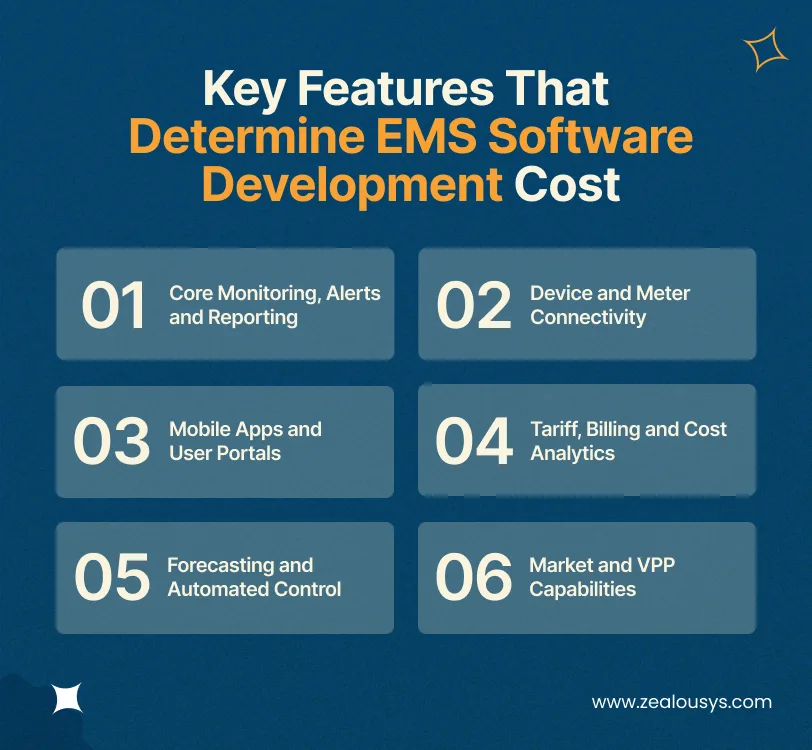
Development companies do not price by individual feature. They price by overall scope, the engineering hours it demands, and the risk it carries. Still, the feature groups you choose are what set that scope, and some of them move the budget far more than others.
Real-time dashboards, threshold alerts, and scheduled reports form the foundation of every EMS. This is the most predictable part of any build. If your project stops here, you are firmly in MVP territory.
Ingesting data from smart meters, IoT sensors, and gateways is where genuine engineering begins. This is the core of IoT energy management system development: cost rises with every additional device type and data format, because each one needs its own connection logic, validation, and error handling. A single meter type is cheap. A zoo of devices is not.
A responsive web dashboard covers most internal use cases. Dedicated iOS and Android apps, or separate portals for customers and installers, add meaningful design and development effort and are usually what separates a mid-tier budget from a basic one.
Translating kilowatt-hours into dollars requires modelling Australian tariff structures, including time-of-use rates and demand charges. This logic is business-critical and unforgiving of errors, so it demands careful development and heavy testing.
Machine-learning demand forecasting, automated load shifting, and battery dispatch sit at the advanced end. These features need data science skill, historical data pipelines, and extensive validation, which makes them among the most expensive line items in any EMS scope.
Integration with AEMO systems, wholesale price signals, and VPP orchestration across large device fleets is the domain of retailers and aggregators. This tier carries the highest engineering cost and the strictest reliability requirements, and it is the main reason enterprise builds reach $400,000 and beyond.
The cost to build energy management software in 2026 falls into one of three brackets. Matching your ambition to the right bracket is the single most useful budgeting exercise you can do before approaching vendors.
| Project Type | Typical Cost (AUD) | Timeline |
|---|---|---|
| MVP / Basic Monitoring Platform | $25,000 – $60,000 | 2 – 4 months |
| Mid-Complexity Commercial EMS | $60,000 – $150,000 | 4 – 7 months |
| Enterprise / Utility-Grade EMS | $150,000 – $400,000+ | 8 – 14 months |
A web dashboard pulling data from one meter type or IoT gateway, with core monitoring, alerts, and reporting. This suits startups validating a product idea and businesses that want visibility over a single site before committing further. It will not dispatch batteries or forecast demand, and it should not try to.
Multi-site monitoring, several device and meter integrations, mobile apps, tariff-aware analytics, and role-based access for facility teams. This is the bracket most Australian commercial and industrial businesses land in, and it is where an EMS starts producing measurable savings on demand charges.
ML-driven energy forecasting, automated demand response, AEMO market integration, VPP orchestration, and the security posture that energy retailers and network operators require. Costs above $400,000 are common once fleets scale into the tens of thousands of devices or wholesale market trading enters the scope.
Knowing where the money goes inside a project matters as much as the total. EMS builds do not follow the generic software template because hardware, live data feeds, and energy-market rules add stages of their own.
| Stage | Share of Budget | What Happens in an EMS Project |
|---|---|---|
| Discovery and Energy Data Audit | 5 – 8% | Site and device inventory, meter format review, sample interval data analysis |
| Solution Architecture | 4 – 6% | Time-series database selection, ingestion pipeline design, scalability planning |
| UI/UX Design | 8 – 12% | Dashboard and data visualization design, mobile screens, operator workflows |
| Core Platform Development | 30 – 36% | Backend, frontend, analytics engine, user and site management |
| Hardware and Third-Party Integrations | 15 – 20% | Meter data feeds, inverter and battery APIs, SCADA/BMS bridges, ERP connections |
| Testing and QA | 10 – 14% | Functional testing plus hardware-in-the-loop validation against live devices |
| Deployment and Go-Live | 4 – 6% | Cloud environment setup, security hardening, cutover, monitoring |
| Post-Launch Stabilization | 4 – 6% | Live-data tuning, edge-case fixes, performance adjustments in the first weeks |
On a $100,000 mid-complexity project, that means roughly $6,000 to $8,000 goes to discovery and around $15,000 to $20,000 to integrations alone. If a vendor’s quote compresses discovery, integrations, or QA to near zero, treat it as a warning sign rather than a saving.
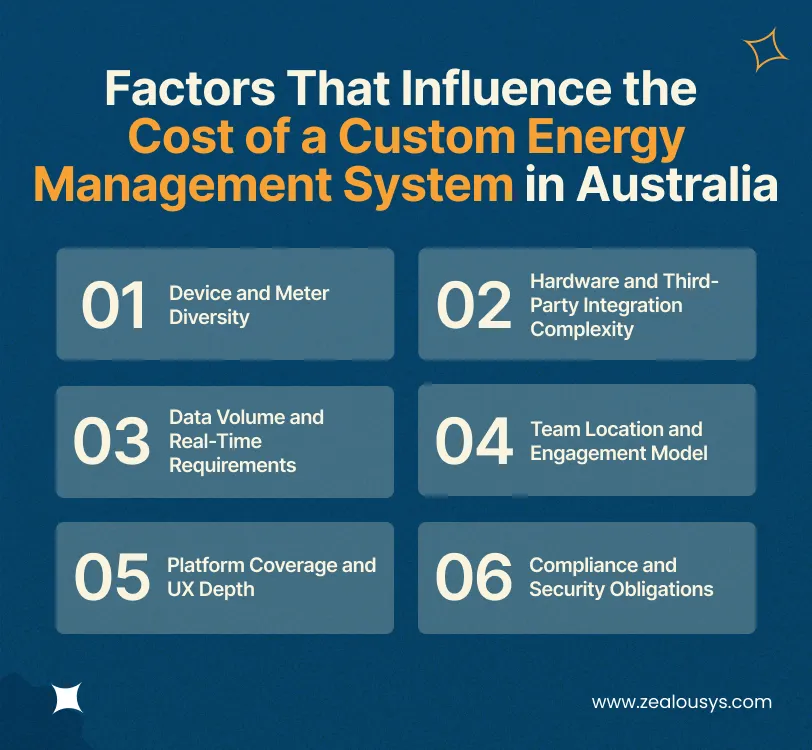
Two projects with identical feature lists can still land tens of thousands of dollars apart. These are the variables doing the work behind the scenes.
Ten sites with the same meter type make for a straightforward project. Ten sites with five meter types, three inverter brands, and a legacy BMS are a different animal, even if the dashboards look identical.
Connecting an EMS to the physical and commercial world is where Australian projects most often blow past their estimates. Typical integration work includes:
Each integration typically adds between $5,000 and $25,000, depending on documentation quality and data mapping effort. Share your device list with vendors before they quote, not after.
An EMS polling 50 devices every 15 minutes has modest infrastructure needs. One ingesting sub-minute telemetry from 20,000 devices needs time-series databases, message queues, and an architecture designed for scale from the start.
Australian onshore agency rates typically run $120 to $220 per hour, while established offshore and hybrid teams deliver the same scope at $30 to $70 per hour. On a 1,500-hour build, that gap can exceed $150,000 on labour alone, which is why a hybrid model of local discovery paired with offshore engineering has become the default for cost-conscious EMS projects.
Web only is the cheapest path. Adding polished iOS and Android apps, or separate portals for different user groups, expands both design and development effort and typically shifts a project up a bracket.
The Privacy Act treats interval data as personal information once it is linked to a customer, grid-connected systems carry AEMO DER Register obligations, and cybersecurity expectations keep rising, with the Essential Eight as the practical baseline and the SOCI Act applying where systems touch critical energy infrastructure.
Expect compliance-related design, security hardening, and audit logging to account for 10 to 15 percent of a mid-complexity budget. Building it in from the first sprint costs far less than retrofitting it into a live platform.
The development invoice is not the finish line. An EMS is live infrastructure, and it carries recurring costs that belong in your business case from day one.
Plan for 15 to 20 percent of the original build cost per year. For a $100,000 platform, that is $15,000 to $20,000 annually, covering bug fixes, dependency updates, device firmware compatibility, and minor improvements. Energy platforms need this more than most software, because meter formats change, inverter APIs get updated, and market rules shift.
Hosting scales with telemetry volume. A single-site MVP might cost $200 to $500 per month on AWS or Azure, while a multi-site platform ingesting high-frequency data commonly runs $1,000 to $5,000 per month once time-series storage, redundancy, and backups are accounted for.
Market data feeds, weather APIs used in forecasting, SMS gateways for alerts, and IoT platform licences typically add $100 to $1,000 or more per month depending on your stack.
When reporting standards or energy market rules change, your platform has to follow, and that work rarely fits inside a standard maintenance retainer. It is the quietest recurring cost and the one most often left out of budgets.
Put together, a realistic five-year view for a $100,000 build lands somewhere between $180,000 and $220,000 all-in. Plan for that number, not the development quote alone.
The timeline brackets sit alongside the cost brackets: 2 to 4 months for an MVP, 4 to 7 for a mid-complexity platform, and 8 to 14 for enterprise builds. What actually decides where your project lands within those ranges is less about coding speed and more about everything around it.
Custom development is not always the right call, and a development company that claims otherwise is selling rather than advising. The decision comes down to how standard your needs are and whether the EMS is a tool you use or a product you own.
Many Australian businesses land in the middle: an off-the-shelf core for standard monitoring, plus custom modules for the workflows that make their operation unusual. It is often the fastest route to value without giving up differentiation where it counts.
If custom is the right path, budget discipline comes from decisions made before development starts, not from squeezing rates afterwards.
Every number in this guide traces back to projects we have scoped, built, and shipped for the Australian energy sector. We have built energy software for Australian clients at both ends of the cost spectrum in this guide:
If you are budgeting an EMS build for 2026, send us your device list, site count, and goals. You will get a scoped estimate against the brackets in this guide, whichever bracket that turns out to be.
In Australia in 2026, expect AUD 25,000 to 60,000 for an MVP, 60,000 to 150,000 for a mid-complexity commercial platform, and 150,000 to 400,000 or more for enterprise and utility-grade systems. The biggest swing factors are how many device and meter types you integrate and whether you need forecasting and automated control.
Plan for 15 to 20 percent of your original development cost annually, plus cloud hosting that ranges from a few hundred dollars a month for a single site to several thousand for high-frequency, multi-site telemetry. Licence fees for market data, weather APIs, and messaging services sit on top of that.
SCADA systems supervise and control industrial equipment in real time at the operational layer, prioritising reliability and direct machine control. An EMS sits above that layer, focusing on energy analytics, cost management, forecasting, and business decisions. The two frequently work together: an industrial EMS often ingests SCADA data rather than replacing it, and building that bridge is a common part of industrial EMS projects.
Yes, and in Australia it usually should. Most major inverter and battery brands, including SolarEdge, Fronius, and Tesla, expose APIs for solar battery monitoring and control. Integration effort varies by manufacturer, typically adding $5,000 to $25,000 per device type, which is why your hardware inventory should be part of the very first scoping conversation.
Only if your platform interacts with the wholesale market or coordinates registered DER at scale, which mainly applies to retailers, aggregators, and VPP operators. A commercial or industrial EMS managing your own sites generally does not need direct AEMO integration, though connected solar and battery systems still carry DER Register obligations handled at installation.
Our team is always eager to know what you are looking for. Drop them a Hi!

Ruchir Shah is Technology Head at Zealous System with hands-on expertise in AI/ML, Microsoft Azure, .NET, Node.js, Python, React, and Angular. He leads enterprise software development, champions digital transformation, and mentors developers building the future of intelligent apps.


Comments