UK training providers, FE colleges, apprenticeship providers, and corporate L&D teams are investing more than ever in digital learning. Yet thousands of organisations are running on LMS platforms that were never built for how UK training actually works. Moodle requires constant plugin management. TalentLMS and Docebo are built for global markets with no awareness of Ofsted, ESFA funding rules, or awarding body integrations. Cornerstone and Totara demand expensive configuration just to get close to what providers need. This guide explains exactly why off-the-shelf LMS platforms consistently fail UK training providers, what custom LMS development actually involves, and how to decide whether building your own platform is the right move for your organisation.
Most UK training providers do not set out to buy the wrong LMS. They evaluate platforms carefully, run demos, compare features, and make what seems like a reasonable decision. Six months later, they are managing workarounds. A year later, they are paying for integrations the vendor promised but never delivered. Two years later, they are facing an Ofsted inspection with a platform that cannot produce the learner progress reports the inspector wants to see.
Custom LMS development for UK training providers exists because the off-the-shelf market was not designed for how UK training organisations actually operate. It was not designed for ESFA funding rule compliance. It was not designed for Ofsted evidence requirements. It was not designed for awarding body integrations, off-the-job training tracking, or the specific reporting structures that apprenticeship providers need to demonstrate quality delivery.
If your current LMS is costing you more in workarounds, manual reporting, and compliance anxiety than it is saving you in operational efficiency, this guide is for you.
Here is what you will learn: why specific off-the-shelf platforms fall short for UK providers, what custom LMS development involves, how the costs compare over three to five years, and how to decide which route is right for your organisation.
Understanding the scale and direction of the UK training and LMS market helps frame the decision between building and buying.
What is a Custom LMS?
A Learning Management System is the digital platform through which training providers create, deliver, manage, and track learning content and learner progress. Most organisations are familiar with off-the-shelf options: Moodle, TalentLMS, Totara, Docebo, Cornerstone OnDemand, or Canvas.
A custom LMS is a platform built specifically for your organisation. It is not a configured version of an existing product. It is software designed from the ground up to reflect exactly how your training operation works, what compliance requirements you face, what integrations you need, and what your learners and trainers expect from a digital learning environment.
For UK training providers, the distinction matters enormously. An off-the-shelf LMS is a general-purpose tool. A custom learning management system is a piece of operational infrastructure built for your specific regulatory context, your specific learner groups, and your specific business model.
This is the section that most LMS vendor sales teams would prefer you did not read. Off-the-shelf platforms are not bad products. They serve millions of users globally. The problem is not that they are poor software. The problem is that they are built for a generic global market and the UK training sector is not a generic global market.
Here is how the most commonly used platforms fall short for UK providers specifically.
Moodle is the most widely used open-source LMS in UK further education and training. It is flexible, free at the base level, and has a large community of developers. It is also one of the most frequently misconfigured and poorly maintained platforms in the sector.
The core problem with Moodle for growing UK training providers is the operational overhead. Running Moodle properly requires server management, regular security updates, plugin compatibility management, and technical staff who understand its architecture. Every plugin you add to create functionality Moodle does not have by default introduces a new dependency that can break during an update.
Moodle has no native ESFA compliance reporting. It has no built-in off-the-job training tracking for apprenticeship providers. Its awarding body integration options are third-party and inconsistent. And when Ofsted inspectors want to see specific evidence of learner progress in a specific format, producing it from Moodle typically requires manual data exports and significant time from your management team.
TalentLMS is a clean, intuitive platform that works well for straightforward corporate training. Its user interface is strong and it is relatively easy to set up. But it was designed for global markets and its compliance and reporting features reflect that.
UK apprenticeship providers using TalentLMS routinely find that off-the-job training tracking is either absent or has to be replicated through manual processes outside the platform. ESFA-compliant evidence exports are not a built-in feature. The platform supports SCORM but its xAPI implementation is limited. For providers on the APAR delivering regulated apprenticeships, TalentLMS creates significant compliance gaps.
Totara is a Moodle-based platform positioned at the enterprise end of the market. It is more capable than core Moodle and has better HR system integration options. But it is expensive, complex to implement, and heavily dependent on specialist Totara partners for configuration and support.
For mid-size UK training providers, Totara’s licensing and implementation costs often exceed what the platform actually delivers. The customisation ceiling is lower than vendors suggest, and when you need something that Totara’s architecture does not support, you are told it is on the roadmap or offered a bespoke development quote that erodes the cost advantage of buying over building.
Docebo is a strong enterprise LMS with solid AI features and a modern interface. It is expensive, primarily targeting large corporate buyers, and its pricing model scales aggressively with user numbers. For UK independent training providers or apprenticeship providers managing hundreds of learners across multiple employers, Docebo’s cost per user model quickly becomes difficult to justify.
Its compliance features are built around US and European corporate training requirements, not UK regulatory frameworks. Ofsted-specific reporting, ESFA funding evidence, and awarding body integrations require significant configuration work that vendors typically scope as a separate professional services engagement.
Cornerstone is a powerful enterprise talent and learning platform. It is also one of the most complex LMS implementations in the market and comes with a price tag to match. For UK training providers that are not large enterprise organisations, Cornerstone is typically over-specified and under-supported.
Its implementation cycles run to six months or more. Its support model is account-managed for enterprise clients and helpdesk-based for everyone else. And its compliance reporting is built around US HR and talent management frameworks, requiring extensive customisation to align with UK regulatory requirements.
Every platform above has the same fundamental problem for UK training providers. They are configured products, not built products. You get what the vendor has decided to build. You adapt to them. They do not adapt to you.
When ESFA changes its funding rules in August 2025, you wait for the vendor to update their platform. When Ofsted introduces a new inspection framework, you discover your platform cannot produce the evidence the inspector wants. When you win a new employer contract that needs a white-labelled learner portal, you find the platform does not support it without an expensive upgrade.
| Factor | Off-the-Shelf LMS | Custom LMS Development UK |
|---|---|---|
| Initial cost | Low to medium, £3 to £15 per user per month | One-time development investment, no per-user fees ever |
| Time to go live | Days to weeks for basic setup | 16 to 32 weeks for a platform built to your specification |
| Fit to your workflows | You adapt your processes to fit the software | Platform built precisely around how your organisation delivers training |
| ESFA compliance | Generic reporting, requires manual workarounds | Built to produce ESFA-compliant evidence automatically |
| Ofsted readiness | Standard reports only, manual evidence collation | Custom reporting built to Ofsted inspection evidence requirements |
| Awarding body integration | Third-party plugins, inconsistent reliability | Direct API integration with your specific awarding bodies |
| SCORM and xAPI support | Varies significantly by platform | Built to the standard your content and tracking requires |
| Off-the-job training tracking | Not natively available on most platforms | Built as a core feature for apprenticeship providers |
| Scalability | Dependent on vendor pricing tiers and roadmap | Scales on your terms, no per-learner cost increase |
| Branding and white-labelling | Limited, vendor branding typically remains | Fully branded to your organisation and employer partners |
| Data ownership | Shared or restricted, vendor terms apply | 100% yours, stored where you choose |
| Vendor lock-in | High, migration is complex and costly | None, you own the code and all your data |
| Ongoing cost | Grows with learner numbers and feature add-ons | Fixed maintenance cost regardless of learner volume |
| Feature control | Vendor roadmap decides what gets built | You decide what gets built and when |
| Long-term ROI | Subscription spend with no asset at the end | Growing operational asset that compounds in value |
| Best for | Organisations under 200 learners with simple delivery models | Mid-size to large providers, apprenticeship providers, regulated training, multi-employer delivery |
A balanced view matters here. Off-the-shelf platforms are the right choice in specific situations and dismissing them entirely would not serve you well.
If your organisation delivers straightforward CPD or short course content to a small learner base with no regulatory compliance requirements, a platform like TalentLMS or LearnDash does exactly what you need at a cost that is entirely justified.
If you are a new training provider that has just entered the market and needs to get a digital learning environment up and running quickly, an off-the-shelf platform gives you a working system in days rather than months. You can evaluate your needs more clearly once you are operational and consider custom development later.
If your learner volume is under 200 and your delivery model is standard, the subscription cost of an off-the-shelf platform is predictable and manageable. The case for custom development strengthens significantly as volume grows.
The honest position is this: off-the-shelf platforms are excellent starting points. They become problematic when your operation grows beyond their capability, when your compliance requirements exceed what they were built for, or when the cumulative cost of workarounds and manual processes exceeds what custom development would have cost.
Custom LMS development for UK training providers makes the strongest case when one or more of the following applies to your organisation.
The compliance and evidence requirements for ESFA-funded apprenticeship delivery are specific, regularly updated, and consequential. Non-compliance risks your funding and your place on the register. A custom LMS built around ESFA requirements is not a luxury. It is operational risk management.
Ofsted inspectors examine the quality of your digital learning delivery, the evidence you can produce for learner progress, and the effectiveness of your leadership and management of the learning environment. If your LMS cannot produce the evidence the inspector wants in the format they want it, that is a judgement risk. Custom reporting built to Ofsted evidence requirements removes that risk.
Multi-employer delivery requires learner portals segmented by employer, employer-level reporting, employer access to their specific learners only, and communication tools that respect the boundaries between employer contracts. Off-the-shelf platforms handle this poorly. Custom platforms handle it as a core design requirement.
Per-user subscription costs compound. A platform costing £8 per learner per month costs £19,200 per year at 200 learners and £57,600 per year at 600 learners. A custom LMS has a fixed maintenance cost regardless of how many learners you add.
If you are currently managing learner data in spreadsheets alongside your LMS, manually producing compliance reports, or running a separate system for off-the-job training tracking, you have already passed the point where off-the-shelf is serving your needs.
Any custom LMS built for UK training providers should include these features as standard. Use this list as a specification starting point when briefing a development partner.
| Feature | What it does | Why UK providers need it |
|---|---|---|
| ESFA-compliant reporting | Generates learner progress and funding evidence in ESFA-required formats | Mandatory for APAR-registered apprenticeship providers |
| Off-the-job training tracker | Records and evidences OTJ hours per apprentice against the 20% requirement | Required for ESFA compliance and Ofsted inspection evidence |
| Ofsted evidence dashboard | Produces learner progress, attendance, and outcome data in inspection-ready format | Reduces inspection preparation time from days to hours |
| Awarding body integration | Connects directly to awarding body portals for learner registration and certification | Eliminates manual data re-entry and certification delays |
| Multi-employer portal | Separates learner data, reporting, and access by employer contract | Essential for providers managing multiple employer partners |
| SCORM and xAPI content delivery | Plays SCORM and xAPI content with full completion and score tracking | Required for interoperability with third-party course content |
| LTI integration | Connects with external tools and content providers via LTI standard | Enables integration with tools like Microsoft Teams for Education |
| Initial assessment and skills scan | Captures prior learning and skills scan data at learner enrolment | Required under ESFA 2024 to 2026 funding rules for learners aged 19 and above |
| Individual learning plan management | Creates and tracks personalised learning plans per learner | Core Ofsted evidence requirement for personalised curriculum delivery |
| Progress and milestone tracking | Records progress against apprenticeship standards or qualification units | Supports both learner management and employer reporting |
| White-label learner portal | Fully branded learner environment per employer or programme | Improves learner experience and employer confidence in the provider |
| Mobile-first design | Delivers content and tracking on any device without a separate app | Essential for learners in workplace settings without desktop access |
| GDPR-compliant data management | Manages learner data in line with UK GDPR requirements | Mandatory for all providers processing learner personal data |
| AI-powered analytics | Identifies at-risk learners, predicts completion rates, flags engagement drops | Supports proactive intervention and improves completion rates |
| HR system integration | Connects with employer HR systems for learner data synchronisation | Reduces admin and improves data accuracy across employer contracts |
These three standards come up in every LMS conversation. Here is what they mean in plain English and why they matter for UK training providers.
SCORM is the most widely used standard for e-learning content interoperability. It defines how online learning content communicates with an LMS, recording completion, time spent, quiz scores, and pass or fail status.
Most UK training content is built to SCORM 1.2 or SCORM 2004 standards. If your LMS does not support SCORM correctly, your content either does not track properly or does not play at all. Off-the-shelf platforms generally support SCORM but with varying levels of reliability, particularly when content was built in older authoring tools.
A custom LMS is built to support the SCORM version your content requires, without the compatibility issues that arise when a generic platform tries to handle content from multiple authoring tools built over different years.
xAPI is the modern successor to SCORM. It records a much broader range of learning experiences, including offline learning, mobile learning, simulations, workplace observations, and social learning. xAPI statements follow a simple subject, verb, object structure: “Learner completed module”, “Learner scored 85% on assessment”, “Learner watched video.”
For apprenticeship providers, xAPI is particularly valuable because it can record and evidence off-the-job training activities that happen outside a traditional e-learning environment. This is a significant advantage for ESFA compliance.
Most off-the-shelf platforms have limited xAPI support. Custom LMS development allows xAPI to be implemented properly, with a Learning Record Store (LRS) that captures and stores the full range of learner experience data.
LTI is a standard that allows an LMS to connect with external tools and content libraries. If you use Microsoft Teams for Education, a specific assessment platform, a video platform, or a third-party content library, LTI is how your LMS connects to those tools without requiring learners to log in separately.
LTI 1.3 is the current standard and supports deep linking, grade passback, and richer integration between your LMS and external tools. Custom LMS development can implement LTI 1.3 from the ground up, giving you a truly connected learning ecosystem rather than a standalone platform.
This checklist covers the compliance requirements that every LMS for UK training providers should support. Use it to evaluate any platform, off-the-shelf or custom.
The following comparison assumes a mid-size UK training provider with 500 active learners across apprenticeship and short course programmes, delivering from a single main site with a small team of trainers and administrators.
| Cost Category | Off-the-Shelf Year 1 | Off-the-Shelf Year 3 | Custom LMS Year 1 | Custom LMS Year 3 |
|---|---|---|---|---|
| Licence / Subscription Fee | £36,000 | £45,000 | £0 | £0 |
| Initial Setup and Onboarding | £4,000 | £0 | £45,000 | £0 |
| Integration Development | £6,000 | £3,000 | £4,000 | £1,500 |
| Training and Change Management | £2,500 | £1,500 | £3,000 | £1,000 |
| Compliance Workaround Tools | £5,000 | £6,000 | £0 | £0 |
| Maintenance and Support | £0 (included) | £0 (included) | £10,000 | £10,000 |
| Feature Upgrades and Additions | £4,500 | £6,000 | £5,000 | £4,000 |
| Total Annual Cost | £58,000 | £61,500 | £67,000 | £16,500 |
| 3-Year Total Cost | £181,000 | £99,500 | ||
| 5-Year Total Cost | £304,000 | £132,500 | ||
By year three, custom LMS development is £81,500 cheaper than off-the-shelf for a 500-learner provider. By year five, the saving grows to £171,500.
Note: The compliance workaround tools row reflects the real cost many UK training providers carry but rarely account for: separate off-the-job tracking tools, manual Ofsted evidence preparation time, awarding body portal management outside the LMS, and the staff hours spent producing reports that a well-built system would generate automatically.
Custom LMS development costs depend entirely on your features and requirements. A focused platform covering core learner management, ESFA compliance, and basic content delivery will sit at the lower end of the investment range. A full-featured platform with multi-employer portals, AI analytics, awarding body integrations, and a mobile learner app will sit higher. Always request a detailed scoping session before committing to any budget.
These figures are provided as a planning guide only and do not constitute a formal quotation.
The subscription fee is rarely the true cost of running an off-the-shelf LMS. These are the costs that accumulate quietly and rarely appear in the original business case.
Compliance workaround tools
When your LMS cannot produce ESFA-compliant reports, you buy a separate tool or spend staff time building Excel templates. When it cannot track off-the-job hours properly, you run a separate spreadsheet. These costs are real and they grow with learner volume.
Most off-the-shelf platforms charge for integrations. Connecting your LMS to your HR system, your awarding body portal, your CRM, or your employer-facing reporting dashboard typically requires either a vendor professional services engagement or a third-party developer.
Platforms like Moodle are presented as free but running Moodle properly for a regulated training provider requires commercial plugins for features that should be standard: proper reporting, decent user management, better content authoring support. Those plugins carry licences, support contracts, and compatibility risks.
Most LMS vendors include annual price increase clauses in their contracts, typically between 5% and 15% per year. At 200 learners on a £10 per user per month platform, a 10% annual increase adds £2,400 to your cost every year without any change in what you receive.
When you eventually outgrow your off-the-shelf platform, moving learner records, completion data, assessment evidence, and course content to a new system is a major project. Vendors rarely make this easy and some restrict data exports to formats that require significant transformation work.
This is the most underestimated hidden cost for UK training providers. If your LMS cannot produce Ofsted-ready reports automatically, your management team spends days before every inspection pulling data manually from multiple sources. At senior management rates, that time has a real cost that never appears in the LMS budget.
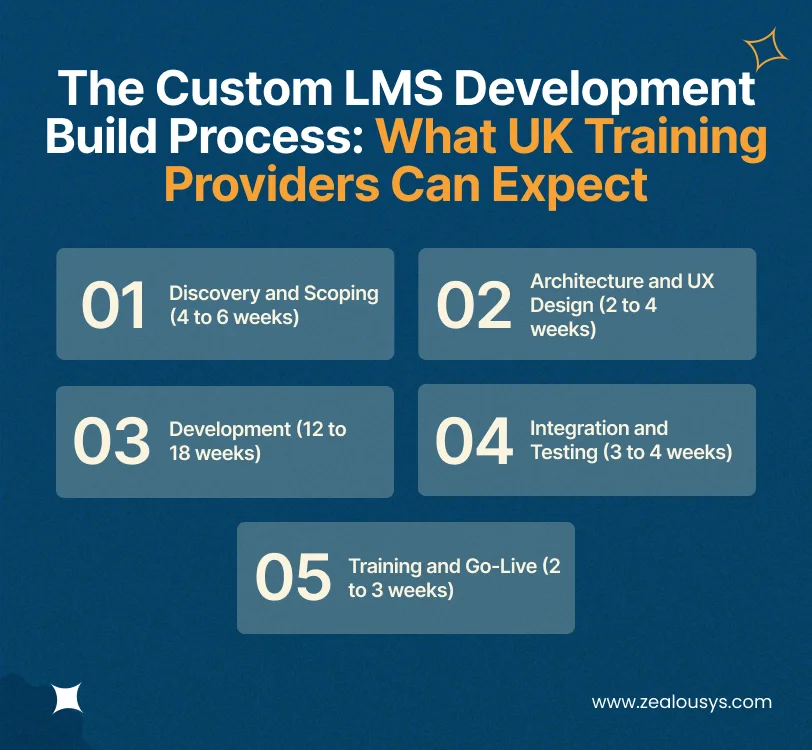
Commissioning a custom learning management system is a structured process. Understanding each phase helps you plan your timeline, secure the right internal resource, and set realistic expectations with your board and senior team before the project begins.
Your development partner works with your training managers, compliance leads, and IT team to document every workflow, learner journey, compliance requirement, integration need, and reporting structure. The output is a detailed technical specification that defines exactly what your custom LMS will do, how it will handle UK-specific compliance, and how it will connect with your existing systems.
This is the most important phase of the entire project. Providers who rush discovery almost always end up with a platform that solves yesterday’s problems rather than building the operational capability they actually need.
The technical architecture is designed, covering database structure, API layer, hosting environment, and integration points. UX wireframes are produced for every user type: learner, trainer, employer contact, administrator, and compliance manager. Good UX design at this stage directly determines whether your trainers and learners adopt the system or find workarounds.
Development runs in two-week sprints. You receive working software at the end of each sprint, not a finished platform at the end of 18 weeks. Regular sprint reviews let your team test real functionality and redirect development if priorities change. For UK training providers, this phase typically covers the learner management and content delivery layer first, then compliance and reporting features, then integrations.
All LMS integrations are connected and tested in this phase. This covers ESFA reporting feeds, awarding body portals, HR system connections, and any employer-facing APIs. User acceptance testing runs with your actual trainers, administrators, and a sample learner group using real content and real learner data.
Your team is trained on the new platform, learner and course data is migrated from your existing system, and the platform goes live. Most projects include a hypercare period of 4 to 6 weeks post-launch where the development team is on standby for rapid fixes and operational questions.
Total timeline: A focused custom LMS covering core learner management, ESFA compliance, and content delivery typically takes 16 to 20 weeks. A full-featured platform with multi-employer portals, AI analytics, awarding body integrations, and a mobile app typically takes 28 to 36 weeks.
Timeline and cost depend entirely on your features and requirements. A provider needing basic compliance tracking and content delivery will reach go-live significantly faster and at lower cost than a provider needing multi-employer portals, AI-driven learner analytics, and full awarding body integration. Always discuss your specific scope with your development partner before fixing any budget or deadline.
These are the mistakes that most frequently result in UK training providers finding themselves locked into a platform that does not serve their needs, at a cost that does not justify what they receive.
Every LMS looks impressive in a vendor demo. The questions to ask are not “can it do this” but “how does it do this when our data volumes, compliance requirements, and workflow complexity are in play.”
The people who will use the system daily, trainers managing learner portfolios and compliance managers producing ESFA evidence, are the best judges of whether a platform actually works. Selecting without their input leads to poor adoption.
Moving learner records, completion histories, assessment evidence, and course content from one LMS to another is rarely straightforward. Build LMS migration time and budget into your plan before you commit to any new platform.
SCORM support varies significantly between platforms and content versions. A platform that claims SCORM support may handle SCORM 1.2 content from one authoring tool but fail with SCORM 2004 content from another. Test your actual content in any platform before signing a contract.
xAPI is the only standards-based way to record the full range of off-the-job learning activities that ESFA requires apprenticeship providers to evidence. If your LMS does not support xAPI properly, you are creating a manual compliance burden.
An LMS that costs £3 per learner per month at 100 learners costs £18,000 per year at 500 learners. Build your LMS cost model around where you expect to be in three years, not where you are today.
Ask any vendor to demonstrate specifically how their platform produces the learner progress evidence that Ofsted inspectors request. If the answer involves data exports and manual consolidation, that is the answer you will live with through every inspection.
If a platform does not currently have a feature you need for ESFA or Ofsted compliance, a roadmap commitment is not a compliance answer. You need the feature, not a promise of the feature.
The true cost of an inadequate LMS is not just the subscription fee. It is the staff hours spent on manual reporting, the separate tools purchased to fill feature gaps, the consultant time before inspections, and the opportunity cost of a compliance team doing data administration instead of quality improvement.
A vendor whose entire customer base is US corporate training departments does not understand ESFA funding rules, Ofsted inspection frameworks, awarding body workflows, or apprenticeship compliance. Their support team will not understand your compliance questions and their product roadmap will not prioritise UK regulatory requirements.
Your learner records are among the most valuable and legally sensitive assets your organisation holds. Before signing any LMS contract, confirm in writing exactly what data you can export, in what format, and what happens to your data if you terminate the contract.
Some providers attempt to solve Moodle’s limitations by commissioning extensive customisation on top of core Moodle. This approach typically creates a fragile system that breaks during Moodle updates, accumulates technical debt rapidly, and ends up costing more than a purpose-built custom platform would have done from the start.
A UK independent training provider delivering apprenticeships in healthcare, business administration, and IT at levels 2 to 4. The organisation has 380 active apprentices across 45 employer partners and a team of 18 trainers and assessors. Ofsted graded them Good at their most recent inspection but the inspection report noted weaknesses in learner progress monitoring and the inconsistency of digital learning delivery across programmes.
The provider was running Moodle for content delivery, a separate spreadsheet system for off-the-job training tracking, a third platform for portfolio evidence management, and manual Excel exports for employer progress reports. Each trainer was managing data across three systems. Producing the evidence bundle for their Ofsted inspection had taken their quality manager six working days of manual data consolidation.
The per-learner cost of their current technology stack had reached £11.40 per learner per month across all three tools. At 380 learners, that was £51,984 per year for a set of systems that did not communicate with each other and created significant compliance risk.
After a formal evaluation, the provider commissioned a custom LMS. The specification included: unified learner management with ESFA-compliant evidence generation, integrated off-the-job training tracking with automated percentage calculations per apprentice, employer portal with real-time progress visibility and three-way review scheduling, Ofsted-ready progress dashboard, awarding body integration with their primary awarding organisations, and a mobile learner app for workplace-based learners.
Development took 28 weeks. The platform went live at the start of the new funding year. Within three months, every trainer was managing all learner activity from a single interface. Off-the-job tracking compliance moved from a manual monthly process to an automated real-time calculation. Employer partners logged into their dedicated portal to view learner progress without requiring trainer involvement for routine updates.
When their monitoring visit arrived, the quality manager produced the full evidence bundle in four hours rather than six days. The annual technology cost reduced from £51,984 to £13,200 in maintenance and feature development. The saving in the first full year after go-live covered 35% of the development investment.
This case is a fictional composite based on common patterns seen in UK apprenticeship and vocational training providers. Your outcomes will vary based on your specific requirements and the quality of your development partner.
Custom LMS development is the process of building a learning management system from the ground up, designed specifically for your organisation’s workflows, learner groups, compliance requirements, and integrations. Unlike off-the-shelf platforms, a custom LMS is not a configured version of an existing product. It is software built around how your training operation actually works.
Custom LMS development in the UK typically costs between £40,000 and £120,000 for an initial build, depending on the features required, the number of integrations, and the complexity of the learner and employer portal structure. Annual maintenance typically ranges from £8,000 to £15,000. Cost depends entirely on your scope: a focused compliance and learner management platform sits at the lower end, while a full-featured platform with AI analytics, multi-employer portals, and awarding body integrations sits higher.
A focused custom LMS covering core learner management, ESFA compliance, and content delivery typically takes 16 to 20 weeks to build. A full-featured platform with multi-employer portals, AI-driven analytics, LMS mobile app, and awarding body integrations typically takes 28 to 36 weeks. Timeline and cost depend entirely on your features and requirements.
Off-the-shelf platforms are built for global markets and do not natively handle UK-specific requirements including ESFA funding evidence, off-the-job training tracking, Ofsted inspection reporting, or awarding body portal integration. These gaps create manual workarounds that cost staff time, introduce compliance risk, and add operational overhead that compounds as learner volumes grow.
SCORM is the traditional e-learning content standard that records completion, time spent, and quiz scores. xAPI is the modern standard that records a much broader range of learning experiences including workplace activities, offline learning, and social learning. For UK apprenticeship providers, xAPI is particularly valuable because it can evidence off-the-job training activities in a way that SCORM cannot.
Yes. Any LMS processing learner personal data in the UK must comply with UK GDPR. This covers how learner data is collected, stored, processed, and deleted. It also governs data subject access requests, the lawful basis for processing, and data retention periods. Your LMS must be built or configured to support these requirements, and your provider should be able to supply a Data Processing Agreement.
An Ofsted-ready LMS is one that can produce the evidence Ofsted inspectors request without manual data consolidation. This includes learner attendance and engagement records, individual learning plan progress, assessment and feedback documentation, achievement and outcome data by programme and cohort, and evidence of the quality of curriculum intent, implementation, and impact. Most off-the-shelf platforms require manual report building to produce this evidence. A custom LMS can be built to generate it automatically.
Yes. Custom LMS development allows direct API integration with awarding body portals including those run by City and Guilds, NCFE, BTEC, IMI, and others. This eliminates the manual learner registration and certification processes that providers running off-the-shelf platforms typically manage outside their LMS.
LTI (Learning Tools Interoperability) is the standard that allows your LMS to connect with external tools such as Microsoft Teams for Education, assessment platforms, video conferencing tools, and third-party content libraries. LTI 1.3 is the current version and supports grade passback, deep linking, and richer tool integration. Whether you need LTI depends on what external tools your organisation uses and whether you want learners to access them from within the LMS without separate logins.
Off-the-job training tracking requires your LMS to record learning activities that happen outside the formal e-learning environment, including workplace observations, shadowing, workshops, projects, and industry visits. xAPI is the standards-based approach to recording these activities. A custom LMS can be built with a dedicated OTJ tracker that records activity type, duration, date, and trainer sign-off, calculates the percentage of programme time against the ESFA minimum requirement, and produces the evidence export your compliance team needs.
Look for a development partner with specific experience building LMS platforms for UK training providers, not just general web application development services. They should understand ESFA funding rules, Ofsted inspection frameworks, SCORM and xAPI standards, and awarding body integration requirements. Ask to see case studies from UK training organisations and speak to references before committing to a development engagement.
Moodle can work for some UK providers but it carries significant operational overhead and compliance gaps for regulated apprenticeship delivery. Core Moodle has no native ESFA compliance reporting, no off-the-job training tracking, and limited xAPI support. Running Moodle for apprenticeship delivery typically requires commercial plugins, dedicated technical resource, and manual processes alongside the platform. For providers at scale or facing Ofsted scrutiny on their digital delivery, the total cost of running Moodle often exceeds what a custom platform would cost.
Yes. Data migration from an existing LMS to a custom platform is part of the build process. The complexity depends on the format in which your current platform exports data, the volume of learner records, and whether historical completion and assessment evidence needs to be preserved. Your development partner should include a data migration plan and testing phase as part of the project specification.
Custom LMS development for UK training providers is not the right answer for every organisation. For smaller providers with simple delivery models and manageable learner volumes, an off-the-shelf platform is a reasonable and cost-effective starting point.
But for mid-size and growing providers delivering regulated apprenticeships, managing multiple employer contracts, preparing for Ofsted inspection, or finding that their current platform is generating more manual work than it eliminates, the case for custom development is strong and increasingly cost-justified.
The UK training sector is not a generic global market. Its compliance requirements are specific, regularly updated, and consequential. An LMS that was not built for that context will always require workarounds, and workarounds cost money, staff time, and in the worst case, compliance outcomes.
The providers that are investing in custom LMS development services in 2026 are not doing so because they want bespoke software for its own sake. They are doing so because they have calculated that the cost of continuing to adapt their operation to a platform that does not fit is higher than the cost of building a platform that does.
Our team is always eager to know what you are looking for. Drop them a Hi!

Pranjal Mehta is the Managing Director of Zealous System, a leading software solutions provider. Having 10+ years of experience and clientele across the globe, he is always curious to stay ahead in the market by inculcating latest technologies and trends in Zealous.


Comments