
If you have started collecting quotes, you already know the frustrating part. The eCommerce app development cost in Australia can sit anywhere between AUD $40,000 and $250,000+, and the same project outsourced to India often lands between AUD $15,000 and $80,000. The gap runs 50-70% for what looks, on paper, like identical work.
So which number is right for your business? And is the cheaper option actually cheaper once you account for everything?
This guide walks through real 2026 rates, what drives them, and where the hidden costs sit on both sides. By the end, you will know exactly which route fits your budget and your risk appetite.
Here is the short version before we go deeper.
| Project Tier | Typical Scope | Australia (AUD) | India (AUD) |
|---|---|---|---|
| Basic MVP | Product catalogue, cart, single payment gateway, order tracking | $40,000 – $80,000 | $15,000 – $30,000 |
| Mid-complexity | Multiple payment options, push notifications, admin dashboard, analytics, Shopify or ERP integration | $80,000 – $150,000 | $30,000 – $60,000 |
| Advanced/ Enterprise | AI recommendations, multi-vendor marketplace, loyalty programs, deep CRM/ERP integrations | $150,000 – $250,000+ | $60,000 – $120,000 |
The gap comes down almost entirely to hourly rates:
| Role | Australia (AUD/hr) | India (AUD/hr) |
|---|---|---|
| Developer (Mid to Senior) | $100 – $200 | $25 – $60 |
| UI/UX Designer | $90 – $160 | $20 – $50 |
| QA Engineer | $80 – $140 | $18 – $45 |
| Project Manager | $110 – $180 | $30 – $60 |
The developers on both sides work with the same frameworks and ship to the same app stores. What changes is the cost of living behind the invoice.
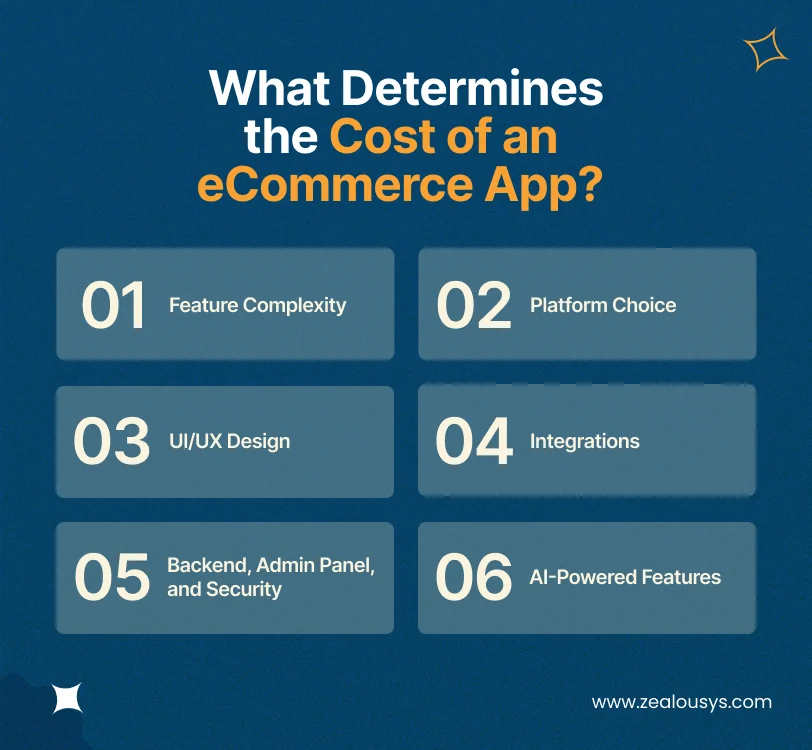
How much does it cost to develop a shopping app? Location changes the rate, scope changes the hours, and your final bill is the product of both. It helps to know which decisions move the number most.
A catalogue, cart, and checkout form the baseline of every shopping app. Add wishlists, reviews, coupons, multi-vendor support, or returns management, and each feature stacks development and testing hours on top. This is the single biggest lever on your budget, and here is roughly how individual eCommerce mobile app features and costs stack up in both markets:
| Feature | Australia (AUD) | India (AUD) |
|---|---|---|
| Cart and Multi-Step Checkout | $5,000 – $15,000 | $2,000 – $5,500 |
| Product Catalogue and Inventory Management | $6,000 – $10,000 | $2,200 – $3,500 |
| Payment Gateway Integration (Per Gateway) | $3,000 – $6,000 | $1,000 – $2,200 |
| Push Notifications | $2,500 – $5,000 | $900 – $1,800 |
| AI Recommendations Engine | $8,000 – $15,000 | $3,000 – $5,500 |
| Loyalty and Rewards Module | $7,000 – $10,000 | $2,500 – $4,000 |
| Admin Dashboard | $8,000 – $14,000 | $3,000 – $5,000 |
Building separate native apps for iOS and Android means maintaining two codebases. Cross-platform frameworks like Flutter and React Native cut costs by 30-40% by shipping both from one codebase, and in 2026, the performance gap with native has narrowed enough that most retail apps have no technical reason to build twice.
Design directly affects conversion, so it is a poor place to cut corners. Custom design work, prototyping, and user testing typically absorb 10-20% of the total project cost. Template-based design costs less upfront but rarely holds up for a brand trying to stand out.
Payment gateways such as Afterpay, Zip, Stripe, and PayPal, shipping APIs like Australia Post, and inventory or ERP connections each add build and testing effort. Australian buyers expect local payment options at checkout, so budget for at least two or three gateways from day one. If your store already runs on Shopify or WooCommerce, the Shopify app development route, where your app sits on top of the existing store backend, cuts both cost and timeline significantly.
The admin panel where your team manages products, orders, and returns is a project of its own. On top of that sit PCI compliance for payments and the Australian Privacy Principles for customer data. From 10 December 2026, new Privacy Act transparency rules also require apps using automated or AI-driven decision-making to disclose it in their privacy policy, which adds a compliance line item for many builds.
Product recommendations, smart search, and chatbots have shifted from nice-to-have to expected. They raise the initial cost but also raise average order value, which is why mid-tier and enterprise builds now include them by default. The returns are measurable: one 180-store omnichannel retailer that added AI demand forecasting and a recommendation engine lifted forecast accuracy from 61% to 79% and improved marketing ROI by 31% on the same budget.
Australian agencies calculate eCommerce app development cost the way everyone does: total development hours multiplied by an hourly rate. The hours are similar worldwide. The rate is where Australia sits near the top globally. Expect AUD $100 to $200 per hour for developers, with senior teams in Sydney and Melbourne at the upper end of that band and specialist consultants reaching $250. Brisbane, Adelaide, and Perth typically run slightly below the Sydney-Melbourne benchmark.
These bands mirror the broader mobile app development cost in Australia for 2026, so eCommerce projects carry no special premium; the complexity does the pricing.
A catalogue, cart, single payment gateway, and order tracking. Lean builds with tight scope can start near the bottom of this band, but eCommerce-specific requirements like payment compliance push most projects toward the middle.
A fashion retailer’s app with Shopify integration, Afterpay and PayPal checkout, push notifications, and an admin dashboard sits squarely in this band. This is where most established Australian SMEs land.
Multi-vendor logic, AI features, or deep ERP integration. Complex AI-heavy builds can go well past this range.
Part of what you pay for is proximity: face-to-face workshops, same-time-zone collaboration, working knowledge of Australian payment behaviour and consumer law, and straightforward legal recourse under Australian contracts. One practical note: under Australian law, source code ownership does not automatically transfer to you. It must be stated in the contract, so ask to see that clause regardless of who you hire. Eligible projects can also claim the R&D Tax Incentive, which returns up to 43.5% of qualifying development spend and softens the local premium for genuinely novel work.
Choose an Australian team when your project carries heavy compliance requirements, needs intensive in-person stakeholder workshops, or sits above AUD $200,000 where communication risk can outweigh labour savings. It is also the safer route if you have no internal capacity to manage a remote vendor at all.
India remains the most common outsourcing destination for Australian businesses, and the numbers explain why. Developer rates run the equivalent of AUD $25 to $60 per hour depending on seniority, roughly a quarter of local rates for comparable skills. A senior developer salary in Ahmedabad or Pune supports a comfortable standard of living at a fraction of Sydney levels, and the billing rate follows.
The same catalogue-cart-checkout scope that costs $40,000+ locally. For founders validating an idea, a focused MVP build at this price leaves budget for marketing and iteration.
Multiple gateways, push notifications, admin dashboard, and analytics. Comparable Western-market builds regularly run two to three times this figure.
Even with multi-vendor logic, AI recommendations, loyalty engines, and ERP integration, this tier still comes in below the price of a mid-tier build in Sydney.
You agree on scope, budget, and timeline upfront, with milestone-based payments along the way. Best for well-defined projects with stable requirements. Avoid it if your scope is likely to change often, because every change becomes a paid variation.
You hire eCommerce app developers in India monthly through an offshore development centre, effectively an extension of your own staff. Per-hour cost works out lower than project pricing, the team builds deep product knowledge over time, and you can scale roles up or down. This is the model most Australian businesses use for long-term builds.
You pay for hours worked, with transparent cost tracking. The right fit when the scope is still taking shape and you want flexibility and control, but it demands active involvement from your side. Avoid it if you need a locked budget.
Around 20 screens, Shopify backend, Afterpay and PayPal checkout, push notifications.
Vendor portal, commission logic, reviews, AI-based search, admin analytics.
For a bootstrapped retailer, that difference funds the launch marketing, the first big inventory order, or the second product line.
Choose an Indian team when your budget sits under AUD $150,000, your requirements can be documented clearly, and you (or one person on your team) can join a regular demo call. That covers the vast majority of SME and startup eCommerce builds.
The build quote is never the full picture, wherever you build. Budget for these before you sign anything.
Plan for 15-25% of your initial build cost every year. That covers bug fixes, OS updates, security patches, and small feature improvements through an ongoing maintenance agreement. An AUD $60,000 app carries roughly AUD $9,000 – $15,000 in annual upkeep.
Apple and Google charge developer account fees, and both take a commission of up to 30% on in-app purchases. Standard eCommerce sales of physical goods are exempt from the commission, but digital products and subscriptions are not.
Payment gateways, analytics tools, push notification services, hosting, and crash reporting all bill monthly. Individually small, collectively a real line item.
Every “can we just add” after the scope is locked costs money. Fixed-price contracts make this explicit; hourly contracts hide it in the invoice. A 20-25% contingency buffer on your total budget is the honest way to plan.
This is the cost people fear most with outsourcing, and it is worth naming honestly. Unclear requirements plus distance can produce rework, and rework erodes savings fast. The fix is a process: written specifications, a regular demo cadence, and milestone-based payments.
Here is the part that surprises most Australian founders: the time zone is barely a problem. India sits only 4.5 to 5.5 hours behind AEST, depending on daylight saving. Your morning overlaps with their late morning and afternoon, giving you half a working day of live collaboration. Compare that with outsourcing to Eastern Europe or Latin America, where overlap with Australian hours shrinks to almost nothing.
The vendor matters more than the vendor’s postcode. A disciplined Indian team will outperform a sloppy local one, and vice versa. Here is what actually separates a safe choice from an expensive mistake.
Ask for live shopping apps they have shipped, then download and use them. Test the checkout flow specifically, since that is where most eCommerce apps fail. Teams with Australian clients already understand Afterpay, Australia Post APIs, and GST handling, which saves weeks of onboarding.
The contract must explicitly assign source code and intellectual property to you on payment. This is not automatic in Australia or India. Sign an NDA before sharing business plans, ideally before the first detailed discussion, and confirm the vendor’s own staff are under confidentiality agreements too.
Never pay large sums upfront. A healthy structure is 10-15% to start, with the remainder tied to demonstrated, working deliverables. If a vendor demands 50% before writing a line of code, walk away.
Ask whether an independent code audit is welcome at any milestone. A confident team says yes without hesitation. Also ask about their testing process: automated test coverage, device testing, and load testing before launch should all have concrete answers.
A named project manager, daily progress updates through a shared project management tool, weekly written reports, and a demo every sprint or fortnight are the baseline. Anything less deserves questions. Ask to meet the actual project manager before signing, not just the sales lead.
Confirm what the maintenance agreement covers, its monthly or annual cost, and guaranteed response times for critical bugs. Get this in writing before launch, not after, when your negotiating position is weaker. A proper handover should also include knowledge transfer and documentation, so you are never locked in.
A ten-minute phone call with a past client tells you more than any proposal document. Ask the reference two questions: what went wrong during the project, and how did the vendor handle it? Every project hits problems; what matters is the response.
This movement has been building for over a decade, and four forces keep pushing it forward:
Demand for skilled developers in AI, modern frontend frameworks, and commerce platforms keeps outpacing local supply. Industry salary data shows Australia’s pool of senior contract engineers is a fraction of the size of Europe’s or India’s, which keeps local rates firm even as remote work expands the talent map.
Many businesses now run a hybrid model: an Australian product owner or tech lead setting direction, with a dedicated offshore team doing the build. In any honest offshore app development cost comparison, that structure saves 40-70% while keeping strategy and accountability onshore.
India’s development sector has spent two decades serving American, British, and Australian clients. An established eCommerce app development company in India arrives with structured QA practices, English-first communication, and direct experience with the payment gateways Australian retailers actually use. Lower rates reflect lower living costs, not lower standards.
For an SME with AUD $50,000, the practical difference is stark:
With mobile commerce now accounting for more than half of online retail transactions, getting to market with a complete product rather than a stripped-back one is often the deciding factor.
The eCommerce app development cost in Australia for a basic app with a product catalogue, cart, and single payment gateway is typically AUD $40,000 to $80,000 with a local agency. The same scope built by an Indian development team usually falls between AUD $15,000 and $30,000.
Yes, typically by 50-70% for the same scope. Indian developer rates run the equivalent of AUD $25-60 per hour versus AUD $100-200 locally. The savings hold as long as you choose a vetted partner and manage the project with clear specifications and milestones.
In 2026, Australian developers charge roughly AUD $100-200 per hour, with blended agency rates of AUD $110-175. Indian developers charge the equivalent of roughly AUD $25-60 per hour depending on seniority and specialisation.
A basic MVP takes around 3-4 months. Mid-complexity apps run 4-7 months, and enterprise or marketplace builds can take 8-12 months. Timelines are similar in both countries; the difference is cost, not speed.
Whoever the contract says owns it. Code ownership does not transfer automatically in Australia or India, so insist on a clause that assigns full source code and IP rights to you on payment. Reputable firms include this as standard.
For most projects under AUD $150,000, yes. The savings of 50-70% are real when you vet the partner: check live apps, secure IP transfer in the contract, pay by milestone, and hold a regular demo cadence. The risk sits in vendor selection, not in the country.
The honest answer to “Australia or India?” is that the partner matters more than the map. What you need is a team that combines offshore pricing with the process discipline Australian businesses expect, and that is exactly how we work at Zealous System.
Every engagement starts with an NDA and a contractual IP assignment before you share a single requirement. You choose the model that fits your project: Fixed Price with milestone-based payments, a Dedicated Team, or Time and Material. From there, you get a named project manager, daily progress updates through a shared project management tool, weekly reports, and a working demo every fortnight.
Our eCommerce app development teams work AEST-friendly hours backed by our local Australian presence in Victoria, use AI-assisted workflows to cut delivery time, and have shipped commerce apps with the integrations Australian retailers rely on, from Afterpay and Zip to Shopify and Australia Post.
If you are weighing quotes right now, the fastest way to a real number is a short conversation. Share your feature list with us, and we will walk you through a line-by-line cost estimate for your eCommerce app, with no commitment attached. Book a quick call whenever suits you.
Our team is always eager to know what you are looking for. Drop them a Hi!

Raj Kewlani is a Project Manager and Mobile & Open Source Development Lead at Zealous System, specializing in agile-driven digital solutions. He focuses on delivering high-quality mobile apps and open-source projects that align with business goals.


Comments