The pharmaceutical industry operates in a highly regulated and competitive environment where accuracy, compliance, quality control, and operational efficiency directly impact business success. Managing manufacturing, inventory, procurement, batch tracking, compliance reporting, and supply chain operations manually often creates delays, compliance risks, and operational inefficiencies.
ERP software for the pharmaceutical industry helps businesses centralize operations, automate workflows, improve compliance management, and gain real-time visibility across departments. From pharmaceutical manufacturing and inventory management to quality assurance and distribution, modern pharmaceutical ERP systems streamline every critical business process from a single platform.
Today, pharmaceutical companies use ERP solutions to improve batch traceability, maintain FDA and GMP compliance, reduce inventory wastage, optimize production planning, and improve supply chain visibility. With AI-driven analytics and automation becoming more important, pharmaceutical ERP software also helps businesses make faster and smarter decisions.
ERP software for the pharmaceutical industry is a centralized business management system that helps pharma companies manage manufacturing, inventory, procurement, compliance, finance, quality control, warehouse operations, and supply chain processes from a single platform.
Unlike traditional ERP systems, pharmaceutical ERP software includes industry-specific functionalities such as:
These features help pharmaceutical companies maintain product quality, regulatory compliance, and operational transparency throughout the manufacturing and distribution lifecycle.
Modern pharmaceutical ERP systems also integrate with:
This integration improves operational efficiency and enables data-driven decision-making across the organization.
Pharmaceutical businesses manage highly complex operations that involve strict regulations, sensitive inventory, and detailed manufacturing processes. Manual systems and disconnected software often create inefficiencies, compliance risks, and limited visibility across operations.
Pharmaceutical ERP software helps businesses:
As pharmaceutical businesses scale, ERP systems become essential for maintaining operational consistency and improving business performance.
Pharmaceutical ERP systems help businesses comply with FDA, GMP, and industry regulations by maintaining accurate records, audit trails, compliance reports, and quality documentation.
This reduces compliance risks and simplifies audit preparation.
Inventory mismanagement can lead to expired stock, shortages, and financial losses.
ERP software improves:
This helps pharmaceutical companies reduce wastage and improve inventory accuracy.
Batch traceability is critical in pharmaceutical manufacturing.
ERP systems allow businesses to:
This improves operational transparency and product safety.
ERP software automates pharmaceutical manufacturing workflows, production planning, procurement, and resource management.
This helps businesses:
Pharmaceutical ERP systems support quality assurance processes through:
This helps businesses maintain high product standards and regulatory compliance.
Modern pharmaceutical ERP software provides real-time visibility across the supply chain.
Businesses can:
This leads to faster and more reliable operations.
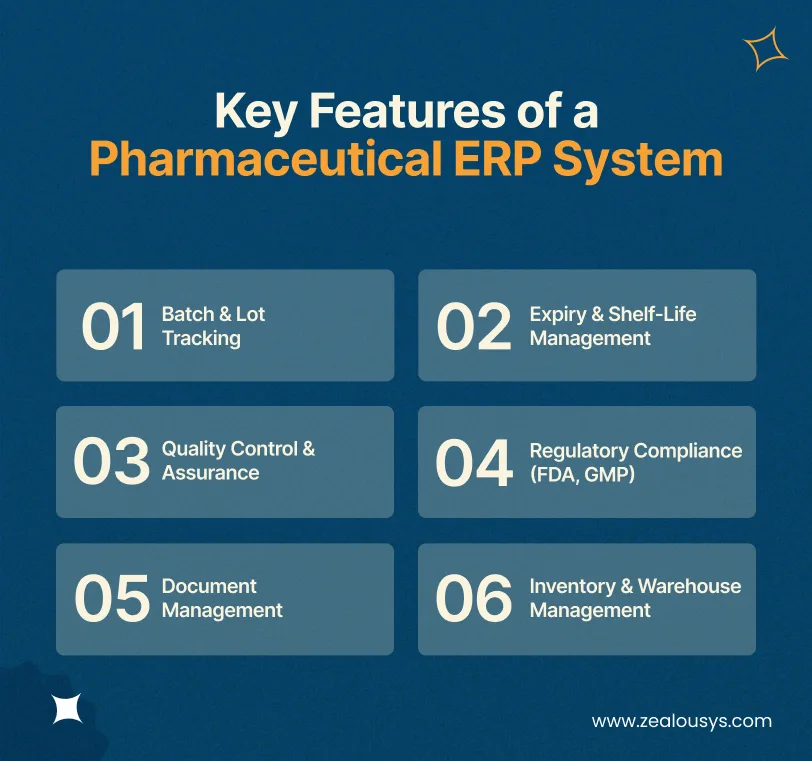
Successful pharmaceutical ERP software should include industry-specific features designed for compliance, manufacturing, inventory management, and operational efficiency.
A pharma ERP software tracks every batch and lot in real time. It records raw materials, production details, and distribution data for each product. This feature helps pharmaceutical business owners and production managers trace products quickly in case of issues or recalls. It also improves transparency and builds trust with regulators and customers.
An ERP for drug manufacturing monitors product expiry dates and shelf life automatically. It alerts teams before products expire and helps them manage stock effectively. Supply chain and inventory managers use this feature to reduce waste and ensure product safety. This capability plays a key role in maintaining quality and compliance.
A reliable pharma software solution includes built-in quality control processes. It tracks quality checks at every stage, from raw materials to finished goods. Production and quality assurance managers use this feature to maintain consistent product standards. It also helps companies reduce errors and meet strict industry requirements.
A pharmaceutical ERP software helps companies follow regulations such as FDA and GMP guidelines. It records every process and maintains audit-ready data. Regulatory and compliance officers rely on this feature to ensure the company meets all legal requirements. This is one of the key benefits of ERP in the pharmaceutical industry, as it reduces compliance risks and simplifies audits.
An ERP system for pharmaceutical companies stores and manages all critical documents in one place. It organizes SOPs, batch records, compliance documents, and reports securely. Teams can access updated documents easily, which improves collaboration and reduces manual work. This feature also supports compliance by maintaining accurate and consistent records.
A pharmaceutical manufacturing ERP provides real-time visibility into inventory and warehouse operations. It tracks stock levels, manages storage conditions, and automates replenishment. Supply chain managers use this feature to optimize inventory and avoid shortages or overstocking. When companies combine this with pharma ERP integration with LIMS and MES, they gain complete control over production and supply chain processes.
Pharmaceutical ERP software helps businesses streamline manufacturing, compliance, inventory, quality control, and supply chain operations from a centralized platform. Modern pharma ERP systems support multiple business functions that improve operational efficiency, regulatory compliance, and real-time visibility across departments.
Pharmaceutical ERP software helps manufacturers manage production planning, raw material allocation, batch processing, and manufacturing workflows more efficiently. Businesses can automate production schedules, monitor resource utilization, and maintain product consistency throughout the manufacturing lifecycle.
Key benefits include:
Batch traceability is critical in the pharmaceutical industry for maintaining product quality and regulatory compliance. ERP software allows businesses to track products, raw materials, lot numbers, and manufacturing batches in real time.
This helps pharmaceutical companies:
Managing pharmaceutical inventory manually often leads to stock shortages, expired products, and operational inefficiencies. Pharmaceutical ERP software provides real-time inventory visibility and warehouse tracking capabilities.
ERP systems help businesses:
Pharmaceutical businesses must comply with strict regulations such as FDA and GMP standards. ERP software simplifies compliance management by automating quality checks, audit trails, documentation, and reporting processes.
Businesses can:
Pharmaceutical ERP software improve visibility across procurement, supplier management, logistics, and distribution operations. Businesses can monitor supplier performance, manage purchase orders, and reduce supply chain disruptions more effectively.
This improves:
ERP software centralizes pharmaceutical financial operations, including invoicing, budgeting, tax management, procurement costs, and financial reporting.
Businesses benefit from:
Pharmaceutical ERP systems help businesses manage order processing, customer data, invoicing, and product distribution efficiently. This ensures faster deliveries and better customer satisfaction.
Key advantages include:
Modern pharmaceutical ERP software uses AI-powered analytics to improve forecasting, inventory planning, and operational decision-making.
AI capabilities help businesses:
Pharmaceutical businesses handle large volumes of compliance and operational documents daily. ERP software centralize document management and simplify audit preparation.
This helps organizations:
Pharmaceutical companies rely on ERP for pharma companies to connect multiple systems and manage complex operations efficiently. Integration helps teams improve data accuracy, reduce manual work, and support compliance. Modern pharma software solutions use ERP integration to create a smooth and connected workflow across departments.
Pharmaceutical manufacturing ERP software integrate with LIMS to manage lab data and quality processes efficiently. This integration allows teams to record test results directly in the ERP system and maintain compliance. It also improves traceability and supports faster decision-making for quality assurance teams.
ERP implementation in the pharma industry becomes stronger when companies integrate ERP with MES. This connection helps production teams track manufacturing activities in real time and maintain batch consistency. It also improves planning, reduces errors, and ensures compliance with industry standards.
ERP for drug manufacturing integrates with CRM and supply chain systems to improve order management and inventory control. This integration helps supply chain and inventory managers track demand, manage stock, and ensure timely deliveries. It also enhances customer satisfaction through better coordination.
API-based integration makes ERP for pharma companies more flexible and scalable. APIs allow different systems to connect easily and share data in real time. This approach reduces integration complexity and helps businesses adapt quickly, making it essential for the best ERP software for pharmaceutical companies.
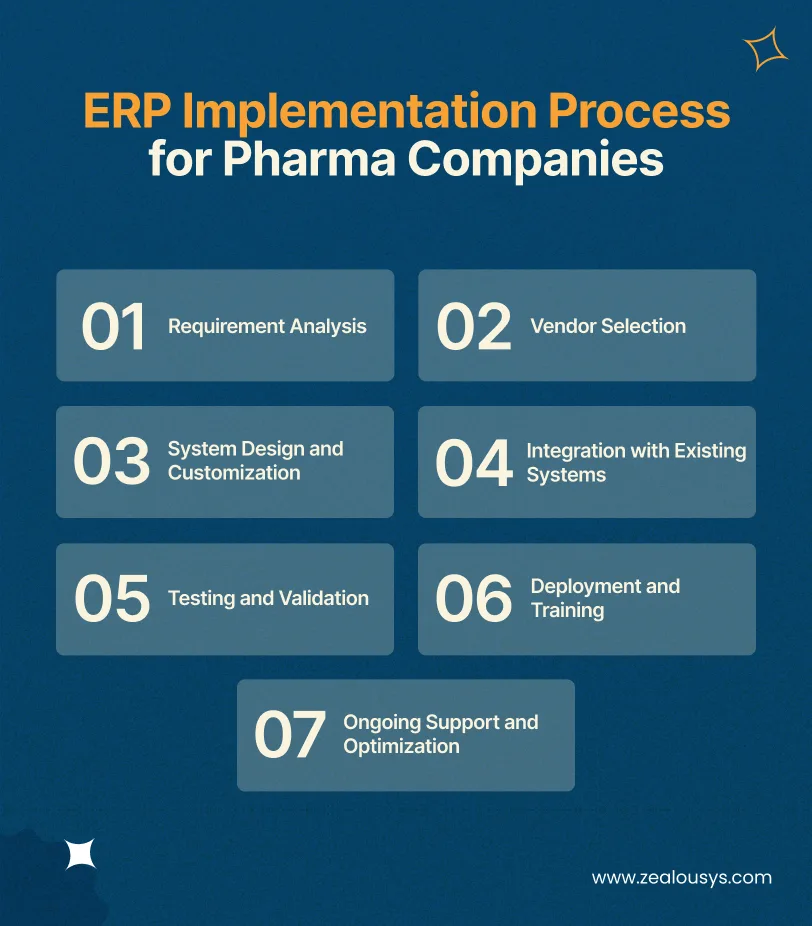
Implementing an ERP system for pharmaceutical companies requires a structured and well-planned approach. Each step plays a critical role in ensuring compliance, efficiency, and long-term success. Here’s how pharma companies can successfully implement a pharmaceutical manufacturing ERP system:
You start by identifying your business goals and operational challenges. You evaluate your current processes in production, quality control, inventory, and compliance. You involve key stakeholders such as production managers, compliance officers, and IT teams to gather accurate requirements.
You define clear expectations for your ERP for pharma companies, including regulatory needs and reporting standards. This step helps you understand the benefits of ERP in the pharmaceutical industry and align the system with your business objectives.
You research and shortlist vendors that offer specialized pharma software solutions. You compare their industry experience, features, and compliance capabilities. You check if the vendor provides a reliable ERP system for pharmaceutical companies with support for GMP and regulatory standards.
You review case studies and client feedback to ensure credibility. You choose a vendor that understands ERP implementation in the pharma industry and can deliver long-term value.
You design the ERP system based on your specific workflows and compliance needs. You customize features such as batch tracking, quality control, and reporting. You ensure the system supports key features of pharmaceutical ERP software, including audit trails and document management. You adapt the system to fit your production processes instead of forcing your team to change workflows. This approach improves user adoption and system efficiency.
You connect your ERP with existing platforms like LIMS, MES, CRM, and supply chain systems. You enable seamless pharma ERP integration with LIMS and MES to ensure real-time data flow. You eliminate data silos and improve visibility across departments. You use API-based integration to improve flexibility and scalability. This step strengthens your overall ERP for drug manufacturing ecosystem.
You test the ERP system thoroughly before going live. You validate all processes to ensure compliance with industry regulations. You check data accuracy, system performance, and workflow functionality. You involve quality assurance teams to confirm that the system meets regulatory standards. This step ensures that your pharmaceutical manufacturing ERP system works reliably in real-world conditions.
You deploy the ERP system in a controlled and phased manner. You train employees across departments to use the system effectively. You provide hands-on training for production, quality, and inventory teams. You ensure users understand how to use the system for compliance and reporting. Proper training helps you maximize the value of your ERP for pharma companies and reduces resistance to change.
You monitor system performance after deployment and resolve issues quickly. You update the system regularly to meet changing regulatory requirements. You analyze data to improve processes and decision-making. You optimize workflows to gain maximum efficiency from your ERP system for pharmaceutical companies. Continuous improvement helps you stay competitive and adapt to future trends, including choosing the best ERP software for pharmaceutical companies in 2026.
Implementing an ERP system for pharmaceutical companies can improve operations, but teams often face key challenges during the process. Understanding these issues helps businesses achieve the full benefits of ERP in the pharmaceutical industry.
Many pharma companies use outdated software that store data in different formats. This makes migration to a pharmaceutical manufacturing ERP complex. Teams must clean and transfer data carefully to avoid errors. Proper planning ensures smooth adoption of an ERP for drug manufacturing.
Strict regulations like GMP and FDA make ERP implementation in the pharma industry more challenging. Teams must configure the system to support compliance, audit trails, and documentation. A well-planned ERP for pharma companies helps maintain regulatory standards.
A pharma ERP software solution requires investment in customization, integration, and training. Integration with LIMS and MES can increase costs. However, the right ERP system for pharmaceutical companies delivers long-term ROI and efficiency.
Employees may resist new systems if they lack proper training. Teams must learn how to use modern pharma software solutions effectively. Companies should provide training and support to ensure successful adoption.
The pharmaceutical industry is rapidly adopting advanced digital technologies to improve operational efficiency, regulatory compliance, manufacturing accuracy, and supply chain visibility. Modern pharmaceutical ERP software is evolving beyond traditional business management systems and becoming a smarter, AI-driven platform that supports real-time decision-making and automation.
Future-ready pharmaceutical ERP systems will focus heavily on intelligent automation, predictive analytics, cloud infrastructure, and connected manufacturing ecosystems. These technologies will help pharmaceutical companies reduce operational risks, improve compliance management, optimize inventory planning, and increase overall business agility.
Artificial intelligence is transforming pharmaceutical ERP software by automating repetitive and time-consuming processes across manufacturing, inventory management, compliance reporting, and procurement workflows.
AI-powered ERP systems help businesses:
AI-driven automation also improves faster decision-making through intelligent recommendations and workflow optimization.
Modern pharmaceutical ERP systems use predictive analytics to help businesses forecast demand, identify operational bottlenecks, and improve inventory planning.
Predictive analytics helps pharmaceutical companies:
These insights help organizations make proactive business decisions instead of reacting to operational issues later.
Cloud ERP solutions are becoming increasingly popular because they offer better scalability, flexibility, security, and remote accessibility compared to traditional on-premise systems.
Cloud-based pharmaceutical ERP software enables businesses to:
Cloud ERP also improves collaboration between manufacturing, warehouse, finance, and supply chain teams.
IoT integration is helping pharmaceutical companies monitor manufacturing equipment, warehouse environments, and production processes in real time.
IoT-enabled ERP systems support:
This improves operational visibility and reduces manufacturing disruptions.
Blockchain technology is improving transparency and traceability in pharmaceutical supply chains. Pharmaceutical ERP systems integrated with blockchain can securely track products, batches, and transactions throughout the distribution lifecycle.
Blockchain-based traceability helps businesses:
This technology plays an important role in regulatory compliance and patient safety.
Regulatory compliance remains one of the biggest priorities for pharmaceutical businesses. Future pharmaceutical ERP software will include advanced compliance automation and real-time monitoring capabilities.
Modern ERP systems help organizations:
Advanced compliance monitoring simplifies audits and improves operational accuracy.
Real-time analytics is becoming essential for pharmaceutical companies that want faster and more accurate business insights.
ERP systems with advanced analytics capabilities help businesses:
These insights enable pharmaceutical businesses to respond quickly to market changes and operational challenges.
ERP for pharma companies is essential for staying competitive and compliant. Pharmaceutical business owners, CTOs, and IT managers use pharmaceutical manufacturing ERP systems to streamline operations, improve accuracy, and gain visibility. Production and regulatory teams rely on ERP for drug manufacturing to ensure consistency and compliance. Many businesses also adopt custom ERP software development services to meet specific needs and improve efficiency.
Modern pharma software solutions help supply chain teams manage inventory and track batches effectively. An ERP system for pharmaceutical companies supports smooth workflows and shows how ERP helps pharma companies with compliance. With the right features of pharmaceutical ERP systems and pharma ERP integration with LIMS and MES, businesses improve connectivity and insights. Partnering with a custom healthcare software development company helps build scalable and future-ready systems.
Our team is always eager to know what you are looking for. Drop them a Hi!

Pranjal Mehta is the Managing Director of Zealous System, a leading software solutions provider. Having 10+ years of experience and clientele across the globe, he is always curious to stay ahead in the market by inculcating latest technologies and trends in Zealous.


Comments