Quick Overview
Facility management software development gives South African commercial property groups a way to replace spreadsheets, WhatsApp groups, and paper job cards with one system built around their portfolio. This guide explains how the software works, the challenges it solves for multi-site property operations, which features matter most, whether to build custom or buy off-the-shelf, and what facility management software development in South Africa typically costs, from an MVP at around $10,000 (R185,000) to advanced platforms at $75,000 (R1.4 million) or more.
Managing one commercial building is hard. Managing fifteen of them across three provinces, each with its own generators, lifts, HVAC plants, tenants, and contractors, is a different job entirely.
Most property groups in South Africa still run this job on a patchwork of Excel sheets, email chains, and WhatsApp messages. A tenant logs a leak with the building manager. The building manager phones a plumber. Nobody records the cost against the asset, nobody checks whether that same pipe failed twice last year, and when the auditor asks for compliance certificates, someone spends a week digging through folders.
The tools exist to fix this. The real question for a property group is not whether to use facility management software, but whether to buy a ready-made platform or invest in custom facility management software built around how your portfolio actually operates. This article walks through both paths, with honest numbers.
Facility management software is a central system for planning, tracking, and recording everything involved in keeping buildings running. A facilities management system for commercial property covers maintenance, assets, compliance, contractors, tenants, and costs in one place.
You will see a few overlapping terms in this space:
In practice, the workflow looks like this. A tenant submits a request through a portal or app. The system converts it into a work order, routes it to the right in-house technician or contractor, tracks progress against an SLA, captures photos and costs on completion, and files everything against the asset’s history. Meanwhile, preventive maintenance schedules generate their own work orders automatically, so generators get serviced before month-end load shifts rather than after they fail.
Every action leaves a record. That audit trail is what separates a managed portfolio from a reactive one.
Global FM platforms are built for global problems. South African portfolios carry a few of their own.
Even with the grid more stable than it was at the 2023 peak, commercial buildings in South Africa run their generators and UPS systems far harder than buildings in most other markets. Every switchover cycle adds wear. Diesel needs tracking, run-hours need logging, and service intervals arrive faster than the standard annual schedule assumes.
A missed generator service is not an inconvenience here. It is a tenant on the phone during an outage, asking why the promised backup power failed.
The Occupational Health and Safety Act puts real legal responsibility on whoever controls a building. Certificates of compliance for electrical installations, lift inspection records, fire equipment servicing under SANS 1475, emergency systems under SANS 10400: all of it must be current, and all of it must be producible on demand.
When these records live in filing cabinets and personal inboxes, proving compliance is slow and risky. When they live in a system that flags expiring certificates 60 days out, compliance becomes routine.
A property group with sites in Gauteng, the Western Cape, and KZN cannot manage by walking around. Head office needs portfolio-level visibility: which buildings are overspending on reactive maintenance, which contractors keep missing SLAs, which assets are approaching end of life. Site teams need something simple that works on a phone, sometimes in a basement with no signal.
International SaaS platforms handle the basics well. Where they strain is the local layer: per-user licensing in dollars that becomes painful at 200 field users, no concept of load shedding schedules or diesel reconciliation, compliance modules built for OSHA rather than the OHS Act, and limited appetite to integrate with the property management or accounting systems a group already runs.
You can work around each gap individually. Together, they are usually the reason property groups start asking about custom development.
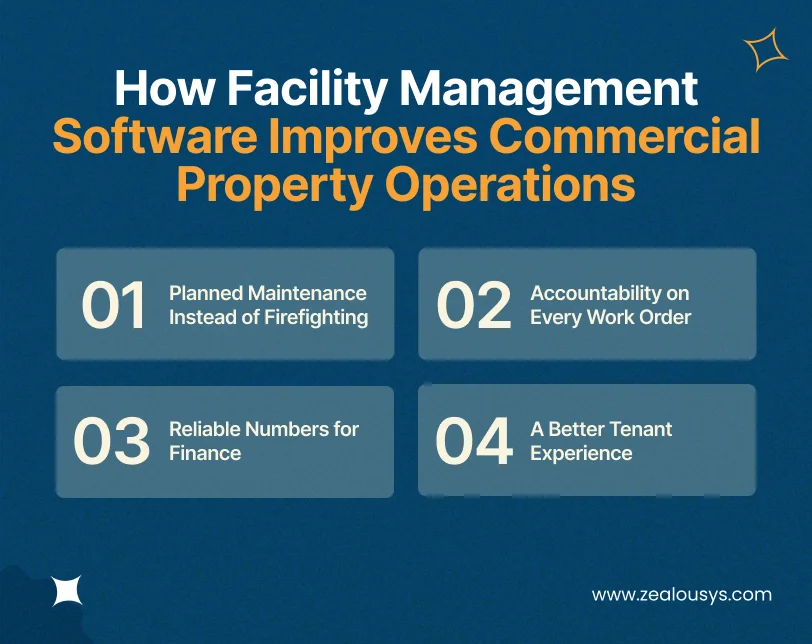
The gains show up in four places, and they compound over time.
Industry experience across FM consistently shows that emergency repairs cost several times more than the same work done on schedule, once you count call-out fees, expedited parts, and tenant disruption. A preventive programme flattens that cost curve and extends the life of expensive plant.
Every request becomes a tracked work order with an owner and a deadline. Nothing disappears into a WhatsApp thread. SLA timers make contractor performance visible, which changes contractor behaviour on its own.
Maintenance cost per square metre, per building, per asset class. Lifecycle cost data that turns “the chiller keeps breaking” into a defensible capex motivation the board can act on.
A portal where tenants can log an issue in two minutes and watch its status beats phoning a building manager who may or may not be on leave. In a soft office market, retention is won on exactly this kind of service detail.
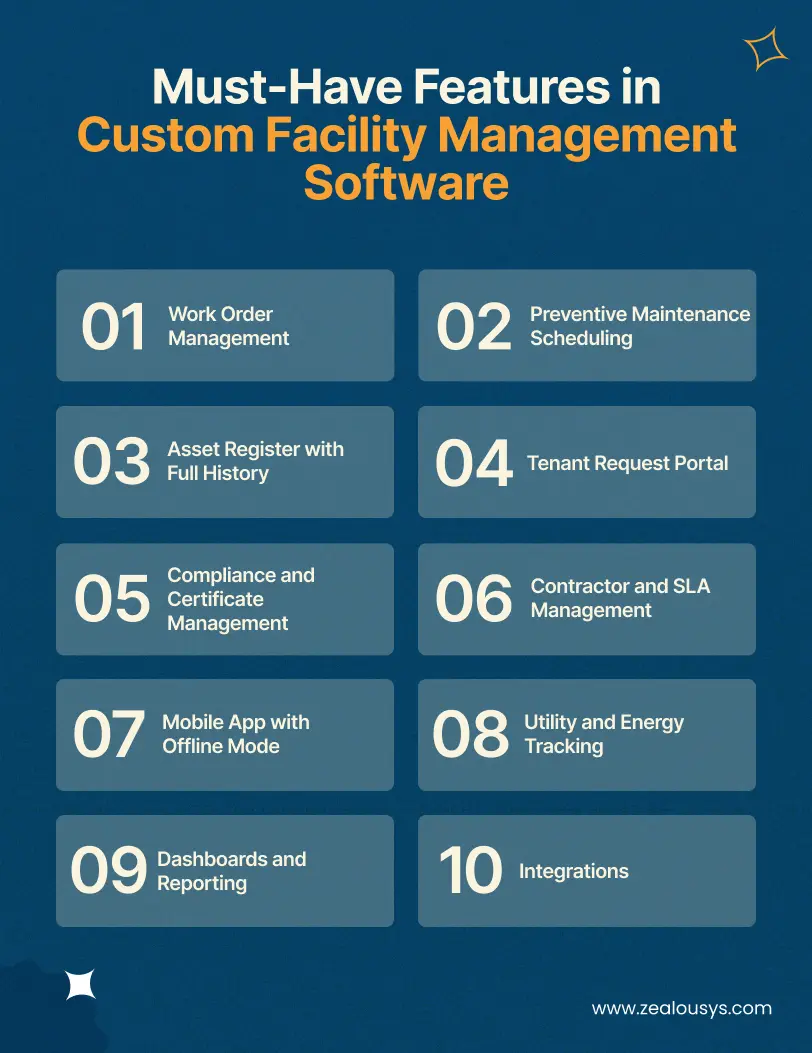
Feature lists can sprawl. For a South African commercial portfolio, these are the ones that earn their place.
A custom build does not need all of this on day one. It needs the right five or six for your operation, done properly, with the rest on a roadmap.
There is no universal answer, and anyone who tells you otherwise is selling one of the two options. Here is the honest comparison.
| Factor | Off-the-Shelf (SaaS) | Custom Development |
|---|---|---|
| Upfront cost | Low | Significant |
| Ongoing cost | Per-user fees, forever, often in USD | Hosting and support, no per-user licensing |
| Time to launch | Days to weeks | Three to six months for a first release |
| Fit to your workflows | You adapt to the software | The software is built around your operation |
| Local compliance (OHS Act, SANS, POPIA) | Generic or absent | Built in from the start |
| Integrations with your existing systems | Limited to what the vendor offers | Whatever your systems need |
| Data ownership | Vendor’s cloud, vendor’s rules | Yours |
| Competitive differentiation | None, competitors use the same tool | A client-facing capability others cannot copy |
You manage a handful of buildings, your workflows are standard, and monthly fees for a small user count are manageable. Speed matters more than fit.
The portfolio is large enough that per-user licensing hurts, your processes genuinely differ from the template, you need deep integration with existing property and finance systems, or FM service delivery is part of what you sell. Outsourced FM providers, in particular, tend to reach this point quickly: a white-labelled client portal is a commercial asset, not just an internal tool.
A useful middle path exists, too. Some groups start on a SaaS product, learn what they actually need, and commission a custom build once the gaps are clear. Nothing about that sequence is wasted.
Cost depends on scope, integrations, and polish, but vague answers help nobody. Based on current market rates for facility management software development in South Africa (rand figures use an indicative exchange rate of around R18.50 to the dollar; check the current rate when budgeting).
| Tier | What You Get | Cost (USD) | Cost (ZAR, approx.) |
|---|---|---|---|
| Basic MVP | Work orders, asset register, preventive maintenance schedules, simple tenant request form, core reports. Web plus a basic mobile experience. | $10,000 – $20,000 | R185,000 – R370,000 |
| Mid-range platform | Everything above, plus a full tenant portal, contractor and SLA management, compliance module with certificate alerts, offline-capable mobile app, dashboards, one or two integrations. | $20,000 – $45,000 | R370,000 – R830,000 |
| Advanced platform | Multi-company architecture for FM providers, energy and utility analytics, IoT sensor inputs, predictive maintenance, BMS and accounting integrations, white-labelling. | $45,000 – $75,000+ | R830,000 – R1.4 million+ |
A working rule across the software industry is 15 to 20 percent of the build cost per year for hosting, support, and improvements. Weigh that against SaaS licensing for your user count over five years, and the comparison often surprises people: at 100-plus users, custom frequently costs less over the asset’s life, and you own the result.
A capable development partner will follow a sequence like this. Knowing the steps helps you hold them to it and helps your own team plan around the milestones.
The partner interviews portfolio managers, site staff, technicians, and finance, and ideally walks a building or two. The goal is to map how work actually flows, not how the org chart says it flows. Expect this to take two to four weeks and to end with a written scope document you can challenge before any code is written. If a partner wants to skip discovery and jump straight to development, treat that as a red flag.
You should see clickable prototypes of the core screens before development starts: the work order queue, the mobile technician view, the tenant portal. Put these in front of an actual building manager and an actual technician, not just head office. Changes cost almost nothing at this stage and a fortune later.
This is where the technical decisions with long-term consequences get made: hosting (local cloud regions help with both POPIA compliance and latency), how integrations will connect, and how the roadmap is phased. Ask the partner to explain these choices in plain language. If they cannot, they may not have thought them through.
Work happens in two-to-three-week cycles, each ending with working software your team can review. This rhythm matters for decision makers: it means course corrections happen monthly, not at a painful reveal six months in. Nominate one person on your side with the authority to give feedback and make small decisions quickly.
Run the system live at a single site for four to six weeks, with real tenants, real work orders, and real edge cases. The pilot will expose gaps that no requirements document catches: a contractor who refuses to use the app, a report finance needs weekly, a workflow the night shift does differently. Fix these before scaling, while fixes are cheap.
Roll out site by site rather than all at once, and pitch training separately for office users and field technicians, because they use the system in completely different ways. Expect resistance from long-serving staff, and plan for it: the fastest cure is pairing them with a colleague from the pilot site who already trusts the system.
After go-live comes bug fixing, performance monitoring, and the phase-two features the pilot proved you need. Agree on the support terms before the project starts, not after.
Expect three to five months from kickoff to pilot for an MVP development, and six to nine months to a mature platform across a portfolio.
Whether you approach a specialist CMMS or CAFM software development company or a broader software development partner, the company you pick matters more than the technology stack they pitch. Six things separate the partners who deliver from the ones who disappoint.
A strong partner asks about your SLA structures, your compliance obligations, and your contractor model before they talk about features. If the first meeting is a technology demo, keep looking. Test them: ask how they would handle generator run-hour maintenance triggers, and listen for whether the answer shows real understanding of building operations or just software vocabulary.
POPIA governs how tenant and employee data is handled, and it has teeth. OHS Act and SANS requirements shape the entire compliance module. A partner who already knows these frameworks builds them in from day one. A partner who learns them on your project bills you for the education and still risks getting it wrong.
Ask to see a field app they have shipped, on a real phone, not in a slide deck. Then ask the specific question: what happens when a technician completes a job card in a basement with no signal? The answer should involve automatic local storage and background sync, described confidently. Hesitation here predicts a frustrating field experience later.
Good partners want to prove the system on one building before rolling out ten, because a pilot protects both sides. Pressure to sign for a full portfolio rollout upfront is a warning sign that the partner is selling scope, not outcomes.
Clarify three things in writing before signing: support response times, what ongoing support costs, and who owns the source code. The answer to the ownership question should be you, unconditionally. If a partner keeps the code, you are renting your own system and negotiating from weakness at every renewal.
Not case study PDFs. Actual past clients, on the phone, ideally in property or a similarly operational industry. Ask those references two questions: what went wrong during the project, and how did the partner handle it? Every project hits problems. The handling is what you are buying.
A basic MVP typically runs $10,000 to $20,000 (roughly R185,000 to R370,000). Mid-range platforms with tenant portals, compliance modules, and offline mobile apps fall between $20,000 and $45,000 (R370,000 to R830,000). Advanced, multi-tenant platforms with IoT and analytics range from $45,000 to $75,000 or more (R830,000 to R1.4 million+).
There is no single best product. The right system depends on portfolio size, existing software, and compliance needs. Smaller portfolios with standard workflows do well on established SaaS platforms. Larger groups and FM providers serving multiple clients usually get better long-term value from a custom build that matches their operation and carries no per-user fees.
Three to five months to a pilot-ready MVP, and six to nine months to a full-featured platform rolled out across a portfolio, depending on integrations and scope.
Off-the-shelf suits smaller portfolios with standard workflows. Custom wins when per-user licensing gets expensive at scale, when you need OHS Act and SANS compliance built in, when deep integration with existing systems matters, or when the platform itself is part of your client offering.
Yes, and this is one of the strongest arguments for building custom. Integrations with systems like Sage or MDA/MRI can push work order costs straight into your ledgers and pull tenant data automatically, removing double capture.
A CMMS centres on maintenance: work orders, schedules, and asset history. CAFM covers a wider field, including space management and occupancy. For most commercial property groups, custom projects are CMMS software development at the core, with selected CAFM features layered on.
South African commercial property groups operate under pressures that generic software was never designed for: load shedding cycles that punish backup equipment, a compliance regime with real legal teeth, and portfolios spread across provinces. Facility management software solves the visibility problem. Custom facility management software solves it in the shape of your operation, without per-user fees that grow every time you hire.
The sensible path is rarely dramatic. Map your workflows, decide honestly between buying and building, start with an MVP, prove it on one property, then scale.
At Zealous System, we build custom facility management and property technology platforms for exactly this kind of operation, from discovery through pilot to portfolio rollout. If you are weighing up a build and want a realistic estimate for your scope, we are happy to talk it through.
Our team is always eager to know what you are looking for. Drop them a Hi!

Pranjal Mehta is the Managing Director of Zealous System, a leading software solutions provider. Having 10+ years of experience and clientele across the globe, he is always curious to stay ahead in the market by inculcating latest technologies and trends in Zealous.


Comments