
Quick Overview
The demo always works.
It runs on inputs the vendor picked, through a workflow the vendor simplified, in an environment where nothing else is competing for attention. Your operations floor offers none of those conditions, which is why so many agentic pilots look excellent in March and get quietly shelved by September. Gartner expects more than 40% of agentic AI projects to be cancelled by the end of 2027, citing rising costs, unclear value, and weak risk controls.
The model is rarely what fails. Today’s frontier models handle the workflows most companies want to automate. Projects break on the engineering around the model: the evaluation nobody built, the guardrails nobody specified, the visibility nobody instrumented until an agent did something expensive in front of a customer.
That makes choosing an agentic AI development partner a different exercise from normal vendor selection, and the familiar signals will steer you wrong. Use the ten criteria below to score your shortlist, take the twelve questions into your first calls, watch for the seven red flags, and run the seven-step process to get from first conversation to signed contract.
Traditional software procurement assumes you can specify correct behavior in advance and check the build against it. Write acceptance criteria, build to them, confirm the output matches, ship.
Agents break that assumption. Give one the same input twice, and you may get two different execution paths. It decides which tools to call, in what order, and when to stop. Its failures are not crashes but confident, wrong actions taken inside your systems with the access you granted.
Three capabilities follow from that, and most conventional development firms have none of them. Check for all three before you go further with any partner.
A non-deterministic system cannot be tested by comparing output against expected values. It needs a graded test suite that runs whenever a prompt, a model, or a tool definition changes.
Ask any partner how they score agent behavior and how often those tests run. If the answer is that they test manually before release, expect to be told the agent still works without ever learning whether it works better or worse than last month.
The agent will be wrong sometimes, so make the partner design for that before they design the successful path.
Ask which actions require a human signature, what the agent is forbidden to touch, and how a person takes over mid-task. Get those answers in the proposal rather than the pilot, because they shape the architecture rather than sitting on top of it.
When an agent does something unexpected, you need to reconstruct what it chose, why, what it called, what it cost, and where the time went.
Confirm this is in the base scope. Teams that instrument after launch spend months investigating problems half-blind, and you will pay for that time.
Many firms selling agentic AI development services are doing generative AI integration: a chat interface over a RAG pipeline. Useful work, different risk profile, and it should not carry an agentic price tag. Use the table below to place a partner’s portfolio before you place their quote.
| Dimension | Generative AI Integration | Agentic AI System |
|---|---|---|
| Autonomy | Responds to prompts; a human drives each step | Plans and executes multi-step work independently |
| System Access | Mostly read-only retrieval | Calls APIs, writes to systems, triggers real actions |
| Memory | Stateless or single session | Persistent state across steps, sessions and agents |
| Main Failure Mode | A wrong answer a human can catch | A wrong action already executed |
| What Must Be Built | Retrieval quality, prompt design | Evaluation, guardrails, observability, human approval |
| Risk | Reputational | Operational and financial |
If every case study a partner shows you sits in the left column, ask what they have shipped from the right one before continuing.
Score every agentic AI development partner against the same ten criteria, then compare totals rather than impressions.
Ask how many agentic systems the partner runs in production today, how long each has been live, and what volume it carries. Then ask what broke in the first month and how they found out. Teams who have operated agents answer the second question without prompting and usually with some detail. If a partner redirects to architecture diagrams, treat their experience as pilot-stage and score accordingly.
Require a process map before you accept any architecture proposal. It should include the decision points, the approval thresholds, and the exceptions your staff currently handle by judgement without documenting. Partners who produce that map have understood your business. Partners who lead with a solution are fitting your problem to something they have already built, so ask what they would change if your exception rate doubled.
Ask when they would use LangGraph, when CrewAI or AutoGen, and when they would build orchestration themselves. Ask the same about multi-agent orchestration: whether your workflow genuinely needs several agents, or one agent with well-defined tool calling. Listen for reasoning that changes with the workflow.
A single confident recommendation delivered before discovery tells you which product they are comfortable selling. Push back once and see whether the answer moves. Ask the same question about how agents reach your systems, whether through the Model Context Protocol or direct integrations.
Request an evaluation report from a live system, redacted as needed. This is the highest-signal thing you can ask for in the entire process. A useful report shows how agent behavior is scored, how often the tests run, and what happened the last time results dropped. If a partner has nothing to show, ask them to produce one during the pilot and make it a deliverable in the contract.
Ask how they decide which actions need a human signature, and have them walk you through a specific example from a past build.
You want to hear approval boundaries described as a design decision with trade-offs. If the answer is just that there is a human-in-the-loop, ask exactly where, on which actions, and what the agent does while it waits.
Ask what they instrument by default, and whether you get trace access during the build or only at handover. Insist on access from the first sprint. Without it you cannot verify a single claim about progress, and you will discover cost and latency problems after they are expensive to fix.
Confirm the certifications your sector requires, typically SOC 2 Type II, along with their GDPR position if any EU data is involved. Then confirm where your data is processed, whether they can deploy inside your own cloud environment, and that your data never trains a model. Get all of it in writing.
Verify certifications at the issuing body rather than trusting a logo on a website. Bring your security reviewer into the second call rather than the final one, since compliance problems surfaced at contract stage restart the whole search.
Ask what happens when a better or cheaper model appears, and when a provider deprecates the one you depend on. Switching should be a configuration change, not a rebuild. Where a partner has a deep commercial tie to one provider, ask them to state it, then weigh their architecture recommendations knowing it.
Ask what a single agent run costs on a comparable system they have built, and what they did to bring that number down. Model routing, where cheaper models handle the simpler steps, is the usual answer from teams who have watched token costs at volume. Partners who have operated agents at scale quote real figures from real systems. If you only get an estimate, make per-run cost a reported metric during the pilot so you learn the economics before you commit to volume.
Confirm in writing that you own everything, including prompts, test sets, and orchestration code. Ask what documentation ships at handover and whether they will train your engineers. If a partner hedges on any of this, settle it before the pilot rather than after the build, when your leverage is gone.
Score each agentic AI development partner from 1 to 5 on every criterion and multiply by the weight. Investigate anything below 3 on a criterion weighted 10 or higher, whatever the total says.
| Criterion | Weight | What to Evaluate |
|---|---|---|
| Production Track Record | 15 | Named systems, time live, volume handled |
| Workflow Understanding | 12 | A process map produced before any architecture |
| Framework Flexibility | 8 | Reasoning that changes with the use case |
| Evaluation Methodology | 15 | An actual report from a live deployment |
| Guardrails and Human Approval | 12 | Defined approval boundaries and takeover path |
| Observability and Tracing | 10 | Trace access during the build, not after |
| Security and Compliance | 10 | Certifications verified at source, residency in writing |
| Model and Cloud Neutrality | 6 | Switching providers without a rebuild |
| Cost Transparency | 6 | Real per-run figures from a live system |
| Knowledge Transfer and Exit Terms | 6 | Full IP assignment, documented handover |
| Total | 100 |
Above 400 out of 500, move to a paid pilot. Between 300 and 400, proceed but write the gaps into the contract as deliverables. Below 300, keep looking.
Have each stakeholder score independently before comparing. Where scores diverge sharply, resolve the disagreement about project goals before you shortlist further.
Ask these in the same order with every partner so the answers stay comparable.
1. How many agentic systems do you have in production right now, and for how long?
2. Can you show me an evaluation report from a live agent, and what did you change after it?
3. Walk me through an agentic project that failed or got cancelled. What went wrong?
4. What share of your agentic work has actually reached production?
5. How do you decide which actions need human approval?
6. When an agent takes a wrong action in a live system, how do you detect it, and how fast?
7. Which orchestration approach fits our workflow, and why not the alternatives?
8. What does a single agent run cost on a comparable system you have built?
9. What happens when a model provider deprecates or reprices the model we depend on?
10. What exactly do we own at the end: code, prompts, test sets, all of it?
11. Who specifically works on this, and are they on other projects at the same time?
12. What would make you tell us this project is not worth doing?
Pay particular attention to the last one. If a partner cannot name a use case they have declined, ask them to describe the worst-fitting project they accepted and what happened.
Ask them to feed the demo a malformed input or an ambiguous request during the call. If they decline or the demo falls over, note it and move the conversation to what they have running in production instead.
If you get reassurance about testing but no graded test sets and nothing that runs automatically, make an evaluation harness a named pilot deliverable or drop the partner.
Require a staged plan: human approval on everything first, then selective automation as results justify it. Ask which specific results would trigger each loosening of control.
Send it back and ask for a scoped discovery phase priced separately. A number produced before anyone has mapped your workflow is either a guess or a template you will be pushed into.
Make trace access a contractual term from the first sprint. Reluctance here usually means there is less running than the status updates suggest.
Ask for explicit language covering prompts, test sets and training data usage, and get it before the pilot. Do not accept a promise to sort it out at handover.
Name the individuals in the statement of work along with substitution terms. Ask directly which of the people in this meeting will write code for you.
Treat one flag as a conversation to have. Treat two or more as a reason to remove that agentic AI development partner from your shortlist.
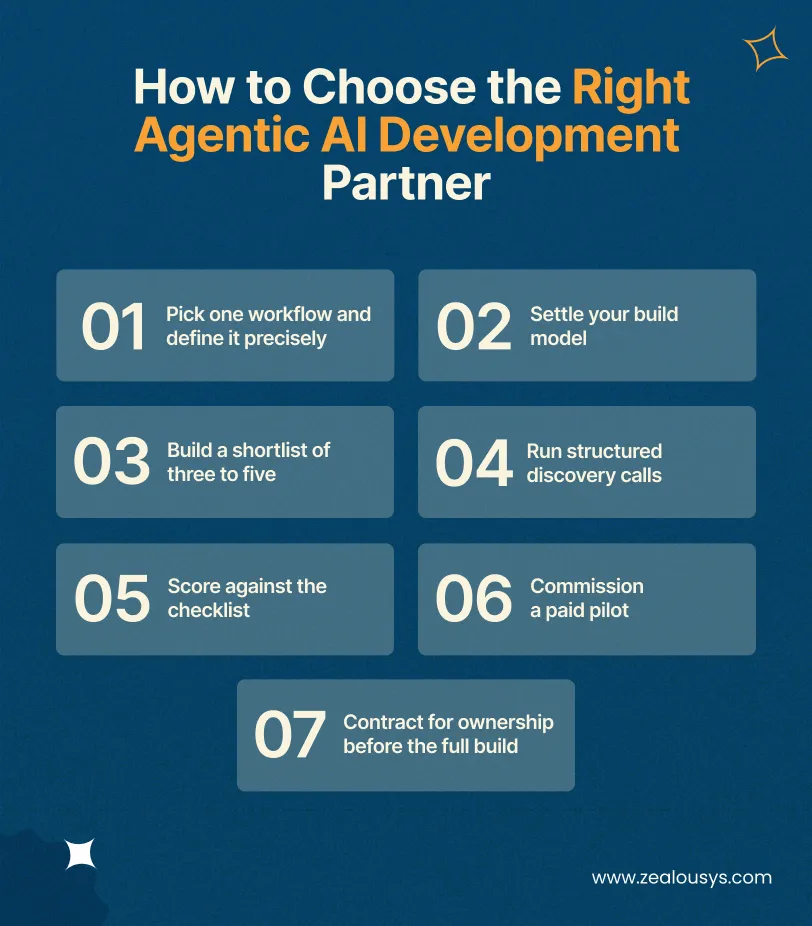
Choose a workflow with a measurable cost and a clear success metric such as resolution rate, cycle time, or cost per transaction. Document the exceptions your team handles by judgement. Do not start vendor conversations until you can describe the process end to end.
Decide between building in-house, hiring an agency, and hiring agentic AI developers to work alongside your team, before you talk to anyone. Many mid-market buyers choose a hybrid, where a partner builds the first system alongside your engineers and ownership transfers afterwards. If you go that route, contract the knowledge transfer at the start rather than negotiating it at the end.
Filter on production evidence before anything else. The best agentic AI development companies for enterprises have named systems live in workflows with real consequences, not a services page and a directory listing. Prioritize firms with agentic systems live in your industry or in a workflow shaped like yours, and set aside anyone whose portfolio is entirely chatbots and copilots.
Work through the twelve questions above with each partner in the same order. Record the red flags as you hear them, because the confident answers blur together once you have sat through four pitches.
Score against the checklist above, then compare where your assessments diverge. Use this stage to verify what can be checked without the vendor’s help, including certifications and named client work.
Never sign a full build off a scorecard. Run a four- to six-week paid pilot on the smallest useful slice of the workflow, with a defined success metric, a test set delivered as an artifact, and trace access from day one.
Lock down IP assignment covering prompts and test sets, data processing and residency terms, named team members, the monitoring you inherit, and the handover package. Agree all of it before the build begins.
Plan for two to four weeks across steps 1 to 5, four to six weeks for the pilot, then six to ten weeks to a hardened production agent. Budget roughly a quarter from first call to something doing real work.
As an AI agent development company, our work starts where this article does, with the workflow rather than the framework.
That shows in projects like the workflow automation platform built for a US freight brokerage, where approvals for carrier onboarding, DOT compliance, and freight invoices were scattered across email and spreadsheets. The team shadowed dispatch coordinators before writing code to find where approvals actually stalled. The build covered seven approval workflows, each with escalation logic and a complete audit trail. The team validated it across more than 200 scenarios, including expired documents, high-value loads and multi-level sign-offs. It then ran alongside the old system for three weeks so no shipment was disrupted.
On the model side, our multilingual retrieval-based assistant for the travel industry handles the grounding and retrieval quality that agentic systems depend on before they can act reliably.
If you are scoping a first workflow, our team runs a short assessment that maps one candidate process and flags the feasibility risks before anyone commits to a build.
Ask for evidence you can check after the call: systems live in production with an outcome metric, an evaluation report from a real deployment, a description of how approval boundaries work, and contract terms covering IP and knowledge transfer. Score every partner against the same weighted criteria so you are comparing capability rather than sales polish.
Start with production experience, move to evaluation, then failure handling. Ask how many agents they run in production and for how long, what an evaluation report from a live system looks like, how they detect a wrong action, which orchestration approach fits your workflow and why, and what you own at the end. Write down which answers named specific systems, numbers, or documents, and follow up on the ones that did not.
Traditional AI predicts or classifies, and automation follows fixed rules. Agentic systems plan multi-step work, call tools, and take actions with real consequences. Budget for evaluation, guardrails, and monitoring as core engineering work rather than as additions, and weight partner selection more heavily than you would on a conventional AI build.
Four things, mostly: how many systems the agent must integrate with, how much exception handling the workflow contains, compliance requirements such as private deployment or audit logging, and how much autonomy you want at launch. More autonomy means more evaluation work, not less. Track cost per run separately from build cost during the pilot, since that number determines whether the system stays viable as volume grows.
Yes, when the controls are contractual and technical rather than promised. Ask for certifications you can verify independently, data processing agreements, residency guarantees, deployment inside your own environment where required, and written confirmation that your data never trains a model.
Plan for six to ten weeks to a first production-grade agent on a scoped workflow, following a four to six week pilot. Treat a promise of anything dramatically faster as a signal to ask what has been left out.
Portfolio slides, methodology decks, and team credentials can all be assembled by a firm that has never run an agent under load. Two things cannot: agents live in production, and an evaluation report showing where they fail.
Ask for both in your first call with every agentic AI development partner on the shortlist. Score the answers against the checklist above, then take the strongest two into a paid pilot before you commit to anything larger.
If you want a second opinion while scoping that first workflow, talk to our team at Zealous System. We will map the process, flag the risks, and tell you plainly if it is not worth building yet.
Our team is always eager to know what you are looking for. Drop them a Hi!

Pranjal Mehta is the Managing Director of Zealous System, a leading software solutions provider. Having 10+ years of experience and clientele across the globe, he is always curious to stay ahead in the market by inculcating latest technologies and trends in Zealous.


Comments