Technology is changing fast, and software development is more important than ever for business success. Companies need smart, flexible solutions that can be built and delivered quickly. Using artificial intelligence (AI) is helping change how software is created and maintained. By applying the latest AI tools, businesses can handle challenges like real-time data and smooth user experiences more easily.
Our team at Zealous uses AI to speed up software development and maintenance. We leverage tools that automate routine tasks and predict when maintenance is needed, helping us deliver faster, better, and more creative solutions.
While challenges like data quality and privacy still exist, we’ve found ways to manage them effectively. Our AI solutions serve many fields such as healthcare, defense, and education. As companies face growing demands in a busy digital world, AI-driven approaches are key to building strong, high-quality software that supports growth and adapts to change.
Software development has changed a lot. It used to be slow and manual, but now it’s fast, precise, and needs to be flexible. Modern apps are more complex—they use cloud systems, real-time data, and work on many platforms. Plus, there’s pressure to deliver quickly and keep everything running smoothly. Because of this, artificial intelligence (AI) has become very important. AI helps by handling repetitive tasks like writing code, fixing bugs, and creating documentation. This lets developers spend more time on creative problem-solving.
At Zealous System, AI is a key part of how we work. Machine learning helps predict problems before they happen. Natural language processing automates writing documentation and creates smart chatbots. Generative AI speeds up coding and design work, while predictive maintenance helps avoid issues and supports growth.
These tools help Zealous deliver strong, reliable software across industries like healthcare and defense, meeting client needs in a tough market. By using data to make better decisions and automating routine work, AI lets Zealous build high-quality software faster and more affordably. As client demands increase, AI helps Zealous manage complexity and drive innovation, making the company a leader in today’s software development and ready for the future.
At Zealous System, AI is deeply integrated into software development and maintenance, helping teams work smarter and deliver better results faster.
Not sure where AI fits in your business or where to begin? We start by understanding your goals, your data, and your current operations. From there we identify the highest-impact opportunities, recommend the right technologies, and build a clear, phased roadmap so you can move forward with confidence and without wasted investment.
Your business generates data every day. Machine learning puts it to work. We build ML models that spot patterns, predict outcomes, and surface insights your team would never catch manually. Whether it is forecasting demand, detecting anomalies, or optimizing resources, the result is smarter decisions made faster and with far less guesswork.
We help your products understand and respond to human language the way people actually use it. From intelligent customer support chatbots that resolve queries instantly to automated documentation that turns technical notes into clear, readable content, NLP removes the manual effort from language-heavy workflows and keeps your users well served around the clock.
We build systems that can see, analyse, and act on visual information in real time. In healthcare, that means supporting faster, more accurate diagnosis from medical imaging. In defence and manufacturing, it means automated object detection, quality control, and situational awareness from live video feeds. If your business deals in visual data, we can turn it into actionable intelligence.
Generative AI does not just assist your team, it actively produces. We build custom generative AI applications that write code, generate UI prototypes, produce content, and automate creative tasks that previously required hours of skilled effort. Powered by GPT-4, Claude, and Gemini, these tools are built around your specific workflows so your team can focus on the work that genuinely needs a human.
We build predictive models that tell you what is likely to happen before it does. Identify system failures before they cause downtime. Spot sales trends before your competitors do. Anticipate customer behaviour before they churn. Predictive analytics turns your historical data into a forward-looking advantage that keeps your business ahead rather than reactive.
We integrate AI into your development and delivery pipeline so your team ships faster with fewer errors. Using tools like GitLab and Jenkins, we automate testing, integration, and deployment workflows so releases that once took days happen in hours. Less manual overhead, more consistent quality, and development cycles that scale with your ambitions.
AI agents go beyond answering questions. They take action. We build autonomous agents that reason through complex tasks, make decisions, and execute multi-step workflows independently, whether that means processing customer requests end to end, managing data across your CRM and ERP, or running entire operational processes without manual input. The result is a digital workforce that works around the clock and scales without adding headcount.
Most AI tools give generic answers because they do not know your business. RAG changes that. We build retrieval-augmented generation pipelines that connect powerful language models directly to your internal knowledge, your documents, your product data, and your databases. The AI answers questions and solves problems using your actual business information, making it accurate, trustworthy, and ready for real enterprise use.
You do not need to build an AI model from scratch to benefit from one. We integrate the world’s leading large language models, including OpenAI GPT-4, Anthropic Claude, Google Gemini, and open-source alternatives like Llama and Mistral, directly into your existing products and workflows. From intelligent search and smart document processing to automated decision support, we handle everything from model selection and prompt engineering to fine-tuning and production deployment.
Your customers expect answers immediately, at any hour, on any channel. We build conversational AI systems that go well beyond scripted responses. They understand context, remember previous turns in a conversation, handle complex queries, and hand off to a human agent exactly when the situation calls for it. Deployed across your website, mobile app, or WhatsApp, they deliver consistent, high-quality support that improves with every interaction.
We put an AI layer on top of your existing data infrastructure so your team can stop waiting on analysts and start getting answers on demand. Ask a question in plain English and get an instant, accurate response drawn from your live data. Automated reporting, anomaly alerts, demand forecasting, and natural language querying, all working together to make your data genuinely useful to every person in your business, not just the technical team.
Getting an AI model working in a demo is straightforward. Keeping it performing reliably in production at scale is a different challenge entirely. We design and manage the infrastructure that keeps your AI systems healthy long after launch, including model monitoring, automated retraining pipelines, version control, A/B testing, and full observability. Your AI investment keeps delivering value and keeps improving, without your team having to babysit it.
At Zealous System, we deliver AI-powered solutions that drive measurable results across industries. Below are key projects showcasing our expertise.
We developed an AI-driven healthcare platform that uses predictive analytics to monitor patient vitals and medical history in real-time, recommending personalized treatment plans. NLP chatbots handle routine patient inquiries, easing the burden on care teams.
Tech Stack: Python, TensorFlow, spaCy, AWS HealthLake
Impact:
Compliance: Adheres to HIPAA standards for data security and privacy.
We built an AI-powered Learning Management System (LMS) for an e-learning client, adapting content delivery based on learner behavior. Machine learning models identify at-risk students and recommend targeted resources to bridge knowledge gaps.
Tech Stack: Python, scikit-learn, React, MongoDB
Impact:
Compliance: Aligns with GDPR for data protection.
We implemented AI models for defense software to analyze satellite imagery and intelligence data using computer vision and data fusion, accelerating threat detection and decision-making.
Tech Stack: OpenCV, YOLO, Python, PyTorch
Impact:
Compliance: Meets defense-specific security standards.
We integrated AI into a SaaS platform to deliver predictive customer behavior analytics and personalized marketing campaigns, using user activity patterns to optimize re-engagement strategies.
Tech Stack: Node.js, Python, Keras, PostgreSQL, Segment
Impact:
Compliance: GDPR-compliant for ethical data usage.
We designed an AI-based predictive maintenance system that monitors software performance metrics in real-time, detecting anomalies to prevent failures before they impact users.
Tech Stack: Prometheus, Grafana, Python, anomaly detection models
Impact:
Compliance: Ensures robust data security protocols.
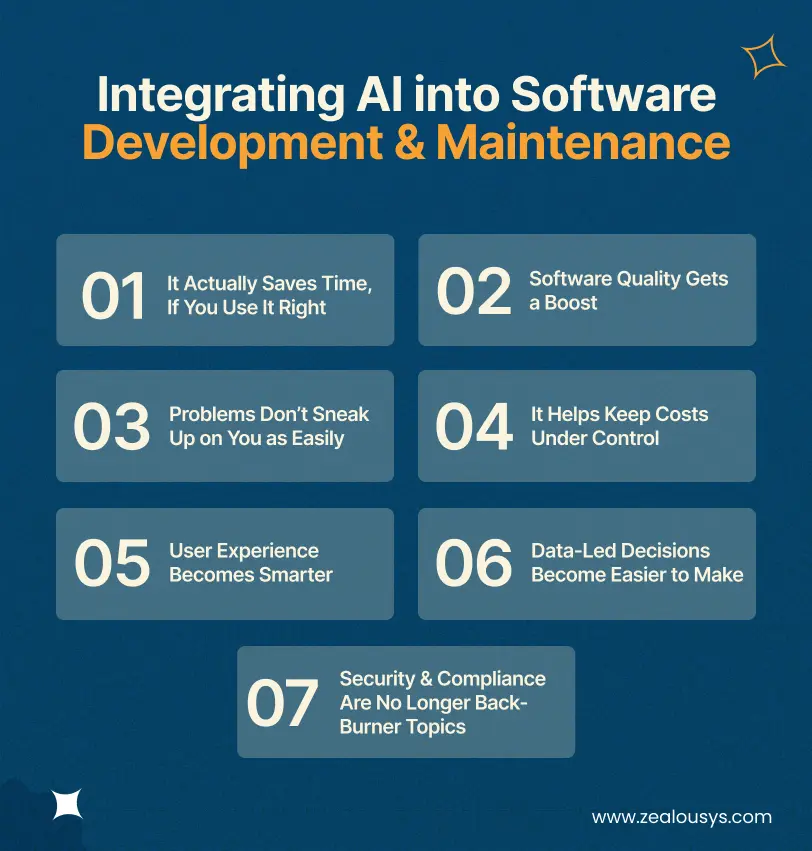
Over the past year, Raj, our experienced project manager, has led several projects where AI helped change the way we build and maintain software. By working closely with his team, he’s seen where AI adds real value, where it still needs work, and how to get the best out of it.
Here are some practical insights drawn from the work Raj and his team have done, grounded in real challenges, real impact, and real lessons learned.
AI tools can speed things up, no doubt. From auto-generating code snippets to running test cases and flagging errors, we’ve seen a real drop in the time spent on repetitive tasks. On one project, for example, using AI to monitor system performance helped us achieve near-continuous uptime and cut down incident response times by over 30%.
But this didn’t happen automatically. It took effort to train models on the right data and integrate them into our workflows. The gains were real, but they were earned.
One of the more immediate benefits was the improvement in code quality. AI-assisted testing and anomaly detection helped us spot bugs and inefficiencies early, some that would’ve taken longer to catch through manual QA. In maintenance, AI also flagged anomalies in live environments before users ever noticed a disruption, reducing emergency patchwork and saving time and cost.
That said, it’s not foolproof. We still rely on manual oversight for anything mission-critical. But as an extra set of (automated) eyes, it’s been valuable.
Predictive maintenance has been one of the more underrated wins. In one healthcare project, AI helped us analyze usage patterns and performance metrics to anticipate where bottlenecks or failures might occur. This approach reduced system disruptions and made our support teams more proactive than reactive.
For long-term product stability, especially in platforms with heavy traffic or real-time use cases, this has made a noticeable difference.
While integrating AI has upfront costs (tools, training, implementation), the long-term savings, particularly in resource allocation and downtime prevention, have been worth it.
In one SaaS product, we used AI models to understand user behavior and optimize how we delivered support and features. The result? Less time spent on blanket fixes, more targeted engagement, and lower churn. It wasn’t magic, but it was measurable.
In the EdTech space, we applied AI to personalize learning paths. Completion rates went up. Engagement metrics improved. These weren’t massive overnight shifts, but incremental improvements that added up. Users noticed—and that alone makes it worth continuing.
Personalization is one of those things users don’t always ask for directly, but when it’s done well, it quietly improves everything.
One unexpected upside was how AI helped surface insights that otherwise would’ve remained buried in logs or spreadsheets. For example, we used AI to analyze real-time user behavior and performance trends, which gave us better clarity on what features to prioritize and what could wait.
The speed of insight-to-action improved significantly, which for us meant better alignment with business goals and user needs.
In regulated environments, like healthcare and finance, compliance isn’t negotiable. AI gave us tools to continuously monitor for threats, flag risks, and ensure we stayed aligned with requirements like GDPR and HIPAA.
It’s not a complete replacement for human judgment or external audits, but it adds a helpful safety net that runs 24/7 and doesn’t get tiring.
While AI brings significant opportunities, its adoption isn’t without hurdles. Based on real-world projects, here’s how we addressed the key challenges that often surface during integration.
AI models rely heavily on large volumes of high-quality data—something not always readily available. To work around this, we collaborated closely with clients to collect relevant datasets, applied data augmentation techniques, and used transfer learning when data was limited. Involving domain experts ensured that the data aligned with the specific context of each project.
The complexity of machine learning models can often make their decisions difficult to understand. This lack of transparency can reduce trust. To address this, we incorporated explainable AI methods and opted for simpler models when possible. The goal was to ensure all stakeholders could interpret the model’s outcomes and feel confident in its recommendations.
Older systems often lack the flexibility to work easily with new AI development services. Rather than forcing replacements, we focused on seamless integration—retrofitting where needed and using IoT gateways or custom APIs to bridge gaps. This approach helped modernize workflows without major disruption.
In areas like drone tech and SaaS platforms, ethical use and data privacy are critical. We implemented strict data handling protocols, including encryption and access controls, and followed all applicable regulatory standards. These steps ensured that innovation didn’t come at the cost of user privacy or trust.
Adopting AI can raise concerns among teams, ranging from job security fears to discomfort with new tools. To ease the transition, we rolled out practical training, provided supportive onboarding, and built user-friendly interfaces. Emphasizing AI’s role in supporting, not replacing. Human expertise made a meaningful difference in adoption.
At Zealous, we don’t just use AI — we build with it at the core of our solutions. As an AI software development services provider, we integrate artificial intelligence into every stage of the software development lifecycle to automate routine tasks, predict issues early, and personalize user experiences. This allows us to deliver faster, smarter, and more dependable software across various industries.
As the need for intelligent solutions grows, AI continues to play a central role in driving innovation and improving quality. At Zealous, we are committed to using AI not only to solve today’s challenges but also to create the next generation of software products.
Our team is always eager to know what you are looking for. Drop them a Hi!

Pranjal Mehta is the Managing Director of Zealous System, a leading software solutions provider. Having 10+ years of experience and clientele across the globe, he is always curious to stay ahead in the market by inculcating latest technologies and trends in Zealous.


Comments