Software development is changing quickly. AI can now generate code, automate repetitive tasks, and help developers build applications faster. But writing code is only one part of building reliable software. Understanding how applications behave, identifying performance problems, and making better engineering decisions still require technical knowledge and experience.
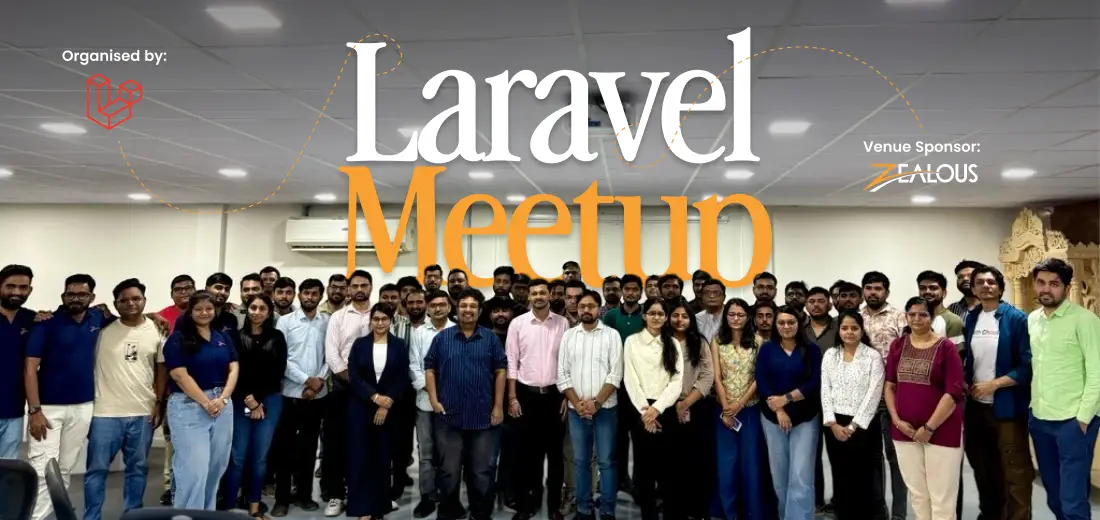
These ideas came together at the Laravel Ahmedabad Community Meetup, held on October 25, 2026, at Zealous System in Ahmedabad.
The meetup brought together Laravel developers, software engineers, and technology enthusiasts for a morning of technical discussions and knowledge sharing. Three speakers covered different aspects of modern software development: debugging applications in the AI era, improving Laravel performance, and using AI for faster decision-making.
Each session offered a different perspective on what it takes to build and maintain better applications.
AI coding assistants have made it easier to generate code, write functions, and speed up development. But what happens when the generated code does not behave as expected?
That was the central question in Ankit Chaudhary’s session, “Building Is Easy Now, Debugging Is Hard.”
Ankit, a Senior Software Engineer at CrescoByte, shared practical insights into debugging Laravel applications and investigating issues across different application layers.
The discussion covered several important areas:
One important takeaway was that generating code faster does not automatically make software reliable. Developers still need to understand application behaviour, identify the actual cause of problems, and verify whether a solution works.
As AI becomes a regular part of development workflows, debugging, critical thinking, and problem-solving will remain important engineering skills.
A Laravel application may work correctly during development but struggle when real users, larger datasets, and increased traffic put it under pressure.
In his session, “Laravel Performance: From Slow Request to Fast Application,” Vaibhav Patel, Senior Software Developer at Zealous System, discussed practical ways to identify and improve application performance.
The session focused on profiling Laravel applications, finding performance bottlenecks, and improving request handling through:
The session highlighted an important point: a functional application is not necessarily a well-performing application.
Performance depends on several factors, including database design, application architecture, query efficiency, caching strategies, and background processing.
For developers working on production applications, understanding these areas helps create software that can handle real-world usage more effectively.
AI automation is moving beyond simple chatbots and content generation. Businesses are increasingly looking at ways to use AI to support decisions and automate workflows.
Prem Thakkar, Senior Software Engineer at York IE, explored this area in his session, “Jev: A Fast Decision Model for AI Automation.”
His talk introduced Jev and explored how faster decision models can support AI-driven automation.
The discussion covered:
The broader takeaway was that useful AI automation is not just about generating responses. It can also help systems evaluate information, make decisions, and support actions within business workflows.
For developers and businesses exploring AI, this creates opportunities to move beyond basic automation and build solutions that address practical operational challenges.
Although the three sessions covered different subjects, they connected around one common idea: building better software requires more than writing code.
Ankit’s session highlighted the importance of debugging and understanding application behaviour when AI makes code generation easier.
Vaibhav’s session showed why application performance, database optimization, and efficient request handling matter when software moves into production.
Prem’s session explored how decision models and AI automation can help developers build smarter workflows.
Together, these discussions offered three important lessons:
These are important considerations for teams building modern web applications, SaaS products, and enterprise software.
Technical knowledge does not grow only within individual companies or development teams. Sharing experiences with people working on different projects often brings new perspectives and practical ideas.
The Laravel Ahmedabad Community meetup was a good example of this.
Developers had the opportunity to learn from experienced speakers, discuss technical challenges, exchange ideas, and connect with others working with Laravel and modern technologies.
For developers, these interactions can introduce new approaches to familiar problems. For the wider technology ecosystem, they help create stronger professional connections and encourage continuous learning.
Ahmedabad has an active developer community, and gatherings like these provide opportunities for people to share what they are building, discuss what they are learning, and grow together.
We would like to thank Punyapal Shah and the Laravel Ahmedabad Community team for bringing developers together and organising the meetup.
A special thanks to our speakers, Ankit Chaudhary, Vaibhav Patel, and Prem Thakkar, for sharing their technical knowledge and practical insights.
We also appreciate everyone who joined us on Sunday morning, participated in the discussions, and contributed to the learning experience.
At Zealous System, we were glad to support the meetup as the venue partner and provide a space for developers to connect and exchange ideas.
We believe technology communities become stronger when people share knowledge, learn from one another, and contribute beyond their individual teams.
We look forward to hosting more such gatherings and supporting the developer community in Ahmedabad and beyond.
Our team is always eager to know what you are looking for. Drop them a Hi!

Meet the Zealous Team – your dedicated source for cutting-edge insights on the latest technologies, digital transformation, and industry trends. With a passion for innovation and a commitment to delivering unparalleled expertise.


Comments