
Quick Overview: Custom loan management software helps South African MFIs run the full lending cycle, from origination and affordability checks to disbursement, collections, and NCR reporting, on one platform. This guide covers the features worth building, the development process, and realistic cost estimates in both USD and ZAR, so you can plan your project with clear expectations.
If you run a micro-finance institution, you already know where the pressure comes from. Growing a loan book is hard enough. Doing it while filing NCR returns on time, running affordability assessments on every application, and chasing repayments across hundreds of accounts is harder still. That is exactly the problem loan management software in South Africa is built to solve, and why more lenders are now looking at loan management software development as a serious option instead of settling for off-the-shelf tools.
Spreadsheets got many micro-lenders through their first few hundred loans. Past that point, the cracks show. A missed statutory return, a loan granted without a documented affordability check, or a collections book nobody can reconcile can cost you far more than any software project ever will.
This guide walks through what lending and loan management software actually does, the features that matter for South African lenders specifically, how the development process works, and what it costs to build. By the end, you should be able to brief a development team with confidence, or at least ask them much better questions.
Lending and loan management software is a system that runs the entire life of a loan. It starts when an applicant walks into your branch or opens your app, and it ends when the final repayment clears and the account closes.
In between, the software handles the work your team currently does by hand:
Micro-lending software, often called microfinance software in South Africa, is a specialised branch of this category. General banking systems are built for large institutions with big IT teams. Micro-lending platforms are built for high volumes of small, short-term loans, thin margins, and lean operations teams. The difference matters because an MFI processing 500 payday loans a month has very different needs from a bank issuing home loans.
You will also hear terms like loan book management system for micro-lenders or credit management system for MFIs. In practice, these all describe the same core idea: one platform that holds your entire lending operation, instead of a patchwork of spreadsheets, paper files, and WhatsApp reminders.
Here is the part that separates South Africa from almost every other lending market: compliance is not a feature you add later. It shapes the entire system.
Every registered credit provider operates under the National Credit Act. The NCA governs how you assess affordability, what you may charge in interest and fees, how you present quotations and agreements, and how you handle borrowers in default. A lending system that ignores these rules is not just incomplete. It actively exposes you to enforcement action from the National Credit Regulator.
An NCR-compliant loan management system builds these rules into the workflow itself. Interest and fee caps are enforced at the product level, so a loan officer cannot accidentally price a loan outside the legal limits. Affordability assessments are captured, calculated, and stored against every application, giving you a defensible audit trail.
Registered credit providers must submit statutory returns to the NCR, including the Form 39 series. Compiling these manually from spreadsheets is slow, error-prone, and stressful every single cycle. Software that tracks the right data from day one can generate these returns in minutes instead of days. For many MFIs, this single feature justifies the entire project.
Compliance does not stop at the NCA. FICA requires you to verify client identity and keep records. POPIA governs how you store and process personal information, and lending businesses hold some of the most sensitive personal data there is: income, debts, ID numbers, and bank details. Your software needs consent management, access controls, and secure storage built in from the start, not bolted on after a complaint.
South African lenders rely on debit order collections, and debit orders now run on DebiCheck. Borrowers authenticate their debit order mandates electronically, which reduces disputes and unauthorised reversals. Any lending platform built for this market needs DebiCheck integration as a first-class feature, not an afterthought. The same goes for integration with local credit bureaus such as TransUnion, Experian, and XDS, which supply the credit data your affordability assessments depend on.
Off-the-shelf international products rarely handle any of this well. That is the honest reason so many SA lenders end up commissioning custom builds.
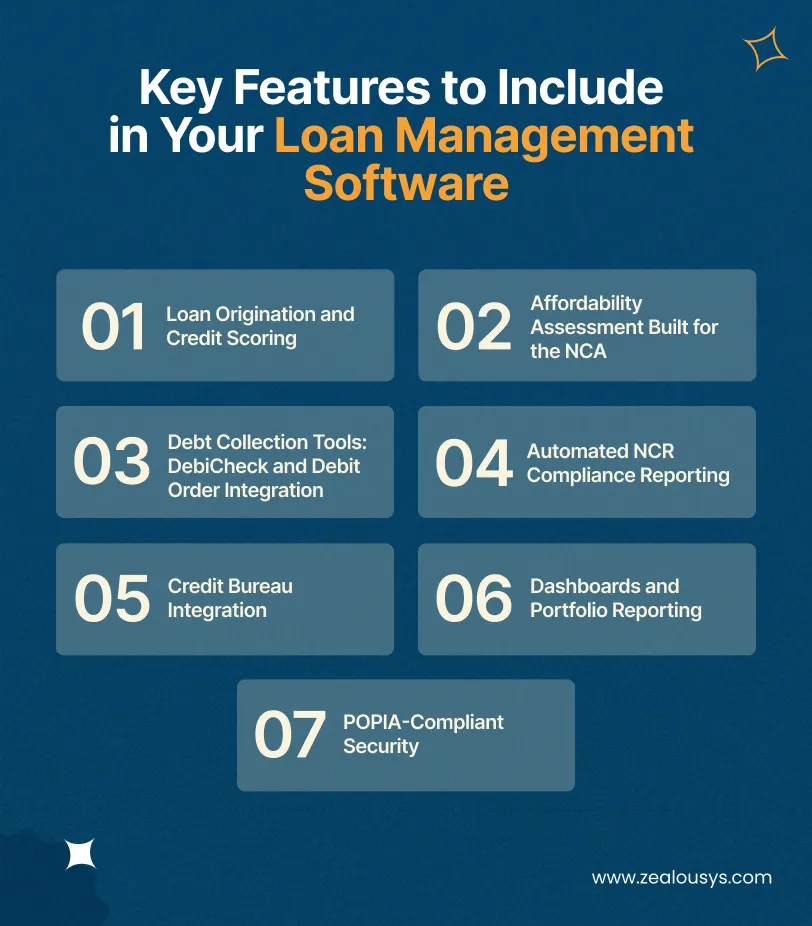
Every lender’s wishlist looks different, but a core set of features comes up in almost every South African MFI project. Treat this as your baseline scope.
Origination is where speed wins customers. The system should capture applications through whichever channels your borrowers actually use: branch, web, mobile app, or USSD for clients without smartphones. Behind the scenes, it should verify identity against KYC and FICA requirements, pull bureau data, and apply your credit scoring rules automatically.
Good loan origination software in South Africa’s payday and short-term lending space gives your team a decision in minutes, with every input recorded. That speed is a competitive edge because borrowers often go with whoever approves first.
This deserves its own module, not a checkbox. The system should collect income and expense information, calculate discretionary income according to the NCA’s requirements, and store the full assessment with the application. If the NCR ever questions a loan, you pull up the record and the numbers speak for themselves.
Debt Collection Tools: DebiCheck and Debit Order Integration
Collections make or break a micro-lending business. The platform should register DebiCheck mandates during origination, schedule collections against pay dates, and automatically retry or escalate when a debit order fails. Arrears workflows matter just as much: aging buckets, automated SMS and email reminders, promise-to-pay tracking, and handover files for external collectors when accounts go deep into default.
For South African lenders, strong debt collection software features are usually where custom builds outperform generic products, because collection strategy is where lenders differ most from each other.
The system should track every data point the NCR’s returns require and generate submission-ready reports on demand. If you have ever spent a weekend reconciling spreadsheets before a filing deadline, you understand the value here. Automating NCR compliance reporting turns a recurring crisis into a routine task.
Two-way integration matters. You pull credit reports from TransUnion, Experian, or XDS during origination, and you submit repayment data back to the bureaus as required of credit providers. Clean, automated bureau submissions also protect you from disputes about incorrect listings.
Your management team should see the loan book in real time: disbursements, collection rates, arrears by bucket, branch performance, and portfolio at risk. When the numbers live in one system, month-end reporting stops being an archaeology project.
Role-based access, encrypted data at rest and in transit, audit logs on every sensitive action, and clear consent records. None of this is optional for a business holding financial data on thousands of individuals.
Off-the-shelf products exist, so the fair question is why build at all. For many SA lenders, four reasons keep coming up.
Perhaps you lend against payslips, or serve informal traders with irregular income, or run a hybrid stokvel-linked product. Packaged software forces your model into its assumptions. Custom software encodes your actual credit policy, your fee structures, and your collection strategy, which are often the very things that make your business work.
Most commercial lending platforms charge per active loan, per user, or as a percentage of book value. Those fees scale with your success. A custom build is a larger upfront investment that you own outright, and the economics usually cross over within a few years for a growing lender.
You are not waiting for an overseas vendor to understand what DebiCheck is or why Form 39 matters. Regulatory changes get built into your roadmap on your schedule.
Your accounting system, payment providers, SMS gateways, and bureau connections plug in the way your operation needs, rather than through whatever connectors a vendor happens to offer.
The honest counterpoint: custom development costs more upfront and takes months, not days. If you are a very small lender with a completely standard model, a packaged product may serve you fine for now. The build decision makes sense when your volumes, margins, or lending model justify owning the platform.
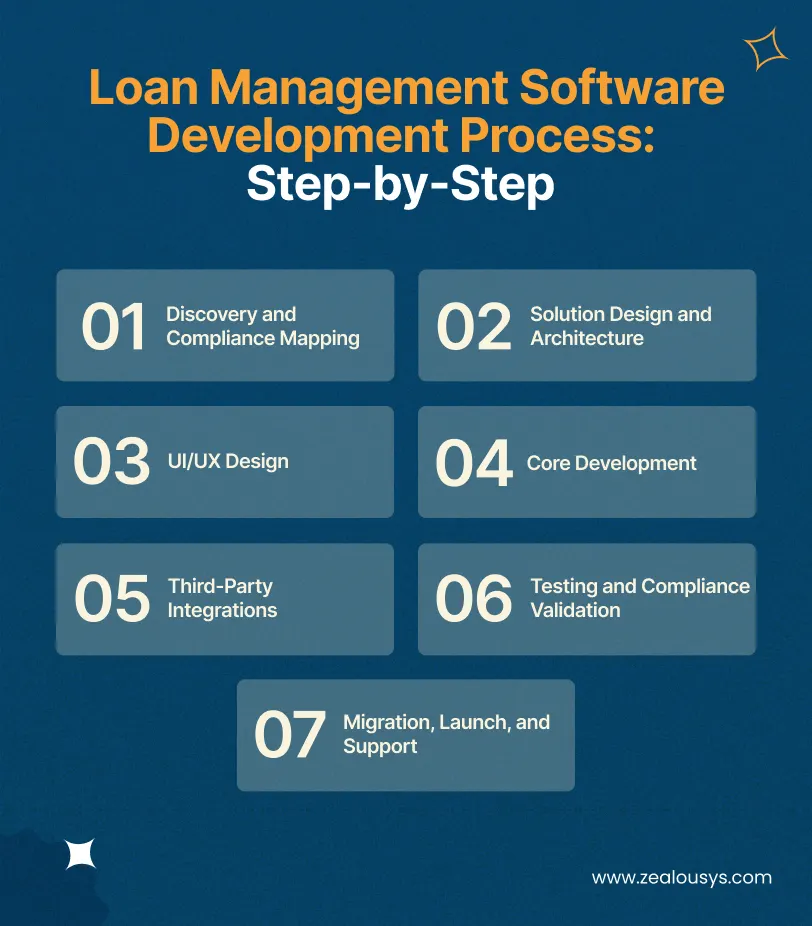
A well-run lending software project follows a fairly predictable path. Knowing the stages helps you hold your development partner accountable.
Typical duration: 2 to 4 weeks. The team documents your lending products, credit policy, workflows, and every regulatory requirement that applies: NCA rules, NCR reporting fields, FICA processes, POPIA obligations. Skipping or rushing this stage is the single most expensive mistake in lending software projects, because retrofitting compliance later means rebuilding core logic.
Typical duration: 2 to 4 weeks. This stage covers system architecture, database design, integration plans for bureaus and payment providers, and a decision on deployment. Most SA lenders now choose cloud hosting for lower upfront cost and resilience, and load-shedding makes a strong case for cloud over a server in your office. On-premise still suits some lenders with strict data policies, and the design stage is where that call gets made properly.
Typical duration: 3 to 5 weeks. Designers create screens for loan officers, back-office staff, management dashboards, and any borrower-facing channels. In this market, designing for low-end Android devices and USSD flows is often what separates software people use from software people work around.
Typical duration: 3 to 6 months for a standard MFI build. This is the main engineering phase, usually delivered in agile sprints, so you see working features every few weeks. Origination, loan servicing, and collections typically come first, with reporting and secondary channels following.
This stage runs alongside development. It covers bureau connections, DebiCheck and debit order rails, payment gateways, SMS and email providers, and accounting exports. Integration timelines partly depend on third parties, so an experienced team starts these early.
Typical duration: 3 to 6 weeks. This includes functional testing, security testing, and a dedicated pass to verify that interest calculations, fee caps, affordability logic, and NCR report outputs match the regulations. Test with real historical loan scenarios from your book if you can.
Existing loan data moves across, staff get trained, and the system goes live, often branch by branch. Plan for ongoing support from day one, because payment rails change, regulations get amended, and your product roadmap will not stand still.
End to end, expect roughly 4 to 9 months from kickoff to launch for a typical MFI platform, depending on scope.
The question every founder asks first, so let’s answer it directly. These are market-standard estimates for developing custom lending software for micro-lenders, quoted in USD with approximate ZAR equivalents. Actual quotes vary with scope, team location, and integration complexity.
| Project Scope | What It Covers | Estimated Cost (USD) | Estimated Cost (ZAR) |
|---|---|---|---|
| MVP / Core Platform | Origination, affordability checks, loan servicing, basic collections, and essential reporting. | $10,000 – $20,000 | R180,000 – R360,000 |
| Mid-Scale Platform | Everything in the MVP, plus DebiCheck integration, credit bureau integration, automated NCR returns, dashboards, and SMS automation. | $25,000 – $50,000 | R450,000 – R900,000 |
| Full-Scale Platform | Multi-branch support, borrower mobile app or USSD, advanced credit scoring, deep integrations, and custom collections workflows. | $50,000 – $150,000+ | R900,000 – R2,700,000+ |
A few factors move the number more than anything else:
One practical tip: start with an MVP that runs your core lending cycle, launch it, then extend. Lenders who try to build everything at once usually pay more and launch later than those who phase the work.
The loan management software development cost for most MFI builds lands between $10,000 and $150,000 (roughly R180,000 to R2,700,000), depending on features and integrations. Large multi-branch platforms with borrower apps can exceed $150,000. An MVP-first approach keeps the initial investment at the lower end.
A typical MFI platform takes 4 to 9 months from discovery to launch. Timelines stretch when integrations with bureaus and payment providers involve third-party onboarding, so experienced teams start those early.
It depends on your stage. Packaged products suit small lenders with standard models and limited budgets. Custom development wins when your lending model is distinctive, your volumes make per-loan fees expensive, or you need compliance and collections workflows that packaged tools handle poorly.
Payday and short-term lenders use a mix of local packaged platforms and custom-built systems. Whatever the choice, the essentials are the same: NCA-compliant pricing, affordability assessment software aligned to NCA rules, DebiCheck collections, and NCR reporting.
Yes, and this is one of the strongest reasons to invest in proper software. A well-built system captures the required data throughout the loan lifecycle and generates statutory returns in a submission-ready format, cutting days of manual work each cycle.
A cloud-based lending platform suits most microfinance institutions: lower upfront cost, easier multi-branch access, and resilience during load-shedding. On-premise makes sense mainly for lenders with strict internal data policies and the IT capacity to maintain their own infrastructure.
For a South African micro-finance institution, lending software is not really an IT purchase. It is the operating system of the business: the thing that decides how fast you approve loans, how reliably you collect, and how calmly you face an NCR audit. Built well, it pays for itself in recovered time, cleaner books, and risks that never materialise.
If you are weighing up a custom build, start small and start with compliance. Map your NCA and NCR obligations first, scope an MVP around your core lending cycle, and choose a development partner who has worked with credit regulations before, not one who will learn them at your expense.
At Zealous System, our custom fintech software development services cover lending and loan management platforms for financial businesses, including compliance-heavy markets like South Africa. If you are exploring what a custom platform would look like for your loan book, we are happy to talk through your requirements and give you an honest read on scope, timeline, and cost.
Our team is always eager to know what you are looking for. Drop them a Hi!

Pranjal Mehta is the Managing Director of Zealous System, a leading software solutions provider. Having 10+ years of experience and clientele across the globe, he is always curious to stay ahead in the market by inculcating latest technologies and trends in Zealous.


Comments