
Quick Overview:
Mental health app development for UK NHS Trusts has moved from a nice-to-have experiment to a serious commissioning priority. Waiting lists for psychological therapies remain long, clinical teams are stretched, and Trusts are under pressure to offer digital pathways that keep patients supported between appointments.
Here is the problem, though. Building a mental health app for the NHS is nothing like building a consumer wellbeing app. The features overlap, but the compliance requirements, procurement expectations, and clinical safety obligations sit in a different league entirely.
If you are a CDIO, a digital transformation lead at an ICB, or a clinical director weighing up a digital therapy pathway, this guide covers the three questions you are probably asking: what should the app actually do, what will the NHS require before it touches a patient, and what will it realistically cost in 2026?
Let’s take each one in turn.
Three forces are pushing Trusts towards digital mental health tools right now.
NHS Talking Therapies (formerly IAPT) has expanded access to psychological support, but referral volumes continue to outpace the available workforce. An app cannot replace a therapist. It can, however, keep patients engaged during the wait, support guided self-help at scale, and free clinician time for the people who need it most.
NHS England’s long-term planning has consistently pointed towards digitally enabled care. Patients who bank, shop, and book travel on their phones expect their mental health support to work the same way. Trusts that offer only face-to-face and phone options are increasingly out of step with how people actually seek help.
A well-designed app that handles mood tracking, guided cognitive behavioural therapy (CBT) exercises, and appointment management reduces missed sessions, cuts administrative overhead, and gives clinicians structured outcome data instead of scattered paper notes. Spread across thousands of patients, the cost per supported person drops sharply compared with fully clinician-delivered pathways.
There is also a timing factor. The 2026 DTAC refresh reset the compliance baseline for every supplier. Trusts are re-reviewing their digital estates, which means Trust and ICB procurement doors that were closed for years are open again, for suppliers who can meet the new bar.
Not every mental health app serves the same clinical purpose. Before any feature discussion, a Trust needs to decide which category it is commissioning, because the category determines the regulatory pathway.
These deliver structured CBT, DBT, or mindfulness programmes that patients work through independently. They suit step 2 interventions in NHS Talking Therapies pathways, where guided self-help is clinically appropriate. Lower regulatory burden, but still DTAC-assessed.
Here, the app connects patients with practitioners: secure messaging, video sessions, homework assignments, and progress reviews. These platforms sit closer to the clinical workflow, so interoperability with Trust systems becomes central to the build.
Designed for patients at higher risk, these include safety planning tools, immediate coping resources, and clearly signposted routes to urgent help. Crisis escalation pathways must be designed with clinical governance input from the very first wireframe, not added later.
Aimed at early intervention and population health, these cover sleep, stress, and low-level anxiety before problems escalate into referrals. They face lighter clinical scrutiny but still need full data protection and accessibility compliance.
Software that delivers a clinical intervention with evidence behind it. If the app diagnoses, treats, or influences clinical decisions, it may qualify as a medical device under MHRA rules, which changes the entire compliance picture. More on that shortly.
Most trusts end up commissioning a blend: a patient-facing app in one of the first four categories, backed by a clinician dashboard. That blend is what the next section covers.
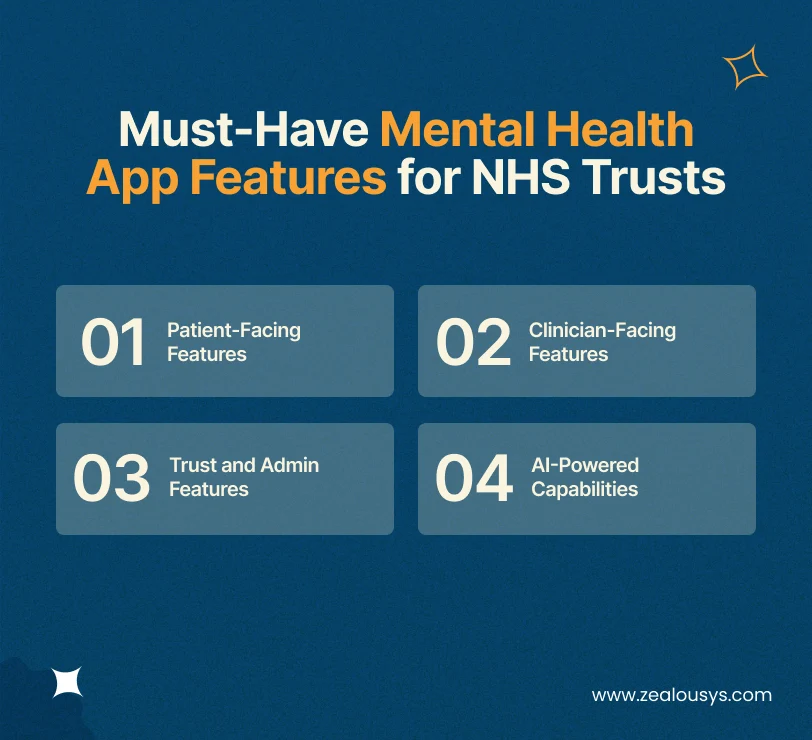
Feature lists are easy to write and hard to prioritise. The list below reflects what NHS clinical and digital teams consistently ask for, grouped by who actually uses each part of the system.
This is where engagement lives or dies. The essentials:
One design principle matters more than any single feature: a patient opening this app may be at their lowest point. Every screen should require the minimum possible effort to reach help.
Clinicians will abandon any tool that adds admin without adding insight. Their side of the platform needs:
The people who sign the contract need visibility too:
Handled carefully, AI adds genuine value. Conversational triage can gather structured information before a first appointment. Sentiment analysis across journal entries can surface early warning signs for clinical review. Content recommendation can adapt self-help material to each patient’s progress. And where a Trust already runs an electronic record system, integrating AI with existing EHR and EMR systems is usually more practical than building anything in isolation.
The caveat is not optional: any AI feature that influences clinical decisions pulls the product towards medical device territory and demands rigorous clinical safety assessment. Trusts should treat AI as decision support with a human always in the loop, and suppliers should document exactly that in their clinical safety case.
This section decides whether your app ever reaches a patient. NHS procurement teams do not reject apps because the interface is dated. They reject them because the compliance evidence is missing, expired, or inconsistent with what the product actually does.
Here is what the NHS will ask for, in the order it usually asks.
The Digital Technology Assessment Criteria is the entry ticket for any digital health technology supplied to the NHS. Introduced in 2021, DTAC assesses products across five domains: clinical safety, data protection, technical security, interoperability, and usability and accessibility.
The framework was refreshed in 2026, and the update matters. NHS England introduced an updated form in February 2026, with full transition required by 6 April 2026. The new version cuts the question count by around a quarter, removes duplication with the DSPT and pre-acquisition questionnaire, and includes a clearer decision tree for medical device classification, an area where suppliers historically got their self-assessment wrong and paid for it late in procurement. Trusts now expect an up-to-date DTAC evidence pack for each version of a product, and they expect reassessment when evidence expires or a major update ships.
The practical lesson: DTAC-compliant app development is not about filling in a form before sale. It is a discipline you build into every release. Some Trusts and ICBs also commission independent reviews, such as an ORCHA assessment, alongside DTAC. Passing one does not exempt you from the other.
DCB0129 is the clinical risk management standard for manufacturers of health IT. Compliance means appointing a qualified Clinical Safety Officer, maintaining a hazard log, and producing a clinical safety case that demonstrates risks have been identified and controlled.
For a mental health app, the hazard log gets serious quickly. What happens if a crisis message goes unread overnight? What if a risk flag fails to fire? These scenarios must be documented, mitigated, and signed off by the CSO before deployment. Trusts have a matching obligation under DCB0160 on their side, so expect their clinical safety team to scrutinise yours.
Mental health data is special category data under UK GDPR, which means the bar for lawful processing, consent, and security sits at its highest. Suppliers need:
Encryption at rest and in transit, penetration testing, and Cyber Essentials Plus certification round out the technical security expectations most Trusts now apply.
DTAC requires accessibility support that meets WCAG 2.1 AA as a minimum, and mental health apps have a stronger reason than most to exceed it. Depression affects concentration. Anxiety affects decision-making. Medication can affect vision and motor control. An accessible app is not a compliance checkbox here; it is clinically necessary design.
Evidence of testing with real users, including users with disabilities and lower digital confidence, carries significant weight in DTAC scoring.
An app that cannot exchange data with Trust systems creates work instead of removing it. The expectations in 2026:
If the app diagnoses, monitors, predicts, or treats a condition, it may be software as a medical device. Classification triggers UKCA marking requirements and MHRA registration. Many mental health apps sit deliberately on the non-device side of the line by positioning outputs as information rather than clinical advice, but that positioning must be genuine, consistent, and reflected in the DTAC submission. The updated 2026 decision tree makes it harder to fudge, which is a good thing for everyone.
A note on CQC: if the service delivered through the app constitutes a regulated activity, such as remote consultations with clinicians, Care Quality Commission registration may also apply to the provider operating it.
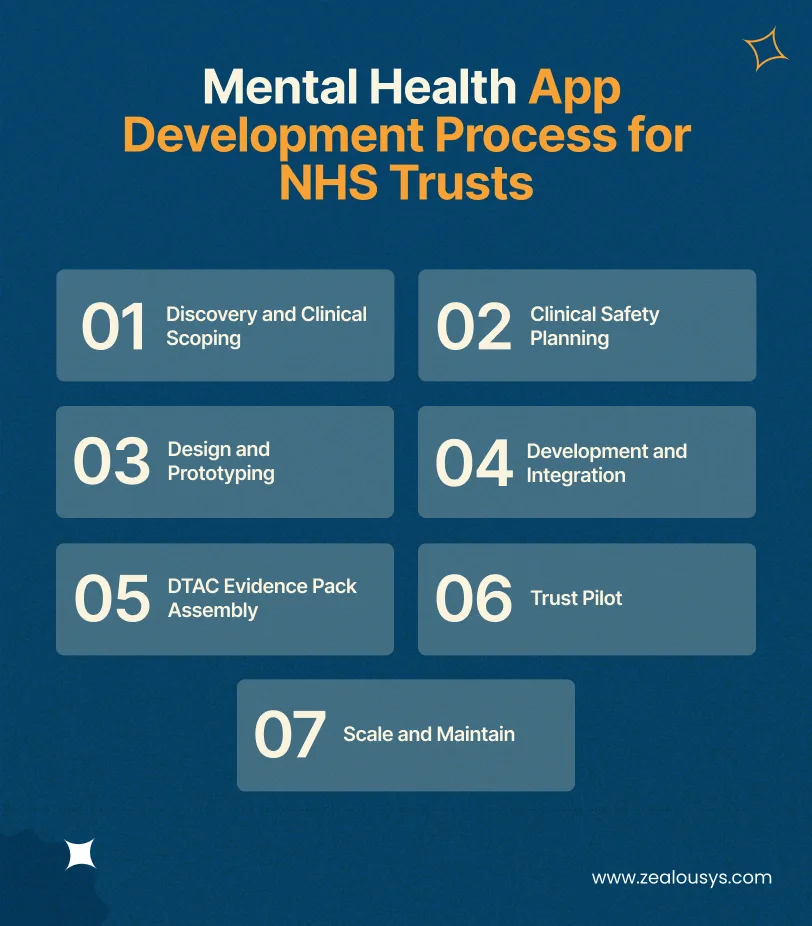
If you are asking how to build an NHS compliant mental health app, here is the short answer: never treat compliance as a final step. The process below bakes it in from the start.
Define the patient cohort, the care pathway the app supports, and the clinical model behind it. Involve clinicians, information governance, and at least one patient representative from the first workshop. Decide the medical device question now, in writing.
Appoint the Clinical Safety Officer and open the DCB0129 hazard log before design begins. Every feature decision from this point gets assessed against it.
Design for accessibility from the first wireframe, not as a retrofit. Test prototypes with real patients and clinicians. Document the user journeys, because DTAC will ask for them.
Build in short cycles with clinical review at each one. Implement FHIR interfaces, NHS login, and security controls as core architecture rather than bolt-ons. Connecting the app to the Trust’s existing healthcare systems at this stage avoids the expensive rework that comes from leaving integration until the end.
Compile the clinical safety case, DPIA, DSPT status, penetration test results, accessibility audit, and interoperability documentation into a single, version-controlled evidence pack.
Run a controlled pilot with one service line. Measure engagement, clinical outcomes, and incident reports. Feed everything back into the hazard log.
Roll out across services, then keep the compliance evidence alive. Every significant release needs a safety review, and expiring certificates need renewal before Trusts ask.
Common pitfalls worth naming: incorrect medical device self-classification discovered during procurement, a DPIA written after the architecture was fixed, accessibility tested only at the end, and DTAC evidence that describes version 1.0 of a product now on version 3.2. Each of these has sunk otherwise strong products.
Realistic NHS mental health app development costs for 2026 fall into three tiers:
| Project Tier | What It Includes | Typical Cost Range |
|---|---|---|
| Basic Mental Health App | Patient-facing app with mood tracking, self-help content, appointment reminders, and core compliance documentation | £15,000 – £45,000 |
| Mid-Level NHS Mental Health Platform | Patient app plus clinician dashboard, outcome measures, secure messaging, DTAC evidence pack, and NHS Login integration | £45,000 – £90,000 |
| Enterprise NHS Mental Health Ecosystem | Full multi-service platform with EPR integration, AI-supported triage, advanced reporting, and ongoing compliance management | £90,000 – £150,000+ |
Treat these as planning ranges rather than quotes. The tier you land in depends less on the app itself and more on what surrounds it, which brings us to the real question.
Five factors move the final number more than anything else:
1. Compliance depth: A full DCB0129 safety case, DPIA, penetration testing, and DTAC pack represent real, skilled work. Budget for it explicitly rather than hoping it hides inside “development”.
2. Integrations: Each connection to an electronic patient record system, NHS login, or the NHS App adds scope. EPR integration is usually the single largest variable.
3. AI features: Triage chatbots and risk analytics add development cost and, more significantly, clinical safety assessment cost.
4. Accessibility and user research: Testing with real patients across ability levels takes time. It also directly improves DTAC scores and clinical outcomes, so it is money well spent.
5. Ongoing maintenance: Plan for roughly 15 to 20 per cent of the build cost annually. Compliance evidence expires, operating systems update, and clinical feedback drives iteration. An app with no maintenance budget is an app with a countdown timer.
Most Trusts and founders face this decision early, so here is an honest comparison rather than a sales pitch.
| Factor | In-House Team | Specialist Development Partner |
|---|---|---|
| Upfront Cost | High: recruitment, salaries, tooling before any code ships | Lower: pay for delivery, not headcount |
| NHS Compliance Expertise | Rare to find in general developer hiring pools | Should come as standard; verify DTAC and DCB0129 track record |
| Speed to DTAC Readiness | Slower while the team learns the frameworks | Faster if the partner has done it before |
| Long-Term Control | Full ownership of roadmap and knowledge | Depends on contract terms and code ownership; insist on both |
| Clinical Safety Capacity | Requires hiring or training a Clinical Safety Officer | Established partners provide or work alongside a CSO |
| Best Suited For | Organisations with existing digital teams and long product horizons | First builds, fixed budgets, and hard procurement deadlines |
A hybrid model often works best in practice: a partner handles the build and compliance groundwork while the Trust’s own team grows into long-term ownership. Whichever route you choose, and whichever mental health app development company you shortlist in the UK market or beyond, ask one question: show me a DTAC evidence pack you have produced. The answer tells you most of what you need to know.
We are Zealous System, an AI-powered software development company that has spent years in healthcare software development, building products where the stakes are high and the margin for error is small.
Our healthcare portfolio covers different settings with one common thread: sensitive data, clinical workflows, and users who cannot afford software that fails them. A few examples:
As an AI-focused development company, we also bring practical experience with the capabilities covered in this guide, from intelligent triage to analytics dashboards, always designed with a human in the loop.
If you are scoping a mental health app for an NHS Trust, or weighing up what DTAC readiness would mean for your product, a short call is the easiest way to get clarity. Bring your requirements, even rough ones, and we will talk through feasibility, compliance implications, and realistic budgets. No deck, no pressure, just a working session on your project.
The Digital Technology Assessment Criteria is the NHS’s national baseline assessment for digital health technologies, covering clinical safety, data protection, technical security, interoperability, and usability and accessibility. For patient-facing technologies procured by the NHS, DTAC compliance is effectively a threshold requirement. The framework was refreshed in early 2026, with full transition to the new form required by 6 April 2026, so evidence packs prepared against the old version need reviewing.
It depends on function. Apps that diagnose, monitor, predict, or treat a condition may qualify as software as a medical device under MHRA rules, triggering UKCA marking and registration. Apps limited to information, self-help content, and appointment management usually sit outside device classification. The updated DTAC includes a decision tree to make this call earlier and more accurately.
Expect £15,000 to £45,000 for a basic patient-facing app, £45,000 to £90,000 for a mid-level platform with clinician dashboards and DTAC evidence, and £90,000 to £150,000 or more for an enterprise ecosystem with EPR integration and AI features. Compliance depth and integrations are the biggest cost drivers.
A basic app typically takes three to five months. A mid-level platform with a full DTAC evidence pack usually runs six to nine months, including clinical safety work. Enterprise builds with EPR integration and a Trust pilot commonly take nine to twelve months or longer.
Yes. The NHS App acts as a front door for patient-facing digital services, and third-party products can connect through approved integration routes, alongside NHS login for identity verification. Integration requirements form part of the interoperability evidence assessed under DTAC.
Our team is always eager to know what you are looking for. Drop them a Hi!

Raj Kewlani is a Project Manager and Mobile & Open Source Development Lead at Zealous System, specializing in agile-driven digital solutions. He focuses on delivering high-quality mobile apps and open-source projects that align with business goals.


Comments