
Building a SaaS MVP in Europe costs anywhere from €15,000 to €150,000 or more. Where you land in that range depends on your product complexity, team structure, and where your developers are based. Most SaaS MVPs take between 3 and 5 months to build.
That’s a wide range, and it’s deliberate. A straightforward B2B tool with user authentication, a dashboard, and three core features sits in very different territory from a multi-tenant SaaS platform with AI features and payment processing. This guide breaks down what actually drives those numbers, what’s typical by region and product type, and where startups quietly lose budget they didn’t plan for.
For most early-stage founders, the hardest part of planning an MVP isn’t the product idea. It’s understanding what the build will realistically cost before you’ve committed to anyone. You’re collecting quotes from different agencies, getting numbers that vary by 300%, and trying to figure out if your expectations are off or if someone is padding their estimate.
The European SaaS market is mature and full of genuine technical talent, from Warsaw to Lisbon, Tallinn to Berlin. But that geographic spread also means pricing varies considerably based on region, team structure, and what each agency or freelancer actually means when they say “MVP.”
This guide is written for founders who need concrete numbers, not vague ranges pulled from blogs written three years ago. It’s also for investors who want to benchmark whether a startup’s tech spend makes sense, and for product managers scoping a budget before kicking off a build.
This is where most budget conversations go wrong before they even start.
An MVP, a minimum viable product, is not a prototype. It’s not a polished demo. It’s not a “lite version” of everything you eventually want to build either. It’s the smallest functional product that lets real users accomplish the core job it promises and gives you enough signal to assess product-market fit before committing to a full build.
For a SaaS product specifically, that typically means:
What it does not mean: every feature on your roadmap, a full custom design system, native mobile apps, or integrations with a dozen external tools.
The discipline here is about restraint. Every feature added to an MVP multiplies cost and timeline, often by more than founders expect. A basic login screen takes a few hours. Multi-factor authentication with SSO takes days. Both technically “count” as authentication. They do not cost the same.
The most consistent mistake early-stage SaaS founders make is treating the MVP as the v1 product. If your MVP scope and cost are starting to resemble a full product build, something has gone wrong in the scoping conversation.
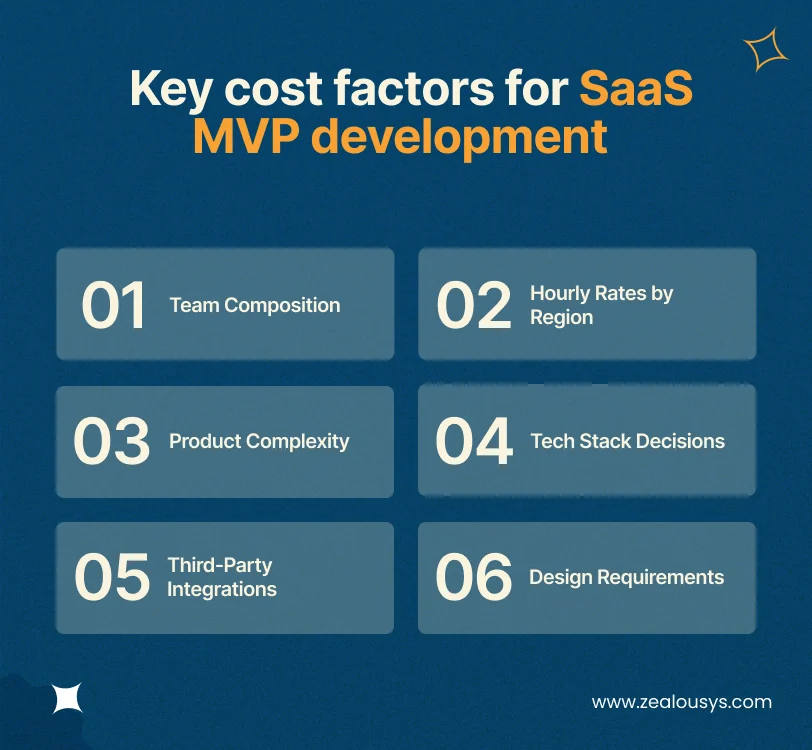
Before putting a number to anything, it helps to understand the variables driving it. A handful of factors drive SaaS MVP development costs in Europe, and they interact with each other in ways that make scoping harder than it looks.
A solo freelancer, a small distributed team, and a product agency carry very different cost structures. Freelancers can keep costs down but place significant coordination responsibility on the founding team. Agencies carry overhead, but they typically include project management and QA as part of the arrangement. The right choice depends heavily on how much bandwidth your founding team has to actively manage a build.
A typical SaaS MVP requires, at minimum:
Developer rates vary significantly across Europe. Based on data from B2B service platforms including Clutch, typical rate ranges in 2025-2026 look like this:
These aren’t hard limits. Senior engineers with strong product backgrounds or niche expertise charge more in every region. But these ranges give you a reliable baseline for planning.
A straightforward SaaS tool with fixed workflows is architecturally different from a multi-tenant platform with role-based access controls and real-time features. Complexity is the single biggest lever on cost, and it’s often underestimated during early scoping.
Choosing a well-documented, widely used stack like React, Node.js, and PostgreSQL means more available developers and faster build velocity. Niche or newer technologies slow things down and make it harder to hire or hand off later.
Connecting your MVP to Stripe, HubSpot, Slack, or other external services takes real time. Each integration adds to the timeline and budget, even when you’re using well-documented APIs.
A functional MVP can be built on a component library like Material UI or Shadcn without requiring a custom design system. A product that needs a distinctive UI design requires dedicated design time and more frontend build hours. Both are valid choices; they just cost differently.
The table below shows estimated cost ranges for a mid-complexity SaaS MVP (user auth, core feature set, dashboard, Stripe billing, basic admin panel) based on team location. These estimates assume a team of 3-4 people working over a 12-16 week period.
| Region | Hourly Rate | Estimated MVP Cost |
|---|---|---|
| Eastern Europe | €25–75/hr | €20,000–€60,000 |
| Southern Europe | €40–80/hr | €35,000–€80,000 |
| Western Europe | €80–150/hr | €70,000–€150,000 |
| Northern Europe / UK | €90–180/hr | €80,000–€200,000+ |
One note worth making here: lower hourly rates do not mean lower quality. Countries like Poland, Romania, Serbia, and Bulgaria have produced strong engineering talent, and many of Europe’s fastest-growing SaaS companies have built their core technical teams in these regions. The rate difference reflects cost of living, not capability or output quality.
Even within the same region, product type significantly affects scope, technical requirements, and cost. Here’s how costs typically break down by category.
Think: a lightweight CRM, a team task manager, or a focused productivity tool with a few fixed workflows.
These products have relatively simple data models, limited external dependencies, and straightforward user flows. They’re the fastest category to build and test. If your core product can be described in a single sentence, this is likely your bracket.
Think: a platform where multiple businesses or user groups have isolated accounts, separate configurations, or distinct data environments.
Multi-tenancy adds architectural complexity that doesn’t exist in simpler SaaS builds. You need proper data isolation between tenants, tenant management logic, and often differentiated permission structures from day one. Cutting corners on multi-tenancy architecture in the MVP stage creates expensive technical debt later.
Think: a product where the core value proposition is AI-driven, whether that’s document analysis, intelligent recommendations, or natural language interfaces.
Estimated cost: €60,000–€150,000+
The cost in this category comes from model integration, data pipelines, and the iteration required to make AI features reliable in production. Using third-party APIs like OpenAI or Anthropic meaningfully reduces cost compared to training custom models, but still adds real complexity to the build.
Think: products handling payments, financial data, health records, or anything operating in an industry subject to regulatory requirements like GDPR, PSD2, or HIPAA.
Estimated cost: €80,000–€200,000+
Compliance requirements, security audits, data residency obligations, and integration with regulated third-party services add substantial time and cost to any build. If your product operates in a regulated space, these requirements aren’t optional, and your initial budget needs to account for them fully.
Every early-stage startup reaches this fork. The decision rarely comes down to cost alone, but cost is a large part of it.
Hiring a founding engineer or a small internal team gives you full control and tight alignment with your product direction. It also comes at a real cost. A mid-level full-stack developer in Western Europe earns roughly €60,000–€100,000 per year in salary alone, according to data from sources like Glassdoor and Levels.fyi. In Eastern Europe, that drops to around €30,000–€55,000.
For a 4-6 month MVP build with two developers, your in-house cost in Western Europe could easily reach €80,000–€120,000 in salaries before accounting for employer taxes, equipment, and benefits. Add to that a 3-4 month hiring timeline, and in-house starts looking significantly more expensive than the headline figure suggests.
In-house makes sense if you have a technical co-founder already, or if you’re planning to maintain and grow an engineering team post-launch and have the runway to absorb both the time and cost.
Platforms like Bubble, Webflow, and Softr can meaningfully reduce development costs for certain types of SaaS products. A no-code MVP might cost €5,000–€20,000 in design and configuration work.
The tradeoff is scalability. No-code platforms impose ceilings on what you can build and how fast it can run under load. For early idea validation, these tools can be entirely appropriate. For a product you intend to grow, you’ll likely rebuild on a proper stack sooner than expected, making the initial savings partially offset by the cost of rebuilding.
Outsourcing to an Eastern European or nearshore agency is the most common path for European SaaS startups that don’t yet have a technical co-founder. A full team including design, development, QA, and project management is available from day one, without the overhead of employment.
Typical cost: €20,000–€100,000, as outlined in the regional breakdown above.
The risks are genuine and worth naming: communication gaps, misaligned expectations, and knowledge transfer friction are common. You can manage these risks with clear documentation, a well-defined product scope, and structured milestone reviews throughout the build.
Platforms like Toptal, Upwork, and local developer networks give access to individual developers at rates between €25–€100 per hour. Building through freelancers is often cheaper than an agency, but it requires you to act as project manager, which is a significant time cost for non-technical founders.
Managing three or four freelancers across different time zones, handling conflicting dependencies, and maintaining momentum without a dedicated team lead is harder than it looks on paper.
The estimate you receive from a developer or agency rarely reflects the full cost of reaching launch. These gaps are what quietly push your startup burn rate above what you planned for. Here are the line items that consistently catch first-time founders off guard.
AWS, Google Cloud, and Azure are not free at production scale. Early-stage SaaS products can often operate on free tiers, but as users, data, and compute requirements grow, costs scale accordingly. Budget roughly €50–€500 per month for infrastructure in the early stages, depending on your architecture and traffic.
Your MVP will almost certainly rely on external services from day one: email delivery (SendGrid, Postmark), error monitoring (Sentry), product analytics (Mixpanel, PostHog), and customer support tooling (Crisp, Intercom). These add up to €200–€1,000 per month even for a lean early product.
Operating a SaaS product in Europe means GDPR compliance is not a nice-to-have. You need a privacy policy, cookie consent management, data processing agreements with all vendors, and, depending on your product type, a data protection impact assessment. Legal fees for proper GDPR setup range from €1,500–€5,000 depending on your jurisdiction and the nature of your data handling.
No product ships without issues that only surface once real users start using it. A practical rule of thumb: allocate 15–20% of your total development budget for the first two months post-launch to address these.
Authentication vulnerabilities, insecure API endpoints, and improperly handled user data are common in MVPs built under time pressure. A basic security review before launch typically costs €2,000–€8,000. Skipping it is a risk most founders don’t think about until something goes wrong in production.
If your MVP doesn’t validate your core hypothesis, you’ll change direction. That’s actually the purpose of an MVP. But design and development work tied to features you end up dropping isn’t recoverable. Building for flexibility from the start reduces the cost of these pivots.
Once your MVP is live, the work doesn’t stop. Dependency updates, security patches, and minor performance fixes are a standing cost. For a small SaaS product, budget roughly €800–€2,500 per month for software maintenance, depending on the complexity of your stack and how actively you’re iterating. This is the cost most first builds don’t account for until the invoices start arriving.
Reducing cost and reducing quality are not the same thing. There are practical ways to bring your budget down without compromising what the product needs to do.
The most impactful cost reduction you can make is removing features before development begins. Before any feature goes into scope, ask a simple question: can we validate the core value of this product without it? If yes, cut it. A useful rule for early-stage products: if a feature can be handled manually or through a workaround for the first 50 users, it doesn’t belong in the MVP.
Newer or niche technologies may look appealing, but they slow development down and make it harder to find and onboard developers. A well-supported stack with a large developer community builds faster and keeps costs lower throughout the project.
Custom UI looks polished but adds significant time to any frontend build. Starting with a component library like Shadcn/UI, Material UI, or Tailwind UI means your developers spend time on product functionality rather than recreating standard interface elements from scratch.
If you’re based in Western Europe, working with a development team in Eastern Europe gives you meaningful cost savings without the timezone misalignment that comes with more distant outsourcing. A team in Warsaw or Bucharest working alongside a founder in Amsterdam or Munich is a well-established model that many successful European SaaS companies have used from the early stages.
Scope creep is one of the most consistent budget killers in any MVP build. Adding features mid-sprint resets timelines and inflates costs in ways that compound quickly. Writing a clear product brief and holding to it through the development phase will do more for your budget than almost any other decision a non-technical founder can make.
Don’t build what you can buy cheaply. Authentication (Auth0, Clerk), payments (Stripe), transactional email (SendGrid), in-app notifications (OneSignal): these are solved problems with reliable, well-priced solutions. Using them adds a small recurring cost but saves weeks of development time.
Timeline and cost are directly linked. Knowing one helps you plan the other. For most SaaS products following an agile MVP development approach, the timeline breaks down like this:
| Phase | Duration |
|---|---|
| Discovery and scoping | 1–2 weeks |
| UI/UX design | 2–4 weeks |
| Backend development | 4–8 weeks |
| Frontend development | 4–8 weeks (parallel) |
| QA and testing | 1–3 weeks |
| Launch preparation | 1 week |
| Total | 12–20 weeks |
That puts most mid-complexity SaaS MVPs at 3–5 months. Simpler tools with focused scope can ship in 8–10 weeks with a tight team. Complex products, particularly those with regulatory requirements or AI-driven features, frequently take 6 months or more.
A few things that reliably push timelines out beyond the build itself:
The fastest MVP builds happen when the founding team is consistently available, decisions get made quickly, and the scope doesn’t shift once development has started.
Most SaaS MVPs in Europe cost between €20,000 and €150,000, depending on complexity and where your team is based. Simple tools built with Eastern European teams can come in under €30,000. Complex or regulated products built with Western European teams can exceed €150,000.
For a mid-complexity SaaS MVP built with a team in Poland, Romania, Bulgaria, or Serbia, a realistic budget is €20,000–€60,000 across a 3–4-month build.
For most European startups without a technical co-founder, yes. Eastern Europe has strong engineering talent, hourly rates well below Western European levels, and timezone alignment with founders based in Germany, France, the UK, and the Netherlands. The model has a long track record of working well for early-stage SaaS.
GDPR compliance, cloud infrastructure, third-party tool subscriptions, post-launch bug fixing, and a pre-launch security review are the most consistently overlooked items. Together, these can add €5,000–€20,000 to your total cost across the first six months.
Remove features that don’t directly test your core hypothesis. Use existing services for authentication and payments rather than building them. Nearshore your development team if you’re in Western Europe. Fix your scope before development starts, and don’t change it mid-sprint.
For validating whether users will pay for a product before committing to a full build, no-code tools like Bubble or Softr can get you there for €5,000–€15,000. For a product you intend to scale, you’ll typically hit the limits of no-code faster than expected.
Get at least three quotes from different teams or agencies. Ask each one to break down the estimate by phase and role. A quote that doesn’t explain where the hours are going is difficult to assess. Compare the phase-by-phase breakdowns, not just the final totals.
There’s no single answer, but Next.js on the frontend, Node.js or Python on the backend, and PostgreSQL for the database is a widely used, well-supported combination that’s easy to hire for across Europe. Many early-stage teams also use Supabase to reduce backend infrastructure complexity in the initial build.
MVP development cost for SaaS startups in Europe is not a single number. It’s a function of your product scope, your team structure, where your developers are based, and what you’re prepared to build in a later version versus now.
What this guide should give you is a working framework: understand which product type you’re building, know your regional options, plan for the costs that don’t appear in initial quotes, and protect your scope once development begins.
The startups that spend their MVP budget well are not always the ones who spend the least. They’re the ones who understood what they were buying before they committed to it.
At Zealous System, we work with SaaS founders across Europe at various stages, from pre-seed validation to post-Series A product scaling. Getting that scoping conversation right is where most successful MVP builds begin.
If the ranges in this guide aren’t specific enough and you need a number tied to your actual product, the Zealous System team works through a short discovery brief to give you a grounded estimate rather than a ballpark. The contact form is the fastest way to start that conversation.
Our team is always eager to know what you are looking for. Drop them a Hi!

Ruchir Shah is Technology Head at Zealous System with hands-on expertise in AI/ML, Microsoft Azure, .NET, Node.js, Python, React, and Angular. He leads enterprise software development, champions digital transformation, and mentors developers building the future of intelligent apps.


Comments