
Node.js is 17 years old. And if you expected it to slow down by now, the data says otherwise.
What Ryan Dahl launched in May 2009 as a lightweight server-side runtime has grown into one of the most widely adopted backend technologies in the world. It powers everything from lean startup APIs to the infrastructure behind Netflix, PayPal, and NASA.
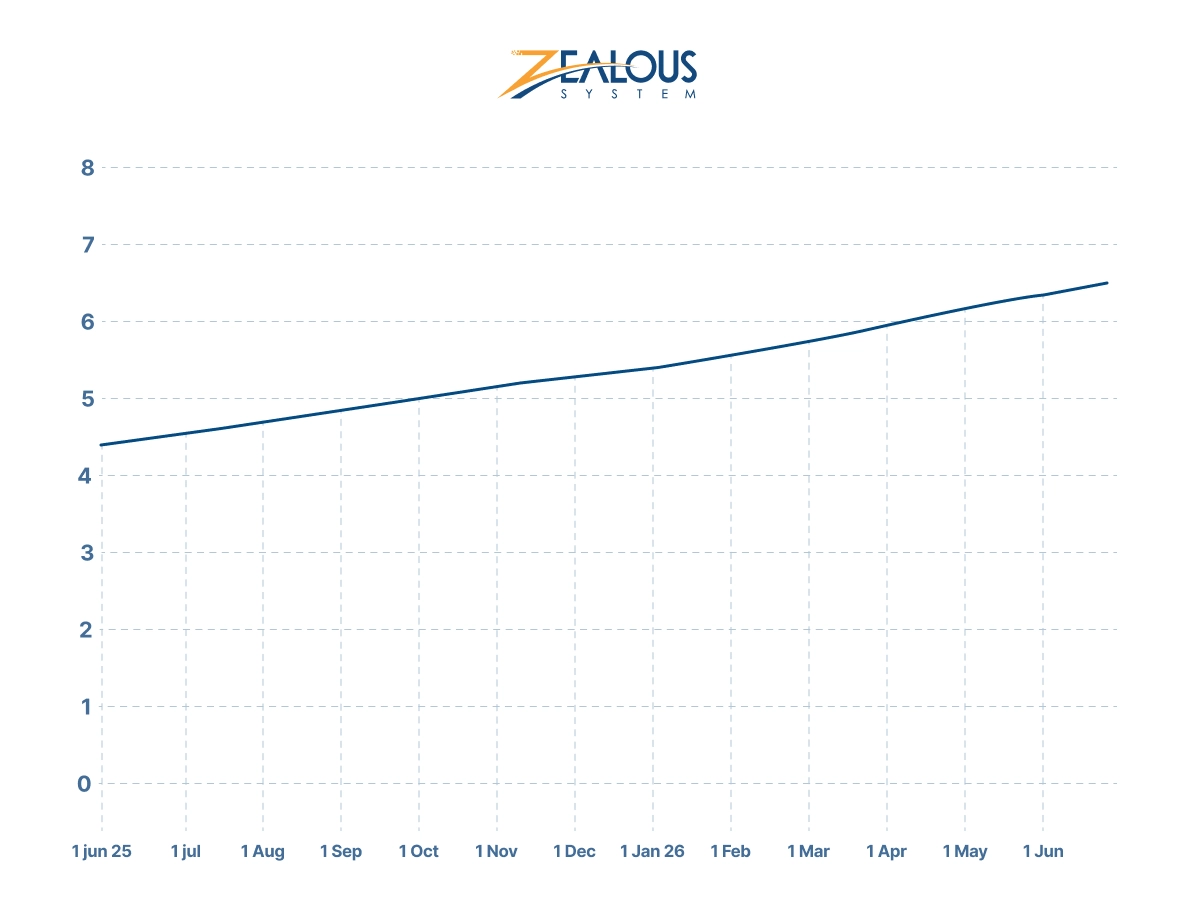
According to W3Techs, Node.js is currently used by 6.5% of all websites whose web server is known. The npm registry, which Node.js developers rely on for packages, is now home to over 3.1 million open-source packages and is used by more than 17 million developers worldwide.
This guide compiles the most up-to-date Node.js statistics for 2026, covering adoption, market share, downloads, developer trends, real-world company performance results, and what the runtime looks like heading into the rest of the decade. Every figure is sourced from publicly available, primary reports.
Let’s first understand:
Node.js is a free, open-source, cross-platform JavaScript runtime environment. It lets developers run JavaScript on the server side, outside of a browser, using Google Chrome’s V8 engine to execute code at high speed.
Before Node.js, JavaScript lived in the browser. Node.js changed that by bringing JavaScript to the backend, giving teams a single language for both client-side and server-side development. That shift removed one of the most common barriers in full-stack development. No more switching between two different programming languages on the same project.
Its core design is event-driven and non-blocking. Rather than waiting for one task to finish before starting the next, Node.js handles multiple operations simultaneously using a single-threaded event loop. This makes it particularly effective for applications dealing with high volumes of concurrent connections, real-time data, or I/O-heavy workloads such as REST APIs, chat platforms, and streaming services.
Beyond web servers, Node.js is also used to build command-line tools, developer tooling, desktop applications, and IoT applications. Its flexibility, combined with the npm ecosystem, is a core reason it has stayed relevant for nearly two decades.
Node.js follows a structured release cycle with two active tracks at any given time.
Starting with Node.js 27, the project is moving to a new annual release cycle where every major version will become LTS, removing the odd/even distinction that previously defined which versions received long-term support.
For production teams, the answer is clear: run Node.js 24. If you are still on Node.js 22, plan your migration now rather than waiting until the maintenance window closes.
Node.js is used by 6.5% of all websites whose web server is known, according to W3Techs‘ June 2026 report. That number reflects consistent year-over-year growth from 3.1% in 2023, and it places Node.js among a very small group of technologies with verified, tracked adoption at this scale.
You will find Node.js running inside some of the most trafficked products on the internet: Amazon, GitHub, Netflix, Spotify, Adobe, Vimeo, Zoom, Discord, and X.
The Stack Overflow Developer Survey 2025, with over 49,000 respondents from 177 countries, remains the most comprehensive current benchmark for developer tool usage. Node.js, along with React and Express, continued to lead the web frameworks category in that survey, showing that Node.js holds ground with both working developers and those still learning the craft.
The npm registry is the backbone of the Node.js ecosystem. With over 3.1 million packages and more than 17 million developers relying on it worldwide, the odds are good that a well-maintained solution already exists for whatever you are building. That scale reduces time-to-build significantly for Node.js teams compared to ecosystems with smaller registries.
It is worth noting that the total count includes deprecated, abandoned, and scoped packages. When evaluating a dependency, download trends and maintenance activity matter more than the headline number.
The nodejs.org domain serves over 2.4 billion requests and more than 3 petabytes of traffic every month, the majority of which goes toward release asset downloads. That infrastructure load is itself a signal of how deeply embedded Node.js has become in global development workflows. Download metrics broken down by version, operating system, architecture, and country are publicly available at nodejs.org/metrics.
Node.js Market Share and Industry Breakdown
W3Techs monitors the top 10 million websites worldwide and updates its Node.js usage data every month. That makes it the most reliable live benchmark for tracking how Node.js market share actually moves over time. The W3Techs breakdown page also segments Node.js usage by content management system, which reveals where Node.js is more or less prevalent depending on the underlying platform.
When you apply 6.5% to the total number of active websites globally, the absolute count runs into the millions. Node.js’s strongest adoption is in applications that go beyond static content: API-first architectures, real-time platforms, SaaS tools, and developer-facing services. These categories are less likely to appear in CMS-based tracking, which is why the WordPress and Wix percentages are lower despite Node.js’s overall strength.
Node.js has a strong global footprint. The United States leads in adoption, followed by the United Kingdom, India, Brazil, and Russia. Each market brings different dynamics to how Node.js is used and by whom.
India stands out in any 2026 analysis. The country has one of the fastest-growing pools of JavaScript developers in the world, and Node.js is a dominant choice across the startup ecosystem in Bangalore, Hyderabad, and Pune. For businesses looking to build or scale a Node.js team, India offers a strong combination of technical talent, competitive costs, and convenient time zone overlap for collaboration with clients in Europe, Australia, and Southeast Asia.
When choosing where to build your Node.js team, these countries consistently stand out.
India has one of the largest pools of skilled Node.js developers globally. Development costs are competitive compared to Western markets, and the time zone works well for teams collaborating with clients in Europe, Australia, and Southeast Asia.
Typical hourly rate: $15 to $40
The US offers high-quality technical talent, strong English proficiency, and easy access to investors and enterprise clients. It is the preferred choice for companies that need senior engineering talent close to home.
Typical hourly rate: $80 to $150
UK developers bring strong technical skills, English fluency, and a business-friendly environment. Operational costs are lower than in many other European markets.
Typical hourly rate: $60 to $100
Ukraine has a deep talent pool in JavaScript and Node.js, with a strong tradition of backend engineering. Many Ukrainian developers have extensive experience with enterprise-grade Node.js applications.
Typical hourly rate: $30 to $60
China offers cost-effective development with access to engineers skilled in the latest technologies. English proficiency can be limited, so communication planning is important for international projects.
Typical hourly rate: $19 to $38
Performance claims about Node.js are everywhere. The ones worth paying attention to are the ones backed by actual engineering teams sharing their own data. Here are the companies that have publicly documented what Node.js did for them.
Netflix was running a Java backend until 2015. The separation between the Java server layer and the JavaScript frontend created friction, slowed down deployment, and made startup times painfully long.
After switching to Node.js, the team achieved a 70% reduction in startup time. Page load time dropped from 5 to 10 seconds down to just over 1 second. The new architecture also made it far easier to break the UI into smaller, independently deployable microservices.
“Node has proven so handy that the company is expanding its use to other layers of the stack,” said Kim Trott, Director of User Interface Engineering at Netflix.
NASA’s EVA spacesuit data was scattered across three separate legacy databases. Accessing a full set of spacesuit lifecycle information required a 28-step process. This became a safety issue in 2013 when a malfunctioning spacesuit during a spacewalk highlighted just how difficult it was to pull together critical data quickly.
NASA adopted Node.js to build a cloud-based, microservices-driven data architecture. The result was a 300% improvement in database access time, with users able to retrieve data in seconds rather than hours. The 28-step retrieval process was reduced to just 7 steps.
PayPal ran a direct comparison between a Java-based application and a Node.js version of the same product. The Node.js application, built by a smaller team with a two-month head start disadvantage, caught up within months and then outperformed.
Results from PayPal’s own engineering team:
“This provided encouraging evidence to show that our teams could move faster with JavaScript,” wrote the PayPal engineering team.
LinkedIn shifted its mobile backend to Node.js, which allowed the company to cut the number of servers running the application, simplify the overall codebase, and unify frontend and backend engineering under a single language. The client and server operating on the same JavaScript stack made collaboration significantly easier across teams.
Trello needed a server that could handle a large number of real-time open connections with minimal latency. Node.js was the right fit. The team used it to keep their single-page application extremely lightweight at 250 KB, with near-zero latency in server interactions. Prototyping time also dropped considerably.
Uber needed a real-time, API-driven architecture capable of processing millions of connections simultaneously. Node.js became the foundation for a distributed, self-healing architecture with over 600 stateless endpoints. Its event-driven model handles the kind of concurrent, real-time ride processing that Uber’s scale demands.
X used Node.js to rebuild mobile.x.com, one of its highest-traffic surfaces. The goal was to deliver a genuinely fast mobile experience, even on slower networks. The result was a loading speed of under 5 seconds on 3G, with the page optimised for 2G speeds as well. The new architecture, called X Lite, is 1 to 3% of the size of the iOS or Android app.
GoDaddy switched to Node.js during a website redesign in 2016. The transition delivered four times higher end-user performance for its web hosting services, and reduced infrastructure costs by a factor of 10 due to the lighter runtime. The rebranded website was rolled out in just one hour.
Node.js handles many concurrent connections through its asynchronous, event-driven architecture. Rather than creating a new thread for each request, it processes requests using a single-threaded event loop. High-traffic applications like real-time chat, live dashboards, and collaborative tools all benefit from this directly.
You can use JavaScript on both the frontend and backend removes the context-switching overhead that slows down mixed-language teams. Developers can move between layers without changing tools or languages, which shortens onboarding time and reduces the chance of communication gaps between frontend and backend specialists.
The npm registry is the largest software registry in the world. It gives Node.js developers access to a massive library of pre-built packages for almost any use case, from authentication to data validation to image processing. The Node.js community is active, well-documented, and backed by the OpenJS Foundation.
Node.js is free and open-source. The ability to use one language across the full stack reduces the number of specialists a team needs, which directly affects hiring costs and project timelines. PayPal’s own data showed a smaller Node.js team outpacing a larger Java team in both speed and output.
Node.js’s non-blocking I/O model makes it a strong choice for applications that handle a high volume of data transfer. It is not the right tool for CPU-intensive computation, but for I/O-heavy workloads like APIs, microservices, and real-time applications, it consistently performs well.
Chat applications, live collaboration tools, real-time notifications, and multiplayer applications all share a common requirement: the ability to push data to connected clients without delay. Node.js handles this naturally, with its event-driven architecture and WebSocket support making it simple to build always-on, low-latency connections.
Node.js’s lightweight, modular nature makes it a natural fit for microservices. Each service can be built, deployed, and scaled independently. Netflix’s architecture is a direct example: what began as a monolithic Java application was broken into independently deployable Node.js services, making it far easier to scale individual components without touching the rest of the system.
Node.js does not operate without competition. Several alternatives have emerged in recent years, each with a distinct set of trade-offs. Understanding the landscape helps teams make better runtime decisions rather than defaulting to what is familiar.
Bun is a newer JavaScript runtime focused on raw performance. Built in Zig, it includes a built-in bundler, test runner, and package manager, reducing the toolchain overhead that Node.js teams often manage separately. On certain benchmarks, Bun is significantly faster than Node.js. Adoption is growing quickly among developers who prioritize speed and toolchain simplicity. It is not yet as battle-tested in large production environments, and npm compatibility, while largely present, has edge cases that matter in complex dependency graphs.
Deno was created by Ryan Dahl himself. It offers built-in TypeScript support, a permission-based security model by default, and native compatibility with web platform APIs. Deno’s ecosystem is smaller than Node.js’s, but its security model is appealing in regulated environments. Deno 2 introduced npm compatibility, which significantly reduced the switching cost for Node.js teams.
Python remains the dominant language for machine learning, data science, and AI-adjacent backend work. FastAPI in particular has grown rapidly and appeared strongly in the Stack Overflow 2025 survey results. For teams building data pipelines, model-serving APIs, or ML-integrated applications, Python is often the right choice. It is not a substitute for Node.js in real-time or I/O-heavy architectures, but it competes directly in the API and backend services space.
Go is a compiled, statically typed language known for high performance and excellent concurrency. It is popular for systems-level programming, high-throughput APIs, and infrastructure tooling. Many large-scale services at companies like Google, Cloudflare, and Uber use Go for components where performance at extreme scale is the priority. The tradeoff is a steeper learning curve and a smaller package ecosystem compared to Node.js.
PHP still powers a significant portion of the web, particularly through WordPress and Laravel. It is a reliable, well-understood choice for content-heavy websites and traditional server-rendered applications. Laravel in particular is a mature, full-featured framework that competes directly with Node.js frameworks for certain categories of web application.
Node.js in 2026 is not standing still. The runtime, its tooling, and the workloads it is being applied to are all shifting. Here is where the most meaningful movement is happening.
Node.js is already the most common runtime in serverless environments. AWS Lambda, Google Cloud Functions, Cloudflare Workers, and Vercel’s edge network all offer first-class Node.js support. As more applications move to edge deployment to reduce latency, Node.js is positioned to remain the default runtime for these use cases.
TypeScript adoption within the Node.js ecosystem has grown significantly. Node.js 24 includes stable built-in TypeScript type-stripping support, meaning developers can run TypeScript files directly without a separate compilation step. For teams building at scale, TypeScript’s static typing catches errors earlier and makes large codebases easier to maintain.
A notable shift in 2025 and 2026 is Node.js showing up as the orchestration layer in AI-powered applications. Teams building LLM-powered APIs, retrieval-augmented generation (RAG) pipelines, and AI agent workflows are reaching for Node.js to handle the routing, context management, and API composition that sit around the AI model itself. Its non-blocking I/O and event-driven model fit this role well.
Libraries like TensorFlow.js and ONNX Runtime for Node.js make it possible to run inference directly in a Node.js process. While Python remains the primary language for model training, Node.js is increasingly used to serve predictions in production without introducing a separate Python service into the architecture.
As npm packages grow in number and complexity, supply chain security has become a real engineering concern. Node.js 24 includes improvements to the built-in permission model, giving developers more control over what a Node.js process can access. Tools like npm audit are now a standard part of most CI pipelines for Node.js projects.
The Node.js community remains one of the most active in open-source software. The OpenJS Foundation, which stewards Node.js alongside other major JavaScript projects, continues to invest in long-term governance, security, and ecosystem health. For developers and businesses alike, that institutional backing matters.
Node.js is a strong choice for:
Zealous System offers expert Node.js developers for hire, ready to tackle your web development projects with precision and efficiency. Our developers are skilled in utilizing Node.js’s capabilities to create high-performance, scalable, and secure applications. Whether you need to build real-time applications, RESTful APIs, or full-stack web applications, our developers have the expertise to deliver top-notch solutions tailored to your specific requirements.
By hiring Node.js developers from Zealous System, you can benefit from our extensive experience in using Node.js development services for various projects across different industries. We follow agile methodologies to ensure timely delivery and collaborate closely with our clients to meet their expectations. With Zealous System, you can rest assured that your Node.js project is in capable hands.
Yes. Node.js is used by 6.5% of all websites whose web server is known (W3Techs, June 2026), and the npm registry it relies on hosts over 3.1 million packages used by more than 17 million developers worldwide. The runtime receives active development, has institutional backing from the OpenJS Foundation, and continues to be the most widely supported JavaScript runtime on cloud and serverless platforms.
Node.js 24 “Krypton” is the current Active LTS release, recommended for all production deployments. Node.js 26 “Lithium” was released on May 5, 2026 as the Current track and will become Active LTS in October 2026. Node.js 22 “Jod” is in Maintenance LTS through April 2027. Node.js 20 reached End of Life on April 30, 2026.
Netflix, PayPal, NASA, LinkedIn, Uber, X (formerly Twitter), GoDaddy, Amazon, GitHub, Spotify, Adobe, Vimeo, Zoom, and Discord are among the well-documented organizations running Node.js in production. Netflix and PayPal have published specific engineering case studies documenting the performance gains they measured after switching to Node.js.
The npm registry hosts over 3.1 million packages as of 2026, making it the largest software registry in the world. It is relied on by more than 17 million developers globally for both open-source and private package management.
Yes, for the right category of large-scale application. Netflix uses Node.js to serve its global streaming interface. PayPal runs all consumer-facing web applications on Node.js. Uber’s distributed architecture runs on 600+ Node.js stateless endpoints. These are not small-scale deployments. Node.js excels at I/O-heavy, real-time, and API-first applications at scale. It is less suited for CPU-intensive computation, where Go, Rust, or Java may be better choices.
Node.js is the most established and most widely supported JavaScript runtime. Bun is a newer runtime that prioritizes raw performance and includes a built-in bundler and package manager. Deno, created by Node.js’s original author, focuses on security and modern web API compatibility.
Both Bun and Deno are growing but have smaller ecosystems and less production track record than Node.js. For most teams in 2026, Node.js remains the lowest-risk choice. Bun is worth evaluating for performance-sensitive tooling. Deno is worth evaluating for regulated environments where its permission model is an advantage.
Our team is always eager to know what you are looking for. Drop them a Hi!

Pranjal Mehta is the Managing Director of Zealous System, a leading software solutions provider. Having 10+ years of experience and clientele across the globe, he is always curious to stay ahead in the market by inculcating latest technologies and trends in Zealous.




Comments