Offshore mobile app development is the practice of hiring a software development team in another country to design, build, test, and maintain your mobile application. It typically reduces costs by 40 to 60 percent compared to local hiring, accelerates delivery by leveraging overlapping time zones, and provides access to specialized talent that may not be available in your home market.
Building a mobile app is one of the most significant technology investments a business can make. As global development talent becomes more accessible and digital collaboration tools improve, offshore mobile app development has moved from a cost-cutting measure to a genuine strategic advantage.
This guide covers everything you need to make an informed decision: what offshore app development actually means, what it costs, which regions to consider, how to choose a partner, and the best practices that separate successful projects from ones that go sideways.
Let’s start by understanding.
Offshore mobile app development refers to the practice of contracting a software development team located in a different country to build or improve your mobile application. The external team handles some or all of the work involved, including requirements gathering, UI/UX design, development, quality assurance testing, and post-launch support.
The word ‘offshore’ is sometimes used interchangeably with ‘outsourcing,’ but there is a meaningful difference. Outsourcing simply means delegating work to a third party, which could be in the same country. Offshore specifically means the partner is in another country, usually one where development labor costs are lower or where specific technical talent is more available.
| Factor | Onshore | Nearshore | Offshore |
|---|---|---|---|
| Location | Same country as your business | Neighboring country or same time zone region | Different continent, significant time zone gap |
| Typical Cost | Highest | Moderate | Lowest |
| Time Zone Overlap | Full | Partial to full | Limited to none (can be structured) |
| Communication | Easiest | Easy | Requires planning |
| Best For | Sensitive or regulated projects | Agile teams needing real-time collaboration | Cost-driven projects with defined requirements |
The offshore software development market was valued at approximately USD 120 billion in 2023 and is projected to reach USD 389.7 billion by 2033, growing at a compound annual growth rate of 12.5 percent. Within this broader market, mobile app development represents one of the fastest-growing segments, driven by the global increase in smartphone adoption and the demand for digital-first business models.
North America is the largest buyer of offshore development services, representing more than 38 percent of global demand. The most popular destination countries for offshore app development include India, the Philippines, Ukraine, Poland, and Vietnam, each offering a combination of technical talent, English proficiency, and competitive pricing.
The offshore software development market is booming! In just 10 years, it’s projected to grow from USD 120 billion in 2023 to an impressive USD 389.7 billion by 2033, with a solid 12.5% annual growth rate. Why’s that? Well, businesses are increasingly looking for cost-effective IT solutions and specialized skills that might not be available locally.
Offshore Mobile App Development is clearly on the rise, and businesses are tapping into global talent to stay ahead in the game. Exciting times ahead!
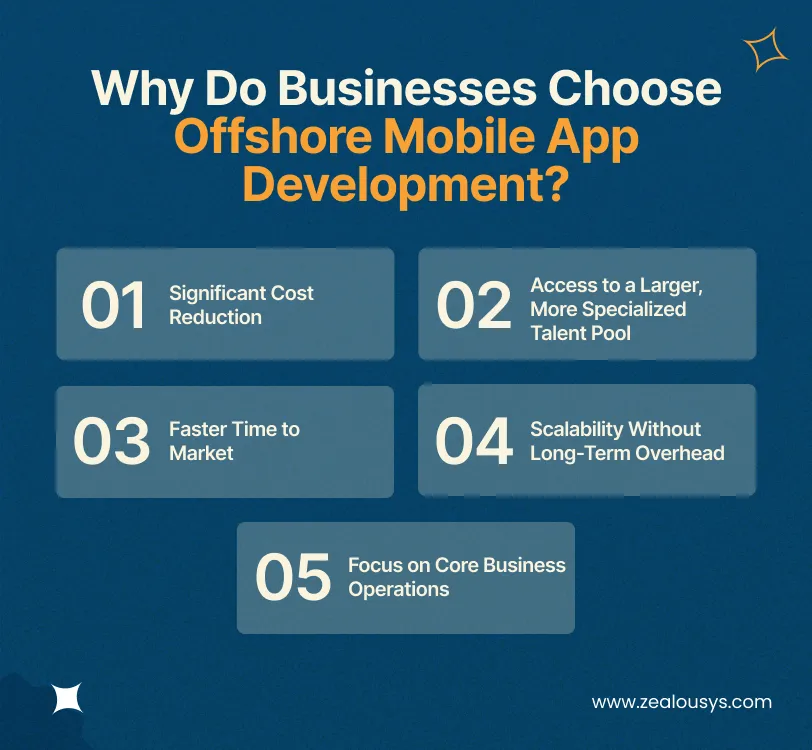
The reasons companies go offshore have evolved. It began as a pure cost reduction strategy, but today the decision is driven by a combination of talent access, speed, and specialization. Here is a clear breakdown of the primary motivators.
Development costs vary dramatically by region. A senior mobile app developer in the United States typically charges between USD 120 and USD 200 per hour. The same caliber developer in India charges between USD 25 and USD 60 per hour, and in Eastern Europe between USD 45 and USD 80 per hour.
For a mid-complexity app requiring 2,000 hours of development, this translates to a total cost of USD 240,000 to USD 400,000 in the US versus USD 50,000 to USD 120,000 offshore. The savings are not marginal. They are structural, and they allow businesses to reinvest the difference into marketing, product iteration, or customer acquisition.
Many technology hubs around the world produce large numbers of software engineers each year. India alone graduates approximately 1.5 million engineers annually. Access to this talent means businesses are not limited to the skills available within commuting distance of their office.
Offshore partners often maintain dedicated teams with specializations in React Native, Flutter, Swift, Kotlin, and cross-platform development frameworks that may be difficult to recruit locally in smaller markets.
Offshore development enables continuous development cycles by leveraging time zone differences. When your in-house team ends the day, an offshore team in Asia begins theirs. With proper handoffs and sprint planning, this creates near-continuous progress on the project, compressing delivery timelines by 20 to 35 percent on average.
For startups with funding timelines or enterprises with competitive launch deadlines, this acceleration can represent a meaningful business advantage.
Hiring full-time developers for a one-time app build creates a recurring fixed cost that outlives the project. Offshore development allows businesses to scale team size up during intensive build phases and reduce it during maintenance phases, paying only for what the project requires at each stage.
Delegating app development to a competent offshore team frees internal leadership to focus on product strategy, customer relationships, and business growth rather than managing engineering sprints, code reviews, and technical architecture decisions.
Understanding the cost landscape before starting vendor conversations helps set realistic budgets and prevents sticker shock during proposals.
| Region | Hourly Rate (USD) | Best Suited For |
|---|---|---|
| India | USD 25 to USD 60 | Large talent pool, strong English proficiency, mature offshore industry, best for complex or long-term projects |
| Eastern Europe (Poland, Ukraine, Romania) | USD 45 to USD 80 | High technical quality, European cultural alignment, good for EU-based businesses |
| Southeast Asia (Philippines, Vietnam) | USD 20 to USD 50 | Cost-competitive, growing talent pool, strong in e-commerce and consumer app development |
| Latin America (Argentina, Colombia, Brazil) | USD 35 to USD 75 | Nearshore for US companies, minimal time zone gap, strong in fintech and startup development |
| China | USD 20 to USD 45 | Large capacity, ideal for hardware-integrated app projects |
These figures reflect mid-to-senior developer rates. Project-based pricing is also common, where a complete app build is scoped and priced as a fixed deliverable rather than an hourly engagement.
The partner selection process is where most offshore engagements succeed or fail. The decision goes beyond comparing hourly rates. Here is a structured process to evaluate vendors effectively.
Before approaching any vendor, prepare a clear project brief that includes the target platform (iOS, Android, or both), the core features you need in the first version, any third-party integrations required, your launch deadline, and your budget range. Vendors who receive a clear brief give you more accurate proposals, which makes comparison easier.
Ask for case studies and live app examples, not just screenshots. Review whether the team has built apps similar to yours in terms of complexity, industry, or platform. A team with experience in healthcare apps brings different practical knowledge than one specializing in retail or logistics.
Look specifically for: evidence of scalable architecture decisions, experience with your target platform’s native requirements, and apps that are still live and maintained (rather than abandoned prototypes).
The way a vendor communicates during pre-sales conversations is a reliable indicator of how they will communicate during the project. Watch for responsiveness, clarity in written answers, and whether they ask intelligent clarifying questions about your requirements. Vendors who respond to a project brief with a generic proposal have not read it carefully.
Confirm which communication tools they use (Slack, Jira, Zoom, Notion), how often they hold status updates, and who your primary point of contact will be throughout the engagement.
Platforms like Clutch require clients to leave verified reviews, making them more reliable than testimonials on a vendor’s own website. Look for patterns across multiple reviews rather than reading a single five-star recommendation. Pay attention to comments about project management, deadline adherence, and how the team handled problems when they arose.
Rather than signing a full development contract with a vendor you have never worked with, commission a paid discovery phase first. This typically involves requirements documentation, architecture planning, and a technical prototype or wireframe deliverable. The output is useful regardless, and the process reveals how the team thinks, communicates, and handles ambiguity under real working conditions.
Confirm that your contract includes clear IP assignment clauses that transfer all code, design assets, and documentation ownership to you upon payment. Ensure the vendor complies with data protection regulations relevant to your market, such as GDPR if you operate in Europe or HIPAA if you handle health data. A reputable offshore partner will have standard NDA and IP clauses ready from the first commercial conversation.
Companies that consistently succeed with offshore development share a set of operational habits. These are not theoretical guidelines. They are the practices that distinguish projects delivered on time from those that experience scope creep, quality issues, or communication breakdowns.
Ambiguity in the initial brief is the single most common cause of cost overruns and delivery delays in offshore projects. Write a scope document that defines every feature, outlines acceptance criteria for each one, and identifies what is explicitly out of scope for the initial version. Share this document with the vendor before finalizing pricing and timelines.
Rather than reviewing work only at the end of a development phase, structure the project into two-week sprints with a demo and review session at the end of each. This approach catches misalignments early when they are still inexpensive to fix, and gives you visibility into progress rather than a binary delivered-or-not status update at the end of a long development cycle.
Offshore teams perform better when they understand the business context behind the app they are building. Share your brand guidelines, your target user personas, competitor apps you admire, and the business problem the app is solving. Teams who understand the ‘why’ behind a feature make better decisions when they encounter situations not covered by the specification.
Even a two-hour daily overlap between your time zone and the offshore team’s working hours is enough to maintain alignment. You can use this window for standups, question resolution, and sprint reviews. Avoid relying exclusively on asynchronous communication for complex technical decisions, as written threads can accumulate misinterpretations over days.
Quality assurance should not be a separate phase at the end of the project. Require unit tests, integration tests, and automated regression suites to be delivered alongside each feature. This practice significantly reduces the bug count in final testing and makes the codebase easier to maintain or hand off in the future.
An app does not stop requiring attention after it goes live. Performance issues, OS update compatibility, user feedback integration, and feature enhancements all require ongoing development effort. Agree on a post-launch support arrangement before the project starts, whether that is a monthly retainer, a dedicated maintenance sprint each quarter, or a defined support period as part of the original contract.
Define data access controls before the offshore team begins working. Use version-controlled repositories with role-based access permissions, ensure all credentials are stored in a secrets manager rather than in code, and conduct a security review before launch. If your app handles sensitive user data, include penetration testing as a pre-launch requirement.
A simple app with basic features typically takes three to four months to build. A mid-complexity app with user accounts, payment integration, and a backend typically takes five to eight months. A complex enterprise app or a platform with multiple user roles can take nine to eighteen months or longer. These timelines assume a dedicated offshore team and a complete specification at the start of development.
A basic MVP (minimum viable product) with core functionality built by an offshore team in India typically costs between USD 15,000 and USD 40,000. A mid-complexity app with a custom backend, third-party integrations, and polished UI design runs between USD 40,000 and USD 120,000. Enterprise-grade or platform-level applications often exceed USD 150,000.
Code quality is maintained through a combination of practices: mandatory code reviews before merging any branch, automated testing requirements as part of delivery criteria, regular audits of the codebase by a technical lead, and clear coding standards documented at the start of the project. Require access to the version control repository from day one so you can review progress independently.
Yes, provided the right contractual and technical safeguards are in place. This includes a signed NDA before sharing any project details, clear data handling protocols written into the development agreement, role-based access control for all systems, and compliance with applicable data protection regulations. Many offshore vendors in India and Eastern Europe routinely build HIPAA-compliant, GDPR-compliant, and PCI-DSS-compliant applications for regulated industries.
Yes. Most established offshore mobile app development firms offer native development for both iOS (Swift, Objective-C) and Android (Kotlin, Java), as well as cross-platform development using Flutter or React Native, which allows a single codebase to target both platforms simultaneously. Cross-platform development reduces cost and time to market but may have trade-offs in performance for graphics-intensive applications.
Options depend on the terms agreed upfront. Some businesses transfer the app to an in-house team for ongoing maintenance. Others retain the offshore partner on a support retainer. A third option is to contract a separate maintenance team. The code and all related assets should be transferred fully to you upon project completion. Ensure this transfer process, including documentation and repository access, is defined in the original contract.
Offshore mobile app development works well when the project scope is clearly defined, the partner selection process is rigorous, and the engagement model includes structured communication. It is not a suitable choice for businesses that need to share highly sensitive proprietary information without strong legal protections in place, or for projects that require constant in-person collaboration.
For most businesses, including startups building their first product and enterprises expanding their digital footprint, offshore development provides a realistic path to a quality mobile application at a cost structure that makes the investment viable. The key variables are partner quality, communication discipline, and the specificity of the initial requirements.
At Zealous System, we have spent over a decade in mobile application development services for clients across healthcare, logistics, fintech, and enterprise software. Our teams in India work across US, UK, South Africa and Australian time zones with structured overlap hours, dedicated project managers, and a delivery process that includes mandatory code reviews, sprint demos, and post-launch support. If you are evaluating offshore mobile app development, we are happy to walk through your project requirements and give you an honest assessment of scope, timeline, and cost.
Our team is always eager to know what you are looking for. Drop them a Hi!

I am currently working as a business analyst at Zealous System. I am experienced in working with stakeholders and managing project requirements, Documentation of requirements, and planning of product backlog.


Comments