
React Native has become one of the most popular frameworks for building cross-platform mobile applications. Companies and developers use React Native to create fast, scalable, and high-performing apps for both Android and iOS using a single codebase. To build reliable applications, teams need to understand React Native architecture and follow a structured development approach from the beginning.
A well-planned React Native mobile app architecture helps developers organize components, manage data flow, and improve application performance. When teams use the right React Native architecture pattern, they can simplify development, reduce technical issues, and make apps easier to scale and maintain. A strong React Native app architecture also helps developers add new features and updates without affecting overall stability.
Developers should focus on more than just writing JavaScript code. They should design a clear and scalable architecture of React Native that supports long-term business growth and smooth app performance. A solid React Native architecture acts as the foundation of a stable and maintainable mobile application.
In this guide, we explain React Native architecture, explore common React Native architecture patterns, and discuss how the architecture of React application development works in modern mobile apps. We also cover the React Native app architecture diagram, key components of the React Native architecture diagram, and best practices developers use to build scalable mobile applications. By understanding React Native architecture explained in a simple way, businesses and developers can create applications that deliver better performance, flexibility, and user experience.
React Native mobile app architecture defines how different parts of a mobile application connect, communicate, and work together. It acts as the foundation of your application and helps developers organize components, business logic, APIs, navigation, and data flow in a structured way.
A well-planned React Native architecture helps teams build applications that feel fast, scalable, and easy to maintain. Just like a blueprint guides the construction of a building, a React Native app architecture guides how developers structure the entire application for long-term success.
When developers understand the architecture of React application development, they can create apps that handle growing user demands, support new features, and deliver a better user experience across Android and iOS platforms.
A strong React Native mobile app architecture helps developers create scalable, maintainable, and high-performance applications. It gives teams a clear structure for organizing code, managing data, and handling communication between different layers of the application.
When developers follow the right React Native architecture pattern, they can improve development speed, reduce technical issues, and make the application easier to scale in the future.
A structured React Native app architecture separates UI components, business logic, APIs, and state management into different layers. This approach keeps the codebase clean and easy to manage.
Developers can quickly understand the project structure, locate files faster, and update features without affecting other parts of the application. A clean architecture of React application development also improves code readability for growing teams.
A scalable React Native architecture allows developers to add new features and modules without restructuring the entire application. Teams can expand the project smoothly as business requirements grow.
Startups and enterprises often choose a modular React Native mobile app architecture because it supports long-term scalability and faster feature development.
Good React Native architecture practices help developers optimize rendering, manage state efficiently, and reduce unnecessary component re-renders.
Developers can also improve communication between the JavaScript layer and native modules. As a result, the application loads faster, performs smoothly, and delivers a better user experience.
A well-defined React Native architecture pattern helps development teams work more efficiently. Frontend developers, backend developers, and QA teams can work on separate modules at the same time without creating conflicts.
When everyone follows the same React Native app architecture, teams maintain consistency across the entire project.
A modular architecture of React application development makes testing easier. Developers can test individual modules, APIs, and components independently.
This structure helps teams identify bugs quickly, improve code reliability, and release updates with confidence.
A structured React Native mobile app architecture helps teams maintain applications more effectively over time. Developers can update libraries, fix bugs, improve features, and optimize performance without rewriting large parts of the application.
This approach reduces technical debt and keeps the application stable as the project grows.
When teams follow a clear structure, developers can easily understand the React Native architecture explained through folders, modules, and workflows. This clarity improves onboarding for new developers and speeds up project development.
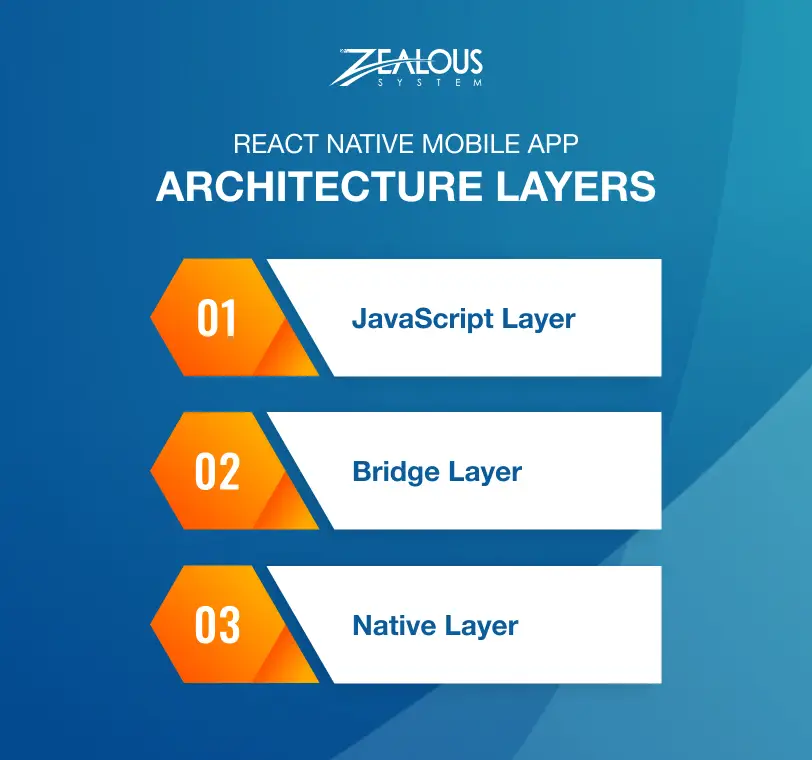
To build scalable and high-performing mobile applications, developers need to understand the React Native mobile app architecture. The architecture of React Native explains how JavaScript code communicates with native platform features while maintaining a responsive user experience.
In a standard React Native app architecture, the application consists of three main layers:
This layered React Native architecture allows developers to write most application logic in JavaScript while still using native device capabilities. Many concepts used in the architecture of React application for web development also influence the React Native architecture pattern, which makes it easier for React developers to transition into mobile app development.
The JavaScript layer forms the core of the React Native mobile app architecture. Developers write most of the application code in this layer using JavaScript and React.
Developers create user interfaces using reusable components, following principles similar to the React app architecture used in web applications. React Native also uses a virtual DOM to update UI elements efficiently and keep the application responsive.
This layer also manages:
Because this layer closely follows the architecture of React application, web developers can quickly adapt to React Native mobile development.
The Bridge layer acts as a communication channel between the JavaScript layer and the Native layer in the React Native architecture.
When JavaScript code needs to access native functionality, the bridge sends messages between the JavaScript thread and the native modules. This communication allows the app to use device capabilities such as:
The bridge makes the architecture React Native flexible because developers can write UI and logic in JavaScript while still accessing native platform features.
The Native layer contains platform-specific code that runs directly on iOS and Android devices. In the architecture of React Native, this layer helps applications deliver native-like performance and user experience.
Developers write native code using:
This layer renders native UI components and manages platform-specific functionalities. Developers can also build custom native modules and integrate them into the React Native app architecture when applications require advanced device capabilities or third-party integrations.
The Native layer plays a critical role in improving app performance, responsiveness, and overall user experience.
Choosing the right React Native architecture pattern plays a major role in building scalable and maintainable applications. A structured React Native mobile app architecture helps teams improve development speed, manage code efficiently, and deliver better app performance.
Different architectural patterns support different project requirements. Some patterns work better for small applications, while others help large-scale apps manage complex data and user interactions more effectively.
Let’s explore some of the most widely used patterns in React Native architecture and the architecture of React applications.
MVC is one of the most common patterns used in React Native app architecture. This structure divides the application into three separate layers: Model, View, and Controller.
Model
The Model manages business logic and application data.
View
The View displays the UI and handles visual presentation.
Controller
The Controller processes user actions and updates the Model or View accordingly.
This React Native architecture pattern helps developers separate concerns and keep the application organized. Many teams use MVC for small and medium-sized projects because it simplifies development and maintenance.
However, as the application grows, the controller layer can become difficult to manage.
MVVM improves React Native mobile app architecture by introducing a ViewModel layer between the UI and business logic.
Model
The Model manages application data and business rules.
View
The View handles user interactions and UI rendering.
ViewModel
The ViewModel connects the View with the Model and manages presentation logic.
This React Native architecture approach improves code reusability and simplifies testing. Developers can update the UI without directly affecting business logic.
Many modern UI frameworks and libraries follow MVVM principles because they help teams create clean and modular architecture of React Native applications.
Flux and Redux focus on unidirectional data flow in React Native architecture. This structure makes application state management more predictable and easier to debug.
Here’s how the flow works:
Redux has become one of the most popular solutions for large React Native app architecture projects because it improves scalability and state management.
Many developers also prefer Redux because it offers strong debugging tools and a large ecosystem.
MobX provides a simpler and more flexible approach to state management in React Native architecture.
MobX uses observable state management. When data changes, the UI updates automatically without requiring complex state handling.
This approach makes the architecture of React Native apps easier to implement and maintain, especially for startups and small-to-medium projects that need faster development.
Developers often choose MobX when they want cleaner code with less boilerplate compared to Redux.
The new React Native architecture introduces major improvements that enhance app performance, scalability, and native communication.
This modern React Native mobile app architecture includes:
Fabric
Fabric improves UI rendering speed and responsiveness.
TurboModules
TurboModules improve communication between JavaScript and native modules.
JSI (JavaScript Interface)
JSI allows direct interaction between JavaScript and native code without relying heavily on the traditional bridge.
These improvements make the new React Native architecture faster and more efficient for modern mobile app development.
As more companies adopt this modern architecture React Native approach, developers can build high-performance applications with better scalability and smoother user experiences.
Many businesses now use the new React Native architecture to create enterprise-grade mobile apps that support long-term growth and advanced functionality.
A strong React Native app architecture helps developers build scalable, maintainable, and high-performing mobile applications. When teams follow the right React Native architecture pattern, they can manage code more efficiently and improve long-term app stability.
Most modern React Native mobile app architecture strategies focus on reusable components, separation of concerns, and proper state management. Developers often follow the Single Responsibility Principle (SRP), where each component handles a specific task. This approach keeps the architecture of React application clean and easier to scale.
A well-planned React Native architecture also improves data flow between components and simplifies debugging, testing, and future updates.
A scalable project structure plays an important role in the React Native architecture. A clean folder structure helps developers organize components, screens, services, APIs, and utilities more effectively.
In a modern React Native mobile app architecture, teams separate business logic from UI components to improve maintainability. This React Native architecture pattern helps developers reuse code and manage large applications more efficiently.
Version control tools like Git also support collaboration and help teams maintain a stable React Native app architecture throughout the development lifecycle.
State management is one of the most important parts of the React Native architecture. It controls how data flows across the application and how components update in real time.
Developers often use local state for simple features within the React Native mobile app architecture. For larger applications, many teams choose Redux to manage centralized data and improve scalability in the React Native app architecture.
The Context API also supports lightweight global state management in the architecture of React Native applications. Choosing the right state management approach helps developers build a more efficient and scalable React Native architecture.
Navigation directly impacts the user experience in the React Native mobile app architecture. A well-designed navigation flow helps users move smoothly between screens and features.
Most developers use React Navigation to handle navigation within the React Native architecture. They implement stack navigation, bottom tabs, and drawer navigation based on application requirements.
A structured navigation system improves usability and strengthens the overall React Native app architecture.
Testing improves the reliability and performance of the React Native architecture. It helps developers identify issues early and maintain application quality throughout development.
Teams commonly use tools like Jest and React Native Testing Library to test components and business logic in the React Native mobile app architecture. Developers also use debugging tools to monitor app performance and resolve runtime issues faster.
Regular testing ensures better stability and improves the overall architecture of React application projects.
API integration connects frontend interfaces with backend services in the React Native mobile app architecture. It allows applications to fetch, update, and manage data efficiently.
Developers handle asynchronous requests, API calls, and CRUD operations within the React Native app architecture. A well-designed API layer improves scalability, performance, and maintainability in the architecture of React Native applications.
Efficient backend integration also supports smoother user experiences and faster application performance.
Security remains a critical part of every React Native architecture. Mobile applications often handle sensitive user data, authentication, and payment information.
Developers secure API communication, encrypt sensitive information, and use secure storage mechanisms within the React Native mobile app architecture. These practices reduce security risks and strengthen the architecture of React application development.
A secure React Native app architecture also helps businesses maintain compliance and protect user data.
Continuous Integration and Continuous Deployment (CI/CD) improve efficiency in the React Native app architecture. Automation helps teams test, build, and deploy applications faster and more consistently.
Developers use CI/CD pipelines to automate workflows in the React Native architecture. This process reduces manual errors, improves release quality, and supports faster updates.
A strong CI/CD strategy helps teams maintain a stable and scalable React Native mobile app architecture while speeding up development cycles.
In conclusion, mastering React Native app architecture is a journey that pays off in the form of scalable, maintainable, and robust applications. By implementing the principles and practices discussed in this guide, you’ll be well-equipped to navigate the complexities of React Native development successfully.
If you’re looking to expedite your project or lack the in-house expertise, consider of to hire React Native app developer or partnering with a reputable offshore React Native app development company. Encourage a modular and scalable mindset, and leverage the resources provided for continuous learning and exploration. Happy coding!
Read Also:
Our team is always eager to know what you are looking for. Drop them a Hi!

Pranjal Mehta is the Managing Director of Zealous System, a leading software solutions provider. Having 10+ years of experience and clientele across the globe, he is always curious to stay ahead in the market by inculcating latest technologies and trends in Zealous.


Comments