A recommendation system (also called a recommendation engine or recommender system) is a type of AI software that analyzes user behavior, preferences, and historical data to suggest products, content, or services a person is likely to want next. It’s the technology behind “customers who bought this also bought,” Netflix’s “because you watched,” and Spotify’s Discover Weekly.
The business case is hard to ignore. Recommendation engines are estimated to influence roughly 35% of Amazon’s revenue, according to McKinsey research cited widely across industry analyses. Netflix saves an estimated $1 billion a year in customer retention because its recommendation algorithm keeps subscribers engaged with content they’re likely to watch. More broadly, McKinsey’s personalization research shows that companies that excel at personalization typically see a 10 to 15 percent revenue lift, alongside a 10 to 30 percent improvement in marketing ROI.
If you run an e-commerce store, a streaming platform, a SaaS product, or any kind of marketplace, you’ve probably asked the same question your competitors are asking: should we build a recommendation system, and what would it actually take?
This guide answers that question from every angle. Whether you’re a founder trying to understand the business case, a technical lead comparing algorithm types, or a growth marketer building a pitch deck, you’ll find what you need here: what recommendation systems are, how they work, what they cost, and how to build one the right way.
At its core, a recommendation system is a software tool that filters through large volumes of data, products, content, users, to predict what a specific person is most likely to want or engage with next. It does this by analyzing patterns: what someone has clicked on, purchased, rated, watched, or searched for, and comparing that behavior against millions of other data points.
Think of it as a digital version of a knowledgeable salesperson who remembers every customer’s preferences and uses that memory to make better suggestions every time they walk in. These systems are common across e-commerce platforms, streaming services, social media apps, and even healthcare and financial platforms, where they help cut through the noise of too many choices and surface the few options that actually matter to that individual user.
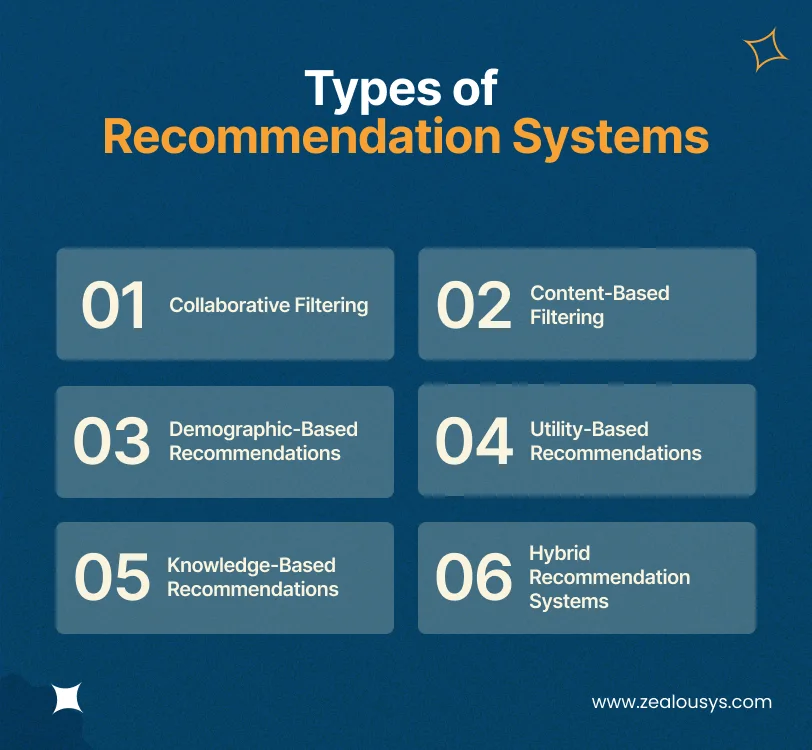
There’s no single way to build a recommendation engine. The right approach depends on your data, your goals, and your industry. Here are the main types in use today.
Collaborative filtering is the most widely used approach, and it works on a simple premise: if users behave similarly, they’ll probably like similar things.
User-based collaborative filtering recommends items based on what similar users have liked. If you and another user both rated several movies highly, the system assumes you’ll enjoy what they enjoyed too.
Item-based collaborative filtering flips this around, looking at relationships between items instead of users. If people who bought Product A frequently also buy Product B, the system will recommend B to anyone who buys A. This is the logic behind Amazon’s “frequently bought together” feature.
Content-based filtering looks at the attributes of the items themselves, genre, category, features, keywords, and recommends items similar to what a user has already engaged with. If someone has been watching action movies, a content-based system will suggest more action movies with similar themes, actors, or directors.
This is a useful question to settle early in your evaluation process: collaborative filtering vs content-based filtering isn’t really an either/or decision for most businesses. Each has blind spots the other can cover, which is why most production systems end up combining them.
These systems use broad user attributes, age, gender, location, rather than detailed behavioral data. They’re simpler to implement but less precise. A fashion retailer recommending different styles to different age groups is a basic example.
Utility-based systems evaluate how useful an item is to a user based on real-time, situational factors like price, availability, or specific requirements. If you’re shopping for a phone, a utility-based system weighs battery life, screen size, and current discounts to surface the best match for your stated priorities.
These systems use explicit, predefined rules about user needs rather than learning from historical behavior. They’re well suited to complex, infrequent purchases, like enterprise software or financial products, where there isn’t enough behavioral data to rely on collaborative or content-based methods.
Hybrid systems combine two or more of the above approaches to cover each other’s weaknesses. Most large-scale, production-grade recommendation engines, including Amazon’s, are hybrid systems that blend collaborative filtering, content-based filtering, and increasingly, deep learning models that can process behavioral sequences in real time.
Recommendation systems have moved well beyond retail and streaming. Here’s how different industries are putting them to work.
Recommendation engines are central to how online retailers drive sales. Amazon’s engine alone is credited with influencing approximately 35% of its total revenue, and broader e-commerce data shows that while product recommendations account for just 7% of site traffic, they generate 24% of orders and 26% of revenue across the industry.
Netflix and Spotify use recommendation systems to keep users engaged with content tailored to their viewing or listening habits. McKinsey research has noted that roughly 75% of what people watch on Netflix originates from recommendations, and Spotify’s Discover Weekly playlist has been a major driver of user growth and retention.
Platforms like Facebook, Instagram, and LinkedIn use recommendation systems to suggest friends, groups, and content based on user interactions, which increases time spent on the platform and drives ad revenue.
Recommendation systems are increasingly used to suggest treatment plans or medications based on a patient’s medical history and similar case outcomes, helping reduce ineffective treatments and improve patient outcomes.
Banks and fintech companies use recommendation engines to suggest credit cards, loans, or investment products based on spending patterns and credit history, a more personalized approach to financial product marketing.
Platforms like Airbnb use recommendation systems to surface accommodations and experiences based on a traveler’s past searches and bookings. Supply chain and inventory management: Recommendation systems help businesses predict demand and optimize ordering strategies by analyzing historical sales data and supplier patterns, reducing waste and stockouts.
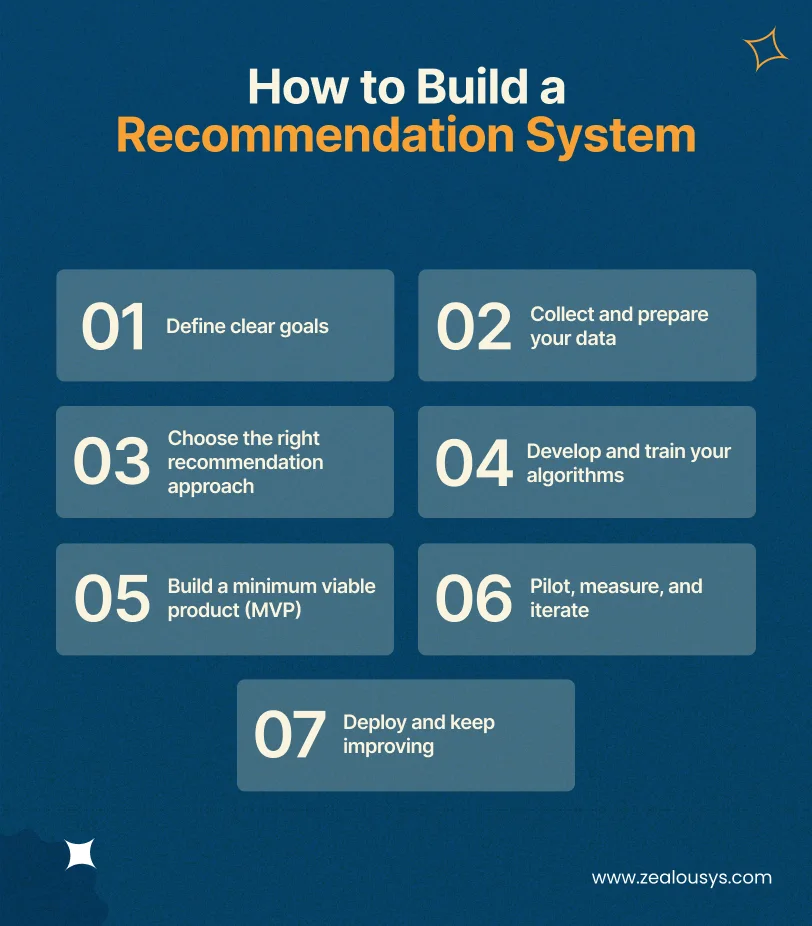
Building a recommendation engine is a structured process. Here’s a practical, step-by-step framework that applies whether you’re building in-house or working with a development partner.
Before any data work begins, decide what success looks like. Are you trying to increase average order value, reduce churn, or improve content discovery? Your goal shapes every decision that follows.
Recommendation systems run on data: user interactions (clicks, purchases, ratings), item attributes (categories, features, descriptions), and user profiles (demographics, preferences). Real-world data is messy, so expect to spend meaningful time cleaning duplicates, filling gaps, and normalizing formats before any algorithm work begins.
Based on your data and goals, decide between collaborative filtering, content-based filtering, or a hybrid model. This decision should be driven by what data you actually have, not by what sounds most sophisticated.
This is where machine learning techniques come in. Models are trained on historical data to recognize patterns and predict what a user is likely to want, then tested against a held-out dataset to check accuracy.
Rather than launching a fully built system, start with a core version that can be tested with real users. This lets you gather feedback and catch issues before investing further.
Run A/B tests comparing the recommendation system’s performance against your existing approach. Track metrics like click-through rate, conversion rate, and average order value to validate real-world impact.
Once validated, scale the system across your platform. Recommendation engines are never “done”: user preferences shift over time, so the system needs feedback loops and regular retraining to stay accurate.
This is usually the question that decides whether a project moves forward. Costs vary significantly based on complexity, data volume, and whether you build custom, use a pre-built platform, or work with open-source tools.
Based on typical industry benchmarks, here’s what businesses can generally expect:
| Project Scale | Estimated Cost Range |
|---|---|
| Small-scale recommendation engine (basic collaborative or content-based filtering) | $10,000 to $30,000 |
| Mid-range customized recommendation system | $30,000 to $50,000 |
| Enterprise-grade, advanced recommendation system (hybrid models, deep learning, real-time personalization) | $50,000 to $150,000+ |
Alternative approaches and their cost implications:
Pre-built platforms and APIs: Services like AWS Personalize or Google AI Recommendations offer lower upfront costs, often priced per prediction (roughly $0.50 to $1.50 per 1,000 predictions), plus infrastructure costs. This is a good entry point for businesses that want to validate the concept before investing in a custom build.
Open-source solutions: Frameworks like TensorFlow, PyTorch, or Surprise are free to use, but require in-house ML expertise, which often shifts the cost from tooling to staffing.
Custom development: A fully custom-built system, the route most mid-size and enterprise businesses take, typically falls in the $10,000 to $150,000+ range depending on complexity, with ongoing maintenance adding 10 to 20% of the initial development cost per year.
These ranges are estimates. The right number for your business depends on the specific factors below.
A handful of variables determine where your project lands on the cost spectrum.
Type of recommendation engine
Basic collaborative or content-based filtering systems cost meaningfully less than hybrid models or systems incorporating deep learning and real-time personalization.
Data volume and quality
The size, variety, and cleanliness of your data has a direct impact on cost. Businesses with fragmented or messy data, duplicate records, missing fields, inconsistent formats, will spend more time and budget on data cleaning and unification before any modeling can begin.
Algorithm complexity
Off-the-shelf algorithms are cheaper to implement than custom-built models tailored to your specific business logic and data patterns.
Integration requirements
Connecting a recommendation system to your existing e-commerce platform, CRM, or app adds development time, especially if custom APIs are required. Cloud infrastructure and hosting. Ongoing hosting and processing costs typically range from $500 to $10,000+ per month depending on traffic volume and data size.
Maintenance and retraining
Recommendation systems degrade in accuracy if left untouched. Budget for ongoing model retraining, performance monitoring, and updates, generally 10 to 20% of the initial build cost annually.
Compliance and data privacy
If your business operates under GDPR, CCPA, or similar regulations, factor in additional cost for ensuring your data collection and storage practices are compliant.
Collaborative filtering recommends items based on the behavior of similar users (or similar items), while content-based filtering recommends items based on the attributes of what a specific user has already engaged with. Most modern systems combine both in a hybrid approach for better accuracy.
Costs typically range from $10,000 for a basic system to $150,000+ for an enterprise-grade, AI-driven recommendation engine, depending on data complexity, algorithm sophistication, and integration needs. Pre-built APIs offer a lower-cost starting point for businesses still validating the concept.
A basic MVP can often be built and piloted within 2 to 4 months. A fully customized, production-ready system with hybrid models and real-time personalization can take 6 to 12 months, factoring in data preparation, model training, testing, and phased rollout.
Not necessarily at the start. Knowledge-based or demographic-based recommendations can work with limited data, while collaborative filtering becomes more accurate as your dataset of user interactions grows. Many businesses start simple and scale up the sophistication of their recommendation approach as their data matures.
E-commerce and streaming are the most visible examples, but recommendation systems are increasingly delivering measurable value in healthcare, financial services, travel, and supply chain management as well.
Recommendation systems have moved from a competitive edge to a baseline expectation, and the data backs that up: from Amazon’s 35% revenue influence to McKinsey’s consistent 10 to 15% personalization revenue lift, the business case is well established across industries.
The real decision isn’t whether to invest in a recommendation system, it’s how to approach it in a way that matches your data maturity, budget, and timeline. Whether that means starting with a pre-built API to validate the concept, or investing in a fully custom hybrid model from day one, the steps outlined in this guide give you a framework to make that call with confidence.
At Zealous System, we specialize in AI software development services and machine learning services, helping businesses design and build recommendation engines that fit their specific data, goals, and budget. With experience across e-commerce, streaming, healthcare, and SaaS platforms, our team can help you move from concept to a production-ready system that delivers measurable results. Let’s talk about what a recommendation engine could look like for your business.
Our team is always eager to know what you are looking for. Drop them a Hi!

Pranjal Mehta is the Managing Director of Zealous System, a leading software solutions provider. Having 10+ years of experience and clientele across the globe, he is always curious to stay ahead in the market by inculcating latest technologies and trends in Zealous.


Comments