Quick Overview
Remote patient monitoring software for UK care homes lets staff track residents’ vital signs, detect falls, and spot early signs of deterioration using connected devices and automated NEWS2 alerts. This 2026 guide explains how RPM software works in a care home setting, the features worth paying for, what CQC and NHS compliance actually requires, typical cost models, and how to decide between an off-the-shelf platform and a custom-built solution. It also walks through the development process for care groups and healthtech founders building their own.
Ask any registered manager what keeps them up at night and you will hear the same three answers: staffing, inspections, and that 3 a.m. phone call about a resident who deteriorated faster than anyone expected.
Remote patient monitoring will not fix rota gaps. What it can do is give your team earlier warnings, cleaner records, and fewer avoidable hospital admissions. And in 2026, with the NHS expanding virtual wards and the Digitising Social Care programme reshaping what inspectors expect to see, the question for most UK care providers is no longer whether to adopt RPM software. It is which route to take: buy a ready-made platform, or build something that fits the way your homes actually run.
This guide covers both paths. Care home operators will find a practical buying checklist. Founders and multi-site groups weighing a custom build will find honest answers on cost, compliance, and process.
Remote patient monitoring (RPM) software collects health data from residents through connected devices, analyses it, and alerts staff or clinicians when something needs attention. In a care home, that usually means a tablet or hub paired with devices measuring blood pressure, pulse, oxygen saturation, and temperature.
Here is the typical flow. A carer takes a resident’s observations using Bluetooth-connected devices. The software records the readings, calculates an early warning score automatically, and flags anything outside the resident’s normal range. If escalation is needed, the data goes straight to a GP, community nursing team, or out-of-hours service, complete with trend history.
A single reading tells a clinician very little. Three weeks of readings showing a slow decline tells them a great deal, and that trend history is what turns an observation into an early warning.
These terms get mixed up constantly, so a quick distinction helps. Telehealth means remote consultations, such as a video call with a GP. Digital social care records (DSCR) replace paper care plans and daily notes. RPM sits between the two: it is the continuous or scheduled collection of health data that feeds both clinical decisions and care records.
The best setups connect all three. Your monitoring data flows into the resident’s digital record, and that record is available during a telehealth consultation.
RPM in care homes goes well beyond vital signs. Most platforms combine several of the following:
Three forces are pushing adoption right now, and none of them is going away.
Virtual wards let residents receive hospital-level care where they live, with care home staff taking observations and submitting them digitally to a clinical team. NHS data showed capacity for around 12,600 virtual ward patients in England by March 2026, and care home residents are part of that picture. Homes with RPM infrastructure already in place are the natural partners for these programmes.
The government has also pledged a wider rollout of remote monitoring across long-term conditions. Once fully running, it expects remote monitoring to free up around 500,000 NHS appointments every year. Care homes that can plug into this system become easier to work with and harder to overlook for local NHS partners.
The Digitising Social Care programme has moved digital care home software from optional to expected. The CQC now looks favourably on providers using digital systems to evidence safe, responsive care. Inspectors want to see how you spot deterioration, how quickly you escalate, and what your records show. RPM software answers all three questions with time-stamped data instead of memory and paper.
Regional NHS programmes are already producing measurable results. In South West London, where 88% of care homes now use digital social care records and shared digital care plans are widespread, participating homes saw a 9% reduction in residents taken to hospital by ambulance. Fewer ambulance journeys mean less distress for residents, fewer disrupted nights for staff, and lower pressure on local A&E.
Similar remote monitoring programmes have run across Sussex, the North East, and the Black Country, each pairing care homes with NHS clinical teams. Expect your local ICB to fund or run something similar within the next commissioning cycle.
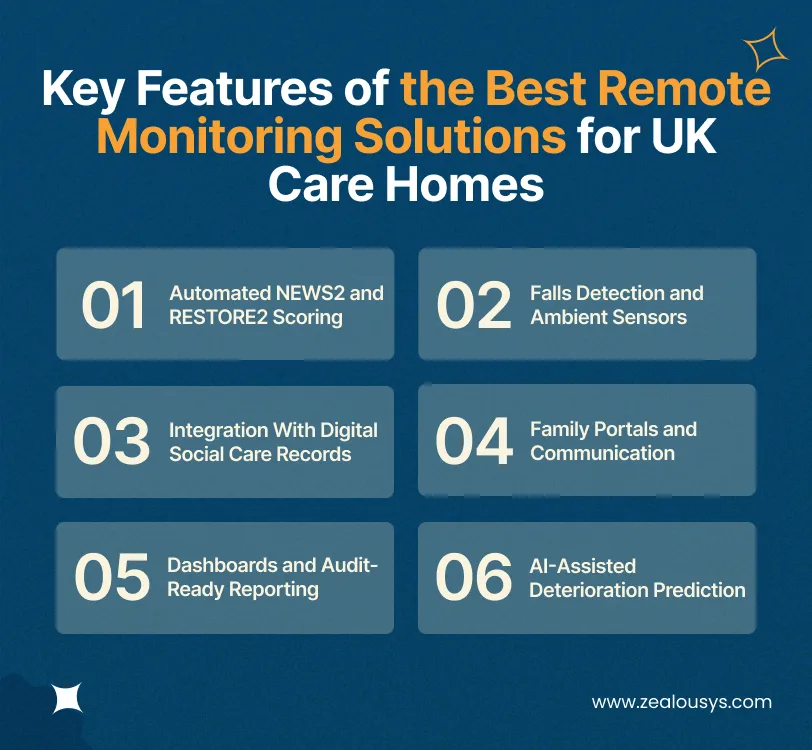
Not every platform earns its licence fee. Whether you are comparing care home monitoring systems or writing a specification for a custom build, these are the features that separate genuinely useful RPM software from a glorified spreadsheet.
The National Early Warning Score (NEWS2) and RESTORE2 are the frameworks NHS clinicians use to assess deterioration. Software that calculates these scores automatically and escalates based on them speaks the same language as the GP on the other end of the referral. This single feature does more to improve care home and NHS communication than anything else on this list.
Falls remain the leading cause of hospital admissions from care homes. Modern falls detection technology combines bed and chair exit sensors, movement detection, and acoustic monitoring to alert staff the moment a high-risk resident is on the move. The goal is not surveillance. It is fewer fractures and fewer unnecessary night-time checks for residents who are sleeping soundly.
Your RPM platform should push data into the DSCR system you already use, whether that is Person Centred Software, Nourish, or another provider, and into GP systems where the local NHS supports it. Without integration, staff end up entering the same data twice, and adoption quietly dies within a month. Interoperability standards such as HL7 FHIR make this possible; our guide on integrating FHIR APIs in healthcare software explains how these connections work in practice.
Families increasingly expect visibility. A portal showing that mum’s observations were taken this morning, and everything looks normal, reduces anxious phone calls and builds the kind of trust that fills beds through word of mouth.
Managers need a home-level view: which residents are trending downward, which observations are overdue, what was escalated, and when. The same data, exported cleanly, becomes your evidence pack when the CQC visits.
The 2026 differentiator. Machine learning models trained on observation histories can flag subtle patterns before a human would, such as small, consistent changes in heart rate or activity that precede an infection. Platforms are also beginning to fold AI into connected clinical records; if this is on your roadmap, our article on integrating AI with existing EHR and EMR systems covers the practical approaches.
Compliance is where many RPM projects, bought or built, come unstuck. Here is what applies in the UK, in plain terms.
The CQC does not certify software. It assesses whether your service is safe, effective, and well-led. Your RPM system supports this by evidencing consistent monitoring, timely escalation, and accurate records. Choose or build software that makes that evidence easy to produce.
Resident health data is special category data. That means a lawful basis for processing, a completed Data Protection Impact Assessment, clear consent processes (including capacity considerations under the Mental Capacity Act), and UK or adequate-territory data residency.
The Digital Technology Assessment Criteria are the NHS’s baseline for any digital health tool used in its programmes. If you ever want your platform used within virtual wards or ICB-funded projects, DTAC conformance is the entry ticket. It covers clinical safety (DCB0129/DCB0160), data protection, security, interoperability, and usability.
Organisations handling NHS patient data complete the DSP Toolkit annually. Your software should make the technical requirements, such as access controls, audit logs, and encryption, straightforward to evidence.
MHRA classification catches many first-time builders off guard. If your software calculates scores that inform clinical decisions, it may qualify as a medical device under UK regulations, requiring UKCA marking and a quality management system. This is a genuine legal question, not a checkbox, and it needs assessing early in any custom build. Get regulatory advice before you write a line of code, not after.
None of these blocks a well-planned project. Compliance designed in from day one is a workstream. Compliance bolted on at the end is a rebuild.
The answer depends on the route you take. Licensed platforms charge on subscription. Custom builds are a one-time development investment. Here is how both models break down, with ranges drawn from real UK healthcare project scoping.
Ready-made platforms usually charge per resident per month, or per home per month, often with hardware (tablets, observation kits, sensors) supplied on lease or purchased upfront. Add implementation fees, training, and sometimes charges for integrations with your existing care home management software. For a single small home, this model is usually the sensible choice. For a 20-home group, per-resident fees compound into a significant annual line that never ends and never becomes an asset.
A custom build inverts the model: higher upfront investment, then ownership. As an indicative guide to RPM app development costs, based on typical development partner rates for UK healthcare projects:
| Tier | Typical Cost | Timeline |
|---|---|---|
| Basic MVP | £8,000 – £16,000 | 3 – 5 months |
| Mid-range platform | £16,000 – £36,000 | 5 – 8 months |
| Advanced/complex build | £36,000 – £60,000+ | 9 – 12 months |
Treat these as planning ranges rather than quotes. The two variables that move budgets most are integration depth and regulatory classification, and both get pinned down during discovery.
Custom development rarely makes financial sense for one home. It starts making sense for multi-site groups doing the licensing maths over five years, and for healthtech founders whose product is the platform.
Whichever route you take, budget for training time, Wi-Fi upgrades in older buildings, device replacement, and the few months of parallel running while staff trust the new system. These soft costs sink more RPM projects than software fees do.
The table below summarises the trade-offs. The two sections after it cover the situations where each route wins.
| Factor | Off-the-Shelf | Custom Build |
|---|---|---|
| Time to launch | Weeks | Months |
| Upfront cost | Low | High |
| Long-term cost (multi-site) | Compounds per resident | Fixed, then maintenance |
| Fit with your workflows | You adapt to it | It adapts to you |
| Integrations | Limited to the vendor’s list | Anything with an API |
| Data and roadmap ownership | Vendor’s | Yours |
| Competitive differentiation | None | Full |
You run one to three homes, your needs match the mainstream (vital signs, NEWS2, alerts), and your local ICB may already fund a specific platform through a regional programme. A funded, NHS-backed, clinically supported platform beats a bespoke build in this scenario every time.
You operate a larger group and want monitoring woven into your own systems rather than another vendor silo. You serve a specialist population, such as dementia, learning disabilities, or complex nursing needs, that generic platforms handle poorly. Or you are a healthtech founder: the platform is your product, and you cannot build a company on someone else’s white-label remote patient monitoring platform forever. In each case, custom remote patient monitoring software development is the route that holds up over a five-year horizon.
There is a middle path worth naming: some providers start on an off-the-shelf platform to learn what their teams actually use, then build custom once the requirements are proven. Nothing wrong with that sequence.
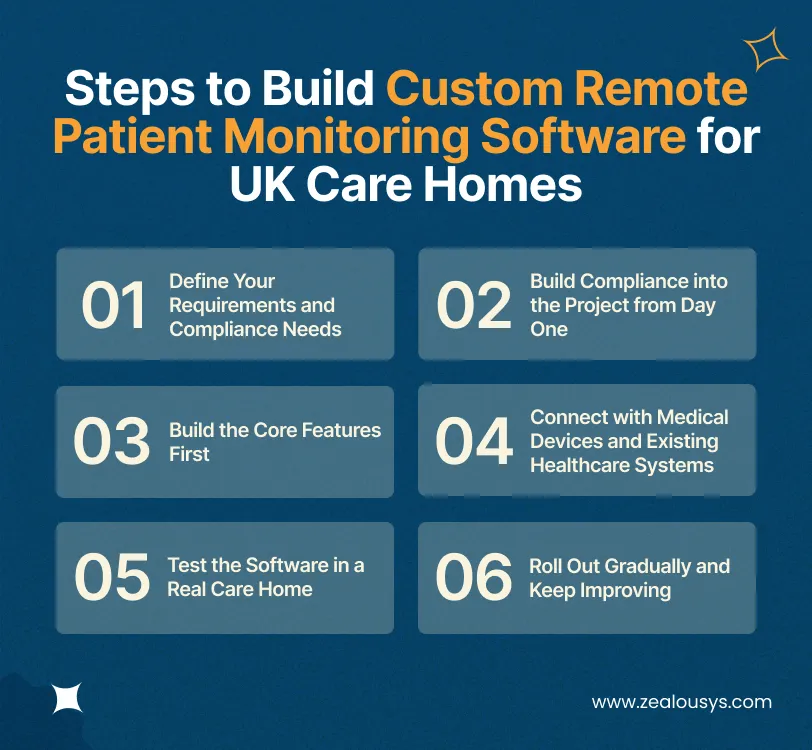
If you’re planning to build a custom remote patient monitoring (RPM) solution, following a structured development process is far more important than rushing to launch. Each stage helps ensure your software is secure, compliant, easy to use, and aligned with the day-to-day needs of UK care homes.
Start by understanding what your software needs to achieve. Which residents will be monitored? What health data needs to be collected? Who should receive alerts, and when?
At the same time, identify the regulatory requirements that apply to your solution. If the software performs clinical assessments or supports medical decisions, it may fall under UK medical device regulations. This is also the right time to identify the systems and devices you’ll need to connect with, such as Digital Social Care Records (DSCR), NHS or GP systems, and remote monitoring devices.
Compliance should never be treated as a final checklist before launch. Building it into the project from the beginning saves time and reduces risk later.
During this stage, your team should complete a Data Protection Impact Assessment (DPIA), prepare Digital Technology Assessment Criteria (DTAC) documentation, and carry out clinical safety assessments under DCB0129. Working with a Clinical Safety Officer early helps identify potential risks before development begins.
Rather than trying to launch every feature at once, focus on the essentials.
Your first version should allow caregivers to record vital signs, calculate NEWS2 scores, generate alerts for abnormal readings, and maintain secure patient records. Once these core workflows have been tested successfully, you can introduce advanced features such as AI-powered health insights, family portals, medication management, or predictive analytics.
A remote patient monitoring platform is most valuable when it works seamlessly with the tools care teams already use.
This usually involves integrating Bluetooth-enabled medical devices, wearable sensors, Digital Social Care Records (DSCR), and NHS or GP systems. Using interoperability standards like HL7 FHIR makes it easier for different healthcare systems to exchange information securely while reducing manual data entry.
Before rolling the platform out across multiple locations, run a pilot in a single care home for several weeks.
This allows you to see how staff use the system in everyday situations, whether alerts are accurate, and where workflows can be improved. Feedback from caregivers and residents during this stage is often more valuable than assumptions made during planning.
Once the pilot is complete, refine the software based on real-world feedback before expanding to additional care homes.
Provide practical training that fits around staff shift patterns, monitor system performance, and release regular updates as healthcare regulations and NHS standards evolve. Over time, you can introduce additional capabilities such as predictive analytics, deeper EHR and EMR integrations, and AI-driven health monitoring.
The CQC does not approve or certify software. What matters is whether your service uses the software to deliver safe, well-documented care. Choose systems that produce clear audit trails and escalation records, since those become your inspection evidence.
Care staff take scheduled observations with connected devices, the software scores them automatically, and anything abnormal triggers an alert to senior staff or an NHS clinical team. Sensors handle passive monitoring, such as falls risk and overnight activity, between scheduled checks.
Yes, provided the platform supports open standards. Ask vendors specifically which DSCR and GP systems they integrate with today, not on the roadmap. For custom builds, HL7 FHIR-based integration makes most UK systems reachable.
RPM is the technology: devices, software, alerts. A virtual ward is an NHS service model in which a clinical team cares for a patient remotely, often using RPM as its data layer. A care home resident on a virtual ward typically has observations taken by care staff and reviewed by the NHS team.
Possibly. Software that informs clinical decisions, such as automated early warning scoring, may be classified as a medical device requiring UKCA marking. This depends on exactly what the software claims to do, so get a regulatory assessment during discovery.
Around three to five months for a compliant MVP and nine to twelve months for a full-featured, multi-site platform, including pilot time. Compliance work runs in parallel with development rather than after it.
At Zealous System, we build remote patient monitoring software for UK care homes and healthtech founders who have outgrown off-the-shelf, from care groups wanting monitoring that fits their workflows to startups taking an RPM product to market. As a healthcare software development company serving UK providers, our teams have delivered healthcare software development projects spanning remote monitoring, records systems, and hospital management platforms, with compliance designed in from the discovery phase rather than retrofitted.
The pattern we see repeatedly: the providers who succeed with RPM are the ones who treat it as a care quality project with a software component, not the other way around. The technology is the easy half. Getting it adopted by a night shift in February is the real work, and that is where experience counts.
If you are weighing a build or trying to work out whether your idea triggers medical device classification, a short conversation early can save months later. You can reach out to our team.
Our team is always eager to know what you are looking for. Drop them a Hi!

Pranjal Mehta is the Managing Director of Zealous System, a leading software solutions provider. Having 10+ years of experience and clientele across the globe, he is always curious to stay ahead in the market by inculcating latest technologies and trends in Zealous.


Comments