Quick Answer: Risk management software in Australia is a platform that helps businesses identify, assess, monitor, and respond to operational, financial, cyber, and compliance risks from a single centralised system. In 2026, Australian businesses prioritise custom risk management software development to meet APRA CPS 230 operational risk requirements, which were updated with targeted amendments in April 2026 and fully commenced for non-significant financial institutions on 1 July 2026. Key features include risk registers, real-time monitoring and alerts, incident management, compliance workflows, and audit trails. Development costs range from AUD 15,000 for a basic MVP to AUD 75,000 and above for enterprise GRC platforms, depending on scope, compliance depth, and system complexity.
Australian businesses in 2026 are operating under the most demanding risk and compliance environment in recent memory. Cyber attacks and data breaches remain the leading operational concern across every major sector. APRA tightened its operational risk standard with targeted CPS 230 amendments that took effect on 1 July 2026, and ASIC continues to sharpen enforcement across financial reporting, private credit, and governance. Meanwhile, the Australia risk management market is growing at 12.55% annually and is projected to reach USD 782 million by 2033.
Against this backdrop, manual risk tracking using spreadsheets or siloed legacy tools cannot keep pace with regulatory demands or emerging threat complexity. Developing custom risk management software in Australia gives organisations a direct, scalable way to address these pressures: centralising risk data, automating compliance reporting, and enabling faster, evidence-based decision-making across finance, insurance, healthcare, mining, construction, and logistics. [Source: IMARC Group, Australia Risk Management Market]
This guide covers what risk management software is, why Australian businesses need it now, the types available, essential features, 2026 compliance requirements, the development process, cost breakdown, and answers to the most common questions from Australian organisations evaluating a build versus buy decision.
Understanding the scale of investment in risk management technology helps Australian organisations benchmark their own spending and understand where the regulatory and competitive pressure is coming from.
| Metric | Figure | Source |
|---|---|---|
| Australia risk management market (2024) | USD 270 million | IMARC Group |
| Australia risk management market (2033 forecast) | USD 782 million (12.55% CAGR) | IMARC Group |
| Australia information security spend (2026) | AU$7.5 billion | Gartner, March 2026 |
| Australia security software spend (2026) | AU$3.3 billion (up 12.3%) | Gartner, March 2026 |
| Global risk management market (2026) | USD 17.23 billion | Coherent Market Insights |
| Global risk management market (2033 forecast) | USD 46.96 billion (15.4% CAGR) | Coherent Market Insights |
| Asia-Pacific share of global risk management market | 20.2% (fastest growing region) | Coherent Market Insights |
| Digital risk management global market (2026) | USD 15.3 billion (16.8% CAGR to 2030) | Research and Markets |
Australian organisations will spend more than AU$7.5 billion on information security in 2026, an increase of 9.5% from 2025. Security software alone accounts for AU$3.3 billion of that spend, growing at 12.3% year on year, driven primarily by the rapid adoption of AI in cybersecurity and the cybersecurity talent shortage pushing organisations toward software-driven solutions. [Source: Gartner, March 2026]
The global risk management market, valued at USD 17.23 billion in 2026, is growing at a 15.4% CAGR through 2033. Asia-Pacific holds a 20.2% share and is the fastest growing region globally, driven by expanding industrialisation, digital transformation, and increasing regulatory attention in countries including Australia. [Source: Coherent Market Insights]
Risk management software is a specialised platform that helps organisations systematically identify, evaluate, monitor, and mitigate threats to their operations, finances, compliance obligations, and reputation. Rather than managing risks across disconnected spreadsheets, email threads, and siloed departmental systems, risk management software centralises all risk information into a single governed platform where every risk is visible, assigned, tracked, and reportable.
Modern risk management platforms include automated workflows that route risks for assessment and sign-off, real-time dashboards that show the current risk profile of the organisation, and notification systems that alert risk owners when indicators change or thresholds are breached. In regulated Australian industries, risk management software also includes built-in compliance frameworks that map organisational controls to specific regulatory requirements, producing the audit trails and regulatory reports that APRA, ASIC, and the Office of the Australian Information Commissioner require.
Custom risk management software development in Australia goes further by aligning the platform precisely with your organisation’s unique processes, data structures, and sector-specific challenges. A custom-built enterprise risk management system for an Australian bank operates on fundamentally different logic from one built for a mining company, even though both manage risk. Custom development produces a system that fits your workflows from day one rather than requiring your workflows to adapt to a generic vendor template.
Several converging pressures in 2026 make the case for purpose-built risk management software stronger for Australian organisations than at any previous point.
Australian organisations face a persistently elevated cyber threat environment. A 2023 survey by the Australian Institute of Criminology found that 47% of respondents experienced at least one cybercrime in the preceding 12 months. The scale of incidents has since intensified: in January 2024, a Russian cyber group infiltrated 65 Australian government departments, stealing 2.5 million documents in the country’s largest government cyberattack on record. Ransomware, business email compromise, and supply chain attacks continue to affect organisations in every sector. Gartner predicts that over 75% of enterprises will use AI-amplified cybersecurity products for most security use cases by 2028, up from less than 25% in 2025, underscoring how rapidly the threat and response landscape is changing. [Source: Gartner, March 2026]
APRA’s CPS 230 Operational Risk Management standard, effective from 1 July 2025 for significant financial institutions and from 1 July 2026 for non-significant financial institutions, imposes mandatory requirements for operational risk frameworks, business continuity planning, and material service provider oversight. APRA finalised targeted amendments to CPS 230 on 30 April 2026, introducing limited exemptions for non-traditional service providers such as central banks and government agencies, while tightening requirements in other areas. Entities that cannot demonstrate CPS 230 compliance face regulatory scrutiny, reputational damage, and potential operational restrictions. [Source: APRA, April 2026]
ASIC’s 2026 priorities include private credit practices, insurance claims handling, financial reporting quality, and misleading pricing. Sound risk cultures and timely breach identification and reporting remain central expectations across all regulated activities. These obligations require documentation, audit trails, and reporting workflows that manual systems cannot efficiently support.
Organisations still relying on spreadsheets and email to manage risk face a fundamental problem: there is no single source of truth, no audit trail of who assessed what risk and when, and no automated mechanism to flag when a risk changes status or a regulatory deadline approaches. In an environment where APRA is conducting active supervisory reviews of CPS 230 implementation and ASIC can request evidence of risk governance at short notice, the inability to produce accurate, timestamped risk records is a material compliance risk in itself.
Australian enterprises select different types of risk management software based on their size, regulatory obligations, and primary risk categories. Most organisations eventually combine elements from multiple types into a unified platform.
Enterprise risk management software provides a full organisational view of risk across strategic, operational, financial, and reputational dimensions. Large Australian banks, insurers, superannuation funds, and mining companies use ERM systems to make risk visible at board and executive level, connect risks across business units, and demonstrate the governance structures that regulators expect. ERM software typically includes risk heat maps, risk appetite frameworks, scenario analysis tools, and board reporting modules.
GRC platforms are the standard choice for APRA and ASIC-regulated entities in Australia. They manage policies, track regulatory obligations, map controls to requirements, and generate audit-ready reports. In 2026, the most capable GRC platforms include automated horizon scanning that identifies new or amended regulations and maps them to existing control frameworks, reducing the manual effort required to keep compliance documentation current. This matters particularly as APRA’s CPS 230 amendments and the updated Material Service Provider Register requirements need to be reflected in compliance systems quickly.
Operational risk software targets the day-to-day risks arising from people, processes, systems, and external events. Construction and mining organisations use operational risk platforms primarily for safety incident reporting, near-miss logging, hazard identification, and contractor risk assessment. Field workers report incidents via mobile apps, managers receive real-time alerts, and safety teams use the data to identify patterns and prevent recurrence. These systems also support compliance with the Work Health and Safety Act and related state-based obligations that require ongoing documented risk assessment.
With Australia spending AU$7.5 billion on information security in 2026 and cyber threats continuing to evolve, dedicated IT and cyber risk management platforms have become essential infrastructure for financial services, healthcare providers, and any organisation holding significant volumes of personal data. These platforms integrate with existing security tools to aggregate vulnerability data, map cyber risks to business impacts, manage incident response workflows, and generate the reporting that APRA CPS 234 Information Security compliance requires. CPS 234 mandates that APRA-regulated entities maintain information security capabilities commensurate with the size and extent of threats to their information assets.
Financial institutions use specialised platforms to manage market risk, credit risk, liquidity risk, and counterparty exposure in real time. The global financial risk management software market is projected to grow from USD 4.79 billion in 2026 to USD 13.31 billion by 2034. In Australia, APRA-regulated banks and insurers require these systems to produce the quantitative risk reports that APRA’s prudential reporting framework demands, including capital adequacy calculations and stress test outputs.
The following features form the foundation of any effective risk management software system for Australian organisations in 2026. Custom risk management software development allows these features to be configured precisely to your organisation’s risk taxonomy, workflows, and regulatory context.
A risk register is the foundational record of every identified risk the organisation faces. A well-designed risk register captures risk description, category, risk owner, inherent rating, current controls, residual rating, and the treatment plan. In Australian regulated environments, the risk register must be accessible to board and senior management, linked to the organisation’s risk appetite statement, and reviewable on demand by APRA or ASIC during supervisory reviews.
Risk scoring tools allow organisations to rate risks consistently across the business using agreed likelihood and consequence scales. Custom software allows you to configure these scales to match your organisation’s risk appetite framework, which is a requirement under APRA CPS 230. Advanced platforms include quantitative risk modelling tools that produce numerical distributions of potential loss rather than just high, medium, and low labels, giving executives and the board more precise information for risk-based resource allocation.
Key risk indicator monitoring continuously tracks metrics that signal changing risk levels, from network anomaly detection for cyber risk to financial ratio monitoring for credit risk to safety incident rates for operational risk. Automated alerts notify risk owners and senior management when indicators cross predefined thresholds, enabling faster responses than manual monitoring can provide. This capability is directly relevant to APRA CPS 230’s requirement for entities to maintain the ability to detect and respond to material operational incidents promptly.
Incident logging and management workflows guide risk teams through the full incident lifecycle from initial reporting through investigation, root cause analysis, corrective action, and closure. For APRA-regulated entities, this module also manages the mandatory incident notification workflow: CPS 230 requires regulated entities to notify APRA of material operational incidents within 24 hours of becoming aware. Automated notification workflows within the incident management module significantly reduce the risk of missing these mandatory reporting deadlines.
Australian organisations in regulated industries manage obligations under multiple simultaneous frameworks: APRA CPS 230, CPS 234, the Corporations Act, the Privacy Act (amended in late 2024 with significantly strengthened enforcement powers), the Anti-Money Laundering and Counter-Terrorism Financing Act (with reforms extending to additional entity types in 2026), and sector-specific requirements. Compliance management modules track each obligation, assign ownership, monitor completion of required activities, and maintain the evidence trail that audit committees and regulators expect.
APRA CPS 230 places significant emphasis on material service provider oversight, requiring regulated entities to maintain a complete and current MSP Register, assess the operational resilience of critical suppliers, and ensure contractual arrangements meet the requirements of the updated standard. A dedicated vendor risk module tracks supplier assessments, contract renewal dates, risk ratings, and the contractual provisions required under CPS 230, reducing the manual effort of MSP Register maintenance and providing evidence of ongoing oversight during APRA supervisory reviews.
Immutable audit trails that capture who assessed each risk, what decision was made, and when are a non-negotiable requirement in APRA-regulated environments. Board reporting modules produce risk dashboards and narrative reports in the format that board risk committees and audit committees expect, without requiring manual compilation of data from multiple systems. This reduces the finance and risk team effort involved in board cycle reporting and improves the consistency and timeliness of the information reaching governance bodies.
For mining, construction, healthcare, and logistics organisations where risk events occur outside the office, mobile-optimised risk reporting tools allow field workers to log incidents, complete risk assessments, and photograph hazards directly from a smartphone or tablet. Offline capability ensures that reports can be completed in remote areas without connectivity and synchronised when a network connection becomes available.
In 2026, the most forward-looking risk management software deployments integrate AI and machine learning to move from descriptive risk reporting, showing what happened, to predictive risk intelligence, showing what is likely to happen. AI models trained on historical incident data, key risk indicator trends, and external threat feeds can identify which risks are deteriorating before they reach breach threshold, surface correlations between risks that human analysts might miss, and recommend treatment actions based on patterns from comparable organisations.
APRA has publicly acknowledged AI’s potential role in compliance automation while emphasising that human oversight must remain in the loop. The regulator’s position, summarised by APRA member Therese McCarthy Hockey as ‘AI can be a valuable co-pilot but it should never be your autopilot,’ shapes how AI should be positioned within risk management software for regulated entities: supporting human decision-making rather than replacing it. [Source: Experteq, APRA 2025 Updates]
Custom risk management software development in Australia must incorporate the specific compliance requirements that apply to your organisation’s sector. The following frameworks are most relevant in 2026.
CPS 230 is APRA’s primary operational risk standard, applying to banks and other authorised deposit-taking institutions, insurers, and superannuation licensees. It took effect on 1 July 2025 for significant financial institutions. Non-significant financial institutions have until 1 July 2026 for full commencement, including business continuity planning and scenario analysis requirements. APRA finalised targeted amendments to CPS 230 on 30 April 2026, introducing limited exemptions for non-traditional service providers including government agencies, regulators, central banks, and financial market exchanges, where contractual compliance with the standard’s requirements is not practicable. [Source: APRA, April 2026]
CPS 230 risk management software requirements centre on five areas. First, the entity must maintain and regularly test an operational risk management framework appropriate to its size and complexity. Second, critical operations must be identified and tolerance levels for disruption set, documented, and tested. Third, a complete and current Material Service Provider Register must be maintained and submitted to APRA. Fourth, material operational incidents must be reported to APRA within 24 hours of detection. Fifth, boards must have clear accountability for risk framework oversight and receive regular, evidenced reporting from management.
CPS 234 requires APRA-regulated entities to maintain information security capabilities that are commensurate with the scale and sophistication of threats to their information assets. Key requirements include classifying information assets by criticality and sensitivity, defining security roles and responsibilities up to board level, implementing controls proportionate to the sensitivity of information assets managed by the entity and by third parties, and conducting regular security control testing and independent reviews. CPS 234 and CPS 230 are increasingly treated as a unified operational resilience programme rather than separate compliance exercises: a major cyber incident is simultaneously a CPS 234 information security event and a CPS 230 material operational incident requiring prompt APRA notification.
ASIC’s 2026 supervisory priorities include private credit practices, insurance claims and complaints handling, financial reporting quality, and misleading pricing conduct. Across all regulated activities, ASIC expects sound risk cultures where potential breaches are identified promptly, investigated thoroughly, and reported to ASIC within the mandatory timeframes. Risk management software that automates breach identification, tracks investigation workflows, and maintains the notification records supports demonstrable compliance with ASIC’s conduct expectations.
The Privacy Act was significantly strengthened in late 2024, with enhanced enforcement powers for the Office of the Australian Information Commissioner and increased penalties for serious or repeated privacy interferences. A children’s online privacy code is due to commence by late 2026. Risk management software that handles personal information must itself comply with the Privacy Act, including maintaining records of personal information holdings, implementing appropriate security safeguards, and supporting data subject rights including access and correction requests.
Mining and construction organisations operate under the Work Health and Safety Act and related state-based legislation that requires ongoing documented hazard identification, risk assessment, and incident reporting. AML/CTF reforms extending in 2026 require additional entity types to implement and document risk-based customer due diligence programs. Risk management software built for these sectors must align with the specific documentation and reporting formats that the relevant regulators use.
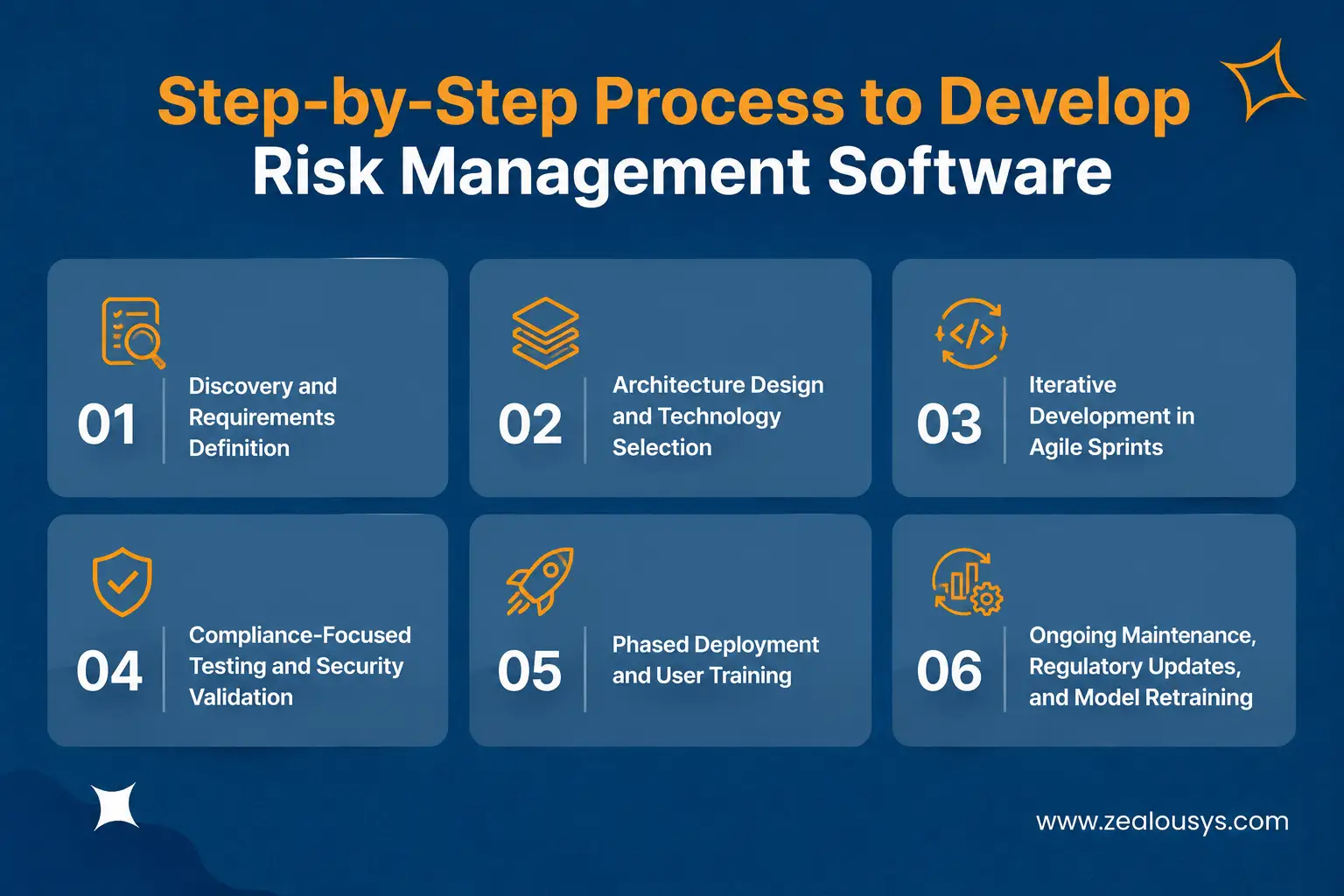
Effective risk management software development begins with a structured discovery phase that brings together stakeholders from risk, compliance, IT, operations, and the business. The objective is to document the specific risks your organisation faces, the regulatory obligations that apply to your sector, the workflows you currently use to manage risks, and the gaps in your current approach. This phase produces a detailed requirements specification that forms the basis of all subsequent design and development decisions, and ensures that compliance with APRA CPS 230, ASIC obligations, and privacy requirements is designed in from the start rather than retrofitted later.
The technical architecture of risk management software must address several Australian-specific considerations. Data sovereignty requirements mean that for most APRA-regulated entities, personal and sensitive data must be stored and processed within Australian borders, which typically means deploying on Australian-region cloud infrastructure with AWS, Microsoft Azure, or Google Cloud. The architecture must support role-based access control so that different risk categories are accessible only to authorised staff. Integration points with existing systems, including financial management platforms, HR systems, and operational databases, must be designed at this stage to avoid costly retrofitting later.
Building risk management software in two-week agile sprints with a working demonstration at the end of each cycle gives your organisation continuous visibility into development progress and the ability to course-correct before significant effort has been invested in a wrong direction. Sprint priorities are sequenced so that the core risk register and assessment workflow are functional early, allowing compliance stakeholders to validate that the system’s taxonomy and workflows match their regulatory requirements before secondary features are built.
Risk management software for Australian regulated entities requires a testing programme that goes beyond standard functional testing. Security testing must cover the application’s resistance to common vulnerabilities including injection attacks, authentication weaknesses, and data exposure. Penetration testing by an independent specialist is standard practice for systems that will handle sensitive operational and compliance data. Regulatory scenario testing validates that the software correctly handles the specific workflows that APRA and ASIC reviewers will examine: incident notification within 24 hours, MSP Register completeness, and audit trail integrity.
Deploying risk management software in phases, beginning with a pilot group before full rollout, reduces the operational risk of the transition and generates practical feedback that can be incorporated before all users are on the new system. Training should be role-specific: risk managers need deep training on configuration and reporting, while field users need focused training on the incident logging and risk assessment workflows they will use daily. Successful adoption is a critical success factor for risk management software: a system that is not used consistently undermines the single-source-of-truth benefit that justifies the investment.
Risk management software is not a one-time build. APRA issues regulatory updates, ASIC revises guidance, the Privacy Act evolves, and the threat landscape changes. Ongoing maintenance must include a mechanism for incorporating regulatory changes into the compliance framework mappings within the software, scheduled security patch updates, performance monitoring, and for AI-powered risk analytics modules, periodic model retraining on current data to prevent prediction accuracy from degrading as the environment changes.
Development cost for risk management software in Australia depends on the scope of the platform, the compliance depth required, the number of system integrations, and the development model used. The table below provides current benchmarks.
| Solution Type | Approximate Cost | What Is Included |
|---|---|---|
| Basic Risk Management MVP | AUD 15,000 to AUD 40,000 | Risk register, basic scoring, simple dashboards, user roles. Suited to SMEs and startups beginning to digitalise risk tracking. |
| Mid-Level Risk and Compliance Software | AUD 40,000 to AUD 70,000 | APRA and ASIC-aligned reporting, audit trails, mitigation workflows, alerts, approval workflows. Suited to regulated SMEs. |
| Enterprise ERM and GRC Platform | AUD 75,000 and above | Full ERM modules, multi-department access, third-party system integrations, advanced analytics, enterprise security. Suited to large regulated enterprises. |
| Offshore Development Model (via Zealous) | 30 to 50% lower than Australian market rates | Same compliance depth and delivery quality at significantly reduced total cost through an offshore-onshore hybrid model. |
Custom risk management software development in Australia pays off when the scope matches your current and future needs. It becomes a worthwhile investment once you weigh these costs against the benefits of better compliance and risk control.
The integration of artificial intelligence and machine learning into risk management software is the defining trend of 2026 for Australian regulated entities. AI is being applied across four specific areas that were previously dependent on manual analysis.
Machine learning models trained on historical risk event data, key risk indicator trends, and operational metrics can identify which risks are most likely to materialise in the near term before they reach breach threshold. This moves risk management from a reactive posture, identifying risks after they have caused harm, to a predictive one, flagging deteriorating risk positions while there is still time to intervene. For Australian banks and insurers, predictive analytics built into GRC software can also support APRA’s requirement for scenario analysis under CPS 230 by generating data-driven scenario parameters rather than relying solely on expert judgment.
AI-powered regulatory horizon scanning tools monitor APRA, ASIC, the OAIC, and other Australian regulatory sources in real time and automatically identify new or amended requirements that may affect an organisation’s compliance obligations. When the April 2026 CPS 230 amendments were published, organisations with AI-powered GRC platforms were able to identify the impact on their MSP Register and contractual arrangements automatically, rather than relying on compliance teams to manually review the amendment documentation. This capability becomes more valuable as Australia’s regulatory output continues to increase in volume and complexity.
Assessing the operational resilience of material service providers at the scale required by CPS 230 is a significant manual effort for large Australian financial institutions with complex supplier ecosystems. AI tools that can automatically score vendor responses to security questionnaires, flag inconsistencies in vendor-provided documentation, and monitor publicly available signals of vendor distress, including security breach disclosures, financial news, and regulatory actions, reduce the resource burden of ongoing MSP oversight.
NLP models can review new contracts and policies against a library of required clauses and flag gaps or non-standard terms that require legal review. For APRA-regulated entities managing material service provider contracts under CPS 230, NLP-powered contract review tools can automatically flag whether each contract contains the required APRA access and notification provisions, significantly accelerating the contract uplift programme that the July 2026 CPS 230 deadline required.
Zealous System builds custom risk management, ERM, and GRC software for Australian businesses that require compliance-aligned, secure, and scalable solutions. Our development team combines technical depth in enterprise software engineering with specific knowledge of Australian regulatory requirements across APRA CPS 230, CPS 234, ASIC governance obligations, and the Privacy Act.
Our offshore development model gives Australian businesses access to senior engineers, solution architects, and compliance-aware developers at significantly lower cost than Australian market rates, without sacrificing delivery quality, communication standards, or regulatory alignment. We operate on Australian business hours overlap, use transparent agile delivery with regular stakeholder reviews, and maintain comprehensive documentation throughout the development process.
We have delivered workforce and project management software for Australian mining operations, demonstrating our practical understanding of the operational and regulatory environment Australian enterprises face. Whether you need a focused compliance module to meet an immediate APRA requirement, a full ERM platform to replace a legacy system, or a greenfield GRC build that consolidates risk management across multiple business units, Zealous System can scope, build, and support the solution.
Risk management software is a platform that centralises an organisation’s risk data, workflows, and compliance obligations in one governed system. It replaces disconnected spreadsheets and email-based risk tracking with a structured environment where risks are logged, assessed, treated, monitored, and reported consistently. For Australian regulated entities, risk management software also provides the audit trails, regulatory reporting outputs, and incident notification workflows that APRA and ASIC require.
APRA CPS 230 requires regulated entities to maintain an operational risk management framework, identify critical operations and set tolerance levels, maintain a complete Material Service Provider Register, report material operational incidents to APRA within 24 hours, and provide boards with regular evidenced risk reporting. Targeted amendments to CPS 230, finalised by APRA on 30 April 2026, introduced limited exemptions for non-traditional service providers and took effect on 1 July 2026. Risk management software that supports CPS 230 compliance must include risk register functionality, incident management workflows with automated APRA notification, MSP Register maintenance, and board reporting modules. [Source: APRA, April 2026]
APRA CPS 234 Information Security requires regulated entities to maintain information security capabilities commensurate with the size and nature of threats to their information assets, classify assets by criticality and sensitivity, conduct regular control testing, and notify APRA of material information security incidents. For risk management software, this means that cyber risk must be a managed risk category within the platform, with specific key risk indicators, control assessments, and incident workflows aligned to CPS 234 requirements. Many Australian financial institutions treat CPS 230 and CPS 234 as a unified operational resilience programme, building a single risk platform that serves both standards.
Basic risk management MVP development for an Australian SME costs approximately AUD 15,000 to AUD 40,000. A mid-level risk and compliance platform with APRA and ASIC-aligned reporting costs AUD 40,000 to AUD 70,000. An enterprise ERM and GRC platform for a large regulated entity starts from AUD 75,000 and can exceed this significantly based on the number of modules, integrations, and compliance frameworks required. Ongoing maintenance typically runs at 15 to 20% of the initial development cost annually. Using an offshore development partner can reduce total development cost by 30 to 50% compared to equivalent Australian market rates.
Enterprise Risk Management software provides an organisation-wide view of risk across strategic, operational, financial, and reputational dimensions, typically used by risk and executive teams to manage the aggregate risk profile. Governance, Risk, and Compliance software emphasises the regulatory obligation and control framework, typically used by compliance teams to track specific regulatory requirements, manage policies, and produce audit-ready reporting. Many organisations, particularly larger APRA-regulated entities, need both capabilities and either choose an integrated ERM and GRC platform or connect separate specialised systems.
A basic risk management MVP takes approximately 8 to 14 weeks from completed requirements to production deployment. A mid-level compliance platform typically takes 14 to 20 weeks. An enterprise ERM and GRC platform with multiple integrations, custom compliance frameworks, and advanced analytics typically takes 6 to 12 months. These timelines assume a structured development process with clear scope documentation and active stakeholder engagement throughout. Using an experienced development partner with prior Australian regulatory experience reduces timeline risk by avoiding the rework that results from discovering compliance requirements late in development.
Off-the-shelf risk management platforms such as LogicManager, Resolver, and MetricStream provide generic risk management functionality that must be configured to each organisation’s needs, but cannot always be adapted to match specific Australian regulatory workflows or sector-specific risk taxonomies without significant customisation. Custom risk management software development produces a system built from the ground up around your organisation’s specific processes, data structures, regulatory obligations, and integration requirements. Custom builds typically cost more initially but produce better long-term outcomes for organisations with complex or specific compliance needs, multiple system integrations, or a requirement for proprietary risk methodologies.
Financial services and insurance organisations need custom risk management software to meet APRA CPS 230 and CPS 234 requirements, manage credit and market risk, and produce regulatory capital reporting. Healthcare providers need software that manages patient safety risks, clinical governance, and compliance with health information privacy requirements. Mining and resources companies need platforms that handle safety hazard management, environmental risk, and contractor risk across multiple remote sites. Construction firms manage work health and safety, project risk, and subcontractor compliance. Superannuation funds face specific operational resilience requirements under CPS 230. Logistics and supply chain businesses need vendor risk management and operational continuity planning tools.
For APRA-regulated entities handling sensitive financial or personal data, storing and processing data within Australian borders on Australian-region cloud infrastructure is standard practice and, depending on the classification of the data involved, may be required to meet APRA’s data sovereignty expectations and the Privacy Act’s requirements. When evaluating development partners for risk management software, confirming that the technical architecture specifies Australian-region deployment and that data does not traverse international boundaries without appropriate safeguards is an important due diligence step.
AI adds four practical capabilities to risk management software in 2026: predictive analytics that identify deteriorating risk positions before they reach breach threshold, automated regulatory horizon scanning that flags new APRA and ASIC requirements as they are published, intelligent vendor risk assessment that scores supplier questionnaire responses and monitors external signals of vendor distress, and NLP-powered contract review that checks material service provider contracts against CPS 230 required clause libraries. AI capabilities in risk management software should include human oversight checkpoints for decisions with material consequences, consistent with APRA’s position that AI can support but should not replace human risk judgement.
Building custom risk management software makes commercial sense when your organisation’s regulatory obligations or operational processes are complex enough that off-the-shelf products require extensive and expensive customisation to meet your needs, when you have specific integration requirements with existing systems that vendor platforms do not support well, when proprietary risk methodologies or scoring models are central to your risk framework, or when long-term total cost of ownership analysis shows that custom development plus maintenance is cost-competitive with ongoing vendor licence costs. Buying an off-the-shelf platform is often faster and simpler for smaller organisations with standard compliance requirements. A scoping consultation with an experienced risk software development partner can help you model both options against your specific requirements before committing.
Developing risk management software in Australia in 2026 is a strategic investment in organisational resilience, not just a compliance exercise. The Australian risk management market is growing rapidly, driven by an elevated cyber threat environment, the intensification of APRA and ASIC regulatory expectations under CPS 230, CPS 234, and the updated Privacy Act, and the increasing availability of AI-powered tools that move risk management from reactive reporting to predictive intelligence.
Custom risk management software development gives Australian businesses in finance, insurance, healthcare, mining, construction, and logistics the precise tools their workflows and regulatory context require, rather than adapting operations to fit generic off-the-shelf vendor templates. The development investment is justified by the alternative: compliance failures, APRA supervisory findings, data breach penalties, and the operational disruption costs that well-designed risk management systems exist to prevent.
Zealous System builds custom risk management, ERM, and GRC software for Australian enterprises, combining regulatory compliance expertise with efficient offshore delivery. Contact us to discuss your risk management software requirements and receive a scoped estimate for your project.
Our team is always eager to know what you are looking for. Drop them a Hi!

Pranjal Mehta is the Managing Director of Zealous System, a leading software solutions provider. Having 10+ years of experience and clientele across the globe, he is always curious to stay ahead in the market by inculcating latest technologies and trends in Zealous.


Comments