Telecom expense management (TEM) solutions are software platforms that help businesses track, audit, and optimize all telecom expenses across mobile, internet, landlines, and cloud communications. They automate invoice processing, catch billing errors, flag unused services, and give IT and finance teams real-time visibility into telecom spending. Businesses that deploy TEM solutions typically reduce telecom costs by 20 to 40 percent.
Managing telecom expenses is one of the most overlooked cost problems in modern businesses. Mobile plans go unused, invoices arrive with billing errors that nobody catches, and vendor contracts auto-renew without review. For mid-size to enterprise companies running dozens or hundreds of telecom accounts, the financial waste adds up fast.
Telecom expense management solutions exist to solve exactly this problem. This guide breaks down what TEM software does, why businesses need it now, what features actually matter, and how to build or select a system that delivers measurable savings.
Telecom expense management (TEM) is the process of tracking, auditing, and optimizing the costs associated with a company’s telecommunications services. This includes mobile phones, business internet, landlines, VoIP systems, cloud communications, and data plans across every department and location.
A TEM solution is the software platform that automates this process. It connects to invoices and billing systems from multiple telecom vendors, compares charges against contracts, flags discrepancies, and produces spending reports that finance and IT teams can act on.
The core goal of telecom expense management is straightforward: make sure a business is only paying for the telecom services it actually uses, at the prices it actually agreed to.
The global telecom expense management market size was estimated at USD 3,157.4 million in 2022 and is projected to reach USD 7,762.5 million by 2030, growing at a CAGR of 11.9% from 2023 to 2030.

Find more at Horizon | Grand View Research
Before looking at solutions, it helps to understand where the waste comes from. Most businesses overspend on telecom for a small set of repeatable reasons.
A company with 500 employees might receive invoices from five or more telecom providers every month. Manually reviewing each one for accuracy is impractical. Errors slip through by default.
Employees leave, projects end, and office locations close. The telecom services attached to those people and places rarely get cancelled automatically. Companies routinely pay for mobile lines, data plans, and landlines that serve nobody.
Telecom contracts are long, technical, and designed to be renewed automatically. Without active contract management, businesses miss opportunities to renegotiate better rates or consolidate vendors.
Telecom carriers make billing mistakes more often than most finance teams realize. Industry research consistently shows that 7 to 12 percent of telecom invoices contain errors or unauthorized charges. Without a systematic audit process, companies absorb those costs.
When telecom data sits across spreadsheets, email inboxes, and different vendor portals, nobody has a clear picture of total spend, which makes cost control nearly impossible.
Here is what businesses consistently report after implementing a TEM solution.
The most direct benefit is cost savings. TEM systems identify unused lines, overcharges, and contract violations that would otherwise go unnoticed. Businesses typically recover 20 to 40 percent of previously unmanaged telecom spend in the first year.
Instead of finance staff manually comparing invoices against contracts, TEM software does this automatically at scale. It flags discrepancies, routes exceptions for review, and processes approvals without human bottlenecks.
TEM platforms aggregate data from all telecom providers into a single dashboard. Finance teams can see total spend by department, location, vendor, or service type in real time rather than waiting for month-end reports.
TEM systems store vendor contracts and compare actual charges against agreed pricing. They alert businesses before contracts auto-renew and identify when carriers are billing above contracted rates.
When a billing error is found, TEM platforms generate the documentation needed to dispute the charge with the vendor. This saves hours of manual work and improves the likelihood of recovering overcharged amounts.
Accurate historical telecom data makes it much easier to forecast future spending. Finance teams can plan budgets based on actual usage trends rather than rough estimates.
TEM systems can flag usage that violates company policy, such as personal calls on business lines or data usage above approved limits, before those costs become a problem.
Not all TEM platforms are built the same. These are the features that separate effective solutions from ones that create more work than they save.
The platform should ingest invoices from all major carriers automatically, either through direct integrations or electronic data interchange. Manual invoice entry is a red flag in any modern TEM product.
A centralized place to store and search telecom contracts with automated alerts for renewal dates, rate changes, and expiration windows.
Granular visibility into how telecom services are being used, broken down by user, department, device, or location. This is the data source for identifying unused or underused assets
Built-in logic that compares invoices against contracts, identifies billing errors, and generates dispute documentation for carrier submission.
Workflow automation improves telecom management by speeding up tasks like invoice approvals, dispute handling, and audits. Automating these processes reduces delays, minimizes errors, and keeps your telecom operations consistent and compliant across teams.
Many organizations also integrate telecom expense management platforms with modern finance tools such as Brex to centralize expense tracking, automate approvals, and improve visibility into company-wide spending. Combining TEM systems with financial operations platforms can help businesses streamline reconciliation, reduce manual accounting work, and maintain tighter control over operational costs.
Flexible reporting tools that allow finance and IT teams to view telecom spend in the formats and time periods most useful to them. Custom dashboards for different stakeholders save significant time.
The best TEM platforms connect directly with systems like SAP, Oracle, ServiceNow, or equivalent tools so that telecom data flows into broader financial and IT management workflows without manual effort.
Tools to manage the full lifecycle of mobile devices and telecom services, from provisioning new employee accounts to decommissioning services when people leave the company.
A TEM platform that only works with one or two carriers is not truly a management solution. Look for broad carrier coverage and the ability to add new providers as your business changes.
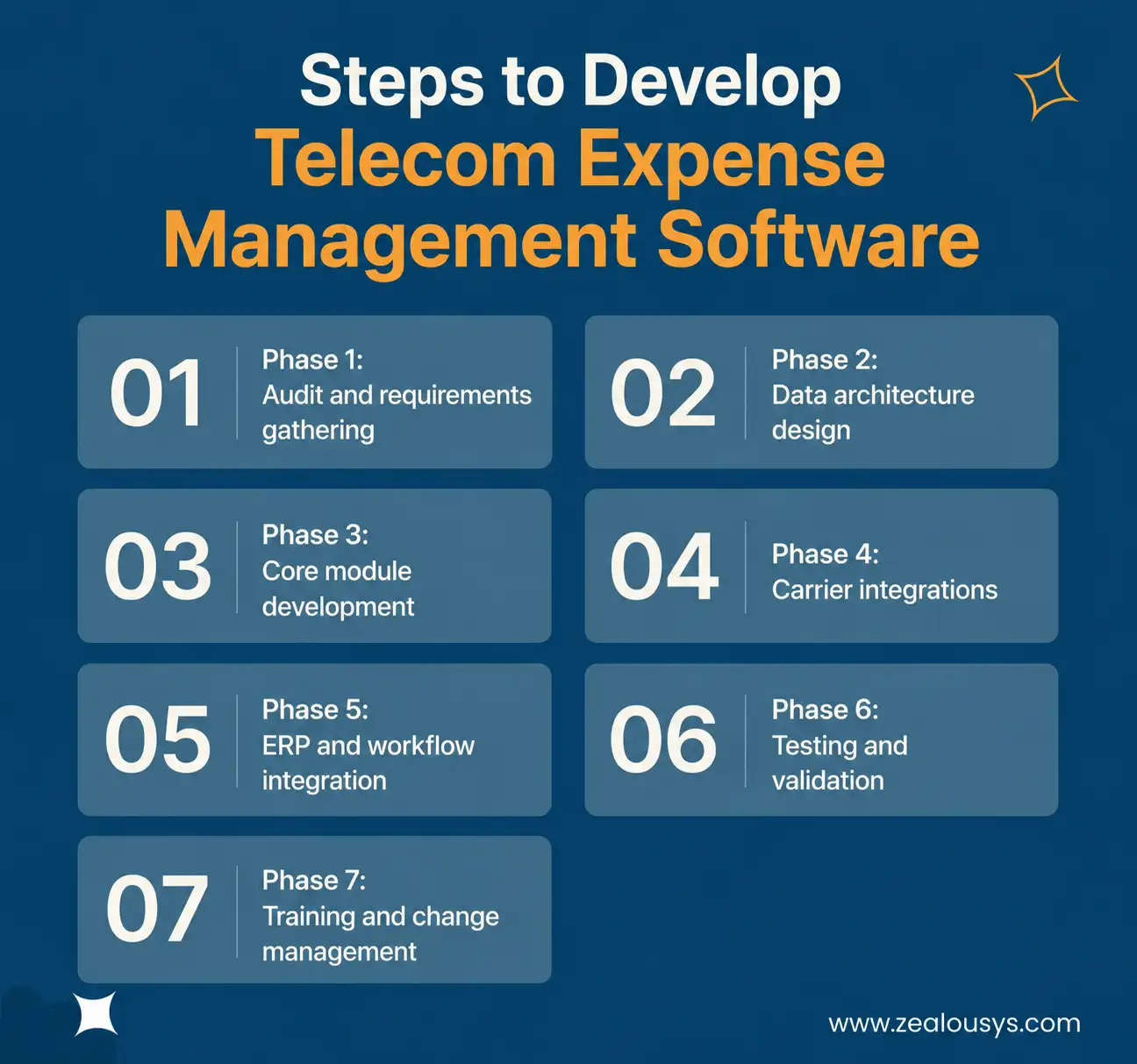
Off-the-shelf TEM products work well for many businesses, but organizations with unique vendor ecosystems, complex approval workflows, or specific integration requirements often benefit from custom-built solutions. Here is what that process typically looks like.
Before building anything, document your current telecom environment. How many vendors do you have? What does your invoice volume look like each month? Where do errors most often occur? Which systems need to integrate with the TEM platform? This audit becomes the foundation for your system requirements.
A TEM system is only as good as the data it can access and organize. Define how invoices will be ingested, how contracts will be stored, how usage data will be collected, and how everything will be linked together at the account and service level.
Build the essential modules in order of business impact: invoice processing first, then audit and dispute management, then reporting, then contract management. This phased approach delivers ROI faster than trying to build everything simultaneously.
Set up direct data feeds from your telecom vendors. For large carriers, electronic data interchange is usually available. For smaller or regional providers, API integration or structured file imports may be the approach.
Connect the TEM system to your financial systems so that approved invoices flow directly into accounts payable, and so that budget data in your ERP reflects current telecom commitments.
Before going live, run the system in parallel with your existing manual process for at least one invoice cycle. Compare what the TEM system finds against what your team finds manually. The gap between those two numbers is your starting point for measuring ROI.
TEM systems require adoption from finance, IT, and sometimes individual business units. Training and clear communication about why the system exists, and what people are expected to do with it, determines whether the platform delivers its potential value.
These are the specific business scenarios where TEM solutions consistently deliver the most value.
A manufacturing company with 30 facilities across multiple countries manages hundreds of telecom accounts. A TEM platform centralizes all vendor invoices, enforces global contract terms, and gives the corporate finance team visibility that was previously impossible to achieve.
When companies acquire other businesses, they inherit the acquired company’s telecom contracts, vendors, and billing processes. TEM software accelerates the rationalization of those environments and identifies redundant services that can be eliminated.
Healthcare organizations need to manage telecom costs while ensuring that the communications infrastructure supporting patient care meets strict regulatory requirements. TEM systems that track service levels and contract terms alongside costs are especially valuable here.
Retail businesses often see significant waste from mobile devices and plans that belong to employees who have left. TEM platforms that integrate with HR systems can automatically flag services for deactivation when an employee exits.
Public sector entities face strict requirements around procurement documentation and cost justification. TEM systems that maintain detailed audit trails of all telecom spending decisions and vendor interactions are well suited to these requirements.
Companies where the entire workforce is distributed across different cities or countries often have fragmented telecom spending. TEM software brings all of that spend into a single view and helps standardize the services and rate plans the company uses globally.
Getting a TEM platform live is only the first step. These practices determine whether the system delivers sustained value over time.
Designate a specific person or team responsible for managing the TEM system and acting on the data it produces. Systems without clear owners tend to drift.
Build a monthly or quarterly process for reviewing TEM data, reconciling disputes, and identifying new opportunities for cost reduction. The savings from TEM are not a one-time event.
When you sign new telecom contracts or renew existing ones, make sure the updated terms are uploaded to your TEM platform immediately. Outdated contract data produces inaccurate audit results.
At least once a quarter, run a report on services with zero or minimal usage and make a deliberate decision about each one. Default to cancellation unless there is a clear reason to keep the service active.
Industry benchmarks for telecom spending per employee, per device, or per location give you a frame of reference for whether your costs are reasonable. TEM vendors and industry analysts publish these benchmarks regularly.
You can use the spending trends in your TEM system as the primary input for telecom budget requests. Finance leadership will have more confidence in budgets grounded in actual historical data than in rough estimates.
Telecom pricing changes frequently. You can use your TEM system’s contract data to identify agreements where current market rates are significantly below what you are paying, and use that information as leverage in renewal negotiations.
This question comes up often for businesses evaluating whether a dedicated TEM solution is worth the investment versus simply improving their existing accounts payable process.
Traditional invoice management handles the payment of bills. A TEM solution manages the entire lifecycle of telecom spending, including verifying that what you are being billed matches what you contracted for, identifying services you should not be paying for at all, and giving you the data you need to make better decisions about your telecom environment going forward.
The difference in outcomes is significant. Businesses that manage telecom invoices through general AP processes typically catch a small percentage of billing errors and do little to address structural waste from unused services or unfavorable contracts. Businesses using dedicated TEM solutions consistently report cost reductions of 20 to 40 percent and ongoing savings that compound over time as the system continues to monitor for waste.
If you are selecting a commercial TEM platform rather than building a custom solution, these are the evaluation criteria that matter most.
Does the platform have direct integrations with your current telecom vendors? Broad carrier coverage reduces the manual work of importing invoice data.
Ask vendors for realistic implementation timelines and references from clients with similar environments to yours. TEM implementations that drag on for months before delivering value are a common frustration.
Some TEM vendors handle carrier disputes on your behalf as part of their service. This can be valuable if you lack internal bandwidth to pursue credits from carriers.
Evaluate whether the platform’s reporting tools match the way your finance and IT teams actually need to see data. Rigid report templates that do not match your internal structure create extra work.
TEM platform pricing varies widely. Factor in implementation fees, per-seat or per-invoice pricing, and the cost of any professional services required to get the system running. Calculate payback period based on realistic estimates of the savings the platform will generate for your specific environment.
TEM systems handle sensitive financial and operational data. Evaluate each vendor’s security certifications, data residency policies, and access controls carefully.
Telecom expense management solutions address a real and measurable business problem: companies consistently overpay for telecom services because they lack the tools to track and audit what they are spending at the service level.
The core value of TEM software is automated invoice auditing, visibility into total telecom spend, contract compliance monitoring, and identification of unused services. Businesses that implement TEM solutions typically achieve cost reductions of 20 to 40 percent in the first year, with ongoing savings as the system continues to surface waste.
Whether you choose a commercial TEM platform or build a custom solution depends on the complexity of your telecom environment, your integration requirements, and how much control you want over the system’s capabilities. Either path, done well, can deliver a strong return on investment.
The key is to move from passive invoice payment to active telecom spend management. The data already exists in your carrier invoices and contracts. TEM software puts that data to work.
Zealous System builds custom telecom expense management software and enterprise cost management platforms for businesses looking to take control of their technology spending. Contact our team to discuss your specific requirements.
Our team is always eager to know what you are looking for. Drop them a Hi!

Pranjal Mehta is the Managing Director of Zealous System, a leading software solutions provider. Having 10+ years of experience and clientele across the globe, he is always curious to stay ahead in the market by inculcating latest technologies and trends in Zealous.


Comments