
Not long ago, seeing a doctor meant taking time off work, sitting in a waiting room, and driving across town for a 10-minute consultation. That model still exists. But it is no longer the only option, and for millions of Australians, it is no longer the preferred one.
Telehealth has moved from a pandemic workaround to a permanent fixture of Australia’s healthcare system. Clinics are adopting it. Hospitals are building around it. And the question being asked in boardrooms, product teams, and clinic offices is no longer “should we explore telehealth?” It is “how do we build it properly?”
What is driving this shift? How do you actually build a compliant, functional telehealth app in Australia? What does it cost? And where do most development projects go wrong?
The answers to those questions shape every decision that follows.
Australia’s geography has always made healthcare delivery complicated. The country spans nearly 7.7 million square kilometres, with a significant portion of the population living in rural or remote areas where access to in-person medical services is limited. Telehealth did not create the demand for remote care. It gave that demand a practical solution.
Around 7 million Australians live in rural and remote regions, where the nearest hospital or specialist can be hours away. For chronic disease management, mental health support, or even routine follow-up appointments, travelling that distance regularly is neither practical nor affordable.
Telehealth apps address this directly by bringing consultations to the patient, not the other way around. For many Australians, this is not a convenience. It is the difference between receiving timely care and delaying it until a condition worsens.
Australia’s government played a decisive role in accelerating telehealth adoption. When the COVID-19 pandemic hit, Medicare Benefits Schedule (MBS) telehealth items were introduced on a temporary basis. They were later made permanent, giving healthcare providers a clear billing pathway for virtual consultations.
That policy decision changed the economics of telehealth almost overnight. Providers could bill for virtual consultations the same way they billed for in-person visits. The financial barrier dropped, and uptake followed.
Once patients experienced the convenience of a virtual consultation, many simply did not want to return to the old model. No travel time, flexible scheduling, no crowded waiting rooms, faster access to specialists. These are not minor conveniences. They add up to a meaningfully better experience for a large segment of the population.
Aged care residents, parents of young children, people with mobility challenges, and those managing chronic conditions all have genuine reasons to prefer telehealth. That preference is now a baseline expectation for many.
Telehealth is no longer just video calls. Remote patient monitoring, AI-assisted diagnostics, wearable device integration, and predictive health analytics are now part of what a telehealth platform can do. This has widened the appeal considerably, particularly for hospitals and healthcare groups looking at long-term digital health infrastructure.
The data behind Australian telehealth adoption makes the scale of this shift hard to ignore. During COVID-19, telehealth services reached 118.2 million consultations for 18 million patients by July 2022, with over 95,000 practitioners involved across the country.
By 2022, telehealth accounted for 17.2% of all consultations in Australia, including:
At its peak in April–June 2020, telehealth made up 31% of all general practice services. That figure reflects just how fast the sector adapted when conditions demanded it.
(Sources: Australian Government Department of Health and Aged Care; Australian National Audit Office; IEBH Telehealth Review, Department of Health, June 2023)
Looking ahead, the Australian telehealth market is projected to grow at a CAGR of 14–18% through 2030, driven by AI integration, remote monitoring, and rising demand for chronic care management. (Source: Grand View Research)
These numbers reflect a structural change, not a temporary spike. Healthcare providers treating them as a passing trend are making a planning error.
Not every telehealth or telemedicine app serves the same purpose. Before any development begins, it helps to understand the landscape and identify where your investment fits.
These are the most common types. Patients book appointments, connect with a GP or specialist via video, and receive prescriptions or referrals digitally. Most GP-focused telehealth apps in Australia fall into this category, covering bulk-billing GPs, specialist second opinions, or urgent care consultations.
These go beyond the consultation. They collect ongoing health data from patients at home, through connected devices, wearables, or manual input. This is particularly useful for conditions like diabetes, hypertension, and heart failure, where regular data matters more than periodic appointments.
Mental health telehealth has seen some of the steepest growth in Australia. Apps in this space offer scheduled therapy sessions, on-demand mental health support, digital cognitive behavioural therapy (CBT) tools, and mood tracking. The lower barrier to entry compared to in-person therapy has driven strong adoption, especially among younger Australians.
Aged care providers are investing in telehealth to manage residents’ health needs without unnecessary hospital transfers. These platforms typically include simplified interfaces, caregiver coordination features, and integration with existing aged care management systems.
Built around specific conditions or condition clusters, these apps combine consultation features with care plans, medication reminders, lab result tracking, and specialist communication into a single workflow. They serve both patients managing their own health and clinicians coordinating ongoing care.
With e-prescriptions now fully supported in Australia, pharmacy-linked telehealth apps allow patients to receive digital prescriptions and have them dispensed or delivered. These sit at the intersection of telehealth, pharmacy services, and logistics. It is a growing space with real commercial potential.
The feature set of a telehealth app has to work for everyone who touches it: patients, clinicians, and administrative staff. Miss a layer, and friction builds fast.
This is where many development projects slow down or go wrong. Telehealth apps in Australia operate in a regulated environment with several overlapping frameworks. Getting compliance right at the architecture stage prevents expensive rework later.
Health information is classified as sensitive data under the Privacy Act 1988. This means your app must handle it to a higher standard than general personal information. The 13 Australian Privacy Principles govern how data is collected, stored, used, and disclosed.
In practice, this requires informed patient consent before data collection, strict limits on how data is used beyond its stated purpose, clear processes for patients to access or correct their own records, and documented data handling procedures that can withstand audit.
If your app integrates with My Health Record (Australia’s national digital health record system), additional obligations apply under the My Health Record Act. Access controls, participation requirements, and data handling rules specific to the PCEHR framework all need to be built into your integration architecture.
The Therapeutic Goods Administration (TGA) regulates medical devices in Australia, and software can qualify as a medical device depending on its function. If your telehealth app includes clinical decision support, AI-based diagnostic tools, or features that directly inform clinical decisions, it may need to be assessed and registered with the TGA as a Software as a Medical Device (SaMD).
This is a step that many development teams overlook in the early stages. Determining whether your product falls under TGA classification should happen before development begins, not after the app is built.
Practitioners using your platform must be registered with the Australian Health Practitioner Regulation Agency (AHPRA). Your platform needs to support credential verification and must not allow consultations by unregistered practitioners.
For consultations to be eligible for Medicare rebates, they must meet specific MBS requirements: minimum consultation duration, correct item numbers, and patient eligibility criteria. Your billing module needs to account for these rules accurately. Errors here create compliance risk for every provider using the platform.
Australian health data should not be stored on overseas servers without clear justification and appropriate safeguards. Most compliant Australian telehealth platforms use locally hosted cloud infrastructure. AWS Sydney, Azure Australia East, and Google Cloud Sydney are the most common choices.
HIPAA is a US regulation and does not apply to Australian providers operating domestically. However, if your platform serves or integrates with US-based health providers, HIPAA compliance becomes relevant. Many Australian HealthTech companies building for export markets choose to build with HIPAA-level controls regardless. The core requirements (encryption, access logs, breach notification procedures) align closely with good practice under Australian law anyway.
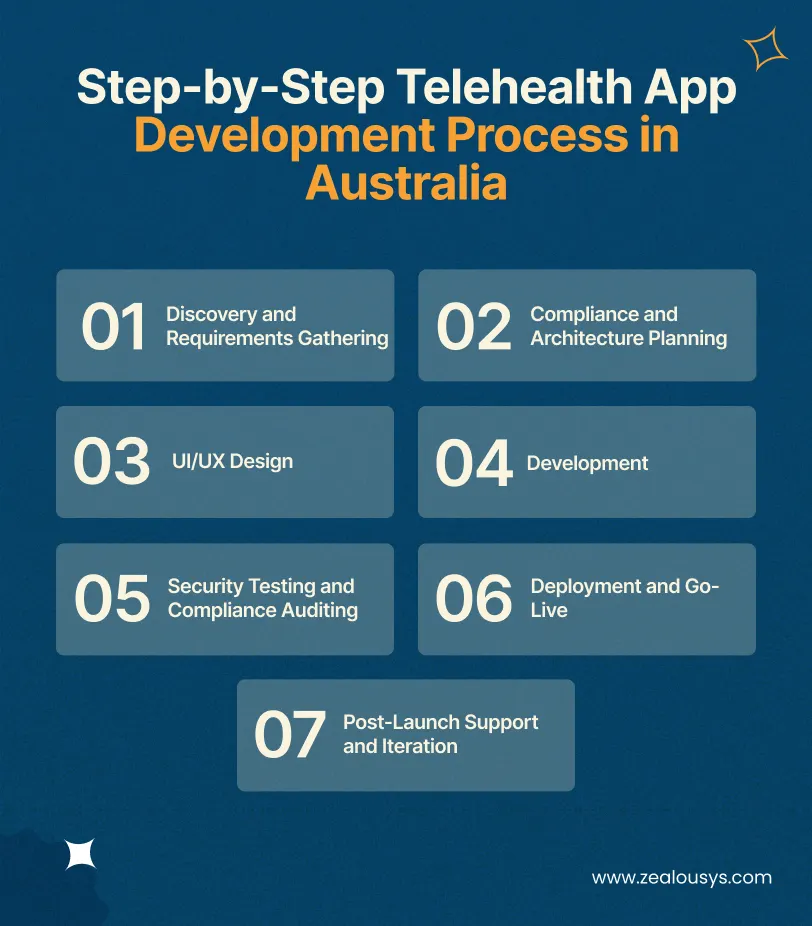
Building a telehealth app is not just a software project. It is a healthcare product with regulatory obligations, clinical workflows, and patient safety implications. The development process needs to reflect that from the beginning.
This phase defines the scope of the product. Who are the end users? What clinical workflows does the app support? What existing systems does it connect with? What compliance requirements apply?
Getting this right means involving clinicians and administrative staff early, not just technical stakeholders. Their input shapes the feature set in ways that make the product work in real clinical environments, not just in a demo.
Before a single line of code is written, the technical architecture should be designed with compliance requirements built in. This means defining the data model with privacy principles in mind, selecting compliant cloud infrastructure, designing role-based access control, and establishing encryption standards for data at rest and in transit.
If a TGA assessment is a possibility, this stage should include a regulatory pathway review. Finding out mid-development that your product qualifies as a medical device is a costly surprise.
Healthcare interfaces need to be simple, clear, and error-resistant. A clinician working under time pressure cannot navigate a confusing layout. Patients, including older Australians and those with limited digital literacy, need a process they can follow without help.
Good UX in telehealth is also partly a compliance issue. Consent flows, data sharing disclosures, and privacy notices need to be presented clearly and in ways that meet legal standards, not buried at the bottom of a registration screen.
Development typically proceeds in sprints, with core features built first. The video consultation infrastructure, typically built on WebRTC or a managed video SDK like Twilio, Vonage, or Daily.co, is one of the most technically complex components to get right.
Integrations with My Health Record, pharmacy networks, and existing PMS platforms require careful API planning and testing, particularly where real-time data exchange is involved. These integrations are also where most post-launch issues originate if they are not tested thoroughly under realistic conditions.
Before launch, the application should undergo penetration testing, code review, and a compliance audit against applicable Australian regulations. This is not optional for healthcare software. Vulnerabilities in a healthcare application carry consequences well beyond reputational damage. They expose patients and providers to serious risk.
Deployment should be phased where possible. A pilot rollout to a limited user group before full launch allows for identification of real-world issues in a controlled setting.
Infrastructure choices matter at this stage. Australian data residency requirements should be confirmed, and monitoring, alerting, and backup systems should be fully operational before patients use the platform.
Healthcare apps do not get built and left alone. Regulations change, clinical workflows evolve, and users provide feedback that shapes future development. A maintenance and update plan should be in place before launch, not assembled after the first problem surfaces.
A basic GP teleconsultation app with booking, video, and billing is significantly less expensive to build than a full-scale chronic disease management platform with remote monitoring, EHR/EMR integration, and AI features. Scoping this clearly upfront prevents budget blowouts later.
Building for iOS only is cheaper than building for iOS, Android, and web simultaneously. Most healthcare providers eventually need all three, but starting with one platform and expanding is a common phased approach.
Connecting to My Health Record, existing practice management software (Best Practice, Medical Director, Genie Solutions), pharmacy networks, and Medicare billing systems adds significant complexity. Each one requires its own scoping, custom development work, and a dedicated testing phase, plus ongoing maintenance as both systems update over time.
Building with proper encryption, audit logging, access controls, and potentially TGA registration requirements adds cost compared to a non-regulated software product. This is not negotiable in healthcare. It is a design requirement.
Building entirely in-house is expensive and slow unless you already have the team. Offshore development is cheaper but can introduce coordination and quality risks in a regulated domain. Many organisations find that working with an experienced Australian healthcare app development company that understands the local regulatory environment offers the most reliable path from scope to launch.
| App Type | Estimated Cost (AUD) |
|---|---|
| Basic telehealth MVP (single platform) | $10,000 – $25,000 |
| Mid-tier teleconsultation app (multi-platform) | $25,000 – $50,000 |
| Full-featured platform with EHR integration | $50,000 – $70,000+ |
| Enterprise-grade platform with AI and monitoring | $70,000 – $150,000+ |
These are estimates. A platform built for a single clinic has a very different cost profile than one built for a hospital network. Ongoing maintenance costs, third-party licensing fees (video SDKs, identity verification, SMS services), and cloud infrastructure costs should also be factored into the total cost of ownership, not just the initial build.
Artificial intelligence is changing what telehealth platforms can actually do, and healthcare providers are paying attention.
One of the most practical applications is using natural language processing (NLP) to generate clinical notes during or after a consultation. Rather than a clinician typing notes manually after each appointment, AI tools can transcribe conversations and structure them into consultation summaries. This reduces administrative burden considerably and gives clinicians more time with patients.
AI-powered triage tools can assess patient symptoms before a consultation and route patients to the appropriate level of care. Someone describing chest pain gets a different pathway than someone with a skin rash. This improves patient safety and reduces the load on practitioners for non-urgent cases.
Patients with chronic conditions generate a large volume of data over time. AI models trained on that data can identify patterns, flag deteriorating health trends, and alert care teams before a patient reaches a critical point. For aged care and chronic disease management platforms, this capability is becoming a real point of differentiation.
Some platforms are beginning to incorporate AI tools for interpreting medical images, reviewing lab results, or flagging anomalies in patient data. These applications require careful TGA assessment, as they can fall under the Software as a Medical Device classification and carry specific regulatory obligations.
AI can be used to adjust care plans to individual patients based on their history, preferences, and response to previous treatment. This moves telehealth from a generic consultation model toward care delivery that genuinely reflects the individual. The result is better patient outcomes and stronger long-term engagement.
Building a telehealth app comes with a distinct set of challenges that general software development does not prepare teams for.
Australian healthcare compliance is not a single framework. It spans multiple acts, agencies, and item-level billing requirements. Development teams coming from outside the healthcare sector frequently underestimate this complexity. Getting it wrong has real consequences: failed Medicare claims, data breach penalties under the Privacy Act, and serious exposure for every provider on the platform.
Many Australian clinics and hospitals run on legacy practice management software with limited API support. Integrating a modern telehealth app with these systems often requires significant custom development, middleware solutions, and close coordination with the existing software vendors.
If a platform is intended to serve rural or remote patients, it needs to perform under poor connectivity conditions. That means designing for low-bandwidth environments, offering fallback audio-only consultation options, and testing against realistic network conditions. Metro broadband speeds are not a realistic benchmark for regional users.
Technology that clinicians find cumbersome does not get used. Any platform that adds friction to a clinical workflow will face resistance, regardless of how technically sound it is. Involving practitioners in design and testing is not a nice-to-have. It is the only way to build something that gets used consistently.
Health data is a high-value target. Telehealth platforms need a robust security architecture that holds up not just at launch but as the platform scales and new vulnerabilities emerge. Ongoing security auditing, not just a pre-launch check, is necessary. It is also, too often, the first thing dropped after the initial build is done.
For founders and product teams, how a telehealth app generates revenue shapes the business model and sometimes the clinical design itself.
Patients or users pay a monthly or annual fee for access to consultation services, often with a set number of included appointments. This model works well for mental health platforms, wellness apps, and specialist consultation services where regular use is expected.
Patients pay per consultation, directly mirroring the traditional fee-for-service model. It is easy to understand and aligns cost with usage. This is common in GP telehealth platforms and urgent care apps, particularly those targeting patients without ongoing health needs.
The platform is licensed to healthcare providers, clinics, or hospital networks, who use it with their existing patient base. Revenue comes from the healthcare organisation, not from individual patients. This is a common structure for practice management-integrated telehealth tools and enterprise health platforms.
Basic services are free; premium features such as priority appointments, specialist access, or advanced health tracking sit behind a paywall. This can work for consumer health apps with a wide reach, though it requires a careful balance between the free and paid tiers to avoid the free tier being too capable or the paid tier too limited.
Platforms that support Medicare billing or private health insurance claiming generate revenue through the reimbursement process. The patient may pay nothing out-of-pocket, while the practitioner receives the Medicare rebate and any gap fee through the platform. The platform typically charges a processing or service fee on each transaction.
Many platforms combine approaches. A clinic might pay a B2B licence fee, patients pay a gap fee per consultation, and the platform takes a percentage on billing. These hybrid structures often reflect the layered way Australian healthcare is funded in practice.
Off-the-shelf telehealth solutions exist, and for some providers, they are the right starting point. But for organisations with specific clinical workflows, existing systems that need integration, or a product intended to scale, custom development almost always makes more sense.
A development partner who understands the Privacy Act, MBS billing rules, TGA software classifications, and My Health Record integration requirements from day one saves significant time and cost. These are not generic software concepts that any team can pick up quickly. They require healthcare-specific experience that shapes decisions at every stage of development.
Off-the-shelf platforms make assumptions about how healthcare organisations operate. A custom-built platform is designed around the actual workflows of your clinical and administrative staff. That fit drives adoption and reduces errors in ways that a configured SaaS product rarely can.
A product built on a proprietary vendor platform is constrained by that vendor’s roadmap, pricing decisions, and feature priorities. A custom-built platform gives you control over your technical direction, your data, and your ability to add or change features as your organisation grows.
Every healthcare organisation runs a combination of systems: a specific PMS, pathology lab interfaces, aged care management software, and health data platforms. A custom development partner builds the exact integrations you need, rather than working around what a vendor has already built.
Telehealth is not something Australian healthcare providers are exploring cautiously anymore. It is infrastructure, as fundamental to care delivery as the clinic itself. The adoption data is clear, the government frameworks are in place, and patient expectations have already shifted. The practical question now is how to build a telehealth solution that actually works: one that is compliant, clinically sound, and built around the way Australian healthcare operates in practice.
That requires clear thinking about regulatory requirements from day one, feature sets that reflect real clinical workflows, and a development approach that accounts for the specific complexity of Australian healthcare.
At Zealous System, we provide healthcare app development services for healthcare startups, clinics, hospitals, aged care providers, and digital health founders building telehealth and custom healthcare solutions for the Australian market. The scope, compliance requirements, and technical decisions covered in this blog reflect the real-world challenges and product strategies we work through with every healthcare client we partner with.
Our team is always eager to know what you are looking for. Drop them a Hi!

Pranjal Mehta is the Managing Director of Zealous System, a leading software solutions provider. Having 10+ years of experience and clientele across the globe, he is always curious to stay ahead in the market by inculcating latest technologies and trends in Zealous.


Comments